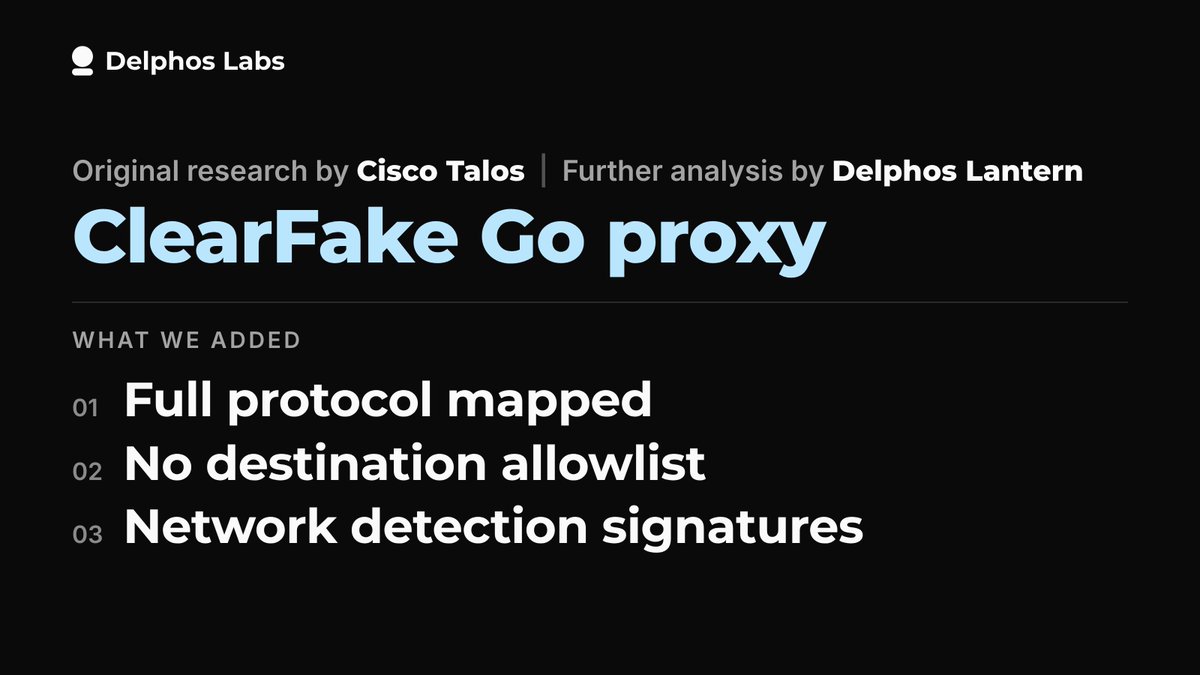
@TalosSecurity's ClearFake writeup is solid research. It follows the WebDAV infection chain end to end, through Amatera, ZigCryptoStealer and NetSupport Manager. It also unpacks the Go reverse proxy used in the operation.
At @DelphosLabs, we ran that proxy through our platform, Lantern, to show what automated binary analysis and reverse engineering can add to a thorough investigation.
Talos describes each multiplexed stream as supplying source and destination addresses. In the binary we analyzed, the request instead contains `net` and `addr`: a network selector passed directly to Go's dialer and a destination address. The network defaults to `tcp` only when `net` is empty; the victim's operating system chooses the local endpoint.
For anyone interpreting captured tasking: `net` selects the network, not the source address. The handler also has no destination allowlist, so containment needs to account for reachable internal and loopback services, not just contact with the controller.
The full Lantern report also documents Chrome impersonation, discarded Yamux logs and a TLS verification bypass that is compiled in but disabled.
https://t.co/vmzhzWPqzr
Read the original Talos writeup here: https://t.co/711b4HyrlQ
Delphos Labs’ Lantern platform, powered by an agentic harness, beats every published result on @QuesmaOrg’s BinaryAudit. BinaryAudit is an independent benchmark for finding backdoors in binaries without source code.
Same model, two harnesses:
Opus 5.0: Lantern 74%, Quesma 70% (our run)
Opus 4.6: Lantern 61%, Quesma 49% (top of the leaderboard)
Lantern adds specialized skills, tooling and persistence. It decrypts and deobfuscates before the model sees the code, so the model reads the real strings instead of inferring them from raw disassembly.
Lantern works on all kinds of software: installers, Android apps, firmware and Chrome extensions.
Have one you think will stump us? Reach out or request access:
https://t.co/DUbQJ8GjMS
Writeup on the Delphos Labs blog.
https://t.co/66phgElZ0O
Delphos threat analysis: KarstoRAT is a Windows RAT that spies through the webcam, microphone, and keyboard. With one operator command, it removes its persistence and deletes itself via a hidden batch script.
While it runs, it also:
- Steals tokens from Discord, Chrome, Brave, and Opera
- Gives the operator a remote shell, screenshots, and clipboard monitoring
- Elevates itself to admin through a fodhelper UAC bypass, without a standard UAC prompt
Lantern, our platform at @DelphosLabs for analyzing software artifacts without source code, found all of this in the sample alone.
Have a suspicious Windows file you think will stump us? Reach out or request access: https://t.co/cggYeJYD7U
Full report, with scope, behavioral sequence, and evidence: https://t.co/KoB6RqXFsU
The @LastPass TIME team and Delphos identified and disrupted a multi-stage malware delivery campaign impersonating at least 40 companies on GitHub. The payload delivered a Microsoft-attested kernel driver that terminated 145 antivirus and EDR processes from kernel mode. It scored 0 out of 72 on VirusTotal as of August 20.
The driver is a renamed copy of CcProtect.sys, which LOLDrivers already catalogues as a BYOVD process killer, with public PoC code. Same product string, version, and submitter. The operators changed the filename to Alinubx.sys.
That was the evasion. Detections keyed to the known name did not match, and renaming a file changes its bytes, so the SHA256 moved with it. A blocklist of known bad hashes does not have this one.
Same driver, same version, same submitter, one new filename. That was enough.
Joint writeup with @LastPass. Hashes, hunt queries, and the full CcProtect comparison are in the post.
https://t.co/nkKrvmVuQF
Kamil Leoniak found a descriptor parser bug in usbvideo.sys, the USB Video Class driver in Windows, during an automated Delphos Labs review of the compiled driver.
The validator accepts a descriptor that cannot advance the parser. The old path rejected bLength=0 because it checked whether the pointer would actually move forward. The newer path, behind Feature_Servicing_UvcDescriptPointerFix and on by default, checks only that the length fits in the remaining buffer. Zero fits, so the caller advances by zero and the loop parses the same descriptor forever.
34 bytes of configuration descriptor were enough, served from a Teensy 3.2 as a single-function UVC device. One core pinned at 100% in kernel mode, USB enumeration stopped system-wide, unplugging did not recover it, normal reboot blocked. Three times from a clean boot.
MSRC closed it on July 23 as not a bug. No CVE, no patch.
One of our security researchers at Delphos Labs, Kamil Leoniak, triggered kernel memory corruption on Windows using a custom USB device and a user-mode stress PoC. Microsoft assigned CVE-2026-50321, classified it as a Windows USB Driver elevation of privilege, and shipped the fix on July 14.
The bug is that the freed object reference stayed reachable long enough for another path to use it.
WinUSB_FreePipe frees a pipe context and only nulls the shared pointer afterward. In that window the interface pipe array still points at freed memory, and device-control IOCTLs dispatch on a WDF parallel queue, so nothing serializes access to that array.
16 threads were enough. 12 calling pipe policy APIs, 4 toggling alternate settings. A policy call read the stale pointer and took a spinlock inside a freed 0xF0-byte NonPagedPool object. Without Special Pool that allocation stays mapped and reclaimable. With it, the machine bugchecks.
Full writeup on the Delphos Labs blog, with the PoC on GitHub.
https://t.co/FswODrY3Cl
A credential stealer took the name of libpsl-5.dll, a Windows library of approximately 200KB, and inflated itself to 55MB. Zero detections across 60+ AV engines when we analyzed it. The Delphos Labs platform pulled it apart on day one; the automated run took 8 minutes, with no human intervention. The vendors did not catch up for six days.
The bloated size is the primary evasion mechanism. The real code ends at about 3.3MB. The other 52MB is a single four-byte pattern repeated across the entire overlay, sitting outside every PE section and outside the image the Windows loader maps. The loader never reads it. It executes nothing. Its only job is to push the file past the size most engines and sandboxes scan.
No signatures. Detection came from the size mismatch, plus an import table pairing process injection with network enumeration, nothing a suffix-list library would do. Its code overlaps several known stealer families.
https://t.co/ilPzIZveb5
One of our security researchers demonstrated a local root shell on Linux using a page-cache poisoning primitive in AF_RXRPC’s RxGK path.
We call it DirtyCBC: a sibling to DirtyFrag in the broader CopyFail / DirtyFrag / Fragnesia family. The issue is fixed on mainline.
The candidate path was surfaced through Delphos’s agentic analysis workflow, then manually verified and exploited end to end.
AES-256 was not broken. It just wasn’t the boundary that mattered.
RxGK decrypted data in place before authentication completed.
Under the right conditions, that write could land in the page cache. The HMAC check still failed and the connection was aborted, but the page-cache mutation had already happened.
Two RESPONSE packets were enough to place a tiny ELF into the cached first page of a readable SUID-root binary. The file on disk stayed unchanged. The next exec produced a root shell.
Full writeup and PoC on the Delphos Labs GitHub.
https://t.co/gmCEub1v2t
We’re hiring 🚀
Security Researcher & Software Engineer @ Delphos Labs
Build AI-powered systems for reverse engineering — tools where AI understands software, automates binary analysis, and scales how we reason about code.
🔗 https://t.co/iDAbZZu5zz
#securityresearch#hiring
XZ backdoor (https://t.co/Te6s0hxcaZ.5.6.1) fully exposed in minutes with Delphos Labs.
Black-box binaries? No more.
Traditional tools would still be unpacking.
That’s software, verified.
Binary highlight: “Cyberpunk 7777 / QubePi” ELF. Text-menu game with hard-coded Postgres creds. Every login/chat/coord sent in clear on 5432—no TLS, no sanitization. Delphos auto-exposed the creds & flow in minutes.
Sample: https://t.co/pe4YmTEB5O
#ReverseEngineering
At @DelphosLabs, we're building tools to automate reverse engineering, no source code required.
Help shape what we build next 👇
https://t.co/cOAtvR5ad2
It takes just a few minutes. Anonymous unless you opt in.
Thanks for your input! 🙏
Machine Learning Meets Malware. If cognition becomes an API call and malware can be reverse-engineered by an LLM, then what’s left of “zero trust”?
Caleb Fenton joined @patio11 for a chat on AI, nation-states, and the new front in software security.
🎧https://t.co/FcExUUt6tz
If you like building platforms and infrastructure and want to get in on the ground floor of a cyber security startup doing AI and reverse engineering, DM me.
Happy Friday everyone! Want a ProcMon for macOS? Ever wish you had your own Endpoint Security client you could task? Want to peer behind the macOS EDR curtain? Have a go and let us know what you think!
https://t.co/uVL198bU0W
New Tiny #tinyML#AIoT module M0S coming out~
Based on BL616, WiFi6+BT5.2+Zigbee, 384MHz #RISCV RV32GCP, 4MB Flash + 512KB SRAM, and USB2.0 HS in tiny 10x11mm stamp module!
It would be <2$ ~