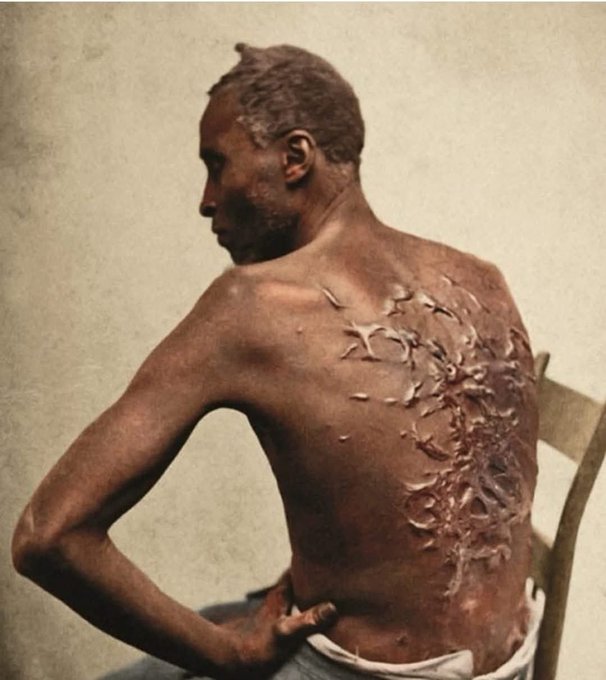
Escaped enslaved man, Gordon, also known as 'Whipped Peter,' shows the scars on his back in Louisiana, 1863. The Trump administration ordered the removal of this photo, along with other signs and exhibits related to slavery, from several national parks.
This image, taken in 1863, shows Gordon, also known as “Whipped Peter,” a man who escaped slavery from a Louisiana plantation after enduring years of brutal abuse. The scars across his back tell a story that words alone never could.
After making a dangerous journey to Union Army lines during the American Civil War, Gordon underwent a medical examination where photographers captured the wounds left by repeated whippings. When the image was published, it spread rapidly across newspapers in the United States and Europe, becoming one of the most powerful pieces of visual evidence exposing the cruelty of slavery.
For many who had never witnessed the realities of slavery, this photograph shattered any illusion that it was a humane institution. It helped strengthen support for the abolitionist movement and encouraged many Black men to join the Union Army in the fight for freedom.
More than 160 years later, the photograph remains one of the most important historical records of slavery ever created. It is uncomfortable to look at, but history is not meant to be comfortable. Images like this remind us why preserving historical evidence matters. They allow future generations to understand not only the suffering people endured but also the resilience and courage of those who survived and fought for freedom.
In recent years, reports that this photograph and other slavery related exhibits were ordered removed from displays at some U.S. National Park sites sparked widespread debate among historians, educators, and preservation groups about how difficult chapters of history should be presented to the public. Whatever one’s political views, the discussion has highlighted the importance many place on protecting historical records so they can continue to educate future generations. (Reuters)
Did you know the author of 'The Three Musketeers', 'The Count of Monte Cristo' & 'The Iron Mask' was a black writer called Alexander Dumas.
Alexandre Dumas, prolific writer of the 19th century, enjoyed immense success for his numerous historical chronicles, such as ‘The Three Musketeers’, ‘The Count of Monte Cristo’ and ‘Queen Margot’ to name a few. Son of an army general born in Saint-Domingue, (present-day Haiti), Dumas was opposed to the racist slurs of his contemporaries. In 2002, for the bicentenary of his birth, Alexandre Dumas was enshrined alongside fellow great authors of his time like Victor Hugo and Émile Zola at the mausoleum of the Panthéon of Paris.
Not enough people remember this. Infantino hand selected Inter Miami to participate in the Club World Cup. Not the MLS champions, but Inter Miami.
They’re the only team that didn’t have to qualify
An Ananda Alert has been activated for 16-year-old Felicia Tummings of Webb Lane, Palmers Cross, Clarendon, who has been missing since Monday, July 06.
She is of dark complexion, stout build, and about 168 centimetres (5 feet 6 inches) tall.
Reports from the May Pen Police are that at about 4:00 p.m., Felicia was last seen at home. Her mode of dress at the time she was last seen is unknown. All efforts to locate her have proven futile.
Anyone with information on the whereabouts of Felicia Tummings is asked to contact the May Pen Police at 876-402-7265, the police emergency number 119, or the nearest police station.
Help us locate missing Felecia Tummings. If you know her whereabouts, please call the May Pen Police or the nearest police station.
#AnandaAlert#Missing
@RealRenk Two women on a billboard is your biggest issue with Jamaica rn? Not the lack of disaster recovery, not the high cost of living, not the deplorable condition our infrastructure is in? But two women on a billboard you think are lesbians?
One of the boats in my fleet went there for repairs. It got stretched out for MONTHS long after the intended due date. Their food, fuel, petty crime situations have become so abhorrent. When the crew reported back with their sightings, it was saddening.
Your electricity provider must complete their service installation within a set number of days, if not you may be entitled to compensation. Learn more in the JPS Guaranteed Standards here: https://t.co/EFiOPdA3Mb
#TheOURJa#WeRegulate
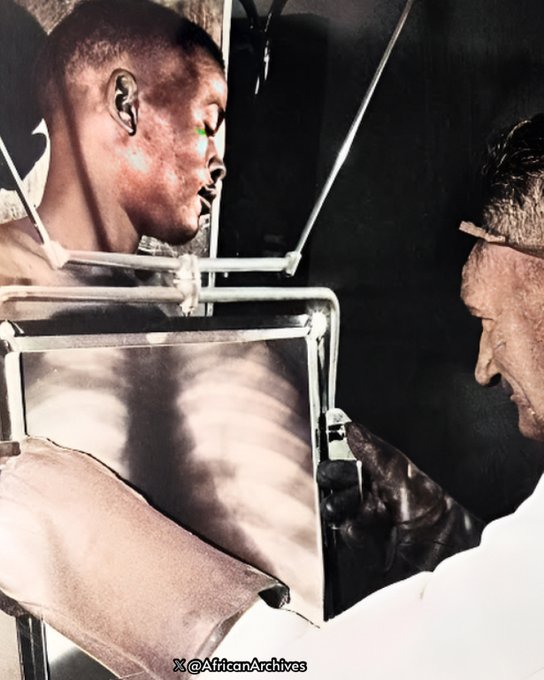
South African mine workers being x-rayed by radiologists at the end of each shift before leaving the De Beers diamond mines in Kimberley, South Africa, exposing them to radiation constantly, 1956.
After four desperate days watching 79-year-old Cinderella Williams decline from an aggressive form of blood cancer which remained undetected until she was critically ill, and the shocking discovery that a single machine — the only one of its kind in the island that could have confirmed the disease and telegraph the exact treatment — had been down for two years, her family, determined to save lives in her memory, has launched a GoFundMe campaign to raise the US$200,000 towards the purchase of the equipment.
https://t.co/vj4WA1ba3m
July 4, 1776, and June 19, 1865, tell two very different stories about freedom in America.
On July 4, 1776, the Declaration of Independence was adopted, announcing that the thirteen American colonies were separating from British rule. The document included powerful words about liberty and equality, but at the same time, hundreds of thousands of African people remained enslaved across the colonies. For enslaved Black people, independence did not mean freedom.
Many enslaved men, women, and children continued working on plantations, farms, and households while the new nation debated the meaning of the very freedom it had declared. Their labor helped build the economic foundation of the United States, yet their own rights were denied.
For generations, enslaved people resisted in many ways. Some escaped, some created secret networks of communication, some preserved African traditions, and others fought through legal challenges, writings, and activism. Free Black communities and abolitionists also pushed the nation to confront the contradiction between its ideals and the reality of slavery.
During the Civil War, President Abraham Lincoln issued the Emancipation Proclamation, which took effect on January 1, 1863, declaring enslaved people in Confederate controlled areas to be free. However, freedom did not immediately reach everyone.
In Texas, one of the most remote Confederate states, many enslaved people remained unaware of their freedom or were prevented from exercising it.
On June 19, 1865, Union General Gordon Granger arrived in Galveston, Texas, and announced General Order No. 3, informing the remaining enslaved people there that they were free.
That day became known as Juneteenth.
The journey from 1776 to 1865 represents nearly 90 years between the promise of independence and the legal end of slavery in the United States. Even after emancipation, Black Americans continued fighting through Reconstruction, segregation, and the Civil Rights Movement to secure the freedoms promised generations earlier.
Madame Celeste Amarilla,
Vous êtes une femme méprisable et indigne de sa fonction.
Vous ne représentez pas le Paraguay, ce pays qui a transpiré la passion et l’honneur tout au long de la compétition. Par votre inconscience et votre racisme décomplexé, le monde entier a déjà oublié le parcours et l’effort historique que vos joueurs ont réalisés durant cette coupe du monde pour laisser place à une dame incompétente donnant la pire image possible de son pays.
Je ne laisserai jamais aux gens comme elle, la liberté de laisser propager leur haine et leur racisme à travers le monde.
People are upset about the World Cup because instead of bringing the world together it’s another reminder of how unjust the world is.
It’s not a conspiracy. A Somali referee was denied entry to the U.S., that’s a fact. The U.S. tried to swap Iran for Italy, and then mistreated the team, that’s a fact. The U.S. president made a call to reverse a red card for an American player, that’s a fact…
From discrimination and over-priced tickets, to commercial breaks and VAR issues, many people who have watched and enjoyed the World Cup since childhood are more than disappointed. The whole tournament was tainted from the beginning, starting with a fake peace prize to gratify the host country.