Bridging the worlds of Astrology, Energy Work and God’s gifts of the earth to help you KNOW, NURTURE and EMPOWER yourself! ♒️♐️♎️ ➡️IG: LightsomeLiving
The LARGEST sunscreen-skin cancer study in HISTORY (n=470,000) found sunscreen users are FAR MORE likely to develop EVERY major form of skin cancer.
INVASIVE MELANOMA: 📈 +292%
MELANOMA IN SITU: 📈 +258%
BASAL CELL CARCINOMA: 📈 +140%
SQUAMOUS CELL CARCINOMA: 📈 +126%
27% of sunscreens are laced with BENZENE, a known carcinogen.
Benzene was detected in products from major brands including Neutrogena, Banana Boat, Sun Bum, CVS Health, EltaMD, Raw Elements, TopCare Everyday, Goodsense, SunBurnt, and Fruit of the Earth.
Listen to Elder Bednar’s counsel:
Can we please, please, please have more people who sin, and want to improve, come to church and partake of the sacrament?
Even if you feel stuck and you think you’ll never fully overcome it. If there is even a desire to turn toward Christ, the sacrament is for you.
And just so we’re clear… this includes every single person reading this post.
The sacrament isn’t a reward for perfect people, it’s an ordinance to remind us that we all need Christ.
🚨New Paper: "Seven Years of 700 Cholesterol Without Coronary Atherosclerosis: A Lean Mass Hyper-Responder Case Report"
Link: https://t.co/5VnRpZlFdR
For the past 7 years, I’ve been running what is essentially a natural experiment in cholesterol and heart health.
During that time, I’ve largely lived with:
👉Total cholesterol around 700 mg/dl
👉LDL cholesterol between 500–600 mg/dL
I recently underwent advanced coronary CT angiography imaging with AI-guided analysis. This is not a CAC. It measures all plaque (soft + calcified), with expert interpretation and AI-guided analysis capable of quantifying plaque down to the cubic millimeter (mm3).
Now, to address the obvious question:
Am I too young for plaque?
In brief: No.
The clearest comparison is individuals with homozygous familial hypercholesterolemia, who often have similarly extreme LDL/ApoB levels and can develop advanced plaque as toddlers, and even heart attacks as early as age 8.
Also, nutrition influencers in their 30s have publicly shared quantified plaque scores from these same imaging technologies. In one recent case, a plant-based influencer in his thirties was found to have 61.3 mm³ of plaque despite having far lower lifetime LDL exposure. (He can identify himself if he so chooses.)
My case also isn’t a one-off.
There are many individuals like me, including older individuals with similar LDL-C and ApoB without any plaque.
The difference is that I’m an unusually well-characterized subject, with extensive metabolic data and health markers tracked over time. You can learn more at the newsletter or open-access paper, linked above.
The science of heart health is not settled. And cholesterol is not a simple story.
🚨 If you want to help spread the word...
Quote Tweet this post (or create an original post) including the article link with a thought. Academic papers are increasingly evaluated using attention metrics. Original posts from unique users are one way to increase these metrics and help ultimately increase its reach.
🚨 If you want to learn more, I'll include more learning resources below 👇
How I Built My Own Personal AI Software Factory (And How You Can Too)
It started with me using these AI tools as a thinking partner to work through complex challenges. That progressed to using Claude Code to shape large, complex features and develop specifications for them in markdown, which then led to breaking those specifications down into discrete, small tasks I could tackle individually. That's what led to /cog-shape, the skill I now use to break down complexity and build out larger systems.
Normally, I'd take notes on a piece of paper on my desk or quickly dash off a title for a GitHub issue whenever I noticed something wrong or thought of an improvement. But as you know with AI, it's garbage in, garbage out: better input yields better outputs. So that's how /cog-capture was born. It creates high-quality GitHub issues that would consistently yield high-quality pull requests.
Both of these you can download and use for free. https://t.co/TaR7mNUay3 They're just markdown text files, and you can knock yourself out updating them, modifying them, and making them better. Though I'm pretty confident that you'll get great results out of the box.
Next I found myself in Cursor or Claude Code building a feature, submitting the PR, and then getting the code review back and copying and pasting the review comments into my session where I had all the context for my changes. I thought, there's gotta be a better way. Using the gh command-line tool, I figured out a way to review the comments, compare them, make a decision about whether or not to fix them and how to respond, close the code review thread, and then update the PR as needed. This tool became cog respond.
This naturally led to cog revise, which, as you might expect, looks for code review feedback on any of my PRs, revises as needed and responds to the comments, and pushes changes up for re-review, fully autonomously. This shaved me hours each week alone.
At this point, I had about 1,000 hours working with these coding agents and was starting to get confident in their ability to autonomously build fully functional features or bug fixes without my intervention — as long as I had the product set up in a clean way where it could run all the tests and self-verify. With that setup, I got to a point where I could trust the system to complete an issue end-to-end. That led to cog build.
A note about the word cog: nobody wants to be a cog in the system, and all the things I'm automating are, in my opinion, the tedious, time-consuming, or annoying parts of software engineering. Where I like to spend my time isn't in the realm of handcrafted code (though I've spent a lot of time enjoying that space.) Where I like to spend my time and energy is in producing a product that actually helps people in the real world. That's the output of software engineering for me, and I like to spend my time at that higher level. All of this automation lets me do just that. The more I can push off to my team of cogs (as long as I'm not seeing a reduction in quality) the better.
Once I saw build working reliably, the result was a lot of PRs. Way more PRs authored and ready for my review than I was used to. At this point I still reviewed every PR and all of the code by hand, but once I approved a PR — (especially on projects where a squash merge were required) there was this dance of pulling the most recent code, integrating the merge with my pull request, resolving merge conflicts, retesting, pushing the changes, waiting for CI to complete successfully, and finally merging. With just 10 PRs in a single day, this dance could take as long as two hours to shepherd through to production. So cog merge was born to solve this problem and get those hours back each week. By my estimation, cog merge alone has saved me more than one day each week! It just works.
At this point, my trust in the system was such that I thought I could set up a fully automated software development lifecycle with each of these tools: pull an issue from the GitHub repository, build it, test it, push it up, revise when there was feedback to address, and then merge to get the code into production. 100% hands-free. So I built cog start to do this for me. It runs cog in a loop indefinitely. At first, I only had it do one issue at a time, then multiple issues, and finally I had it pulling any unassigned issue from my GitHub repository.
The net result was that all of a sudden, I had zero bugs in any of my repositories. As fast as I could use /cog-capture or /cog-shape to create issues, cog start would be running in the background on a $600 16GB Mac mini 24/7, pulling and resolving them. All I had to do was review and approve. This was mind-blowing for me. What was most humbling was how good the coding output was. Now, I care a lot about architecture, and I think I have a pretty decent one for my projects and I think that helps. I also have lots and lots of tests and guardrails in place, and I'm careful to make sure the issues I put into the system are small enough that I'm not asking it to do something impossible. But notwithstanding all of that, I now have a system that can produce as much as I describe, faster than I can think. If I can think it and describe it, it can build it 24/7. A single cog running all the time is probably 10x as productive as I am as a senior software engineer. To me, that's amazing.
Sometimes I have a lot of small, nitpicky bugs to fix, and when that happens, I've learned I can totally trust the system to solve them end-to-end without my intervention at all. So I added a feature called cog rubber-stamp that runs in the background and approves all of the PRs for me automatically, so they go through the entire system unattended. I labeled it "rubber-stamp" because the word has a kind of negative connotation, and I'm not sure this should be done all the time. In fact, most of the time I take the time to review the PRs. But I'm learning that, as good as these agents are getting, there are definitely times when I can rubber-stamp the PRs, go to sleep, and 20 issues just show up the next morning in production — all fixed, all perfect.
The next issue I was struggling with was the constant release of new coding models and coding harnesses. In my own personal experience, the harness really matters, and the LLM being used in the harness also really matters. To make it worse, I started to learn that these public coding benchmarks were being gamed and didn't actually represent my real-world experience. How am I to know what is the best tool for the job? So I built cog arena. Cog arena lets me route any issue to any collection of harness or model combos I choose in parallel. I have a judge model look at the output of all the attempts, take the best from each and build out a really high quality PR. This is great for high stakes issues but it's also been great to build intuition about which models and which harnesses work best for my code base specifically and not just some generalized coding benchmark.
A single cog takes up around 12 MB of RAM, so theoretically on my Mac mini I could have hundreds of cogs running in the background all the time picking up work and getting it done — but I ran into GitHub API limits, so I only run 35 cogs on my Mac mini. On my MacBook Pro, I spend my time exploring new ideas, shaping new product features, or capturing bugs and small feature requests. Then the Mac mini just goes to work.
The dev capacity on my Mac mini is easily 100 developers' worth of output, gated only by my ability to clearly architect and articulate what must be built, along with guidelines on how things should be put together. Because I have 25 years as a software engineer, I'm finding out this works really well for me. Maybe someone less experienced would do worse. I don't know. I know a lot of people say there's AI slop everywhere, and that not looking at the code guarantees you'll have a ball-of-mud architecture. But in my personal experience so far, this is working really clean and really well. If you can describe how you want your code to be in terms of functional and nonfunctional requirements, AI can do it most of the time, and that is a lot of leverage.
If that weren't enough, I've started adding to my system two cheap mini PCs — one running Linux and the other running Windows 11 Pro — both running cogs 24/7.
Honestly, my problem now is one of multi-agent orchestration. I use a lightweight API call to lock and distribute tasks among the various machines, but mostly I'm trying to figure out how to keep them all busy all the time. It's really mind-blowing for me, and very exciting.
One important point in all of this: this whole system uses these AI coding harnesses in ways allowed by the various companies, so I can use their flat-rate plans. That means I'm using subsidized tokens and able to get an enormous amount of work done before I hit any of their limits. That said, newer open-source models are coming out, and I'm comparing their output with the closed-source models' output using cog arena so that if the costs become too high or the flat-rate pricing model disappear, I'll have something viable to move to. Long term, I'm seriously considering getting a server-class rack to run a very capable model locally and have all my cogs use it. At that point, I'll be able to build with effectively a multi-hundred-dev team for the cost of electricity.
If any of this is interesting to you, you can purchase Cog for $10 a month and have as many dev coding agents doing the software development lifecycle end-to-end as you have RAM. No per-usage charges, just a flat rate.
I hope it helps a bunch of new software startups get off the ground, at a minimum. And I hope it helps small businesses generally do — in a more efficient and effective way — what I see a lot of people doing with their own claws: building custom software for themselves.
https://t.co/qQyJziyaR4
Daniel Okey cracked the code to fixing elder's quorum: use the budget on weekly snacks, sit the men in a circle, and ask them to discuss anonymous survey answers to the question, "what is on your heart or mind this week?"
Brilliant
Almost exclusively everyone who moves into my place is on a statin. It's one of the first medications I work to get them off of.
I show their doctors the research - high LDL is linked to longer lifespan, and the triglyceride-to-HDL ratio is a better indicator of heart disease than LDL alone.
As long as the family backs me up, I can usually get them off. We've deprescribed statins from a lot of residents and they're doing fine.
I can't think of the last time I've had a cardiac event in one of my assisted living homes.
Bryan Johnson reveals what you MUST do to get the best sleep possible
''Reading a book for 10 minutes before bed is as powerful as sleep medication, on some metrics it's even more powerful than sleep meds''
''Have your final meal of the day 4 hours before bed, it gives your body time to digest, and when your body has that distance it will lower its body temperature, your blood glucose will be down, melatonin is produced and it gets the body in a more relaxed state''
''You need like an hour wind down routine, if your bedtime is 10 PM, when 9 PM comes turn off all the screens and spend that hour doing things that relax you, read a book, breath work, meditation, hang out with a friend, anything but be on your screen''
Dr. Larry Palevsky: “Vaccines are MADE to cause inflammation.”
“Every child vaccinated is injured because inflammation has to happen.”
“By definition, we cause inflammation when we give vaccines.”
“How long does that inflammation go on?”
“We have no data.”
“Where does that inflammation go in the body?”
“We have no data.”
“When you look at the studies… there are no real understandings of what happens.”
“We have so many kids with chronic inflammation.”
“We are administering a medical procedure that causes inflammation without data to understand how long it lasts and where it goes in the body.”
“We owe it to our children to find these answers before we keep causing inflammation.”
@MAHA_Institute
RFK Jr. told Tucker Carlson the CDC buried its own internal study showing a 1135% INCREASE in autism risk from hepatitis B vaccination.
The researchers were shocked.
So they covered it up.
How?
“They got rid of all the older children essentially and just had younger children who are too young to be diagnosed [with autism].”
Imagine discovering evidence of catastrophic harm and making sure no one ever found out.
Then telling everyone it’s “safe.”
Forget what Dr. Fauci or your AI chatbot tells you.
Here’s what the real data shows about the risks and benefits of 11 vaccines still in use today. 🧵
High school should teach:
- Prompt engineering (it's a skill now)
- Real Estate 101
- Types of biases
- How to have hard conversations
- Vibecoding basics
- Entrepreneurship
- Serving others
- Sales tips
- Handling rejection
- Compounding (not just money)
- Automating your work (Zapier, Make)
- Opportunity cost
- Bias for action
Sharon Eubank says temples are the greatest poverty-alleviation system in the world. That claim has data behind it. Here it is.
Poverty research consistently shows that the strongest predictors of escaping poverty are family stability, social capital, and community trust. The temple system is built to produce all three.
Here is the mechanism, step by step.
Step 1: The problem with poverty isn’t money. It’s infrastructure.
William Easterly, a former World Bank economist and current professor at NYU, argued that large top-down aid programs often fail because they lack local accountability and feedback loops. The planners don’t live there. The money arrives, gets absorbed, and the people it was meant to help stay poor.
The Church’s model is the opposite. Individual. Family. Ward. Bottom-up.
Step 2: The temple is a sacred commitment device.
In behavioral economics, a commitment device is a tool that binds people to hard decisions before the moment of temptation arrives. The temple represents one of the strongest commitment mechanisms found in modern religious life.
Covenants made there are treated by participants as the most binding promises of their lives: fidelity, honesty, sobriety, care for neighbors. Any religion can encourage those behaviors. The temple makes them the subject of a sacred promise. A low-stakes promise produces low-stakes compliance. A covenant made in what the participant believes is the house of God produces something categorically different.
Step 3: Religious belief itself predicts economic outcomes.
Harvard economist Robert Barro studied religiosity and economic growth across more than 100 countries. His conclusion is that religion affects economic outcomes mainly by fostering beliefs that influence individual traits such as thrift, work ethic, honesty, and openness to strangers. These are not soft virtues. They are the precise inputs that economists identify as prerequisites for functioning markets and cooperative communities.
Baylor sociologist Byron Johnson has spent decades studying religion and social outcomes. His research consistently finds that participation in tight-knit religious communities with strong norms correlates with lower crime, stronger family stability, higher volunteerism, better mental health, and improved economic stability.
These outcomes are not mystical. They emerge from dense networks of trust, shared norms, and mutual accountability. The temple covenant is designed to produce exactly those norms.
Step 4: Those promises produce the behaviors poverty research says matter most.
Harvard economist Raj Chetty’s landmark research on intergenerational mobility found that high upward mobility areas have higher fractions of religious individuals and greater civic participation. The single strongest predictor of upward mobility he identified was family structure, specifically the percentage of single parents in an area.
Chetty’s research also shows that cross-class friendships are among the strongest predictors of upward mobility. Religious congregations are among the few institutions where people from very different socioeconomic backgrounds regularly interact and form those relationships. That is precisely what Eubank describes: people of all social classes entering the same building, making the same promises, and becoming accountable to one another.
Temple covenants call participants to form families within marriage and to remain faithful to those families. Melissa Kearney, a Notre Dame economist, shows married households have incomes 63 to 113 percent higher than single-parent households. Children of single mothers are five times as likely to be poor.
The temple does not passively attract people who already have stable families. It is the institution that produces the promises that create them.
Step 5: The ward runs on hyper-local feedback loops.
Robert Putnam of Harvard found that religious congregations generate a disproportionate share of America’s social capital and civic engagement. The ward that forms around a temple community is a high-trust, high-density network, but what makes it functionally different from a government program is its feedback loop.
The bishop knows who is hungry today. The Relief Society knows which family just lost an income. The distributors are volunteers who live on the same street. There is no application, no bureaucracy, and minimal administrative overhead. This is exactly what Easterly said top-down aid could never replicate: a system where the people delivering help are accountable to the same community receiving it.
Step 6: The safety net doesn’t require a temple recommend.
Does this system abandon people who can’t keep the rules?
It doesn’t. Church welfare is administered based on need, not temple standing. The temple is the aspirational goal, the capstone of the system. The ward is the safety net for everyone within its boundaries, regardless of where they are in their faith. Someone in crisis doesn’t need a recommend to receive food, housing assistance, or a referral to a self-reliance course. The commitment standard and the compassion standard operate on separate tracks.
Step 7: The self-reliance program converts the network into measurable outcomes.
Within six months of completing a Church self-reliance course:
41% improved their ability to provide for their families.
40% increased income.
61% started or expanded a business.
47% found better employment.
52% enrolled in further education.
Local. Accountable. Feedback-driven. Built on trusted relationships. This is the bottom-up model Easterly argued was the only approach that actually works.
Step 8: This scales globally, and works best where institutions are weakest.
In developed nations, secular institutions carry much of the trust infrastructure. In developing nations with weak rule of law and high corruption, they don’t. Religious trust networks are often the only thing that functions. Within the global Latter-day Saint community, a temple recommend signals adherence to behavioral standards—honesty, sobriety, and responsibility—to an entire global network that shares them. That matters most precisely where formal institutions fail.
What about the rest of the world?
You cannot export a culture of trust to the whole world at once. You build hubs, communities of high-trust behavior, that then spill outward. The Church logged 7.4 million volunteer hours and spent $1.58 billion in external humanitarian aid in 2025. That output doesn’t come from nowhere. It comes from the people the temple system produced. The temple creates the culture. That culture produces the people. The people go out and relieve the poor.
The full mechanism:
Temple covenant > binding moral commitment > stable marriage and family > cross-class trust networks > hyper-local welfare > self-reliance and capability building > exit from intergenerational poverty.
Every link in that chain is supported by independent, secular research. Easterly. Barro. Putnam. Johnson. Chetty. Kearney.
The world treats poverty as a liquidity problem, a lack of cash. The temple system treats it as an infrastructure problem, a lack of stable families and high-trust networks. One requires a check. The other requires a covenant.
The temple is not primarily a building. It is a commitment institution that produces the family stability, social capital, and moral accountability that social science repeatedly links to upward mobility. The data shows which one lasts.
“You can’t love children too much.”
Gabor Maté flips the “mama’s boy” stereotype on its head:
A landmark study followed newborns and how their mothers related to them.
Most moms were attuned and loving.
Some were distant.
Some were extra doting and coddling.
35 years later?
The adults who turned out most independent, successful, and self-actualized were the ones who received super abundant love from their mothers.
Maté’s takeaway:
The real “mama’s boy” isn’t created by too much love—it’s created by anxious love.
When a mother coddles not because the child needs it, but because she needs it to soothe her own anxiety, the child absorbs that anxiety.
It’s not excessive love that creates dependency… it’s unresolved parental anxiety being downloaded into the child.
Clip from this 52-second gem — Maté dismantling the myth with science and compassion.
Ever notice how the most confident people often had parents who were unapologetically loving?
Or seen how anxiety can quietly pass down generations?
Your thoughts — drop them below.
The single LARGEST vaccine–dementia study ever conducted (n=13.3 million) found that adult vaccines (flu, pneumococcal, shingles, tetanus, diphtheria, pertussis) increase risk of DEMENTIA (+38%) and ALZHEIMER’S (+50%) for a DECADE.
The more doses, the higher the dementia risk.
🤣🤣🤣 knowing RFK, I can assure you, he will LOL at this SNL Skit about him, MAHAspital & all of us health nuts!
Once in a while, SNL still makes me laugh.
Must watch👇👇👇
Dr Suzanne Humphries exposes what DTaP, Polio & Hib shots do to babies.
The shots cause the activation of 33 allergy related genes and 66 asthma genes plus the upregulation of 67 cancer genes & 25 immunological genes.
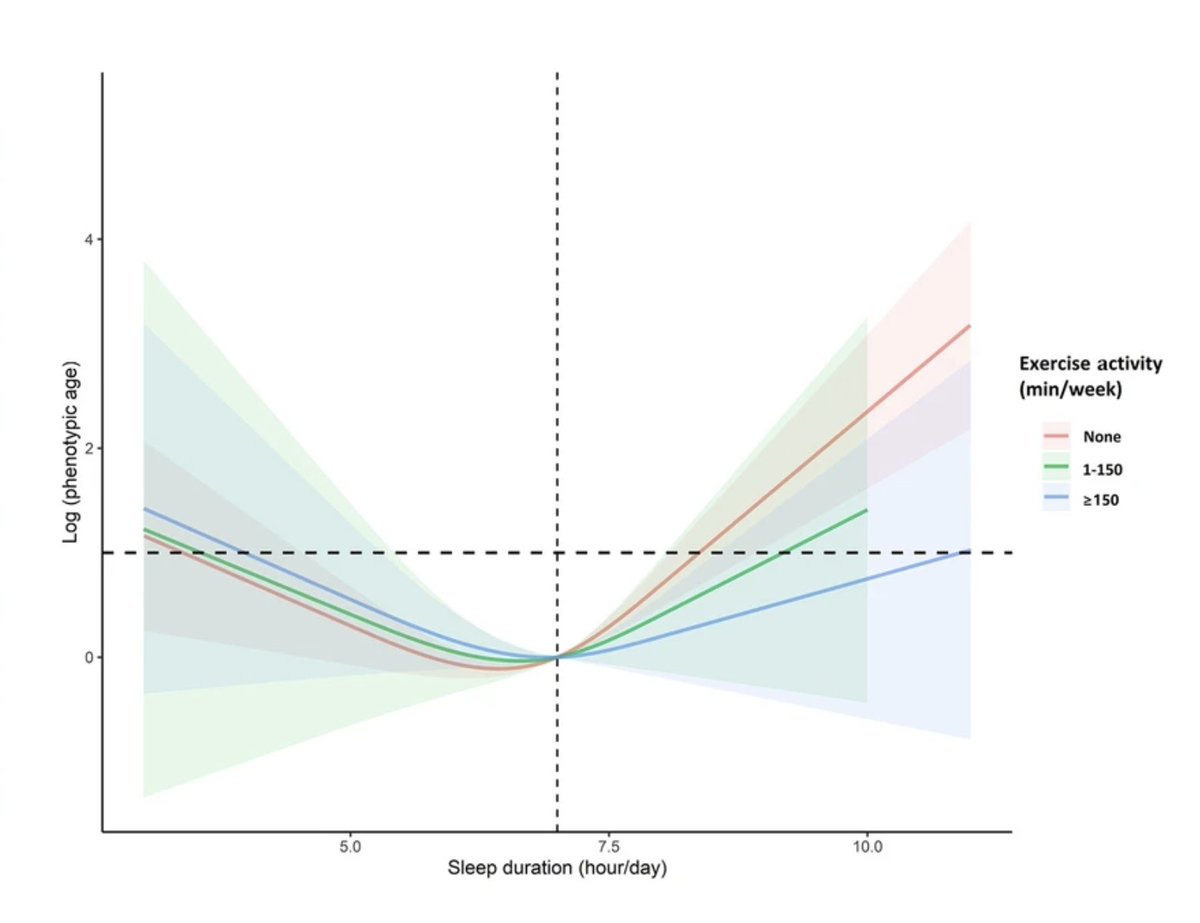
Regular exercise is linked to slower biological aging - but only in people sleeping 7+ hours.
People who slept under 6 hours and exercised actually aged faster.
I don't know who needs to hear this, but if you homeschool, you don't need to spend 6+ hours per day doing it.
Public school should not be your model.
What a typical homeschool day might look like:
- Kids wake up 8:30 - 9:00
- Kids start school around 10:00
- Kids are usually done by lunchtime. Sometimes they go a little bit after. Rest of the day is free.
- At night, the family reads together for 45-60 minutes.
Sometimes we go to the zoo.
Sometimes we take walks.
Sometimes they have an online class.
Sometimes they do nothing extra.
One day a week we go to our co-op and spend time with other families. They usually do a science experiment.
As kids reach middle school, they take on more responsibility for themselves, and school lasts a bit longer per day.
But at that point, your personal involvement doesn't increase drastically.
You already helped them grow and spread their wings.
They can fly a bit on their own.