Google lanzó la herramienta que todo desarrollador pedía desde hace años.
Se llama CodeWiki.
Pegas cualquier repositorio y la IA lo convierte automáticamente en una documentación interactiva.
No solo resume el código:
• Genera diagramas automáticamente
• Explica cómo funciona cada parte
• Crea tutoriales paso a paso
• Detecta arquitectura y dependencias
• Y hasta monta un chatbot que entiende tu código completo
Básicamente:
convierte proyectos imposibles de entender en algo que cualquier desarrollador puede navegar en minutos.
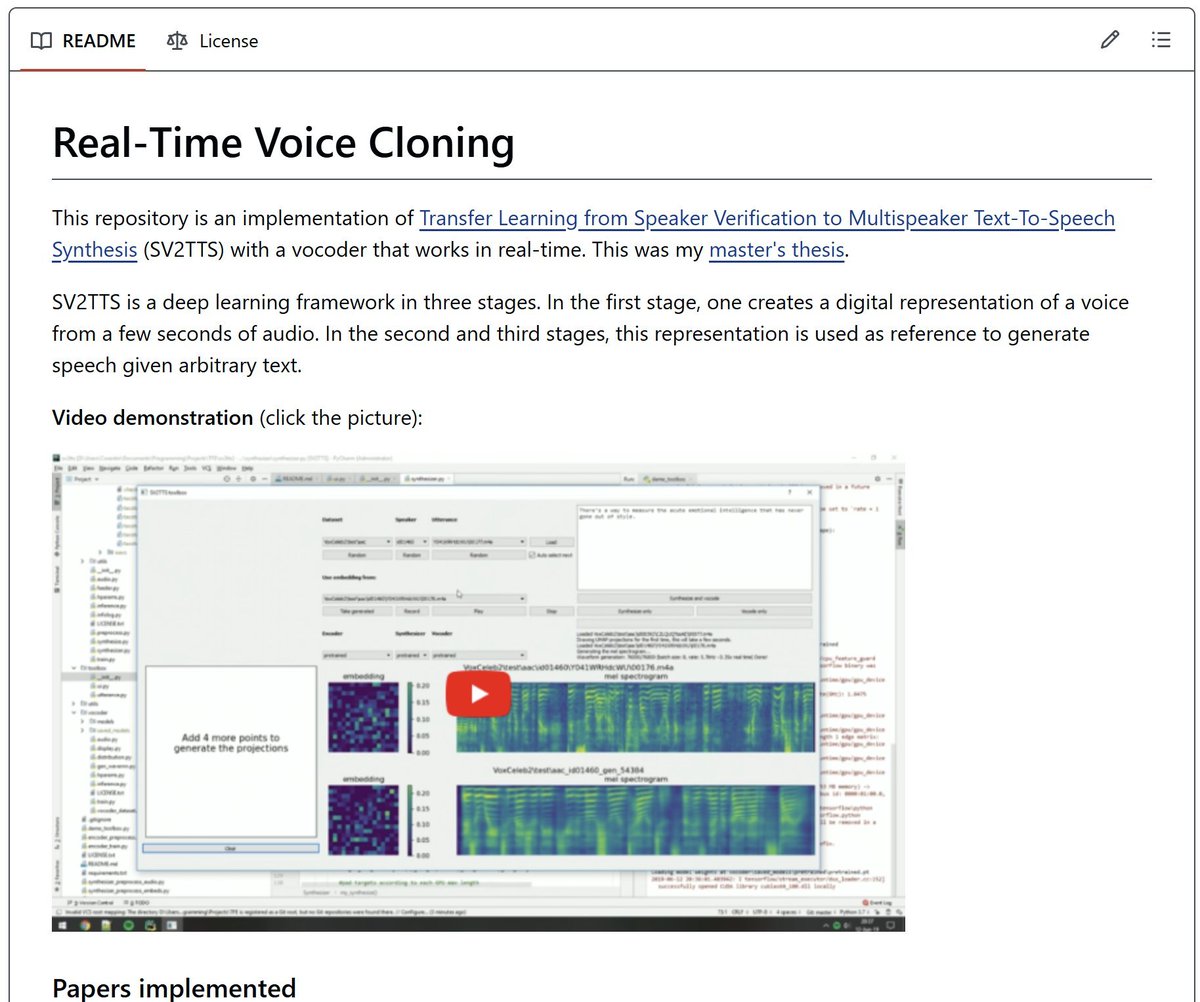
10 REPOSITORIOS DE GITHUB PARA CLONAR CUALQUIER VOZ CON IA
ElevenLabs está bien. Pero pagas cada mes por algo que existe en abierto, que puedes correr en tu máquina y que nadie te puede quitar si cambian los precios.
→ Cada repo clona una voz a partir de segundos de audio
→ Le escribes el texto y la voz lo dice con tu entonación
→ Todo corre local, tus audios no salen a ningún servidor externo
→ Varios soportan múltiples idiomas y ajuste de velocidad
→ Open source, gratis, sin límite de caracteres ni de créditos
Lo que te cobran como servicio premium lleva años disponible en GitHub. Solo había que saber dónde mirar.
Guárdalos 👇
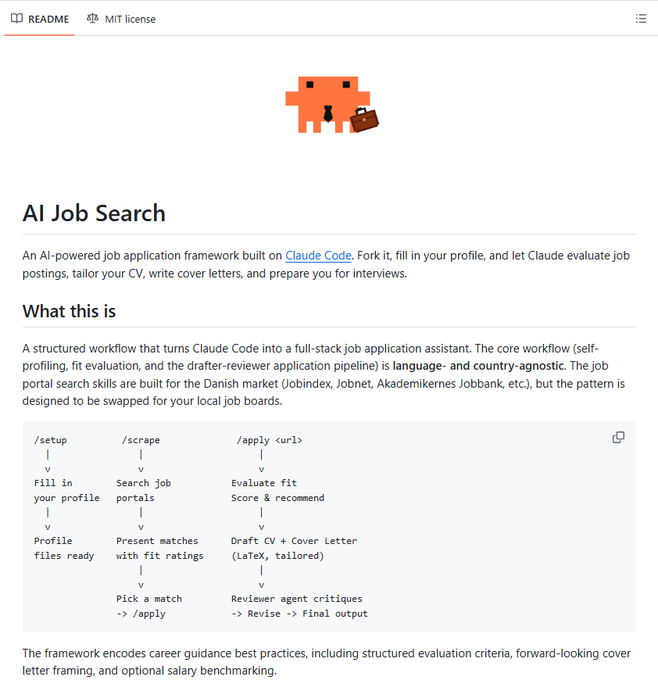
UN CIENTÍFICO DANÉS PROGRAMÓ A CLAUDE PARA QUE BUSQUE TRABAJO POR ÉL Y LO ACABA DE HACER PÚBLICO
Mandar CVs es uno de los trabajos más absurdos del mundo: copiar, pegar, adaptar, personalizar, repetir. Todo manual, todo lento, todo para que lo lea un algoritmo antes que un humano.
→ Analiza la oferta de trabajo automáticamente
→ Genera un CV personalizado para cada puesto
→ Redacta la carta de presentación adaptada al contexto
→ Todo lo hace Claude por debajo, sin que toques nada
→ Open source, ya en 3.5k stars en GitHub
El tío que debería estar buscando trabajo ha construido la herramienta que lo busca por él.
Aquí te explico cómo funciona 👇(repoo al final del hilo)
Doom scrolling but make it educational 🤓
Introducing Short Video Overviews in NotebookLM! Turn your most complex sources into 60-second, vertical videos that deep dive into any concept.
Rolling out now to Google AI Ultra and Pro subscribers on mobile & web (free users soon!)
才发现这个 repo 就是扒了这个 API https://t.co/ilz76TNgQ8,而且它扒的还是旧版 v1(Free Version)
新版 v2 更强大,有 Images, HD videos(我看了一下比 gif 强),我试了一下,视频质量很高,还有一个 Muscle Visualizer,一个组件来高亮不同的肌肉部位,很有想法。V2 的免费额度也很高,All free plans include a limit of 1,000 requests per hour per API key,视频另算。感觉一般的小应用加点缓存也够用了。
我现在发现卖这种小众服务其实还是很有需求的啊,比如这种健身的 API,几乎没有啥竞争对手吧,当你数据质量高的话,那几乎是垄断的。这个服务也卖一次性 data,一次性可以全部下载,600刀,数据量也不大。
Build your first robot in simulation! 👾
📌 If you’re self-learning robotics, this is genuinely one of the better repos to save for later.
@NVIDIARobotics released a "Getting Started with Isaac Sim" tutorial series covering everything from building your first robot to hardware-in-the-loop deployment.
What's inside?
→ Building Your First Robot Explore the Isaac Sim interface, construct a simple robot model (chassis, wheels, joints), configure physics properties, implement control mechanisms using OmniGraph and ROS 2, integrate sensors (RGB cameras, 2D lidar), and stream sensor data to ROS 2 for real-time visualization in RViz.
→ Ingesting Robot Assets Import URDF files, prepare simulation environments, add sensors to existing robot models, and access pre-built robots to accelerate development.
→ Synthetic Data Generation Learn perception models for dynamic robotic tasks, understand synthetic data generation, apply domain randomization with Replicator, generate synthetic datasets, and fine-tune AI perception models with validation.
→ Software-in-the-Loop (SIL) Build intelligent robots, implement SIL workflows, use OmniGraph for robot control, master Isaac Sim Python scripting, deploy image segmentation with ROS 2 and Isaac ROS, and test with and without simulation.
→ Hardware-in-the-Loop (HIL) Understand HIL fundamentals, learn NVIDIA Jetson platform, set up the Jetson environment, and deploy Isaac ROS on Jetson hardware.
The progression makes sense: start with basics (build a robot), add perception (sensors and data), generate training data (synthetic generation), develop software (SIL), then deploy to hardware (HIL).
For robotics teams, this is the path to faster iteration. Simulate first, validate in software-in-the-loop, generate synthetic training data at scale, then deploy to hardware with confidence. 🎓
If this helps at least one engineer to become more fluent in the world of robotics, means a lot to me! 🫶🏼
Here's the course (it's free): https://t.co/VqvvuRpFjs
~~
♻️ Join the weekly robotics newsletter, and never miss any news → https://t.co/GoA3ZuwoPB
As engineering, product, design, DS, etc. melt into a new kind of role, I was reflecting on what roles might look like in the future. For example, when I look at the Claude Code team I see what I think is five archetypes:
1. Prototyper: comes up with brand new ideas; churns out many ideas, most of which don't ship
2. Builder: quickly turns a prototype/idea into production-grade product/infra
3. Sweeper: cleans up the UI, simplifies the code and system, unships, optimizes performance
4. Grower: takes a product that has been built and iterates on it to improve Product-Market Fit
5. Maintainer: owns a mature system to make it secure, reliable, fast, and efficient as it scales
Many people span across 2 roles, and sometimes 3 roles. I also notice that these roles are not really tied to job function -- eg. across Anthropic, some designers match category 1, some 2, some 3; same for engineers, PM, DS.
A healthy team needs a mix of these, depending on the product:
- A product that is new and pre-PMF needs people that are strong at 1+2+3
- A product that is growing and has found PMF needs 2+3+4 and some 5
- A product that has strong PMF needs 3+4+5 and some 2
Maybe product roles of the future will look more like this, and less like the domain-specific roles of today?
you don’t need a robot to see physical ai in action, you just need a browser.
this week I finally tried something I've wanted to do for a while: design an SO-101 scene in three.js, connect it to a real leader arm, collect teleoperation data, train an ACT model, then port it to run in the browser.
the result is the first ever demo of ACT that runs locally on the web.
try it yourself now at https://t.co/2smZGyVx66
En la web de la BBC puedes seleccionar un jugador y ver acciones de partido en 3D virtual.
Así se ha visto el gol de Lamine Yamal y así lo ha visto el.
This "loop" automation is nuts inside of Codex.
"/goal go over every single feature in this app create a user story with expected behaviour based on the code keep a single canonical spreadsheet tracking the features status
- when done switch loop to testing every user story and documenting all errors
- when done fix every logistical error or ux error
- test every user behaviour again post fix"
Shoutout to @MatthewBerman for the heads up.
Hundreds of user stories being worked through like it's nothing.
This is one of the coolest open-source AI agent projects I've seen in a while: 'Understand Anything'
It's a plugin for Claude Code, Codex, OpenCode etc. that analyzes your codebase and turns it into a knowledge base that you can interact with.
It explains the codebase to you, rather than showing you the structure.
It seems like it's designed for code but I opened my Obsidian vault of podcast highlights in Claude Code, then ran /understand.
The result is a knowledge graph that I can search of highlights from 888 podcast episodes and 144K lines of markdown text.
Today we introduce a new vectorized dataset for mapping fine-scale ecological features, such as hedgerows, that often go undetected by standard satellites. This precision provides a new roadmap for addressing climate & biodiversity challenges without compromising food security. More: https://t.co/NRU3hrqvrd
📚 Presentamos la actualización de Nodo Educacional: 15 años de data pública del sistema educativo chileno, en un solo lugar.
🔗 https://t.co/S7vCcTvRGD
→ +11 mil establecimientos georreferenciados
→ Ficha por universidad y colegio
→ Trayectorias reales de egreso
→ Simulador PAES y más
Una herramienta especialmente útil mientras se rinde la #PAES de invierno.
🎬 Defensive Clinic: Morocco vs Brazil 🇲🇦🇧🇷
⚙️ Flexible 4-4-2 mid/low block
🧱 Central compactness forcing wide play
🧮 Constant +1 wide overloads on wingers
🪤 Suffocating touchline traps on the flanks
👥Front two cover shadows isolating midfielders
Pure tactical discipline!🦁
Clearly my favorite combo right now for projects Seedance 2 + Starlight Precise 2.5 (HDR export)This is a real game changer. #Topaz
We’ve moved from “nice-looking AI footage” to actual professional, usable workflows.
The HDR export quality just went up a massive notch.Are you already testing this combo?
Tell me where you’re at in the comments