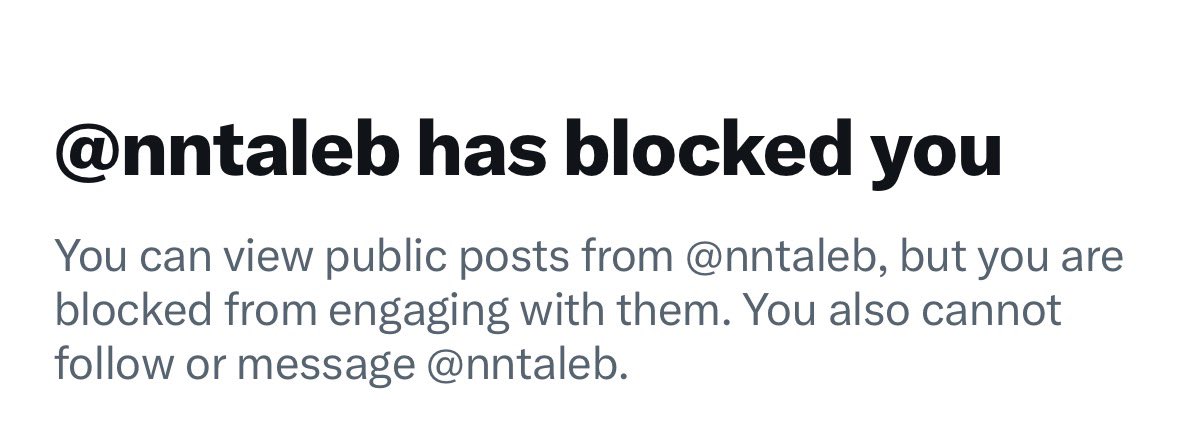
Today is a small celebration. Turns out I was blocked on Twitter by #NassimTaleb himself, some time ago, lord of black swans and fragility. Only noticed it today, by accident. Making this man’s blacklist isn’t exactly hard, but it’s flattering all the same.
Why he blocked me is fairly clear. I wrote a polite post saying his position on Israel since October 7th has been disappointing. Nothing offensive, ordinary criticism. But apparently, for a man who spent his whole career lecturing the world on intellectual courage, hearing disagreement from an ordinary reader was unbearable.
Amusingly, this is a systemic trait, not a one off. Discover Magazine asked back in 2014 whether someone should run a background check on Taleb’s fragile ego to figure out what makes him so averse to criticism. The same piece quotes his own admission that he blocks science journalists quickly, supposedly because they don’t understand the gap between small and extreme differences. In other words, a man openly stating his principle, block anyone who might turn out to be right.
The Spectator, a piece generally sympathetic to Taleb, unintentionally paints the portrait of a classic fragile genius. Friends describe him as kind in person, but admitthere’s a paradox here, a courtly conversationalist in private and an aggressive brawler on Twitter. Funny how the courage only shows up where there’s no risk of a real time response.
There’s also a telling episode involving GMOs, unrelated to Israel, but a perfect illustration of the method. In 2014 he publicly calledAnne Glover, then the EU’s chief scientific advisor and one of the most respected scientists in the world, a “dangerous imbecile” Genetic literacy project for disagreeing with him on genetic engineering. Not an argument, not data, just a label.
A philosopher who runs the site Curiosity described a similar episode, pointing out a factual error in one of Taleb’s articles. The response was predictable, Taleb admitted the correction was right, then simply told him to get lost. A man who built a career exposing other people’s errors struggles to admit his own, and struggles even harder to forgive the person who caught it.
On Israel, it’s the same pattern, just higher stakes and higher volume. This isn’t a couple of bad tweets. The Times of Israel documented in detailhow Taleb denies the validity of racial and genetic arguments in words, then turns around and uses them against Jews and Israel himself. And he does it remarkably consistently, anti-Israel posts have long been a noticeable, if not dominant, share of his feed.
Here’s what’s genuinely curious. Taleb, for all his self-regard, pours an enormous amount of resource into this subject, time, reputation, intellectual capital, year after year. Ordinarily, self-loving people treat every minute of attention as too precious to give away for free. It raises a fair question, what drives a man to invest this consistently in the same propaganda line without any apparent payoff. Ideological obsession on this scale is rare enough on its own, but it would be naive to rule out more prosaic explanations too, grants, sponsors, the political interests of certain circles. It would be naive to assume this is pure altruism.
A man who built his brand on the idea of antifragility turns out to be remarkably fragile the moment criticism lands on him personally, and remarkably generous when it comes to attacking Israel. Maybe that’s his own black swan, the inability to predict that one day, it wouldn’t be him doing the blocking, it would be reality.
Today is a small celebration. Turns out I was blocked on Twitter by #NassimTaleb himself, some time ago, lord of black swans and fragility. Only noticed it today, by accident. Making this man’s blacklist isn’t exactly hard, but it’s flattering all the same.
Why he blocked me is fairly clear. I wrote a polite post saying his position on Israel since October 7th has been disappointing. Nothing offensive, ordinary criticism. But apparently, for a man who spent his whole career lecturing the world on intellectual courage, hearing disagreement from an ordinary reader was unbearable.
Amusingly, this is a systemic trait, not a one off. Discover Magazine asked back in 2014 whether someone should run a background check on Taleb’s fragile ego to figure out what makes him so averse to criticism. The same piece quotes his own admission that he blocks science journalists quickly, supposedly because they don’t understand the gap between small and extreme differences. In other words, a man openly stating his principle, block anyone who might turn out to be right.
The Spectator, a piece generally sympathetic to Taleb, unintentionally paints the portrait of a classic fragile genius. Friends describe him as kind in person, but admitthere’s a paradox here, a courtly conversationalist in private and an aggressive brawler on Twitter. Funny how the courage only shows up where there’s no risk of a real time response.
There’s also a telling episode involving GMOs, unrelated to Israel, but a perfect illustration of the method. In 2014 he publicly calledAnne Glover, then the EU’s chief scientific advisor and one of the most respected scientists in the world, a “dangerous imbecile” Genetic literacy project for disagreeing with him on genetic engineering. Not an argument, not data, just a label.
A philosopher who runs the site Curiosity described a similar episode, pointing out a factual error in one of Taleb’s articles. The response was predictable, Taleb admitted the correction was right, then simply told him to get lost. A man who built a career exposing other people’s errors struggles to admit his own, and struggles even harder to forgive the person who caught it.
On Israel, it’s the same pattern, just higher stakes and higher volume. This isn’t a couple of bad tweets. The Times of Israel documented in detailhow Taleb denies the validity of racial and genetic arguments in words, then turns around and uses them against Jews and Israel himself. And he does it remarkably consistently, anti-Israel posts have long been a noticeable, if not dominant, share of his feed.
Here’s what’s genuinely curious. Taleb, for all his self-regard, pours an enormous amount of resource into this subject, time, reputation, intellectual capital, year after year. Ordinarily, self-loving people treat every minute of attention as too precious to give away for free. It raises a fair question, what drives a man to invest this consistently in the same propaganda line without any apparent payoff. Ideological obsession on this scale is rare enough on its own, but it would be naive to rule out more prosaic explanations too, grants, sponsors, the political interests of certain circles. It would be naive to assume this is pure altruism.
A man who built his brand on the idea of antifragility turns out to be remarkably fragile the moment criticism lands on him personally, and remarkably generous when it comes to attacking Israel. Maybe that’s his own black swan, the inability to predict that one day, it wouldn’t be him doing the blocking, it would be reality.
Today is a small celebration. Turns out I was blocked on Twitter by #NassimTaleb himself, some time ago, lord of black swans and fragility. Only noticed it today, by accident. Making this man’s blacklist isn’t exactly hard, but it’s flattering all the same.
Why he blocked me is fairly clear. I wrote a polite post saying his position on Israel since October 7th has been disappointing. Nothing offensive, ordinary criticism. But apparently, for a man who spent his whole career lecturing the world on intellectual courage, hearing disagreement from an ordinary reader was unbearable.
Amusingly, this is a systemic trait, not a one off. Discover Magazine asked back in 2014 whether someone should run a background check on Taleb’s fragile ego to figure out what makes him so averse to criticism. The same piece quotes his own admission that he blocks science journalists quickly, supposedly because they don’t understand the gap between small and extreme differences. In other words, a man openly stating his principle, block anyone who might turn out to be right.
The Spectator, a piece generally sympathetic to Taleb, unintentionally paints the portrait of a classic fragile genius. Friends describe him as kind in person, but admitthere’s a paradox here, a courtly conversationalist in private and an aggressive brawler on Twitter. Funny how the courage only shows up where there’s no risk of a real time response.
There’s also a telling episode involving GMOs, unrelated to Israel, but a perfect illustration of the method. In 2014 he publicly calledAnne Glover, then the EU’s chief scientific advisor and one of the most respected scientists in the world, a “dangerous imbecile” Genetic literacy project for disagreeing with him on genetic engineering. Not an argument, not data, just a label.
A philosopher who runs the site Curiosity described a similar episode, pointing out a factual error in one of Taleb’s articles. The response was predictable, Taleb admitted the correction was right, then simply told him to get lost. A man who built a career exposing other people’s errors struggles to admit his own, and struggles even harder to forgive the person who caught it.
On Israel, it’s the same pattern, just higher stakes and higher volume. This isn’t a couple of bad tweets. The Times of Israel documented in detailhow Taleb denies the validity of racial and genetic arguments in words, then turns around and uses them against Jews and Israel himself. And he does it remarkably consistently, anti-Israel posts have long been a noticeable, if not dominant, share of his feed.
Here’s what’s genuinely curious. Taleb, for all his self-regard, pours an enormous amount of resource into this subject, time, reputation, intellectual capital, year after year. Ordinarily, self-loving people treat every minute of attention as too precious to give away for free. It raises a fair question, what drives a man to invest this consistently in the same propaganda line without any apparent payoff. Ideological obsession on this scale is rare enough on its own, but it would be naive to rule out more prosaic explanations too, grants, sponsors, the political interests of certain circles. It would be naive to assume this is pure altruism.
A man who built his brand on the idea of antifragility turns out to be remarkably fragile the moment criticism lands on him personally, and remarkably generous when it comes to attacking Israel. Maybe that’s his own black swan, the inability to predict that one day, it wouldn’t be him doing the blocking, it would be reality.
Today is a small celebration. Turns out I was blocked on Twitter by #NassimTaleb himself, some time ago, lord of black swans and fragility. Only noticed it today, by accident. Making this man’s blacklist isn’t exactly hard, but it’s flattering all the same.
Why he blocked me is fairly clear. I wrote a polite post saying his position on Israel since October 7th has been disappointing. Nothing offensive, ordinary criticism. But apparently, for a man who spent his whole career lecturing the world on intellectual courage, hearing disagreement from an ordinary reader was unbearable.
Amusingly, this is a systemic trait, not a one off. Discover Magazine asked back in 2014 whether someone should run a background check on Taleb’s fragile ego to figure out what makes him so averse to criticism. The same piece quotes his own admission that he blocks science journalists quickly, supposedly because they don’t understand the gap between small and extreme differences. In other words, a man openly stating his principle, block anyone who might turn out to be right.
The Spectator, a piece generally sympathetic to Taleb, unintentionally paints the portrait of a classic fragile genius. Friends describe him as kind in person, but admitthere’s a paradox here, a courtly conversationalist in private and an aggressive brawler on Twitter. Funny how the courage only shows up where there’s no risk of a real time response.
There’s also a telling episode involving GMOs, unrelated to Israel, but a perfect illustration of the method. In 2014 he publicly calledAnne Glover, then the EU’s chief scientific advisor and one of the most respected scientists in the world, a “dangerous imbecile” Genetic literacy project for disagreeing with him on genetic engineering. Not an argument, not data, just a label.
A philosopher who runs the site Curiosity described a similar episode, pointing out a factual error in one of Taleb’s articles. The response was predictable, Taleb admitted the correction was right, then simply told him to get lost. A man who built a career exposing other people’s errors struggles to admit his own, and struggles even harder to forgive the person who caught it.
On Israel, it’s the same pattern, just higher stakes and higher volume. This isn’t a couple of bad tweets. The Times of Israel documented in detailhow Taleb denies the validity of racial and genetic arguments in words, then turns around and uses them against Jews and Israel himself. And he does it remarkably consistently, anti-Israel posts have long been a noticeable, if not dominant, share of his feed.
Here’s what’s genuinely curious. Taleb, for all his self-regard, pours an enormous amount of resource into this subject, time, reputation, intellectual capital, year after year. Ordinarily, self-loving people treat every minute of attention as too precious to give away for free. It raises a fair question, what drives a man to invest this consistently in the same propaganda line without any apparent payoff. Ideological obsession on this scale is rare enough on its own, but it would be naive to rule out more prosaic explanations too, grants, sponsors, the political interests of certain circles. It would be naive to assume this is pure altruism.
A man who built his brand on the idea of antifragility turns out to be remarkably fragile the moment criticism lands on him personally, and remarkably generous when it comes to attacking Israel. Maybe that’s his own black swan, the inability to predict that one day, it wouldn’t be him doing the blocking, it would be reality.
Today is a small celebration. Turns out I was blocked on Twitter by #NassimTaleb himself, some time ago, lord of black swans and fragility. Only noticed it today, by accident. Making this man’s blacklist isn’t exactly hard, but it’s flattering all the same.
Why he blocked me is fairly clear. I wrote a polite post saying his position on Israel since October 7th has been disappointing. Nothing offensive, ordinary criticism. But apparently, for a man who spent his whole career lecturing the world on intellectual courage, hearing disagreement from an ordinary reader was unbearable.
Amusingly, this is a systemic trait, not a one off. Discover Magazine asked back in 2014 whether someone should run a background check on Taleb’s fragile ego to figure out what makes him so averse to criticism. The same piece quotes his own admission that he blocks science journalists quickly, supposedly because they don’t understand the gap between small and extreme differences. In other words, a man openly stating his principle, block anyone who might turn out to be right.
The Spectator, a piece generally sympathetic to Taleb, unintentionally paints the portrait of a classic fragile genius. Friends describe him as kind in person, but admitthere’s a paradox here, a courtly conversationalist in private and an aggressive brawler on Twitter. Funny how the courage only shows up where there’s no risk of a real time response.
There’s also a telling episode involving GMOs, unrelated to Israel, but a perfect illustration of the method. In 2014 he publicly calledAnne Glover, then the EU’s chief scientific advisor and one of the most respected scientists in the world, a “dangerous imbecile” Genetic literacy project for disagreeing with him on genetic engineering. Not an argument, not data, just a label.
A philosopher who runs the site Curiosity described a similar episode, pointing out a factual error in one of Taleb’s articles. The response was predictable, Taleb admitted the correction was right, then simply told him to get lost. A man who built a career exposing other people’s errors struggles to admit his own, and struggles even harder to forgive the person who caught it.
On Israel, it’s the same pattern, just higher stakes and higher volume. This isn’t a couple of bad tweets. The Times of Israel documented in detailhow Taleb denies the validity of racial and genetic arguments in words, then turns around and uses them against Jews and Israel himself. And he does it remarkably consistently, anti-Israel posts have long been a noticeable, if not dominant, share of his feed.
Here’s what’s genuinely curious. Taleb, for all his self-regard, pours an enormous amount of resource into this subject, time, reputation, intellectual capital, year after year. Ordinarily, self-loving people treat every minute of attention as too precious to give away for free. It raises a fair question, what drives a man to invest this consistently in the same propaganda line without any apparent payoff. Ideological obsession on this scale is rare enough on its own, but it would be naive to rule out more prosaic explanations too, grants, sponsors, the political interests of certain circles. It would be naive to assume this is pure altruism.
A man who built his brand on the idea of antifragility turns out to be remarkably fragile the moment criticism lands on him personally, and remarkably generous when it comes to attacking Israel. Maybe that’s his own black swan, the inability to predict that one day, it wouldn’t be him doing the blocking, it would be reality.
Today is a small celebration. Turns out I was blocked on Twitter by #NassimTaleb himself, some time ago, lord of black swans and fragility. Only noticed it today, by accident. Making this man’s blacklist isn’t exactly hard, but it’s flattering all the same.
Why he blocked me is fairly clear. I wrote a polite post saying his position on Israel since October 7th has been disappointing. Nothing offensive, ordinary criticism. But apparently, for a man who spent his whole career lecturing the world on intellectual courage, hearing disagreement from an ordinary reader was unbearable.
Amusingly, this is a systemic trait, not a one off. Discover Magazine asked back in 2014 whether someone should run a background check on Taleb’s fragile ego to figure out what makes him so averse to criticism. The same piece quotes his own admission that he blocks science journalists quickly, supposedly because they don’t understand the gap between small and extreme differences. In other words, a man openly stating his principle, block anyone who might turn out to be right.
The Spectator, a piece generally sympathetic to Taleb, unintentionally paints the portrait of a classic fragile genius. Friends describe him as kind in person, but admitthere’s a paradox here, a courtly conversationalist in private and an aggressive brawler on Twitter. Funny how the courage only shows up where there’s no risk of a real time response.
There’s also a telling episode involving GMOs, unrelated to Israel, but a perfect illustration of the method. In 2014 he publicly calledAnne Glover, then the EU’s chief scientific advisor and one of the most respected scientists in the world, a “dangerous imbecile” Genetic literacy project for disagreeing with him on genetic engineering. Not an argument, not data, just a label.
A philosopher who runs the site Curiosity described a similar episode, pointing out a factual error in one of Taleb’s articles. The response was predictable, Taleb admitted the correction was right, then simply told him to get lost. A man who built a career exposing other people’s errors struggles to admit his own, and struggles even harder to forgive the person who caught it.
On Israel, it’s the same pattern, just higher stakes and higher volume. This isn’t a couple of bad tweets. The Times of Israel documented in detailhow Taleb denies the validity of racial and genetic arguments in words, then turns around and uses them against Jews and Israel himself. And he does it remarkably consistently, anti-Israel posts have long been a noticeable, if not dominant, share of his feed.
Here’s what’s genuinely curious. Taleb, for all his self-regard, pours an enormous amount of resource into this subject, time, reputation, intellectual capital, year after year. Ordinarily, self-loving people treat every minute of attention as too precious to give away for free. It raises a fair question, what drives a man to invest this consistently in the same propaganda line without any apparent payoff. Ideological obsession on this scale is rare enough on its own, but it would be naive to rule out more prosaic explanations too, grants, sponsors, the political interests of certain circles. It would be naive to assume this is pure altruism.
A man who built his brand on the idea of antifragility turns out to be remarkably fragile the moment criticism lands on him personally, and remarkably generous when it comes to attacking Israel. Maybe that’s his own black swan, the inability to predict that one day, it wouldn’t be him doing the blocking, it would be reality.
Today is a small celebration. Turns out I was blocked on Twitter by #NassimTaleb himself, some time ago, lord of black swans and fragility. Only noticed it today, by accident. Making this man’s blacklist isn’t exactly hard, but it’s flattering all the same.
Why he blocked me is fairly clear. I wrote a polite post saying his position on Israel since October 7th has been disappointing. Nothing offensive, ordinary criticism. But apparently, for a man who spent his whole career lecturing the world on intellectual courage, hearing disagreement from an ordinary reader was unbearable.
Amusingly, this is a systemic trait, not a one off. Discover Magazine asked back in 2014 whether someone should run a background check on Taleb’s fragile ego to figure out what makes him so averse to criticism. The same piece quotes his own admission that he blocks science journalists quickly, supposedly because they don’t understand the gap between small and extreme differences. In other words, a man openly stating his principle, block anyone who might turn out to be right.
The Spectator, a piece generally sympathetic to Taleb, unintentionally paints the portrait of a classic fragile genius. Friends describe him as kind in person, but admitthere’s a paradox here, a courtly conversationalist in private and an aggressive brawler on Twitter. Funny how the courage only shows up where there’s no risk of a real time response.
There’s also a telling episode involving GMOs, unrelated to Israel, but a perfect illustration of the method. In 2014 he publicly calledAnne Glover, then the EU’s chief scientific advisor and one of the most respected scientists in the world, a “dangerous imbecile” Genetic literacy project for disagreeing with him on genetic engineering. Not an argument, not data, just a label.
A philosopher who runs the site Curiosity described a similar episode, pointing out a factual error in one of Taleb’s articles. The response was predictable, Taleb admitted the correction was right, then simply told him to get lost. A man who built a career exposing other people’s errors struggles to admit his own, and struggles even harder to forgive the person who caught it.
On Israel, it’s the same pattern, just higher stakes and higher volume. This isn’t a couple of bad tweets. The Times of Israel documented in detailhow Taleb denies the validity of racial and genetic arguments in words, then turns around and uses them against Jews and Israel himself. And he does it remarkably consistently, anti-Israel posts have long been a noticeable, if not dominant, share of his feed.
Here’s what’s genuinely curious. Taleb, for all his self-regard, pours an enormous amount of resource into this subject, time, reputation, intellectual capital, year after year. Ordinarily, self-loving people treat every minute of attention as too precious to give away for free. It raises a fair question, what drives a man to invest this consistently in the same propaganda line without any apparent payoff. Ideological obsession on this scale is rare enough on its own, but it would be naive to rule out more prosaic explanations too, grants, sponsors, the political interests of certain circles. It would be naive to assume this is pure altruism.
A man who built his brand on the idea of antifragility turns out to be remarkably fragile the moment criticism lands on him personally, and remarkably generous when it comes to attacking Israel. Maybe that’s his own black swan, the inability to predict that one day, it wouldn’t be him doing the blocking, it would be reality.
Today is a small celebration. Turns out I was blocked on Twitter by #NassimTaleb himself, some time ago, lord of black swans and fragility. Only noticed it today, by accident. Making this man’s blacklist isn’t exactly hard, but it’s flattering all the same.
Why he blocked me is fairly clear. I wrote a polite post saying his position on Israel since October 7th has been disappointing. Nothing offensive, ordinary criticism. But apparently, for a man who spent his whole career lecturing the world on intellectual courage, hearing disagreement from an ordinary reader was unbearable.
Amusingly, this is a systemic trait, not a one off. Discover Magazine asked back in 2014 whether someone should run a background check on Taleb’s fragile ego to figure out what makes him so averse to criticism. The same piece quotes his own admission that he blocks science journalists quickly, supposedly because they don’t understand the gap between small and extreme differences. In other words, a man openly stating his principle, block anyone who might turn out to be right.
The Spectator, a piece generally sympathetic to Taleb, unintentionally paints the portrait of a classic fragile genius. Friends describe him as kind in person, but admitthere’s a paradox here, a courtly conversationalist in private and an aggressive brawler on Twitter. Funny how the courage only shows up where there’s no risk of a real time response.
There’s also a telling episode involving GMOs, unrelated to Israel, but a perfect illustration of the method. In 2014 he publicly calledAnne Glover, then the EU’s chief scientific advisor and one of the most respected scientists in the world, a “dangerous imbecile” Genetic literacy project for disagreeing with him on genetic engineering. Not an argument, not data, just a label.
A philosopher who runs the site Curiosity described a similar episode, pointing out a factual error in one of Taleb’s articles. The response was predictable, Taleb admitted the correction was right, then simply told him to get lost. A man who built a career exposing other people’s errors struggles to admit his own, and struggles even harder to forgive the person who caught it.
On Israel, it’s the same pattern, just higher stakes and higher volume. This isn’t a couple of bad tweets. The Times of Israel documented in detailhow Taleb denies the validity of racial and genetic arguments in words, then turns around and uses them against Jews and Israel himself. And he does it remarkably consistently, anti-Israel posts have long been a noticeable, if not dominant, share of his feed.
Here’s what’s genuinely curious. Taleb, for all his self-regard, pours an enormous amount of resource into this subject, time, reputation, intellectual capital, year after year. Ordinarily, self-loving people treat every minute of attention as too precious to give away for free. It raises a fair question, what drives a man to invest this consistently in the same propaganda line without any apparent payoff. Ideological obsession on this scale is rare enough on its own, but it would be naive to rule out more prosaic explanations too, grants, sponsors, the political interests of certain circles. It would be naive to assume this is pure altruism.
A man who built his brand on the idea of antifragility turns out to be remarkably fragile the moment criticism lands on him personally, and remarkably generous when it comes to attacking Israel. Maybe that’s his own black swan, the inability to predict that one day, it wouldn’t be him doing the blocking, it would be reality.
Today is a small celebration. Turns out I was blocked on Twitter by #NassimTaleb himself, some time ago, lord of black swans and fragility. Only noticed it today, by accident. Making this man’s blacklist isn’t exactly hard, but it’s flattering all the same.
Why he blocked me is fairly clear. I wrote a polite post saying his position on Israel since October 7th has been disappointing. Nothing offensive, ordinary criticism. But apparently, for a man who spent his whole career lecturing the world on intellectual courage, hearing disagreement from an ordinary reader was unbearable.
Amusingly, this is a systemic trait, not a one off. Discover Magazine asked back in 2014 whether someone should run a background check on Taleb’s fragile ego to figure out what makes him so averse to criticism. The same piece quotes his own admission that he blocks science journalists quickly, supposedly because they don’t understand the gap between small and extreme differences. In other words, a man openly stating his principle, block anyone who might turn out to be right.
The Spectator, a piece generally sympathetic to Taleb, unintentionally paints the portrait of a classic fragile genius. Friends describe him as kind in person, but admitthere’s a paradox here, a courtly conversationalist in private and an aggressive brawler on Twitter. Funny how the courage only shows up where there’s no risk of a real time response.
There’s also a telling episode involving GMOs, unrelated to Israel, but a perfect illustration of the method. In 2014 he publicly calledAnne Glover, then the EU’s chief scientific advisor and one of the most respected scientists in the world, a “dangerous imbecile” Genetic literacy project for disagreeing with him on genetic engineering. Not an argument, not data, just a label.
A philosopher who runs the site Curiosity described a similar episode, pointing out a factual error in one of Taleb’s articles. The response was predictable, Taleb admitted the correction was right, then simply told him to get lost. A man who built a career exposing other people’s errors struggles to admit his own, and struggles even harder to forgive the person who caught it.
On Israel, it’s the same pattern, just higher stakes and higher volume. This isn’t a couple of bad tweets. The Times of Israel documented in detailhow Taleb denies the validity of racial and genetic arguments in words, then turns around and uses them against Jews and Israel himself. And he does it remarkably consistently, anti-Israel posts have long been a noticeable, if not dominant, share of his feed.
Here’s what’s genuinely curious. Taleb, for all his self-regard, pours an enormous amount of resource into this subject, time, reputation, intellectual capital, year after year. Ordinarily, self-loving people treat every minute of attention as too precious to give away for free. It raises a fair question, what drives a man to invest this consistently in the same propaganda line without any apparent payoff. Ideological obsession on this scale is rare enough on its own, but it would be naive to rule out more prosaic explanations too, grants, sponsors, the political interests of certain circles. It would be naive to assume this is pure altruism.
A man who built his brand on the idea of antifragility turns out to be remarkably fragile the moment criticism lands on him personally, and remarkably generous when it comes to attacking Israel. Maybe that’s his own black swan, the inability to predict that one day, it wouldn’t be him doing the blocking, it would be reality.
Today is a small celebration. Turns out I was blocked on Twitter by #NassimTaleb himself, some time ago, lord of black swans and fragility. Only noticed it today, by accident. Making this man’s blacklist isn’t exactly hard, but it’s flattering all the same.
Why he blocked me is fairly clear. I wrote a polite post saying his position on Israel since October 7th has been disappointing. Nothing offensive, ordinary criticism. But apparently, for a man who spent his whole career lecturing the world on intellectual courage, hearing disagreement from an ordinary reader was unbearable.
Amusingly, this is a systemic trait, not a one off. Discover Magazine asked back in 2014 whether someone should run a background check on Taleb’s fragile ego to figure out what makes him so averse to criticism. The same piece quotes his own admission that he blocks science journalists quickly, supposedly because they don’t understand the gap between small and extreme differences. In other words, a man openly stating his principle, block anyone who might turn out to be right.
The Spectator, a piece generally sympathetic to Taleb, unintentionally paints the portrait of a classic fragile genius. Friends describe him as kind in person, but admitthere’s a paradox here, a courtly conversationalist in private and an aggressive brawler on Twitter. Funny how the courage only shows up where there’s no risk of a real time response.
There’s also a telling episode involving GMOs, unrelated to Israel, but a perfect illustration of the method. In 2014 he publicly calledAnne Glover, then the EU’s chief scientific advisor and one of the most respected scientists in the world, a “dangerous imbecile” Genetic literacy project for disagreeing with him on genetic engineering. Not an argument, not data, just a label.
A philosopher who runs the site Curiosity described a similar episode, pointing out a factual error in one of Taleb’s articles. The response was predictable, Taleb admitted the correction was right, then simply told him to get lost. A man who built a career exposing other people’s errors struggles to admit his own, and struggles even harder to forgive the person who caught it.
On Israel, it’s the same pattern, just higher stakes and higher volume. This isn’t a couple of bad tweets. The Times of Israel documented in detailhow Taleb denies the validity of racial and genetic arguments in words, then turns around and uses them against Jews and Israel himself. And he does it remarkably consistently, anti-Israel posts have long been a noticeable, if not dominant, share of his feed.
Here’s what’s genuinely curious. Taleb, for all his self-regard, pours an enormous amount of resource into this subject, time, reputation, intellectual capital, year after year. Ordinarily, self-loving people treat every minute of attention as too precious to give away for free. It raises a fair question, what drives a man to invest this consistently in the same propaganda line without any apparent payoff. Ideological obsession on this scale is rare enough on its own, but it would be naive to rule out more prosaic explanations too, grants, sponsors, the political interests of certain circles. It would be naive to assume this is pure altruism.
A man who built his brand on the idea of antifragility turns out to be remarkably fragile the moment criticism lands on him personally, and remarkably generous when it comes to attacking Israel. Maybe that’s his own black swan, the inability to predict that one day, it wouldn’t be him doing the blocking, it would be reality.
Today is a small celebration. Turns out I was blocked on Twitter by #NassimTaleb himself, some time ago, lord of black swans and fragility. Only noticed it today, by accident. Making this man’s blacklist isn’t exactly hard, but it’s flattering all the same.
Why he blocked me is fairly clear. I wrote a polite post saying his position on Israel since October 7th has been disappointing. Nothing offensive, ordinary criticism. But apparently, for a man who spent his whole career lecturing the world on intellectual courage, hearing disagreement from an ordinary reader was unbearable.
Amusingly, this is a systemic trait, not a one off. Discover Magazine asked back in 2014 whether someone should run a background check on Taleb’s fragile ego to figure out what makes him so averse to criticism. The same piece quotes his own admission that he blocks science journalists quickly, supposedly because they don’t understand the gap between small and extreme differences. In other words, a man openly stating his principle, block anyone who might turn out to be right.
The Spectator, a piece generally sympathetic to Taleb, unintentionally paints the portrait of a classic fragile genius. Friends describe him as kind in person, but admitthere’s a paradox here, a courtly conversationalist in private and an aggressive brawler on Twitter. Funny how the courage only shows up where there’s no risk of a real time response.
There’s also a telling episode involving GMOs, unrelated to Israel, but a perfect illustration of the method. In 2014 he publicly calledAnne Glover, then the EU’s chief scientific advisor and one of the most respected scientists in the world, a “dangerous imbecile” Genetic literacy project for disagreeing with him on genetic engineering. Not an argument, not data, just a label.
A philosopher who runs the site Curiosity described a similar episode, pointing out a factual error in one of Taleb’s articles. The response was predictable, Taleb admitted the correction was right, then simply told him to get lost. A man who built a career exposing other people’s errors struggles to admit his own, and struggles even harder to forgive the person who caught it.
On Israel, it’s the same pattern, just higher stakes and higher volume. This isn’t a couple of bad tweets. The Times of Israel documented in detailhow Taleb denies the validity of racial and genetic arguments in words, then turns around and uses them against Jews and Israel himself. And he does it remarkably consistently, anti-Israel posts have long been a noticeable, if not dominant, share of his feed.
Here’s what’s genuinely curious. Taleb, for all his self-regard, pours an enormous amount of resource into this subject, time, reputation, intellectual capital, year after year. Ordinarily, self-loving people treat every minute of attention as too precious to give away for free. It raises a fair question, what drives a man to invest this consistently in the same propaganda line without any apparent payoff. Ideological obsession on this scale is rare enough on its own, but it would be naive to rule out more prosaic explanations too, grants, sponsors, the political interests of certain circles. It would be naive to assume this is pure altruism.
A man who built his brand on the idea of antifragility turns out to be remarkably fragile the moment criticism lands on him personally, and remarkably generous when it comes to attacking Israel. Maybe that’s his own black swan, the inability to predict that one day, it wouldn’t be him doing the blocking, it would be reality.
Today is a small celebration. Turns out I was blocked on Twitter by #NassimTaleb himself, some time ago, lord of black swans and fragility. Only noticed it today, by accident. Making this man’s blacklist isn’t exactly hard, but it’s flattering all the same.
Why he blocked me is fairly clear. I wrote a polite post saying his position on Israel since October 7th has been disappointing. Nothing offensive, ordinary criticism. But apparently, for a man who spent his whole career lecturing the world on intellectual courage, hearing disagreement from an ordinary reader was unbearable.
Amusingly, this is a systemic trait, not a one off. Discover Magazine asked back in 2014 whether someone should run a background check on Taleb’s fragile ego to figure out what makes him so averse to criticism. The same piece quotes his own admission that he blocks science journalists quickly, supposedly because they don’t understand the gap between small and extreme differences. In other words, a man openly stating his principle, block anyone who might turn out to be right.
The Spectator, a piece generally sympathetic to Taleb, unintentionally paints the portrait of a classic fragile genius. Friends describe him as kind in person, but admitthere’s a paradox here, a courtly conversationalist in private and an aggressive brawler on Twitter. Funny how the courage only shows up where there’s no risk of a real time response.
There’s also a telling episode involving GMOs, unrelated to Israel, but a perfect illustration of the method. In 2014 he publicly calledAnne Glover, then the EU’s chief scientific advisor and one of the most respected scientists in the world, a “dangerous imbecile” Genetic literacy project for disagreeing with him on genetic engineering. Not an argument, not data, just a label.
A philosopher who runs the site Curiosity described a similar episode, pointing out a factual error in one of Taleb’s articles. The response was predictable, Taleb admitted the correction was right, then simply told him to get lost. A man who built a career exposing other people’s errors struggles to admit his own, and struggles even harder to forgive the person who caught it.
On Israel, it’s the same pattern, just higher stakes and higher volume. This isn’t a couple of bad tweets. The Times of Israel documented in detailhow Taleb denies the validity of racial and genetic arguments in words, then turns around and uses them against Jews and Israel himself. And he does it remarkably consistently, anti-Israel posts have long been a noticeable, if not dominant, share of his feed.
Here’s what’s genuinely curious. Taleb, for all his self-regard, pours an enormous amount of resource into this subject, time, reputation, intellectual capital, year after year. Ordinarily, self-loving people treat every minute of attention as too precious to give away for free. It raises a fair question, what drives a man to invest this consistently in the same propaganda line without any apparent payoff. Ideological obsession on this scale is rare enough on its own, but it would be naive to rule out more prosaic explanations too, grants, sponsors, the political interests of certain circles. It would be naive to assume this is pure altruism.
A man who built his brand on the idea of antifragility turns out to be remarkably fragile the moment criticism lands on him personally, and remarkably generous when it comes to attacking Israel. Maybe that’s his own black swan, the inability to predict that one day, it wouldn’t be him doing the blocking, it would be reality.
Today is a small celebration. Turns out I was blocked on Twitter by #NassimTaleb himself, some time ago, lord of black swans and fragility. Only noticed it today, by accident. Making this man’s blacklist isn’t exactly hard, but it’s flattering all the same.
Why he blocked me is fairly clear. I wrote a polite post saying his position on Israel since October 7th has been disappointing. Nothing offensive, ordinary criticism. But apparently, for a man who spent his whole career lecturing the world on intellectual courage, hearing disagreement from an ordinary reader was unbearable.
Amusingly, this is a systemic trait, not a one off. Discover Magazine asked back in 2014 whether someone should run a background check on Taleb’s fragile ego to figure out what makes him so averse to criticism. The same piece quotes his own admission that he blocks science journalists quickly, supposedly because they don’t understand the gap between small and extreme differences. In other words, a man openly stating his principle, block anyone who might turn out to be right.
The Spectator, a piece generally sympathetic to Taleb, unintentionally paints the portrait of a classic fragile genius. Friends describe him as kind in person, but admitthere’s a paradox here, a courtly conversationalist in private and an aggressive brawler on Twitter. Funny how the courage only shows up where there’s no risk of a real time response.
There’s also a telling episode involving GMOs, unrelated to Israel, but a perfect illustration of the method. In 2014 he publicly calledAnne Glover, then the EU’s chief scientific advisor and one of the most respected scientists in the world, a “dangerous imbecile” Genetic literacy project for disagreeing with him on genetic engineering. Not an argument, not data, just a label.
A philosopher who runs the site Curiosity described a similar episode, pointing out a factual error in one of Taleb’s articles. The response was predictable, Taleb admitted the correction was right, then simply told him to get lost. A man who built a career exposing other people’s errors struggles to admit his own, and struggles even harder to forgive the person who caught it.
On Israel, it’s the same pattern, just higher stakes and higher volume. This isn’t a couple of bad tweets. The Times of Israel documented in detailhow Taleb denies the validity of racial and genetic arguments in words, then turns around and uses them against Jews and Israel himself. And he does it remarkably consistently, anti-Israel posts have long been a noticeable, if not dominant, share of his feed.
Here’s what’s genuinely curious. Taleb, for all his self-regard, pours an enormous amount of resource into this subject, time, reputation, intellectual capital, year after year. Ordinarily, self-loving people treat every minute of attention as too precious to give away for free. It raises a fair question, what drives a man to invest this consistently in the same propaganda line without any apparent payoff. Ideological obsession on this scale is rare enough on its own, but it would be naive to rule out more prosaic explanations too, grants, sponsors, the political interests of certain circles. It would be naive to assume this is pure altruism.
A man who built his brand on the idea of antifragility turns out to be remarkably fragile the moment criticism lands on him personally, and remarkably generous when it comes to attacking Israel. Maybe that’s his own black swan, the inability to predict that one day, it wouldn’t be him doing the blocking, it would be reality.
Today is a small celebration. Turns out I was blocked on Twitter by #NassimTaleb himself, some time ago, lord of black swans and fragility. Only noticed it today, by accident. Making this man’s blacklist isn’t exactly hard, but it’s flattering all the same.
Why he blocked me is fairly clear. I wrote a polite post saying his position on Israel since October 7th has been disappointing. Nothing offensive, ordinary criticism. But apparently, for a man who spent his whole career lecturing the world on intellectual courage, hearing disagreement from an ordinary reader was unbearable.
Amusingly, this is a systemic trait, not a one off. Discover Magazine asked back in 2014 whether someone should run a background check on Taleb’s fragile ego to figure out what makes him so averse to criticism. The same piece quotes his own admission that he blocks science journalists quickly, supposedly because they don’t understand the gap between small and extreme differences. In other words, a man openly stating his principle, block anyone who might turn out to be right.
The Spectator, a piece generally sympathetic to Taleb, unintentionally paints the portrait of a classic fragile genius. Friends describe him as kind in person, but admitthere’s a paradox here, a courtly conversationalist in private and an aggressive brawler on Twitter. Funny how the courage only shows up where there’s no risk of a real time response.
There’s also a telling episode involving GMOs, unrelated to Israel, but a perfect illustration of the method. In 2014 he publicly calledAnne Glover, then the EU’s chief scientific advisor and one of the most respected scientists in the world, a “dangerous imbecile” Genetic literacy project for disagreeing with him on genetic engineering. Not an argument, not data, just a label.
A philosopher who runs the site Curiosity described a similar episode, pointing out a factual error in one of Taleb’s articles. The response was predictable, Taleb admitted the correction was right, then simply told him to get lost. A man who built a career exposing other people’s errors struggles to admit his own, and struggles even harder to forgive the person who caught it.
On Israel, it’s the same pattern, just higher stakes and higher volume. This isn’t a couple of bad tweets. The Times of Israel documented in detailhow Taleb denies the validity of racial and genetic arguments in words, then turns around and uses them against Jews and Israel himself. And he does it remarkably consistently, anti-Israel posts have long been a noticeable, if not dominant, share of his feed.
Here’s what’s genuinely curious. Taleb, for all his self-regard, pours an enormous amount of resource into this subject, time, reputation, intellectual capital, year after year. Ordinarily, self-loving people treat every minute of attention as too precious to give away for free. It raises a fair question, what drives a man to invest this consistently in the same propaganda line without any apparent payoff. Ideological obsession on this scale is rare enough on its own, but it would be naive to rule out more prosaic explanations too, grants, sponsors, the political interests of certain circles. It would be naive to assume this is pure altruism.
A man who built his brand on the idea of antifragility turns out to be remarkably fragile the moment criticism lands on him personally, and remarkably generous when it comes to attacking Israel. Maybe that’s his own black swan, the inability to predict that one day, it wouldn’t be him doing the blocking, it would be reality.
I recently finished Countdown to Zero Day.
It’s often described as a book about #Stuxnet, but that’s only part of the story. Much of the book explores the broader history of cyber operations, malware, industrial control systems, and the events that made Stuxnet possible. At times, those detours feel dry and pull the reader away from the main narrative. At other times, they provide valuable context.
What I appreciated most was the authors’ epistemology. They resist the temptation to turn speculation into fact. When the evidence ends, they simply say, “We don’t know.” The book acknowledges these as open questions rather than filling the gaps with convenient stories.
I enjoyed it, but I wouldn’t recommend it broadly. It’s a book for readers who already have a solid technical background and are genuinely interested in the history of cyber operations.
https://t.co/lmYWRRSbLf
#TIL : the Latin word “sinister” simply meant “left.” But the origin of its bad reputation isn’t obvious. The Roman augurs themselves, facing south, considered the left side favorable. It was the Greeks, facing north, who saw the left side, that is the west, as the direction of sunset and bad omens. It was this Greek interpretation that eventually won out and attached itself to the Latin word.
Its counterpart, “dexter,” right, gave us the English “dexterous,” skillful. A physical orientation of the body slowly turned into a moral metaphor.
“Dexter” and “sinister” are also the sides of a heraldic shield, defined not from the viewer’s perspective but from that of the person holding the shield. So the “sinister,” ominous side of the shield is actually on our right.
All in all, left was never much of a good thing, except for the Romans themselves.
Today, for some reason, I found myself thinking about what the signs of a real change of power in #Russia would look like. I don’t know what all of them would be. But for me there are two necessary conditions.
First, Lenin will finally be buried. Second, the murder of Vlad Listyev will be fully solved, with the people who ordered it and carried it out named.
This doesn’t guarantee change. But without it, any change remains decorative.
Today, for some reason, I found myself thinking about what the signs of a real change of power in #Russia would look like. I don’t know what all of them would be. But for me there are two necessary conditions.
First, Lenin will finally be buried. Second, the murder of Vlad Listyev will be fully solved, with the people who ordered it and carried it out named.
This doesn’t guarantee change. But without it, any change remains decorative.