You can not get a state contract in Georgia unless you pledge loyalty to Israel
You can get a state contract without pledging loyalty to America and Georgia
How does anyone pretend this is normal?
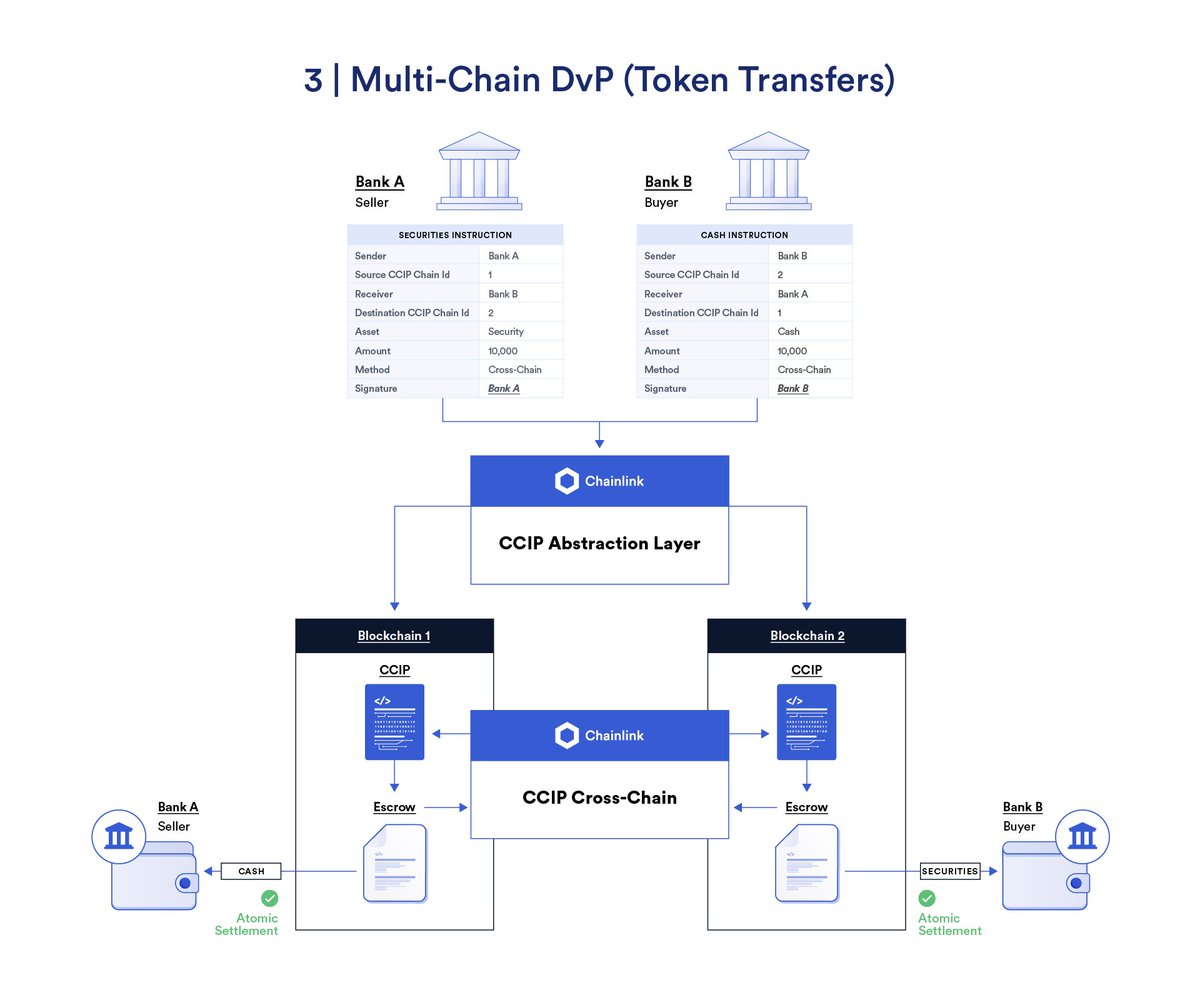
With Swift, multiple leading market infrastructures and the largest major financial institutions now clearly seeing the value of tokenization, we are nearing an inflection point for blockchain adoption in capital markets.
Chainlink and CCIP are key infrastructure to enable this transition out of the proof-of-concept phase and into production-level usage for real value, three key use cases will be:
1. Enabling secondary markets for tokenized assets across multiple institutional counterparties and banks, by allowing easy asset movement across any blockchain, public or private via CCIP. This means that even if a token is created on one chain, it can be bought from many chains. For example, facilitating Delivery vs. Payment (DvP) with stablecoins/cash/deposit tokens by performing transactions with the exchange of assets across blockchains.
2. Synchronizing on-chain to off-chain systems by supporting communication between legacy infrastructure and blockchains, greatly reducing the integration burden for large pools of capital by enabling existing institutions to interact with assets on any blockchain.
3. Creating a golden record that is updated by various Chainlink services, easily moved across multiple chains into multiple markets and consistently updated as it moves across those chains. For example, a RWA gold coin that uses Proof of Reserves to prove its holdings and has identity data attached to allow large institutions/pools of capital to purchase it in line with their existing legal requirements, transfer it across multiple chains using CCIP, and keep its key characteristics updated throughout.
These use cases will help financial institutions create large, multi trillion dollar, global and on-chain markets, while also gaining the large operational efficiencies of blockchain technology. It’s now clearer than ever: the next frontier of finance is on-chain, and Chainlink is the gateway.
https://t.co/hh4XNP4gIg
@LinkWarLord Ah, very clever. That way they don't have to go as far as inventing a fake title for their fake panel. They can just use the name of the conference for their fake panel. Very efficient.
No.
Difficulty adjustments don't make mining profitable. They're done after too many miners quit mining because mining itself became unprofitable in order to reduce block times back down to 10 minutes.
Once block times are back to 10 minutes, those unprofitable miners, who quit mining, don't return back to mine. Why? Because the profitability of mining is unchanged for them. The difficulty adjustment doesn't increase transaction fee revenue, increase the number of BTC in a block reward, or increase the price of BTC.
After the difficulty adjustment is made, the network is still going to have less and less BTC to print, so it will be able to employ fewer and fewer miners, which means the network is getting more centralized and less secure, which further undermines BTC's narrative (what all of its valuation is based on).
As that happens, the token becomes less desirable to own as people see the network is in a state of decline, which will further reduce the price, which will make miners even less profitable, which will make even more of them quit, & the positive feedback loop of decline will continue.
I have no idea what you're even attempting to prove or refute with this.
Users will get raped paying higher fees for two weeks to get their transactions included until the difficulty adjustment is made...and then what happens next?
All of this is a red herring. After the difficulty adjustment is made, the network still has less total money to pay miners, which means less miners are securing the network compared to before. You simply have an ever-shrinking pool of funds from which to pay miners.
It's hilarious that people are quote tweeting your video in celebratory fashion when you literally didn't refute any of the problem.
@ChrisBlec Why are you screaming at Chainlink and not the devs themselves though, anyone can spin their own Chainlink network without multisig, it's an open source protocol.
>1. The Halvening and Miner Revenue The first argument says that #BTC📷 price needs to double every 4 years to maintain miner revenue due to the halving of block rewards. However, this overlooks the role of transaction fees. Over time, as the block reward diminishes, the protocol is designed to make transaction fees a more significant portion of miner compensation.
No, what I wrote doesn't overlook this. I literally gave the ratio betwen fees (3%) vs inflation (97%), which means I didn't overlook the fees. My entire post is about how what BTC does (pet rock) doesn't create fees.
Your last sentence in this section points out what the protocol was "designed" to do. It doesn't matter what it was "designed" to do; what matters is what it's actually doing. It was designed to be "peer to peer electronic cash", which was supposed to generate the missing fees, and since it failed at that, it's now cosplaying as digital gold, but being digital gold doesn't create fees. That's the whole problem.
>2. Scalability and New Use Cases The second argument questions the emergence of a new, substantial use case for Bitcoin that could generate increased transaction fees. While it’s true that scalability is an issue, it’s also a focal point of ongoing development, such as layer-2 solutions like Lightning Network. Also, the emergence of DeFi and other financial instruments on Bitcoin’s network can act as potential sources of increased transaction fees.
Lightning Network has no adoption. No one wants to use a highly volatile asset as a payments token. If it could be worth more tomorrow, why spend it today? If it could be worth less tomorrow, why accept it as payment today? The reality is that stablecoins have entirely won this use-case. Anything with volatility is dead on arrival.
Furthermore, even if someone accepted BTC for payments, but wanted to avoid the volatility, they would immediately dump the BTC. So, creating use-cases that give people additional incentives to dump your token aren't bullish for the price appreciation of the token. So, if you want your token to be a store of value, which is what BTC wants to be, then you want to create value propositions that encourage holding the token such as paying real yield to holders (can only come from sufficient fees); not designing additional reasons and methods to dump the token.
Additionally, the infrastructure possibilities for stablecoins to further integrate with other payment rails only further bolster the massive competitive advantage stablecoins have over BTC. Just look at the volume of transactions happening in stablecoins across all the major smart contract chains. Then, look at all the additional infrastructure Circle is building to further boost the adoption of USDC. Then, realize all of that is just the tip of the iceberg because 11,500 banks, which are on SWIFT's network, will now be interoperable with all relevant chains through Chainlink's CCIP, and many will be issuing their own stablecoins over crypto rails on a massive scale.
>3. Assumptions on Miner ROI The contention that miners will cease operations if ROI falls below a specific threshold assumes a static cost structure and doesn’t consider advancements in mining efficiency. Miners are continuously improving the efficiency of their operations, reducing electricity costs, and deploying more advanced hardware, all of which can adjust the ROI calculations.
Correct. They can adjust the ROI calculation, which means it can postpone the security budget peak by some increment of time. They can't reverse the trend. It just buys you a bit of time vs the inevitable.
Halvenings wipe out 50% of your revenue every 4 years. Your marginal incremental gains on electricity and hardware can't come close to offsetting that. Halvenings are the only certainty in Bitcoin. Everything else is hopium or delaying the inevitable.
>4. Market Cap Concerns The argument implies that an increase in market cap becomes exponentially difficult over time. However, the adoption curve of new technologies typically follows an S-curve, not a linear trajectory. The global financial market is in the quadrillions, leaving ample room for #Bitcoin📷 to grow.
Bitcoin isn't a "new technology." If blockchain was like aviation, then Bitcoin is the plane the Wright brothers launched in Kitty Hawk. It was a prototype, but it's a relic now. It's the original meme coin, before we knew what meme coins were.
Bitcoin isn't even trying to compete as a technology. That's happening elsewhere in the crypto space. Just take a look at what Bitcoin conferences look like to see the proof. Other protocol conferences have presentations on zero knowledge proofs, MEV, new consensus protocols, decentralized sequencer sets, etc. Does Bitcoin have anything like this?
The typical Bitcoin conference highlight is Max Kaiser ripping up money and Michael Saylor telling people to buy Bitcoin.
What technology has Bitcoin launched in the last 5 years that have changed the protocol in any meaningful way or generated fees for itself? The most meaningful thing BTC has done in the last 5 years to create revenue for itself is to offer the trading of cartoon wizard pictures on its chain.
And, yes, once your protocol is already worth hundreds of billions of dollars, it does become exponentially harder to continue growing past that point, because it requires proportionate amounts of capital to continue growing past that point.
>5. Network Security and Value Death Spiral The doomsday scenario outlined assumes that low ROI will lead to reduced network security. However, this perspective disregards game-theoretical elements intrinsic to Bitcoin’s protocol, which ensures that miners have a vested interest in maintaining network security, as their existing investments and future revenues are tied to the network’s value.
The miners don't have mutually aligned interesteds in the longevity of the network at all. The miners aren't invested in the token; the miners are invested in real estate, ASICs, and electricity. The token is a passthrough they dump to recoup their investments into their overhead components and then turn a profit.
The miners dump everything they mine eventually. Anything they're holding is just temporary until the price gets high enough for them to take profits. They will simply mine Bitcoin while it's profitable to mine Bitcoin. The moment the network doesn't have enough money to pay people, people will respond by stopping mining, until it's profitable once again.
But, now the network can only afford to hire fewer miners than it did before, which means the network is less decentralized and less secure. That reality will damage the market's perception of the BTC network, which will further drop the price, which will further reduce how many miners the network can employ.
There will be a sustained, steady decline of how many miners the network can hire because price and operational efficiency gains can't keep pace with the preprogrammed halvenings.
>6. The 21 Million Cap Lastly, the argument presents a false trilemma between network value, security, and the integrity of the 21 million cap. Bitcoin’s fixed supply is a cornerstone of its value proposition, and any changes would require community consensus, which is unlikely given the vested interests.
There is no "false trilemma". Rather, there's a very real corner that BTC has painted itself into. There's only two ways to pay your validator sets in any protocol: transaction fees from paying customers or inflation. Bitcoin's problem is that it doesn't have enough fees from customers and it's running out of inflation.
Bitcoin simultaneously decided that it's primary use-case is to be a thing that doesn't generate fees, which automatically means that it has to be more dependent on inflation, but before it decided to choose that use-case, Satoshi had already programmed it to have a fixed supply and decreasing inflation.
Well, you can't have your cake and eat it, too. You need money to pay your miners because they won't work for free, but the network doesn't know how to make money and it's running out of reserves.
I get that you're a street shitter grifter, but do you realize that BTC is literally the original meme coin? And, because it's a pet rock meme coin, it constantly needs new ponzi money coming in to prop up its price. Otherwise, it can't afford to pay its miners.
Because 97% of the money paid to miners comes from inflation (block rewards) and that inflation gets cut in half every 4 years (halvenings), that means BTC's price has to double every 4 years just to have the same amount of revenue to pay miners as the last epoch.
HODLing pet rock, its primary use case, produces no protocol revenue to pay miners. People are now hoping that trading pictures of cartoon wizards will help BTC survive, but it's futile. You need a use case that sustainably increases user fees by almost 30X to replace the revenue lost from four halvenings.
No one can even name what that hypothetical use case is, despite the fact that the profit motive to create it exists just as much today as it does in the future. It's not even clear that such a use-case can even be built given the lack of scalability of the network.
Who will be mining BTC after block rewards drop by 94%, if the price doesn't do a 12X-16X? You would need a 16X just to keep the profitability of miners equal to where its at today. Anything below that and they're making less money than they are today.
Do you think people will mine BTC to earn sub 1% ROI or mine at a loss? Just because you *need* the price to keep doubling doesn't mean it will. It gets exponentially harder as the marketcap gets larger. We're talking about you needing trillions of dollars worth of marketcap being added every four years, once we are four halvenings out. That's an entire marketcap of Apple, the most valuable company in the world, being added every four years and only larger from there on out.
At some point, in 20 years, you take transaction fee revenue and add it to BTC's current price, multiplied by the size of its block reward, and its total compensation to miners is non-competitive, or an outright loser, compared to other allocations of capital. Even if BTC mining produces positive income, if it's too low of a return, capital will move elsewhere.
So, that means people will stop mining because its a money losing endeavor, or returns are too low, and the network security starts to drop, and as that happens, it will start losing the memetic value of it being the most secure/decentralized network in the world, which will cause people to sell, which further plummets the price, which further reduces the returns of mining, which makes more people quit mining, etc. You can see the positive feedback loop.
BTC needs to create a sustainable revenue stream from transactions to compensate miners (to offset that dwindling block reward) or they will be forced with the prospects of a security and value death spiral or...having to add additional inflation above their 21M hard cap and having to do that would be the ultimate nail in the coffin for so many of the memes around BTC around "money not controlled by people", "hardest money on Earth", "money not printed by central banker" etc; all your favorite laser eye cult memes.
Your choices are:
A) Creating sustainable revenue from people using the network for something that generates revenue
B) Removing the 21M hardcap and adding more inflation via block rewards and completely undermining the stories we've been told
C) Network security and value death spiral
None of those choices are very promising. But, believing that its value will just magically keep doubling because that's what you need to have happen in order to avoid catastrophe doesn't mean it will happen. I love that you're trying to trash other projects as MLM schemes, when the largest one ever made is staring you in the face.
The New York Times actually has the nerve to support calls for genocide! If ever there was a time to cancel that publication, it is now.
You can read their articles for free anyway using https://t.co/2NjvMTsWmj.