Here's a cool map you won't find anywhere else.
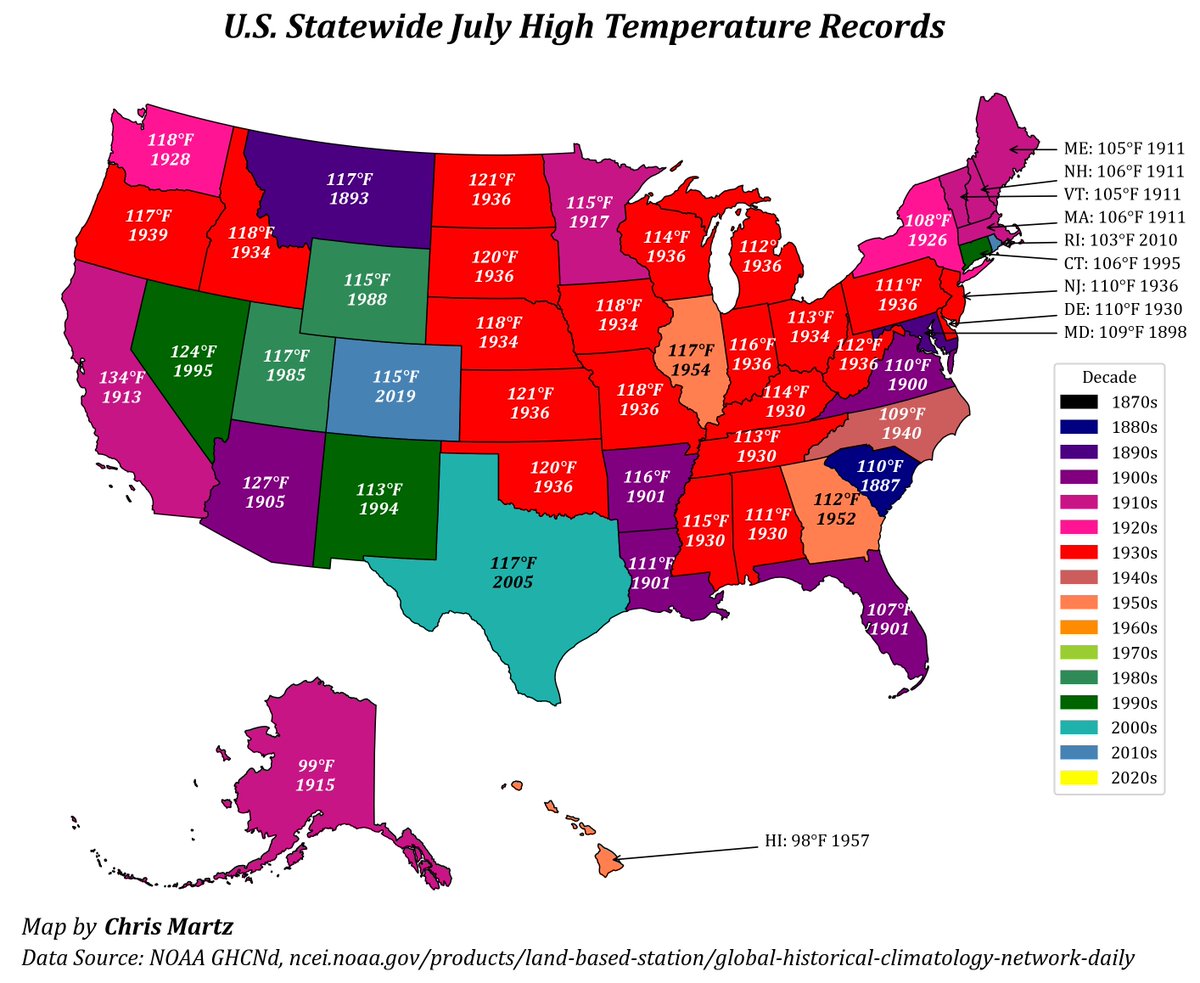
U.S. statewide JULY high temperature records.
40 (80% of) U.S. states set their “all-time” statewide July high temperature records before 1955; 11 of those were set in 1936 alone. Five states set theirs in 1930.
California's record of 134°F in Death Valley remains the official statewide, U.S. national, and worldwide “all-time” record high temperature for all months, although its authenticity has been challenged.
@chriscfore American students are spending too much time on extracurricular activities, particularly sports. They could spend several hours playing sports on a daily basis, but have little to no homework to practice foundation skills in reading and math.
Ramsey County, whose legislative delegation unanimously opposes photo id to vote, requires photo id TO. DISPOSE. OF. YARD. WASTE. How are minorities, illegal aliens, recently married women, and members of the alphabet community supposed to dispose of yard waste?
In the 1980s American schools started to prohibit the teaching of phonics, yes you read that right (if you can read), and the result 40 years later is that the average American reads at a sixth grade level.
Someone who doesn't have much can be more generous giving a little than a rich person giving a lot. Some people respond to the generosity while others respond to the money. You want the first type with you, and you always want to treat them generously.
When I had nothing, I was as generous as I could be with people who appreciated my generosity more than the higher levels of compensation others could afford to give them. For that reason, they stayed with me. I never forgot that, and I made a point of making them rich when I had the opportunity to do so. And they in turn were generous to me in their own way when I needed their generosity most. We both got something much more valuable than money--and we got the money too.
Remember that the only purpose of money is to get you what you want, so think hard about what you value and put it above money. How much would you sell a good relationship for? There's not enough money in the world to get you to part with a valued relationship. #principleoftheday
Nobody ever said radical honesty was easy. Sometimes, especially with new employees who have not yet gotten used to it, an honest assessment feels like an attack. Rise to a higher level and keep your eye on the bigger picture and counsel the person you are evaluating to do the same. #principleoftheday
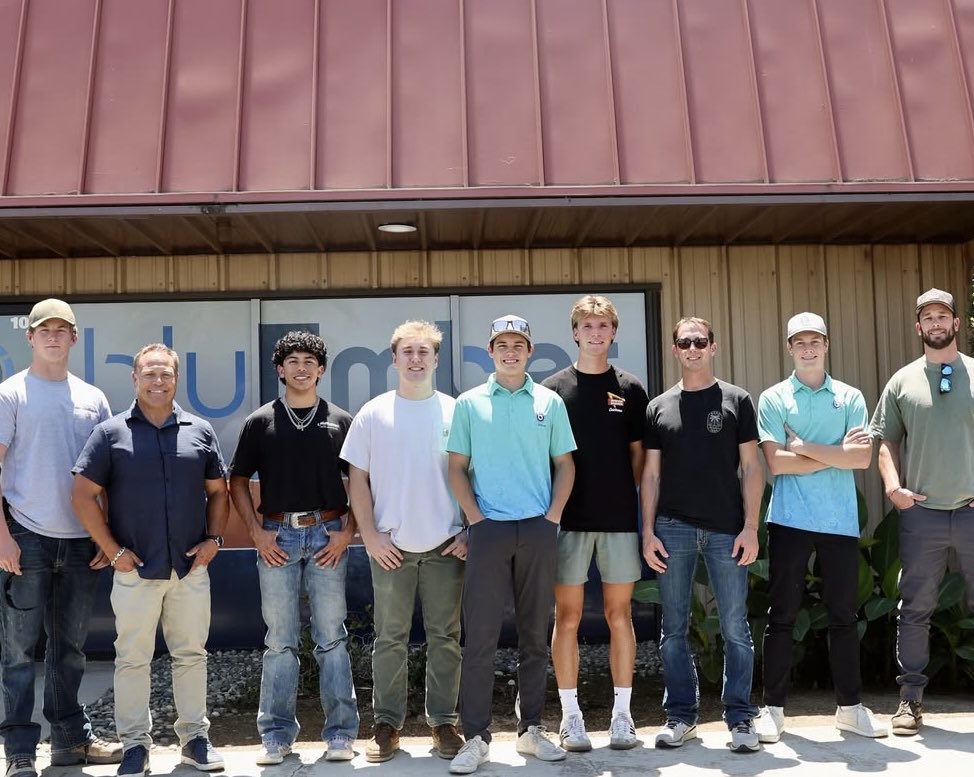
3 years ago this month our son Joel (then 17) bought himself a plane ticket to Des Moines because he had heard there was a guy making a killing out there cleaning windows. He asked this stranger if he could come stay a few weeks and learn the business from him and the guy said yes.
Joel came back and started his own window cleaning business. It took off so fast he left it in the hands of his younger brother Nate and moved to Montana to start another branch. They both started offering other services by just saying yes whenever someone asked if they did something else, until Nate hit the jackpot installing Christmas lights.
A little over a year ago, Joel (newly married) and Nate (newly engaged) met up in Utah to get trained on these new permeant outdoor LED lights they were seeing around. Soon that's all they were doing. But they both felt they could be doing it a lot better if they had a better product to work with.
So they sold their other businesses, joined forces, designed their own product, and started manufacturing the steel tracking for it themselves. This year their younger brother Sam moved to Montana to take over Joel's location while Joel and his wife moved to Hawaii to start a new location there.
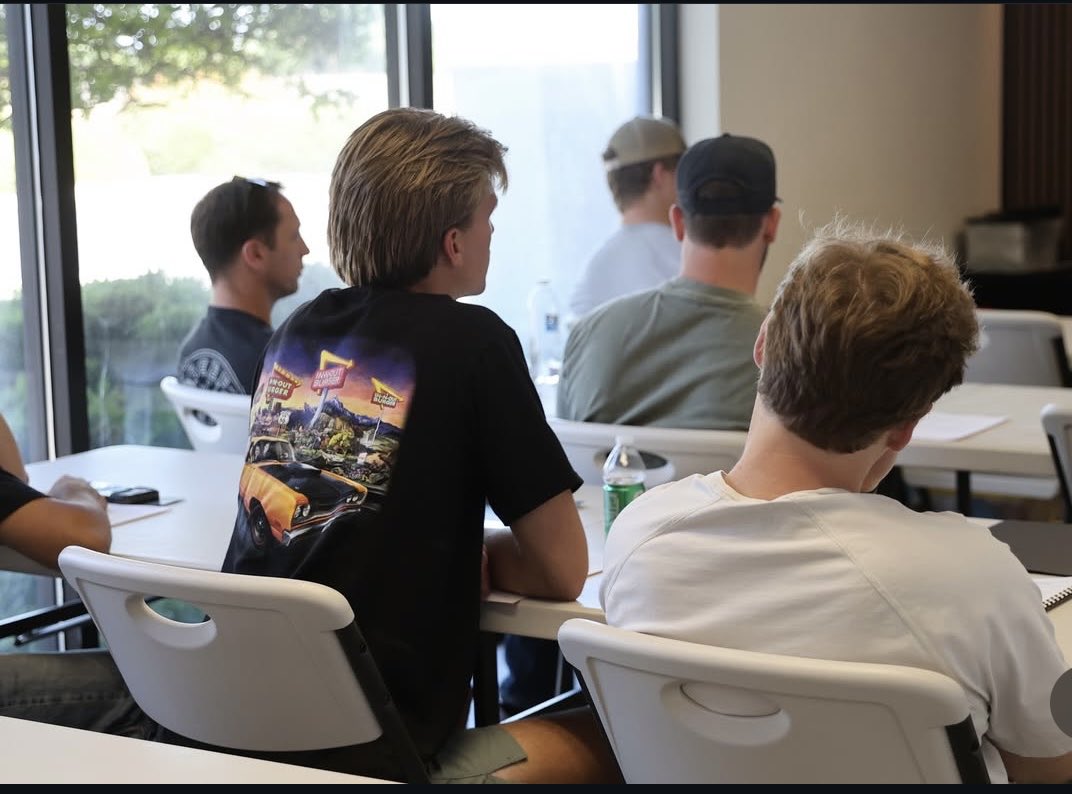
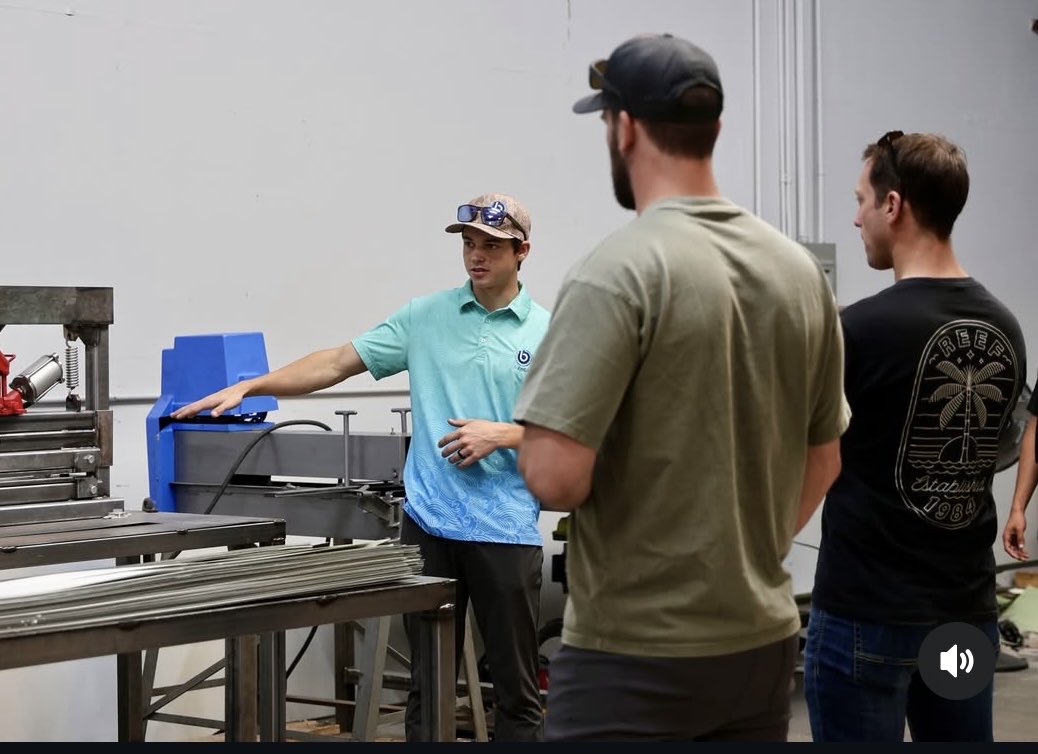
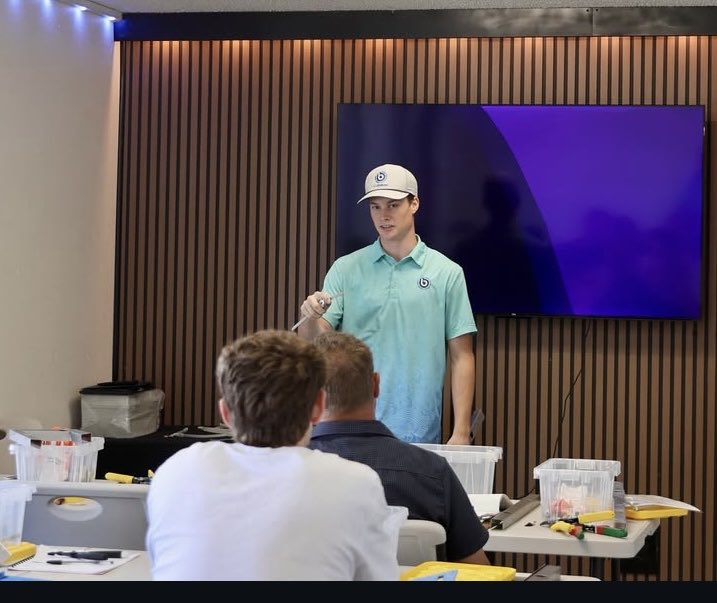
This past weekend they hosted their first seminar for dealers to come learn how to sell and install their product. Now bluEmber Lights could be coming to your state too!
This is not a commercial for their company. They obviously don't need mom's help in marketing.
This is a pep talk for everyone who has lost faith in the next generation of young men. It's a pep talk for those young men themselves. And it's a pep talk for their moms.
Teenage boys are gifted with an extraordinary amount of energy, drive, stamina, competitiveness, ambition, risk-taking, courage, and optimism. That is their natural state and unfortunately our culture seems to do everything it can to kill all of it. What we tend to see instead is laziness, complacency, entitlement, uncertainty, fear, anger, and blame-shifting. Such a state is a demoralizing, paralyzing trap. But I think many could break free by the grace of God. Dads obviously play the most crucial role in this but moms are often the main decision makers regarding education and training.
To those moms I would just ask them to reexamine their sons' educational environment. Is it making or breaking him? No amount of learning will be of any use if the process has left your son weaker, less capable, anxious, bitter, and unmotivated. The problem is as women, we tend to look at an environment through the lens of our own wants and needs. What would be the making of us could have the opposite effect on our sons. It could be the breaking of them.
Today is Memorial Day. Many of those who have bravely fought and died to protect us and pave the way for young men like yours to provide in freedom, were the same age as this month's high school graduates. Our country is still full of that caliber of youthful bravery. Let's not burry it too.
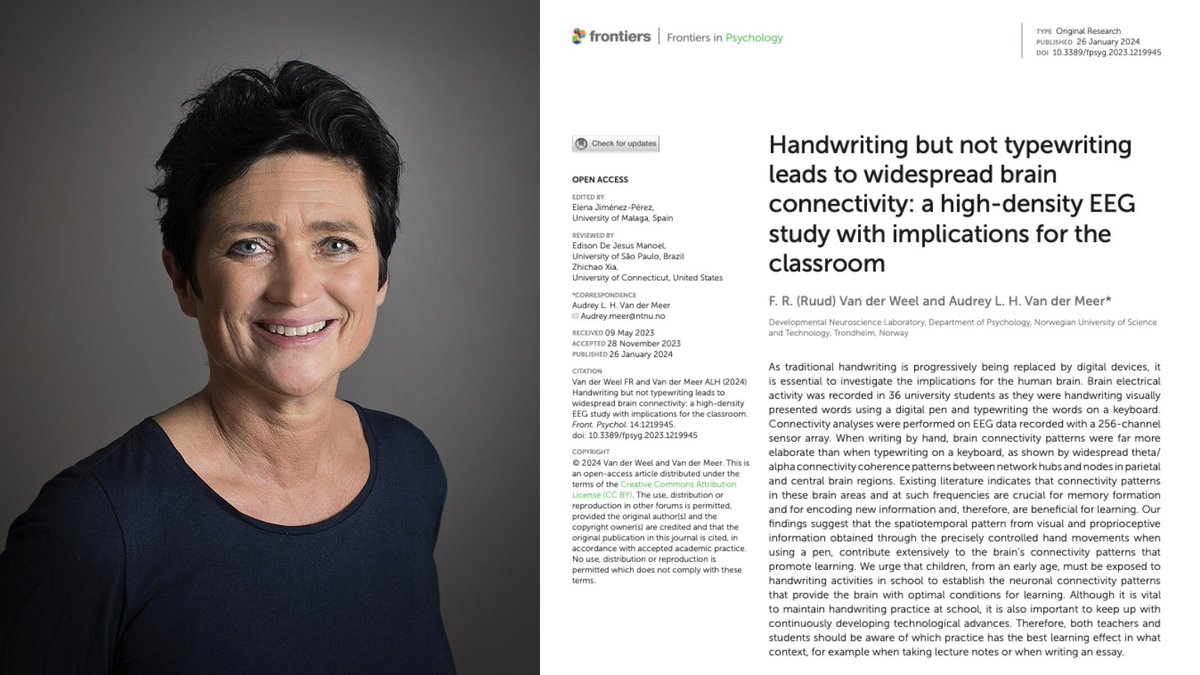
A Norwegian neuroscientist spent 20 years proving that the act of writing by hand changes the human brain in ways typing physically cannot, and almost nobody outside her field has read the paper.
Her name is Audrey van der Meer.
She runs a brain research lab in Trondheim, and the paper that closed the argument was published in 2024 in a journal called Frontiers in Psychology. The finding is brutal enough that it should have changed every classroom on Earth.
The experiment was simple. She recruited 36 university students and put each one in a cap with 256 sensors pressed against their scalp to record brain activity. Words flashed on a screen one at a time.
Sometimes the students wrote the word by hand on a touchscreen using a digital pen, and sometimes they typed the same word on a keyboard. Every neural response was recorded for the full five seconds the word stayed on screen.
Then her team looked at the part of the data most researchers had ignored for years, which is how different parts of the brain were communicating with each other during the task.
When the students wrote by hand, the brain lit up everywhere at once.
The regions responsible for memory, sensory integration, and the encoding of new information were all firing together in a coordinated pattern that spread across the entire cortex. The whole network was awake and connected.
When the same students typed the same word, that pattern collapsed almost completely.
Most of the brain went quiet, and the connections between regions that had been alive seconds earlier were nowhere to be found on the EEG.
Same word, same brain, same person, and two completely different neurological events.
The reason turned out to be something nobody had really paid attention to before her work. Writing by hand is not one motion but a sequence of thousands of tiny micro-movements coordinated with your eyes in real time, where each letter is a different shape that requires the brain to solve a slightly different spatial problem.
Your fingers, wrist, vision, and the parts of your brain that track position in space are all working together to produce one letter, then the next, then the next.
Typing throws all of that away. Every key on a keyboard requires the exact same finger motion regardless of which letter you are pressing, which means the brain has almost nothing to integrate and almost no problem to solve.
Van der Meer said it plainly in her interviews.
Pressing the same key with the same finger over and over does not stimulate the brain in any meaningful way, and she pointed out something that should scare every parent who handed their kid an iPad.
Children who learn to read and write on tablets often cannot tell letters like b and d apart, because they have never physically felt with their bodies what it takes to actually produce those letters on a page.
A decade before her, two researchers at Princeton ran the same fight using a completely different method and ended up at the same answer. Pam Mueller and Daniel Oppenheimer tested 327 students across three experiments, where half took notes on laptops with the internet disabled and half took notes by hand, before testing everyone on what they actually understood from the lectures they had watched.
The handwriting group won by a wide margin on every question that required real understanding rather than surface recall.
The reason was hiding in the transcripts of what the two groups had actually written down.
The laptop students typed almost word for word, capturing more total content but processing almost none of it as they went, while the handwriting students physically could not write fast enough to transcribe a lecture in real time, which forced them to listen carefully, decide what actually mattered, and put it in their own words on the page.
That single act of choosing what to keep was the learning itself, and the keyboard had quietly skipped the choosing and skipped the learning along with it.
Two studies. Two countries. Same answer.
Handwriting makes the brain work. Typing lets it coast.
Every note you have ever typed instead of written went into your brain through a thinner pipe. Every meeting, every book highlight, every idea you captured on your phone instead of on paper was processed at half depth.
You did not forget those things because your memory is bad. You forgot them because typing never woke the part of the brain that would have made them stick.
The fix is the thing your grandmother already knew.
Pick up a pen. Write the thing down. The slower road is the faster one.
This is a very common misconception in statistics:
If 1% of a population has a disease and the tests have a 5% chance of giving a false positive, what's the probability of having the disease given that we tested positive?
The answer is NOT 95%. It's actually way less.
On day 1 of my high school history class, our professor got up and said
You are 15 or 16 years old. 200 years ago people your age were married, planted crops, had children, and built a cabin by winter. You can do your homework. The bar set for you historically is embarrassingly low. You are not dealing with regional famine or plague. You do not have to save your family from marauders or go into battle to destroy your enemies. You have to sit down and learn from someone who cares about you in a safe, air-conditioned room. You have no excuses.
@NinaPanickssery When three generations live together it’s easier to help take care of each other. Now that adult children live on their own, sometimes in a different city, makes it a lot harder for grandparents to help.
Kevin O’Leary thinks the highest paying job right now is customer acquisition on social media
“I used to pay those guys $48,000, now I’m paying them $250,000 because you can measure their work based on customer acquisition every week”
“Most of them become contractors, they make half a million dollars a year because they know how to take content, turn it into a 59 second ad on social and acquire 200 customers”
“Those people in their early 20’s are so valuable now. If you know how to use your phone, somebody wants to hire you”
Great “trick” to get kids to learn
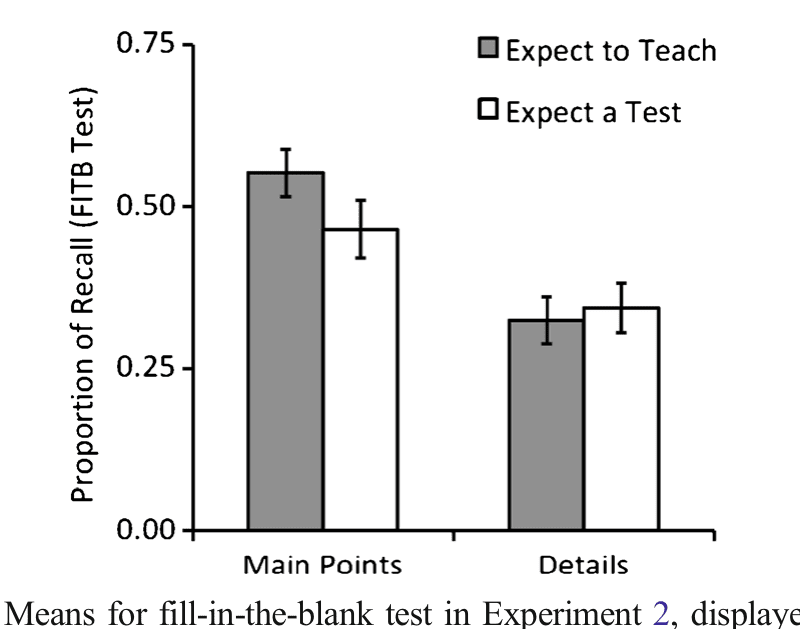
Two groups read the same passage.
* Group A was told they'd be tested.
* Group B was told they'd have to teach it to another student.
Nobody actually taught anything.
They were just told they’d have to teach.
Group B crushed it.
Better recall.
Better organization.
Advantage concentrated on main points.
So just believing they'd have to teach changed how they studied.
The researchers' line that stuck with me: students have effective study strategies they simply don't use unless prodded to.
So our kids already know how to learn well.
They just don't do it when they're told to study for a test. The test framing makes them passive.
While teaching makes them active.
At @ForgePrep, the highest level of mastery students can demonstrate is teaching another students to competence. It’s part of why we have Montessori mixed age classes as this creates more opportunities for this type of teaching
The concept of "teenager" is a modern invention.
For most of human history, a boy of 13 was already a man, apprenticed in a trade or fighting in a war.
George Washington was a professional surveyor at 16.
Alexander Hamilton managed a trading company at 14.
In medieval Europe, noble boys could be pages at 7 and squires by 14.
In Rome, a boy put on the "toga of manhood" at 14.
The idea that an 18 year-old is "still figuring things out" would have been incomprehensible to our ancestors.
I believe this is why we think teenagers are so troubled. They are men and women stuck in a society that treats them as children. Of course they are going to "rebel".
We should give them more responsibility and expect much more of them.
To: Admitted Students on Ivy Decision Day
From: UATX
Congratulations. Getting in was hard and you should be proud. Now here’s some unsolicited advice so you don’t waste the next four years.
Go to class. We know this sounds obvious. But as the New York Times reported recently, Harvard students routinely skip class, rarely speak up when they're there, and focus on their devices instead of the discussion. Faculty say few students do enough preparation to contribute meaningfully. The average college student spends about 20 hours a week on class and studying combined. At UATX, we aim for 50. That’s the difference between a part-time commitment and a full-time job. You (or your parents) are about to spend upwards of $90K a year. If you don't show up, you're paying roughly $250 per skipped lecture for the privilege of sleeping in.
Read the books yourself. Your generation is the first to arrive at college post-literate — raised on short-form video, dependent on algorithms, and increasingly incapable of sitting with a difficult text long enough to let it change your mind. Ninety percent of college students use AI academically. This makes you more reliant on the authority of others. Most professors will also stand between you and the text. They’ll tell you what Marx “really meant,” what Aristotle “failed to see,” as though an academic in 2026 has outsmarted minds that shaped civilizations. The good professors do the opposite: they put you in front of the book and they work with you to find what a great mind has to teach us directly. Find those professors, and read everything yourself.
Say what you actually think. Seventy-three percent of conservative students report withholding their political views in class out of fear their grades will suffer. Our advice isn't political; it's intellectual. If you spend four years learning to say what's expected instead of what's true, you’ll graduate roughly where you started — just older, more credentialed, and more practiced at self-censorship. One study finds that nearly half of students show no measurable gains in “critical thinking” after two years in college. Keep this in mind as you make decisions about which professors to take and how to do your assignments. Taking a small hit on your paper to gain integrity and wisdom is usually worth it.
Ask for real grades. Sixty percent of Harvard undergraduate grades are now A’s. Twenty-five years ago, it was 20%. It got so bad that the legendary Harvard professor, Harvey Mansfield, started giving students two grades: the official one for their transcript, and a private one reflecting what they actually earned. He called the official grades “ironic.” So here's a suggestion: Take your A, but also ask your professors for a “Mansfield grade” so that you know where you stand. And don’t avoid difficult courses to keep your transcript clean for law school.
Get work experience before you graduate. Forty-two percent of recent college graduates are working jobs that don't require a degree. Many employers are projecting the next few years to be the worst college grad job market in years. A degree alone — even from an Ivy — is not a job guarantee. Seek out apprenticeships, internships, and real work starting freshman year. The students at UATX are connected with entrepreneurs and business leaders from day one. Many will graduate with four years of work experience alongside their degree. You can build something similar at your school, but you'll have to do it yourself.
Understand how debt shapes your life. If you're paying full freight or even half, do the math with your eyes open. Your decision to take on debt will quietly reshape the trajectory of your adult life through countless small surrenders: the job you take because it’s safe instead of starting the company. The city you choose to live in. The relationship you delay and the kids you don’t have. For women, a $1,000 increase in student loan debt lowers the odds of marriage by 2% per month in the first four years after graduation. None of that shows up in the college brochure. If you're going to take on debt, treat it like the constraint it is from day one: save aggressively and make sure every dollar is buying something that will actually compound in your favor.
Find the people who take school seriously. The best thing about a great school isn't the lectures or the library. It's the handful of professors and students who are genuinely there to learn — who read ahead, argue in good faith, and push you to be sharper. Find them. UATX is a small community of those who seek a serious education. At a larger university, you have to build this community yourself.
*
The most dangerous thing about an elite university is that it is very easy to do nothing for four years and still come out looking successful. The transcript will say you excelled. The diploma with the fancy crest will open certain doors. Your parents will be proud. And yet you will have coasted — through inflated grades, unread books, and borrowed opinions.
Getting in is an accomplishment. Making the next four years worth it will be harder, and the right decisions will change everything.
We wish you luck.