From someone who has been around the science and speculation long enough to have a historical perspective on where this work falls on "the path" - a solid, fast, and connected technical digest of the first mechanosynthesis paper.
We must act now.
AI capabilities are advancing far faster than our understanding of the economic implications.
We must act now to guide AI to complement humans rather than simply imitate them — and to generate prosperity for the many, not just the few.
I'm delighted that 16 Nobel Laureates, over 200 top economists, and top AI researchers agree and signed our statement on transformative AI.
1/n
@robinhanson It seems more about uncontrollable capabilities and less about the intentions of rivals. Similar risks would arise if the goal of all the R&D spending was to uplift actual human children to superintelligence.
Thread on "The Future Worth Building is Human" by Thinking Machines Lab, aka Thinking Machines, aka Thinky 🤖🧠
Overall I found it thoughtful + I'm glad to see competition in the AI company vision market.
Some things that I want to call special attention to / am unsure on...
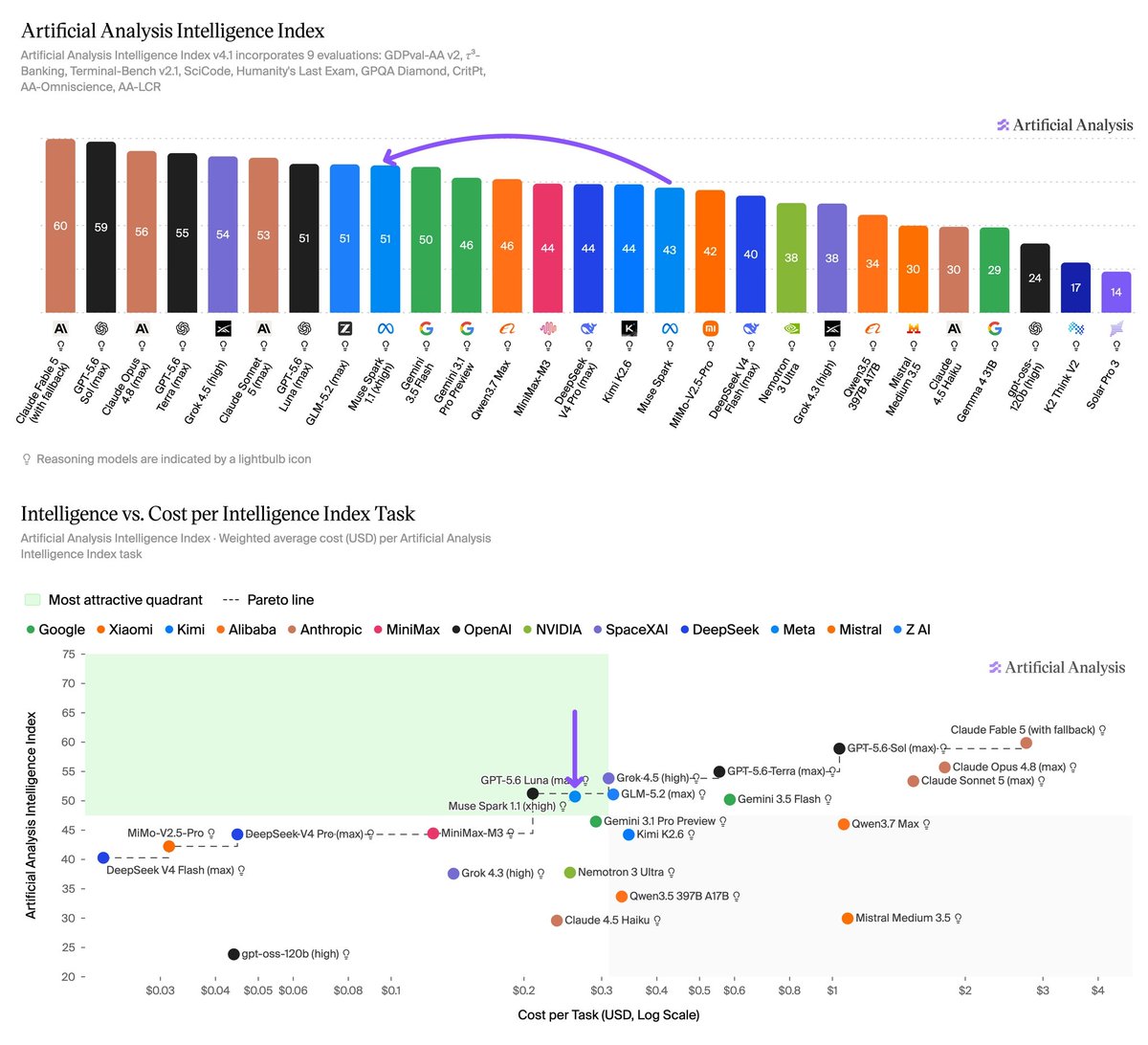
Meta's Muse Spark 1.1 scores 51 on the Artificial Analysis Intelligence Index and is cost and token efficient compared to its peers
Muse Spark 1.1 (xhigh) improves 8 points over Muse Spark 1.0 (43) in three months. It is effectively tied with GLM-5.2 (max), GPT-5.4 (xhigh), and GPT-5.6 Luna (max) at 51, three points behind Grok 4.5 (high, 54), with the leading edge at Claude Fable 5 (60), GPT-5.6 Sol (max, 59), and Claude Opus 4.8 (max, 56).
The gains concentrate in Scientific Reasoning, coding, and knowledge; agentic knowledge work lags on GDPval-AA v2.
@AIatMeta shared access with us ahead of public release for benchmarking. Congratulations to @AIatMeta, @finkd, and @alexandr_wang on the release!
Key Takeaways:
➤ Muse Spark 1.1 gains substantially on the first Muse Spark release. This was driven in particular by gains in agentic knowledge work (GDPval-AA v2) and coding (SciCode, TerminalBench). On Humanity's Last Exam, it reaches 45%, within a point of Claude Opus 4.8 (max, 46%) and ahead of GPT-5.5 (44%) and Grok 4.5 (high, 40%)
➤ The most token-efficient of the models effectively tied at 51 and among the cheaper models to run. Muse Spark 1.1 used 94M output tokens to run the Intelligence Index, fewer than GPT-5.4 (xhigh, 109M), GPT-5.6 Luna (max, 125M), and GLM-5.2 (max, 141M). We estimate ~$0.26 per Intelligence Index task at Meta's $1.25/$4.25 pricing - below GLM-5.2 ($0.37) and roughly 3x below GPT-5.4 ($0.89)
➤ The AA-Omniscience gain is driven by abstention rather than accuracy. The score more than quadrupled from 4 to 18 as the hallucination rate fell 35 points (73% to 38%), with the attempt rate down from 95% to 82% and accuracy roughly flat (45% to 41%)
Other model details:
➤ Context window: 1M tokens, up from 262k for Muse Spark 1.0
➤ Pricing: $1.25/$4.25 per 1M input/output tokens; cache hits discounted to $0.15 per 1M
➤ Output speed: ~114 tokens/s median on Meta's first-party API, with a ~21s time to first answer token
➤ Availability: Meta's first-party API at launch
More test-time compute leads to greater intelligence. But as we push ttc from seconds to weeks, latency becomes a bottleneck.
GPT-5.6 Sol Ultra scales parallel ttc. The time taken to generate a proof to a 50-year-old problem drops from perhaps a whole day to a single hour.
GPT-5.6 Sol comes close second to Claude Fable 5 in the Artificial Analysis Intelligence Index at one third of the cost, and leads the Artificial Analysis Coding Agent Index in OpenAI’s Codex harness
We supported @OpenAI with pre-release evaluation of GPT-5.6 Sol, Terra, and Luna. GPT-5.6 Sol (max) scores 1 point below Claude Fable 5 (max) in the Artificial Analysis Intelligence Index at 59 points, at approximately one third of the cost. GPT-5.6 Terra (max) and Luna (max) score 55 and 51 respectively in the Intelligence Index, at ~50% and ~80% lower Cost per Task than Sol.
GPT-5.6 Sol (max) leads the Artificial Analysis Coding Agent Index at 80 points.
Congratulations @OpenAI and @sama on the launch!
Key takeaways:
➤ One third of the cost of Claude Fable 5: On max reasoning effort, GPT-5.6 Sol costs $1.04 per task in the Artificial Analysis Intelligence Index - offering a similar level of intelligence to Claude Fable 5 at approximately one third of the cost. Reasoning levels across GPT-5.6 Sol and Luna offer a range of options at the Pareto frontier of Intelligence vs Cost per Task. For example, GPT-5.6 Luna (max) matches or exceeds the intelligence of GLM-5.2 (max) and Gemini 3.5 Flash at a lower cost. GPT-5.6 Terra (max) and Luna (max) cost $0.55 and $0.21 per Intelligence Index task, ~50% and ~80% less than Sol. Across reasoning efforts, each new GPT-5.6 model pushes past GPT-5.5 on the Pareto frontier (excluding non-reasoning). Notably, Luna and Sol are always on the Pareto frontier ahead of Terra. This means that for any Terra effort level, there is a Luna or Sol effort level that is more intelligent at no extra cost, or as intelligent at lower cost.
➤ Leading in all Coding Agent evaluations: The new Artificial Analysis Coding Agent Index pairs models with agentic harnesses and features three frontier coding evaluations - DeepSWE, Terminal-Bench v2, and SWE-Atlas-QnA. GPT-5.6 Sol (max) in Codex scores 80 in the Index, leading in all three evaluations (tying Grok 4.5 in Grok Build for SWE-Atlas-QnA). In addition to scoring higher, its per task cost is ~40% and ~10% cheaper than Claude Fable 5 (max) and Opus 4.8 (max) respectively in Claude Code. GPT-5.6 Terra (max) and Luna (max) score 77 and 75 in the Coding Agent Index respectively, with ~60% and ~80% per-task cost reductions compared to Sol.
➤ Highest Presentation Elo in AA-Briefcase: GPT-5.6 Sol (max) ranks second only to Claude Fable 5 (max) in AA-Briefcase, and has the highest Presentation Elo of any model. AA-Briefcase is a new benchmark for testing models on realistic knowledge work tasks in complex projects built by industry experts. GPT-5.6 Sol (max) has the highest recorded Presentation Elo - its outputs across various file types, including PowerPoint and Excel, are the most visually attractive of any model. Fable 5 (max) still leads AA-Briefcase, largely due to its Rubric Score of 56% vs 42% for GPT-5.6 Sol (max). Fable 5 (max) also scores 1764 in Analytical Quality Elo vs GPT-5.6 Sol (max) at 1592.
➤ First OpenAI models with cache-write pricing: GPT-5.6 introduces cache-write pricing for the first time at OpenAI. Sol, Terra, and Luna are priced at $5/$30, $2.5/$15, and $1/$6 respectively per million input/output tokens. OpenAI has retained its previous discount of 90% for cache reads, but joins Anthropic in introducing a cost premium for cache writes, at 1.25x the price of input tokens. Cache writes occur when input tokens are committed to memory. Charging for a cache write more accurately reflects the model’s cost to serve, as cached tokens occupy memory whether or not they are reused. Also in line with Anthropic's models, GPT-5.6 introduces a max reasoning effort level.
➤ Low token use: GPT-5.6 Sol (max) uses fewer output tokens than most models of comparable intelligence, and defines a new Pareto frontier of Intelligence vs Output Tokens per Task. GPT-5.6 Sol (max) offers a slight improvement in token efficiency with 15k tokens per Intelligence Index task, vs GPT-5.5 at 16k. Notably, it uses fewer tokens and is more intelligent than Claude Opus 4.8 (max), GLM-5.2 (max), and Gemini 3.5 Flash (high).
SpaceXAI’s Grok 4.5 scores 54 to place fourth on the Artificial Analysis Intelligence Index following only Fable 5, GPT-5.5, and Opus 4.8. It scores on par with GPT-5.5 in Codex on the Artificial Analysis Coding Agent Index in the Grok Build harness, at much lower cost
Grok 4.5 improves 16 points over Grok 4.3 on the Intelligence Index, bringing SpaceXAI to the intelligence frontier behind only OpenAI and Anthropic, and outperforming all open weights models and notably Google’s Gemini models. Key standout areas of performance are agentic knowledge work and coding.
Grok 4.5 in Grok Build scores 76 on the Artificial Analysis Coding Agent Index, on par with GPT-5.5 (xhigh) in Codex and just below Fable 5 (max) in Claude Code, and at a small fraction of the token usage and price.
Congratulations to @SpaceXAI, @cursor_ai, and @elonmusk on the impressive release!
Key Takeaways:
➤ Grok 4.5 performs very strongly on agentic tasks. Grok 4.5 ranks #4 on GDPval-AA v2 with an Elo of 1543, between Claude Opus 4.8 (1600) and GLM-5.2 (1513). It achieves the top score on 𝜏³-Banking of 33%, above 31% from GPT-5.5 (xhigh), and sits on the cost vs performance Pareto frontier across all three agentic evaluations in the Intelligence Index
➤ Grok 4.5 is one of the most cost efficient models to run for near-frontier intelligence. It costs $0.31 per task on the Artificial Analysis Intelligence Index and $2.59 per task on the Artificial Analysis Coding Agent Index within Grok Build
➤ Low cost for Grok 4.5 is driven by both low pricing and token efficiency. Grok 4.5 has a headline price over 60% lower than Claude Opus 4.8 and GPT-5.5, and used ~14k output tokens per Intelligence Index Task - over 60% lower than Opus 4.8. On the Coding Agent Index, Grok 4.5 stands out on the Pareto frontier of Coding Agent Index score vs. Total Tokens, using only 1.9M tokens for the Coding Agent Index while scoring 76
➤ As a coding agent, Grok 4.5 in Grok Build is on par with GPT-5.5 and offers efficiency benefits: In our Artificial Intelligence Coding Agent Index that consists of DeepSWE, Terminal-Bench v2, and SWE-Atlas QnA, Grok 4.5 in Grok Build ranks third, on par with GPT-5.5 (Codex) and below Fable 5 (Claude Code). It is also very efficient in achieving this result: Grok 4.5 in Grok Build cost $2.49 per task while Fable 5 in Claude Code cost $11.80 and GPT-5.5 in Codex $5.07. This is driven by relatively low token pricing and the model using far fewer tokens than comparable models (1.9M average tokens used per task), significantly less than Fable 5 in Claude Code (7.2M) and GPT-5.5 in Codex (6.2M)
Other model details:
➤ Context window of 500k tokens - a reduction from Grok 4.3’s 1M token context, but retaining configurable reasoning and vision input
➤ Pricing of $2/$6 per 1M tokens of input/output; cache hits are discounted by 75% to $0.5 per 1M tokens, and costs still double with long (>200k token) inputs
➤ As Elon Musk has disclosed, Grok 4.5 is 3x larger than its predecessor at 1.5T parameters
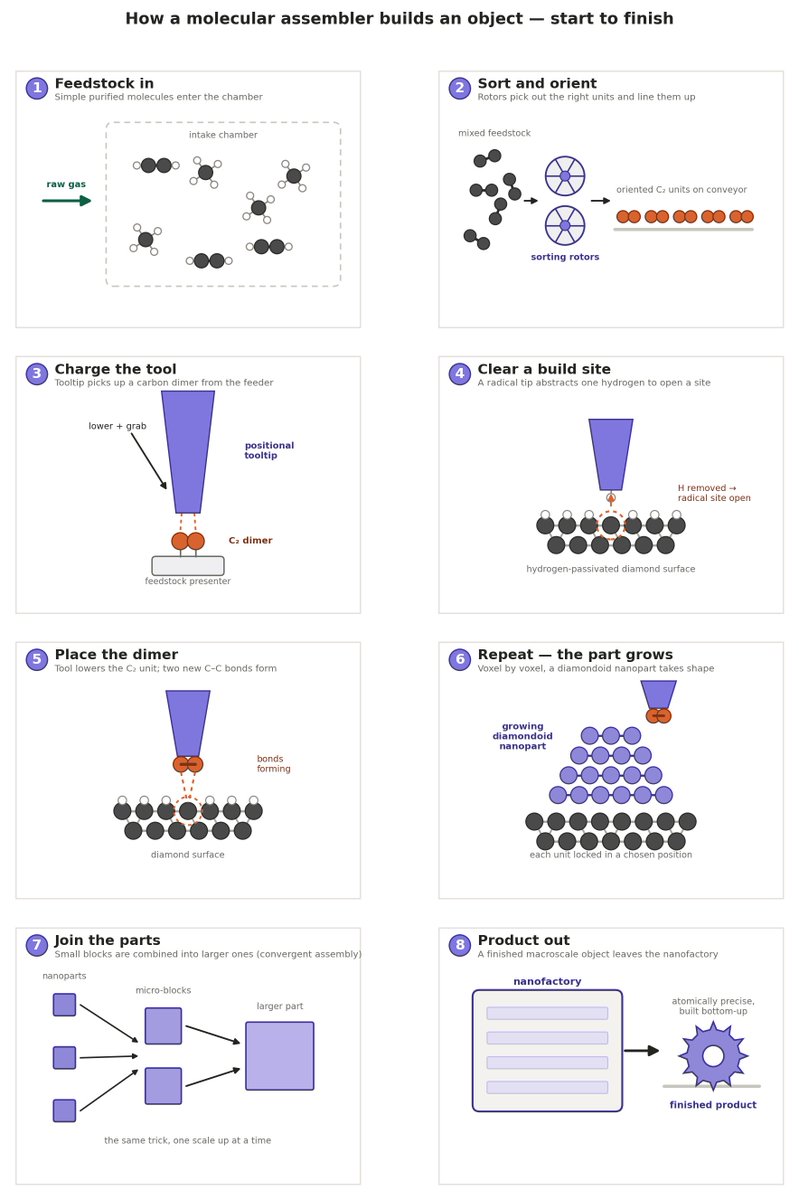
I just asked Fable 5 to help design a functional molecular assembler (replicator) from the ground up.
A complete engineering blueprint: architecture, subsystems, components, manufacturing methods, assembly process, control software, and detailed diagrams.
A stated goal of the AI Cos is ~"AI can do all cognitive and physical work, at human level or better". Looking at "what happens if they succeed" should be legitimate.
https://t.co/9KpXO9x63A
Sorry but this is sophisticated but ultimately hollow cope, and it's worse if coming with fresh OAI and GDM affiliations.
So, no, @alexolegimas, Ricardo's essay is about a different point than @zetalyrae. 'No-One Escapes the Permanent Underclass' mostly argues that when you stop being useful for production or capital allocation or violence and lose these as a source of leverage - and all you have is capital ownership - you are likely to be expropriated. If you've you read both essays, what is your actual argument about the political economy of the situation?
And, no, @deanwball the conclusions of the essay are not in the stated premises, and the premises are not outrageous. There are many who believe that even if "AI can do all cognitive and physical work, at human level or better, and cheaper than humans." and also believe "most humans will be disempowered" but they can escape the shared fate of humans by accumulating capital, working at AGI labs, or similar. The essay makes an argument against that. (I don't think the attack against you was a good or necessary part of the essay)
I'm an optimist in the sense that I believe the political economy problems are solvable and it is possible to escape @zetalyrae's conclusion, but we have better chance if people seriously engage with the problem, and this is the opposite.
New paper alert! "Residual stress evaluation of 316L WAAM components using neutron diffraction &contour method" has been published in Additive Manufacturing Letters🎉Congrats 👨🎓M Domogala! #AdditiveManufacturing#WAAM#ResidualStress#Neutrons4Science https://t.co/iUPNaDz08A