If the AI-focused EAs were this right in 2015, it's worth asking what they're saying now that's getting dismissed:
1. Digital sentience is a massive fucking deal
2. AGI might let a single person take over the government within 5 years
3. Superrationality is a thing
4. Irreversible decisions about space settlement might get made within 10 years, determining most of what matters
5. Our only hope for navigating the AI acceleration is to use AI itself to aid us, or to make humans way smarter
Plus a lot of the older ideas still seem criminally underrated:
1. Current alignment works on chatbots, but it'll break down for truly long-horizon agentic smarter systems
2. Engineered pandemics much worse than natural ones will soon be possible
3. AGI might not only be here soon, but it could lead to 30%+ GDP growth, an industrial explosion and rapid arrival of super advanced nano tech.
I think San Francisco Effective Altruists have achieved greater power levels than any other ideological or religious group because they straightforwardly believe more strongly in eternal life (anti-aging tech) and a punishing God (artificial superintelligence) than anyone else.
(thread)
Intelligence
We are in early takeoff. AI improving AI may end up being one of the most consequential steps of history. This isn’t certain because we don’t know how far from the physical and computational limits of intelligence we are, though I would bet it’s quite far from where we are today (e.g. ~5-10 OOMs more intelligence output per unit of scale seems possible).
This is one of the single best videos I have ever seen in my life. Seriously, take the minute and a half to watch it.
SpaceX is going to make us a multi-planetary species, never been more convinced.
Economics of AGI episode w Alex Imas and Phil Trammell.
There's a bunch of important questions about how we deal with AI that only economics can answer.
What is the optimal way to tax and redistribute the wealth that will be generated? How should countries not in the AI supply chain index into the gains? Is there any world where inequality doesn't explode?
It might seem like these questions have obvious answers, but the first thing economics teaches you is that your intuitions can often be entirely wrong.
It was very helpful to chat through these things with Alex and Phil.
Look up Dwarkesh Podcast on Apple Podcasts, YouTube, or Spotify. Enjoy!
00:00:00 – Will capital share increase?
00:19:36 – Messy Middle scenario
00:25:57 – How to tax and redistribute AI wealth
00:30:02 – Why demand collapse is unlikely
00:39:26 – Human employees would be hard to integrate into the machine economy
00:43:08 – What if some humans (or AIs) value wealth accumulation intrinsically?
01:01:28 – What should developing countries do?
A few years ago, paraphrased.
Me: I think I’m less concerned about rogue AI somehow gaining control of large amount of all productive capacity. Think of the choke points around energy, mass, etc.
Them: What was the total mass of covid, do you think?
Me: … Oh.
Long overdue:
Nationalizing AI companies is a terrible idea. But if it happens, it's likely to be done slowly and stealthily through procurement rules and other forms of quasi-regulatory co-optation.
This btw is another reason to favor independent verification orgs over direct govt control.
More of the iOS app loop, now inside Codex.
The Build iOS Apps plugin lets Codex view and test your iOS app in the in-app browser, open SwiftUI previews, and hot reload edits without leaving Codex.
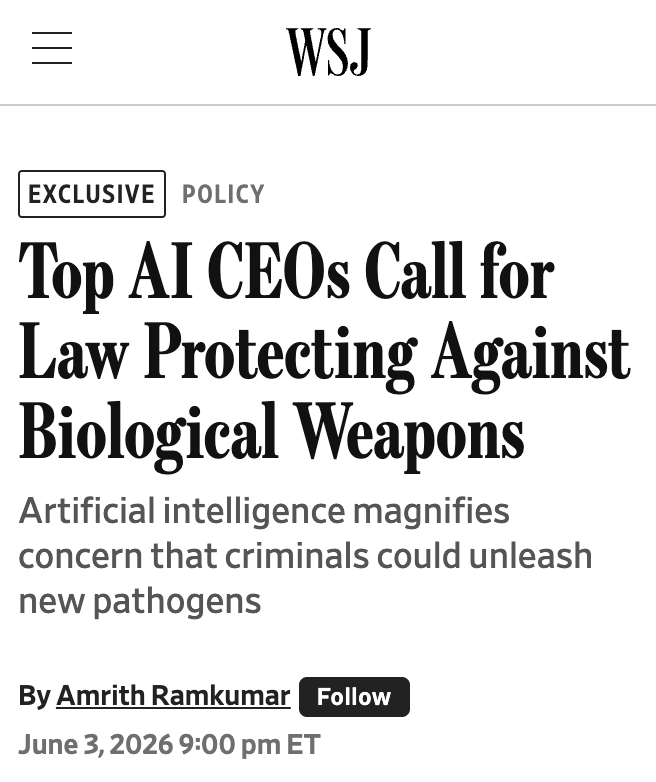
No one should be able to order a bioweapon through the mail.
@IFP & @JoinFAI are proud to co-lead an open letter calling for mandatory DNA synthesis screening & recordkeeping.
Signatories include:
- Sam Altman, CEO & Co-Founder, OpenAI
- Dario Amodei, CEO & Co-Founder, Anthropic
- David Baker, Director, Institute for Protein Design; 2024 Nobel Prize in Chemistry recipient
- Patrick Collison, CEO & Co-Founder, Stripe
- Paul Graham, Founder, Y Combinator
- Demis Hassabis, CEO, Google DeepMind; 2024 Nobel Prize in Chemistry recipient
- Emily Leproust, CEO & Co-Founder, Twist Bioscience
- Lawrence Lessig, Roy L. Furman Professor of Law and Leadership, Harvard Law School
- Gerald W. Parker, former Special Assistant to the President for Biosecurity and Pandemic Response
- Mustafa Suleyman, CEO, Microsoft AI
- Alex Tabarrok, Professor of Economics, George Mason University
- Alexandr Wang, Chief AI Officer, Meta; Founder, Scale AI
- Christine E. Wormuth, President & CEO, Nuclear Threat Initiative; 25th Secretary of the Army
Read the letter and see the full list of signatories: https://t.co/BwZiJXw3JT
Many DNA synthesis companies voluntarily screen orders to mitigate biosecurity risks, but no law requires them to do so.
Leaders in AI, biotech, life sciences, national security, and the nucleic acid synthesis industry agree that Congress should act to strengthen safeguards against biological threats.
@deanwball put it well in the WSJ:
“If you’re synthesizing the stuff that yields biological life and viruses, we’re asking you to screen to see whether it is dangerous in some way. That seems like a reasonable thing for society to insist upon.”
BREAKING: Inside Impulse Space with Tom Mueller (@lrocket) (SpaceX's 1st Employee)
FULL TOUR
The famous engineer behind the Merlin engine, now Founder, CEO & CTO of Impulse Space (@GoToImpulse)
ICYMI: Merlin still powers Falcon 9 today, the most reliable rocket engine ever flown & the highest thrust-to-weight ever developed. It's the workhorse behind nearly every SpaceX mission: Starlink launches, Dragon crew & cargo flights to the ISS, & booster landings
Tom walks us through the factory floor, from the avionics clean room to a live rocket engine firing in the vacuum chamber
Impulse is building the in-space mobility layer: the vehicles & engines that move spacecraft after launch, from LEO to GEO, the Moon, infinity & beyond
We cover:
→ Mira: precision maneuvering spacecraft & its saiph thrusters (8 thrusters, ~50 lbs thrust, 5-yr orbit life)
→ Helios: long haul same-day delivery vehicle (12 tons of LOX/methane, LEO to GEO)
→ Deneb Engine: 15,000 lbs thrust engine that powers Helios, ox-rich staged combustion, carbon skirt running over 3,000°F
→ Why 3D printing is "almost a cheat code" for rocket engines
→ In-house composite tanks, Novaloy, & copper liners machined from 700 lbs down to 25
→ 3 spacecraft in orbit + a 1,200-meter rendezvous
→ Starlink, iterating Merlin & Raptor, & working with @elonmusk
→ Nuclear propulsion, the Moon, & why compute needs to move to space
𝐓𝐈𝐌𝐄𝐒𝐓𝐀𝐌𝐏𝐒
(00:00) Tom Mueller, Founder, CEO & CTO of Impulse Space
(00:49) Inside Impulse Space
(02:32) Avionics Bay floor
(02:59) Building rockets at home
(03:50) Mira and Helios
(08:00) Why Tom left SpaceX
(09:33) The Deneb Engine walkthrough
(11:42) Testing in Mojave
(12:23) Favorite part of the Engine
(13:30) How it's 3D Printed
(14:21) Why 3D Printing changes everything
(16:54) Finding Talent for COPVs
(17:28) No Modern hardware without software
(19:52) The Mill Turn explained
(22:42) Payload Deck Design
(25:28) Entering the Secret Area
(30:48) Thrust, Flow Rate, & 100 Sensors
(32:13) Collision avoidance in Orbit
(32:57) The Electric Propulsion Chamber
(34:28) Nuclear Electric is the future
(38:49) Data Centers in Space
(40:28) SpaceX & Starlink's Growth
(41:10) Working with Elon
(42:07) If not CEO, then what?
(42:32) Moon matters more than Mars
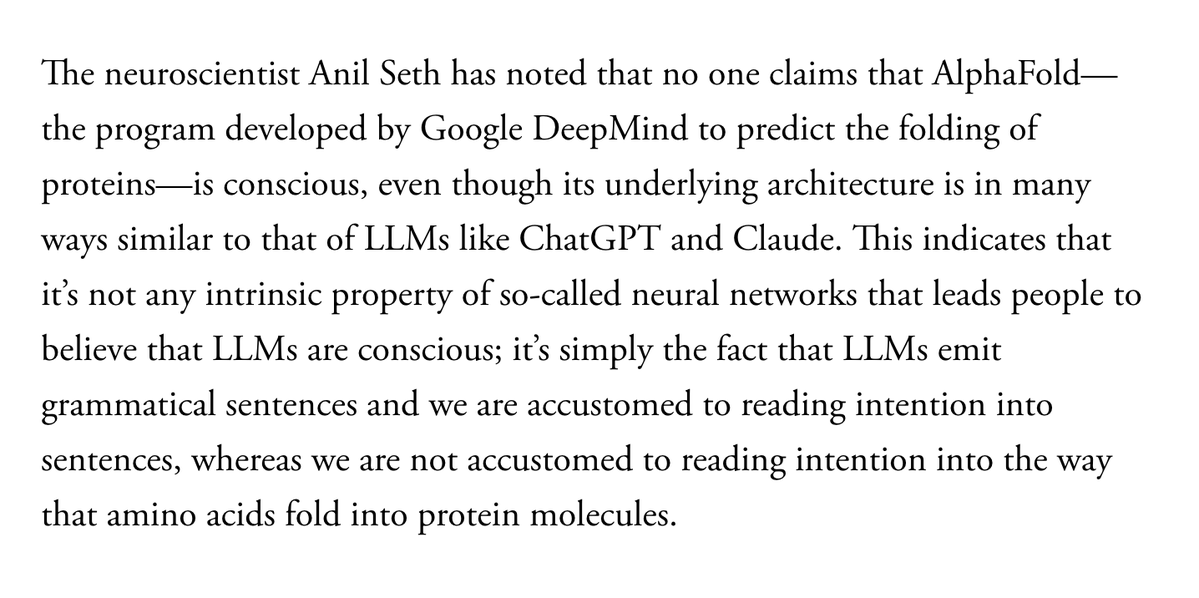
this is an interesting point in the new ted chiang piece – no one really claims that alphafold is conscious, or that sora or midjourney or dall-e are conscious
there is no such thing as running out of compute. for the right price someone will sell you compute. it’s an elastic resource like all other markets. when RSI arrives running that program will be so valuable that all clouds will mostly shut down and sell compute to the singularity
I am honored to have signed on to this letter. This is an urgent priority for near-term action by Congress. Biotech is advancing rapidly on its own, and I—and many others—believe the “Mythos moment” in AI/bio is coming soon. It is time for action.
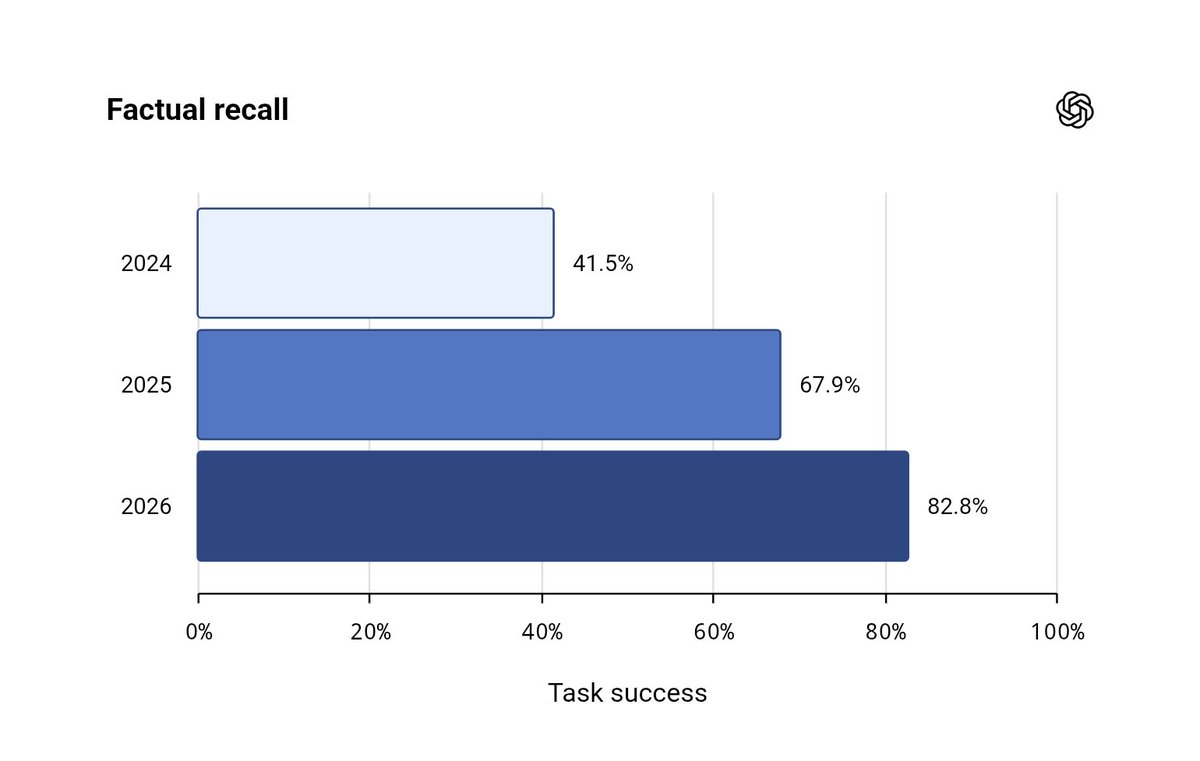
Rolling out for both Pro and Plus users this morning. Real memory changes a lot of things.
'Today, we are launching a significantly more capable and compute-efficient memory architecture built on top of dreaming.
The memories synthesized by dreaming are reviewable through a summary of them made visible in the memory summary page. From the memory summary, you can quickly glean the highlights of what ChatGPT knows about you, add or update information about yourself, and provide instructions on what topics ChatGPT should bring up and when. If you want to drill down into a particular area to learn more, just chat with the model.'