In 1987 the Lisp Machines faded. LispM brings one back, built for AI agents.
A classic-style desktop where Claude Code, Codex, Hermes and LispM's own Lisp agent work side by side. Every tool is Lisp, so agents can drive the whole machine.
This is LispM. It's all Emacs.
@Wbackdown SHRDLU. It's ~15k lines of 1990s Common Lisp, ported from Winograd's 1970 Lisp and Micro-Planner.
Some planner functions were broken; each fix was checked against the 1972 source.
And SHRDLU plans a whole command before moving, so LispM replays the moves to draw the arm.
We've recreated three classic AI applications from the 1970s on LispM, and they're now available in the LispM App Store.
It's been a lot of fun! Come experience what AI was like on Lisp Machines half a century ago. https://t.co/rF9dD4UEcp
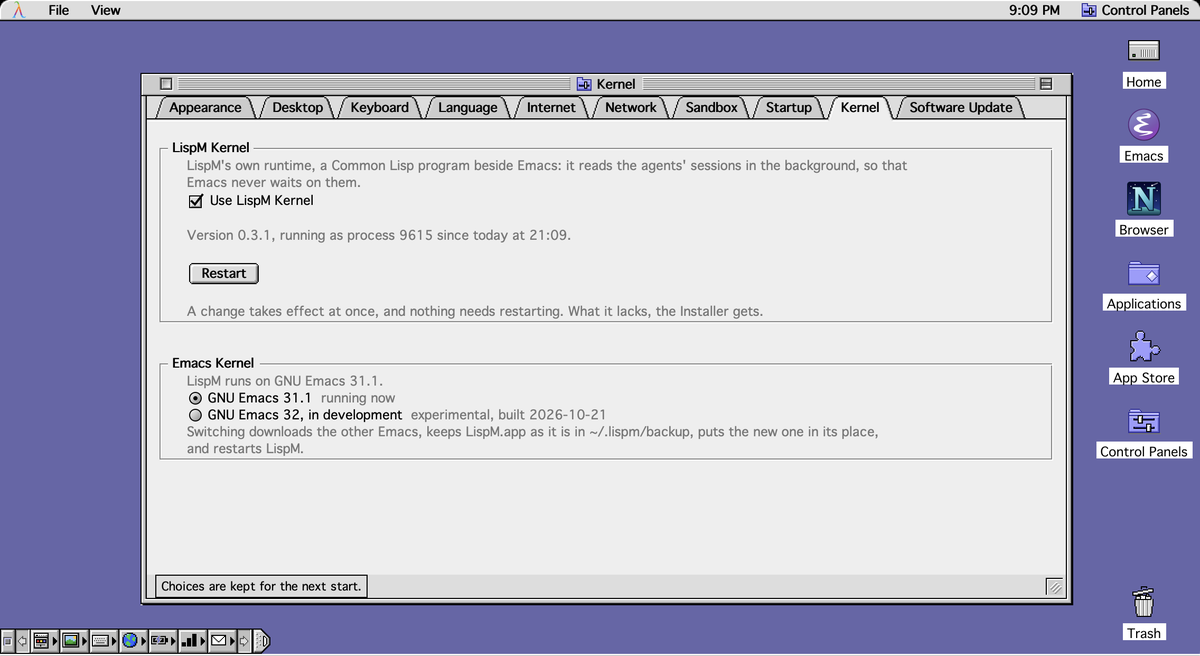
LispM now has a kernel of its own.
LispM is an open-source Lisp Machine for AI agents: a classic-style desktop and agent harness for Claude Code, Codex and Hermes, built on GNU Emacs. In 0.10.0 a Common Lisp kernel runs beside Emacs and takes the waiting off the editor.
Refreshing packages through a proxy used to freeze Emacs for six seconds. Through the kernel: no pause over 0.1 s.
One Kernel panel switches both LispM Kernel and the Emacs underneath: 31.1, or 32 experimental.
LispM: a Lisp Machine, rebuilt for agents.
#Lisp #CommonLisp #emacs
30 days until Devcon 8 (!!!) 🇮🇳
The people building Ethereum's future. The conversations shaping what's next. The ideas that turn into real-world impact.
All in one place, for 4 days in Mumbai.
Join us, November 3–6.
https://t.co/gYg20gHpeG
ETHGlobal Tokyo Partner Spotlight: @UniswapFND
The Uniswap stack gives developers tools to build onchain finance, from AMMs and v4 hooks to APIs and shared liquidity.
Plenty to experiment with. Looking forward to seeing what teams ship.