We have extended the #ELS2022 submission deadline by one week. Please submit your papers by Jan. 30th! #lisp
/cc @programmingconf
https://t.co/GUSZyILKw7
After a much too long hiatus, I am once again preparing to send out the weekly #Lisp#Newsletter. Please subscribe if you are interested: https://t.co/dySnJlFE7j
For those among my followers who like tech memoir stuff, I put up a relatively brief blog post today, reminiscing about #Symbolics, a #LispMachine company I used to work for.
"Automated Departure Message" https://t.co/XGCil5GEok
#tech#history#humor
An interesting into to Lisp:
https://t.co/eiWDKiAeCI
I've posted the link to the Hacker News: https://t.co/I5ScwHEDzU please vote to show it in the TOP.
Retweet and show this video to your non-lisper friends!
Always wanted to be(come) a Common Lisp Developer and live in Marbella Spain: "+1 year of professional experience working as a developer in any language or equivalent university project experience or quality personal projects.". Ravenpack https://t.co/j2TJ1qxuG7
Today's Common Lisp Project of the Day is "cl-ltsv".
This system implements an LTSV logs parser and serializer. LTSV is based on TSV format but each field has a name.
This lets us easily add new fields and to process logs in a manageable way:
Nicolas Hafner (@Shinmera) finally opened a semi-decent tier! He is the author of Portacle, Kandria, several Common Lisp articles and, incredibly enough, 80+ libraries in Quicklisp! He's definitely at least a top 3 CL contributor. Let's give him some love!
https://t.co/QiO74pSK3r
Today's Common Lisp Project of the Day is "smug".
This system provides a framework for building parsers in a functional way.
Smug parsers are lisp functions which can be combined together to process complex grammar.
Today's Common Lisp Project of the Day is "lazy".
This is a small library by @codeninja_blog. It provides only a macro to wrap and remember any form and a function to force its evaluation.
For example, let's create a few functions which accept and return lazy objects:
Today's Common Lisp Project of the Day is "dynamic-classes".
This is a very interesting but undocumented library which allows to dynamically create CLOS classes as a mixin composition.
Mixins are chosen depending on parameters given to the constructor.
Name your favorite programming construct that is as dangerous as powerful.
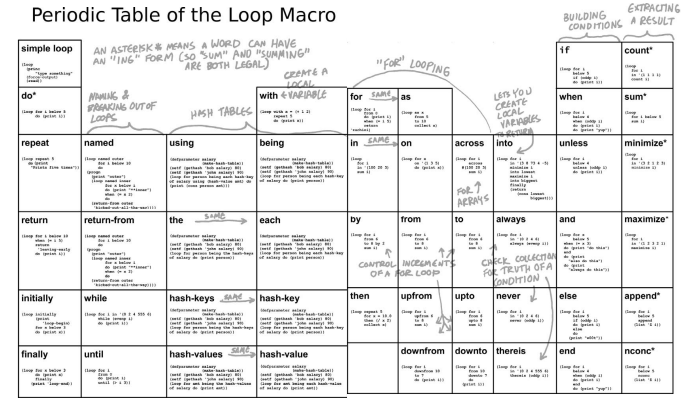
My favorite is the #lisp loop macro, a construct so powerful that it has it's own "periodic table"