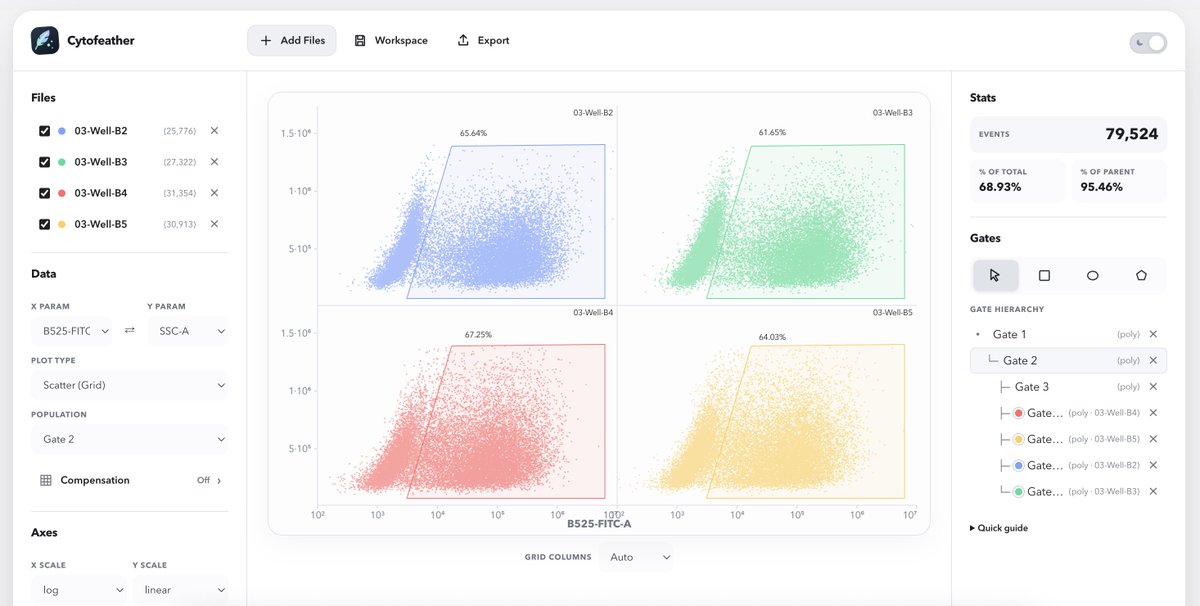
I love that we can now just use Codex/Claude Code to create more enjoyable (and free) versions of software for biology
Meet Cytofeather 🪶 A lightweight flow cytometry app for your browser
https://t.co/dGyuDlFYo6
Benchmark alert! 📏
Today, @liv_soro and I launch the first comprehensive benchmark for yeast-focussed sequence-to-function models.
https://t.co/FFXP1ghtjV
Beauty should be a core pursuit of biotechnology. There should be companies and nonprofits that engineer organisms solely for the sake of crafting beautiful things.
A few reasons why:
1/ Biotechnology has historically worked in reductionist ways, but many useful functions only emerge at the systems level. By engineering a systems-level outcome, like beauty, we will get much better at engineering organisms in predictable ways.
When I say "reductionist," I mean that most useful things in biotechnology (drugs and tools) were discovered by stripping molecules from their natural contexts. Scientists collect organisms from soil or wherever and then study their molecules in isolation. This basic approach has yielded everything from rapamycin to antibiotics and CRISPR.
This reductionism, though, means that that we know disturbingly little about how life actually works at a systems-level. My core argument is that, by studying beauty, we can remedy this.
Beauty has persisted through tens of millions of years of evolution because it is functional; bright colors help attract pollinators to a plant, for example, which helps the plant breed. If evolution has created all of this beauty for functional reasons, then it stands to reason that by trying to create **new** forms of beauty, we'll be able to discover and understand how these systems-level functions work! Indeed, we may even be able to create entirely new functions that biology hasn't evolved yet. These functions will not possible to understand via isolated molecules or reductionism.
Therefore, a company pursuing engineered beauty for the sake of beauty will probably make many fundamental discoveries about how organisms develop, interact, adapt to their surroundings, and so on.
2/ Beauty is a way to grow the field and bring more people into biotechnology. Nick Desnoyer’s flower design work, for example, has probably reached hundreds of thousands of people. The glowing plants from Light Bio, too, were featured in the mainstream press. You may not think that these examples are “important” for the universe relative to, say, an incrementally better cancer therapeutic, but there’s no question that they are way more popular to mainstream audiences and good, overall, for the field.
3/ The market is huge! Breeding is already widely used to engineer beauty, or at least to select for aesthetic preferences. Pugs are evolutionarily suboptimal, but they've been bred precisely to satisfy a certain aesthetic desire are now a multi-billion dollar industry. The Juliet Rose, developed via breeding over a 15-year period, debuted at the 2006 Chelsea Flower Show and is enormously profitable today. Why should deliberately engineered forms of beauty be any different?
If you are building a biotech company or nonprofit that is pursuing beauty, please reach out! I’d love to help.
Meanwhile in Europe: the Impossible Burger is still 100% illegal. Thank you, anti-GMO people, for protecting us from sustainable, humane and delicious plant-based burgers. 🙃
The March issue is live https://t.co/mlXpfNOzQz
On our cover, Walker et al. engineer bacteria to synthesize a melanin-producing enzyme, allowing them to grow a black material that can substitute for leather in fashion items https://t.co/rlzp86SXcD
We trained a genomic language model on all observed evolution, which we are calling Evo 2.
The model achieves an unprecedented breadth in capabilities, enabling prediction and design tasks from molecular to genome scale and across all three domains of life.
Thrilled to see our ExIGS tool featured! A true testament to the power of collaboration. Huge congrats to the team for their hard work! 🧬@ajaylabade31@z_chiang@CarolineComenho https://t.co/x6e5P3MfeW
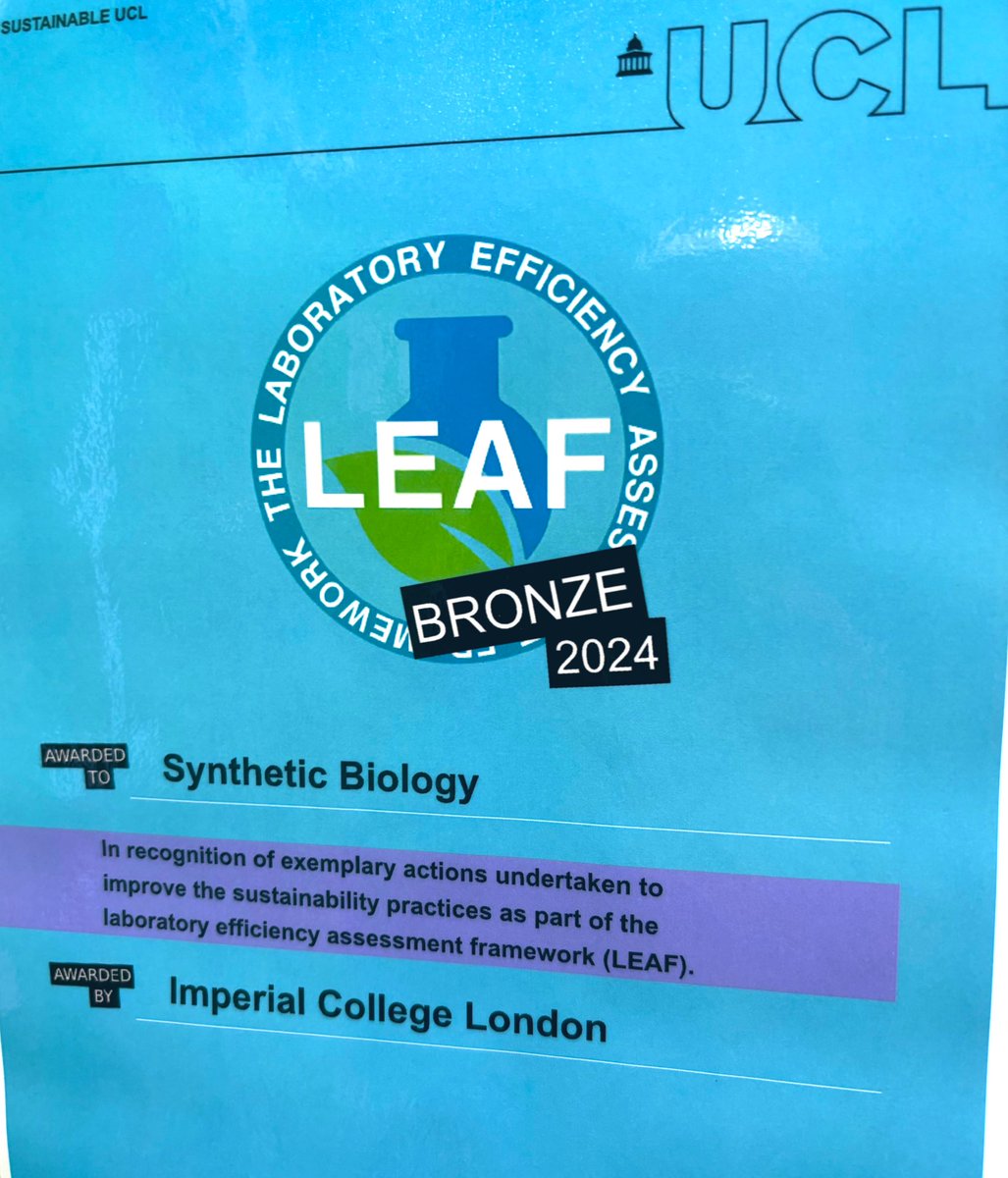
We’ve won an important award. 🎉 🍃 🥉 Thanks to all the @ImperialBioeng synbio lab members and especially Ellie Wareham for putting principles into practice to get us LEAF certification. Next stop Silver.
New preprint from our lab is now up on BioRxiv. This time it's a short but sweet one - a very useful method called POLAR-seq developed by @KlaudiaCiurkot in her 2 years in our group. We're keen to share this work early considering how useful it. https://t.co/0FmN1hstPo
Would you use a wallet grown from bacteria? 🧫
#OurImperial researchers @ProfTomEllis and Ivy Li have genetically engineered bacteria to grow plastic-free vegan leather that dyes itself
They went on @BBCTheOneShow this evening to explain the science behind the fashion
Watch ➡️ https://t.co/0w8e1YbJKs
#TheOneShow
Ok Twitter/X gang. It’s time for you to help me decide the best @ImperialBioeng synbio student yeast bioart of 2024.
Our top 4 contenders are below ⬇️ and at the end there’s a poll for voting. 🗳️
Next time someone proposes a mindfulness session, can we just set up Just Dance on a Switch in a lecture theatre? The science says it will be a lot more effective.
£2 billion investment planned over the next 10 years... here's the full details of the UK's Engineering Biology National Vision... https://t.co/QxKzlpITAi
“We have a very clear mission, to make Britain a science superpower”
A fantastic start to #Synbitech2023 from Andrew Griffith MP, Minister for Science, Research and Innovation who announced £2bn of investment in engineering biology.
https://t.co/u97L3B6T2a
At @sangerinstitute we are recruiting 3 new faculty (at any level) in
Generative Biology / AI/ML / Synthetic Genomics.
Really well-funded positions with access to Sanger's unique capacity for large-scale data generation and long-term projects. pls RT!
https://t.co/AcNUnf9fkO
Scientifically accurate DNA model 🧬, with Lego lab with mini figures of Watson & Crick, Franklin et al.
Who doesn't want it?
Pls vote via the link below to bring it to the market!
It was designed by one of our MSc students @Lego_DNA - kudos! 🙌 🥳
https://t.co/K8klfWlvxS