A couple of thoughts on the memory debate:
1) I think those expecting ASPs/GMs to soon fall sharply because memory makers are signaling that – amid the signing of LTAs with price caps/floors and large volume commitments – GMs won’t go any higher often don’t appreciate how much unmet data center memory demand there is right now.
With memory capacity directly or indirectly affecting LLM size, context length, TPS and the ability to handle long-horizon agentic tasks, the likes of $NVDA and $AMD would undoubtedly attach more HBM to their accelerators, and both they and hyperscalers would include more main memory and flash storage in their server designs, if supply wasn’t an issue and they could be assured that prices would be around current levels or lower going forward.
All of that’s worth keeping in mind when trying to gauge the longer-term impact of LTAs. Yes, LTAs have been broken before and it’s possible the ones memory makers are now signing are eventually broken as well. But given all that unmet demand, it’s also possible they lead to far more memory being attached to accelerators and servers in 2028/2029 (as supply opens up), and with the memory being sold at ASPs that yield healthy GMs by historical standards.
2) At current valuations, memory makers might be trading at single-digit multiples of what they’ll earn in a couple of years even if DRAM/NAND ASPs drop by 30% or so, especially after accounting for volume growth, cost/bit declines and buybacks. For memory stocks to look truly expensive here, ASPs would have to implode, and -- given all that unmet data center demand, as well as price elasticity for consumer memory products -- that seems unlikely to me unless AI capex meaningfully declines. And if that’s the scenario one is betting on, then memory stocks are far from the only AI infra plays one should be selling here.
This might be the most bullish signal for compute stocks I've seen all year (Save This)
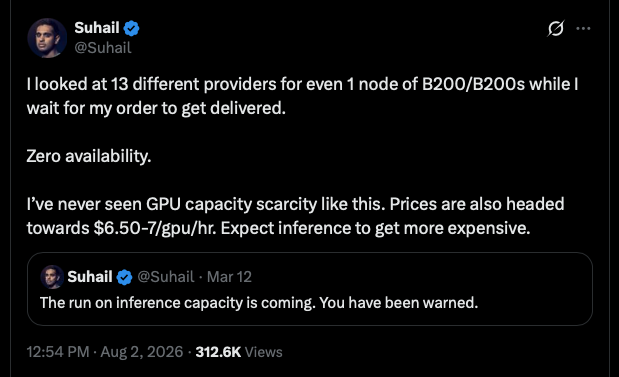
Suhail (founder of Mixpanel and Playground AI) just tried to rent ONE node of Nvidia B200s.
He went to 13 different providers: 0 availability
Let me explain why this matters:
1. Every GPU is already rented. When supply is sold out, prices rise. And when prices rise, every deployed GPU on earth becomes more profitable overnight
2. This is INFERENCE demand, not training. Training is a project that ends. Inference is a subscription that scales with every new user, agent and app. It never stops
3. Cheaper models were supposed to kill compute demand. Instead usage exploded so fast that the world ran out of capacity (this is the part Wall Street still doesn't get)
So who wins?
$NVDA sells every chip it can make, and the scarcity IS the product
Neoclouds ($CRWV, $NBIS) with capacity already in the ground get pricing power AND full utilization at the same time
Memory ($MU), because every one of these GPUs ships stuffed with HBM
And power/datacenter infra, because that's where the bottleneck moves next
Scarcity like this doesn't resolve in a quarter. It takes years of buildout, which is exactly why hyperscaler capex estimates keep getting revised HIGHER every single earnings season
Milk Road PRO analyst portfolios are positioned across the whole compute stack. You can track our 5 analysts' real-time portfolios, research and live trade alerts inside Milk Road PRO and it only costs $1 to try it (there's literally no risk), link in bio to join
We are going MUCH HIGHER!
대만의 문제점이라고 나오는데 한국도 크게 다르지 않은 것 같네요.
탈원전,저출산,고환율
인프라 감당 수준 넘는 TSMC 성장, 청구서는 사회로.
가장 급한 것은 전기다.
대만전력은 앞으로 5년간 반도체와 AI 데이터센터에서 지난 10년 평균의 2배가 넘는 신규 수요가 발생한다고 본다. 지난해 원전 연장 국민투표 찬성률은 74%였으나 동의표 문턱을 넘지 못해 부결됬다. 그런데 대만전력이 재가동을 신청해 이르면 2028년 원전이 돌아온다.
전기가 몇 년의 문제라면 인재는 한 세대의 문제다.
대만은 2028년까지 AI,녹색,디지털 융합 인재를 누��� 45만명 양성하겠다는 계획. 현재 해마다 배출되는 대졸자는 20만명을 넘지만 대만 신생아 수는 약 10만명으로 10년 전의 절반 수준. 10년 뒤 대졸자는 10만명 아래로.
밖으로는 미국 공장을 짓고 중국의 인재 유인에 시달리는데, 안으로는 태어날 인재가 줄어드는 중.
Recommended reads for the week
SemiAnalysis — China’s CXMT Is Set to Challenge DRAM Incumbents
Goldman Sachs — Americas Technology: Hardware — Expert Network Series: CPU Server Demand Driven by Refresh, Agentic AI
Morgan Stanley — Old Memory: Better to Buy More
J.P. Morgan — First Principles — AI Power Infrastructure: Following the Power
$MU CEO, in effect:
"For > decade $AAPL has been buying our chips for $5, gluing it inside a metal box, & selling it to consumers for $99 upgrades & laughing at our attempts to get $7.
Now we're charging them $50 & they turned around & raised prices on their customers $250."
Can a company 1/20 the size of $LITE and $COHR compete on equal footing for dominance of the massive OCS market?
In this article, I not only provide the most intuitive, comprehensive, and easy-to-read overview on OCS, but also introduce an undiscovered small-cap OCS company with a unique solution and evaluate its potential.
the world of advanced packaging is getting crazier and crazier and I am here for it, and we are still so early
(glass panel stuff no earlier than 2029)
(10 Tbps/mm clearly needs DWDM, or I guess a big array of VCSELs)
After too many hours of research/DD to count, these are my Top 5 AI Stocks in the Top 5 AI Sectors to Invest in:
1. Neoclouds: The GPU & Compute landlords. Whoever owns the compute owns what every AI company on the earth needs to grow & succeed.
$NBIS - Nebius. Spun out of Yandex, rebuilt as a pure-play AI cloud. Microsoft and Meta committed billions in contracted backlog. The fastest growing neocloud on the board. My favorite pick as a long-term investment.
$CRWV - CoreWeave. The American-founded neocloud. SemiAnalysis rated this Neocloud in a class of it's own, which can not be understated. Deals with Anthropic, OpenAI, Meta, Perplexity, Google, Microsoft... the list goes on forever.
$HUT - Hut 8. Started as a bitcoin miner, pivoted hard into AI hosting and power infrastructure. Owns the power, not just the GPUs. They're landing deals left and right, definitely an underappreciated sleeper pick.
$APLD - Applied Digital. Same playbook. Former crypto miner now building purpose-designed AI data center campuses with long-term hyperscaler leases.
$CIFR - data center host for Anthropic's directly, purchased Google TPU v7 Ironwoods (400K units, ~$10B), backed by a 10-year, $3B+ Fluidstack hosting deal where Google guarantees $1.4B of lease obligations for a 5.4% equity stake. One of the only neocloud-adjacent names with real exposure to Google's silicon instead of pure Nvidia GPU rental.
2. Optical / Photonics:
Because every GPU is useless if it can't talk to the GPU next to it.
$CRDO - Credo. The connectivity layer inside every AI cluster. Active electrical cables and DSPs that scale with every rack hyperscalers deploy.
$LITE - Lumentum. Legacy telecom optics company that's become a core 800G/1.6T transceiver supplier for the AI buildout.
$ALAB - Astera Labs. Connectivity chips that solve the bottleneck between GPUs, memory, and storage. Pure-play AI infrastructure with almost no legacy drag.
$COHR - Coherent. Lasers, optical components, and transceivers spanning the entire photonics stack from datacom to industrial.
$MRVL - Marvell. Custom silicon and photonic fabric for hyperscalers. The company quietly inside more AI racks than people realize.
3. Memory:
The most cyclical, most violently mispriced sector in semis. HBM demand changed the entire setup.
$DRAM - DRAM ETF. One ticker, every important memory company on the planet, including South Korean companies like SK Hynix and Samsung Electronic, companies you CAN'T INVEST IN with most brokerages.
$SNDK - SanDisk. Spun off from Western Digital, now a pure-play NAND flash story riding the same supply tightness as everyone else in this sector.
$MU - Micron. One of three companies on Earth that makes HBM. The clearest direct line from AI buildout to memory revenue.
$WDC - Western Digital. Hard drive and enterprise storage demand riding the same data center capex wave as everything else on this list.
$STX - Seagate. The other half of the storage duopoly. Enterprise nearline drives are seeing the same supply crunch dynamics as memory.
4. Analog / Power Semis:
Unsexy. Necessary. Every data center, every EV, every robot needs power management silicon that doesn't get the AI premium yet:
$MXL - MaxLinear. Smaller-cap analog and mixed-signal play with infrastructure and data center exposure that's still flying under the radar.
$STM - STMicroelectronics. European chip giant spanning auto, industrial, and power semis. Way out of favor relative to its diversification.
$ON - ON Semiconductor. Power semis for EVs and industrial, now leaning harder into data center power delivery as a growth vector.
$VSH - Vishay. Passive components: resistors, capacitors, diodes. Boring until you realize literally everything electronic needs them.
$POWI - Power Integrations. High-voltage power conversion chips. Small cap, niche, and positioned for the power efficiency problem AI data centers haven't solved yet.
5. Physical AI / Robotics:
It's coming, soon, and the market is beginning to realize it.
$OUST - Ouster. Lidar for robotics, industrial, and autonomy. Consolidated the space after merging with Velodyne, now the survivor.
$VICR - Vicor. High-density power modules for robotics, AI servers, and defense. Power delivery at the component level, not the rack level.
$VPG - Vishay Precision Group. Precision sensors and strain gauges. The torque and force-sensing hardware that gives robots a sense of touch.
$AEVA - Aeva. 4D lidar with built-in velocity sensing. Smaller and earlier stage than the rest of this list, highest risk, highest ceiling.
$AMBA - Ambarella. Edge AI vision chips. Powers the cameras and perception systems inside cars, robots, and security infrastructure.
I believe a portfolio with these 25 names will severely outperform the market over the next few years. I have 7 figures throughout many of these names. These are all names I'm currently invested in, or plan on investing in in the near future.
None of this is financial advice.
VPEC new price hikes on Epiwafers today.
Positive bottleneck read through on companies like $IQE and Landmark (3081) in terms of pricing power/demand for epiwafers.
This follows $MTSI investment into IQE to secure capacity, and shows how important some of these chokepoints are.
(disclosure: have positions in IQE)
Is 800 VDC delayed to 2028? Taiwan data center parts suppliers and systems assembly firms say there’s been no word from Nvidia about any sort of delay, after rumors surfaced that mass production had been pushed back by a year, media report. $NVDA https://t.co/eYFUBa5MIM
Five Key Points
> TEL developed batch molybdenum deposition equipment
> For 3D NAND word line replacing tungsten
> Supports over 400 layer stacking
> SK Hynix and Samsung already evaluating adoption
> Cryogenic etch technology breaks channel hole speed limit
Three Conclusions
> TEL gains higher market share in deposition and etch
> Expected to take large orders from Lam Research
> AI memory demand drives long term growth
TEL Potential Deep Discussion
I was told TEL batch molybdenum deposition tool has entered critical validation at SK Hynix M15 fab
Insiders revealed clients are highly satisfied with fill performance and resistance
This is currently the closest scheme to mass production in the industry
Industry sources indicate
TEL cryogenic etch has beaten Lam main solution in Samsung internal tests
Channel hole etch speed improved nearly three times
Expected to be prioritized in next year V10 generation
Tokyo Electron leverages these two technologies
To capture the most critical window in NAND high layer transition
Supply chain estimates suggest over one billion USD order shift
Company is accelerating molybdenum related capacity expansion
Under 2025 to 2026 memory capex recovery
Equipment shipment expected to rise sharply
R&D investment exceeds 300 billion yen targeting next gen 3D integration
Overall
Among top four semiconductor equipment makers
TEL benefits most directly from high layer NAND transition
Long term market share and profit growth potential is strongest
Worth tracking latest customer adoption progress
#TokyoElectron
According to GSR, hyperscalers are paying 15–30% in prepayments, and Microsoft has already paid Samsung Electronics as much as $10 billion in prepayments.
Why Are Silicon Capacitors Becoming Important? And Why Is SEMCO's Stock Surging?
The reason silicon capacitors have failed to grow into a large market until now is clear. TSMC, which holds an overwhelming share in substrates for AI packaging, has historically sourced silicon capacitors in-house. As a result, it has been effectively impossible for silicon capacitor suppliers outside of TSMC to break into the AI packaging value chain.
But with the rise of Intel's EMIB, the situation is changing.
Silicon capacitor suppliers like Murata and SEMCO are now supplying silicon capacitors for Intel's EMIB, and have begun to benefit directly from AI demand.
The existing silicon capacitor market was effectively an oligopoly dominated by Murata and TSMC. SEMCO was closer to a latecomer.
Yet even SEMCO—the latecomer—has managed to land a supply contract worth more than $1 billion. For context, SEMCO's silicon capacitor revenue last year was a mere few million dollars.
So how did SEMCO ramp its revenue this quickly? It comes down to the fact that SEMCO is the only company in the world that operates both a silicon capacitor business and a substrate business.
The reason silicon capacitors have become important for Intel's EMIB is that Intel cannot make its own silicon capacitors and must source them externally. On top of that, within Intel's EMIB BoM, the highest value-added component is the substrate.
So if a company can deliver both the substrate and the silicon capacitor to Intel's EMIB on a turnkey basis, that maximizes SEMCO's bargaining power and value. This is precisely why SEMCO's stock has been surging recently.
Of course, this isn't to say Murata will benefit less. Murata still maintains a very close relationship with Ibiden—Intel's first-vendor for substrates—and is clearly positioned to benefit from EMIB. That said, my view is that the emergence of a new player like SEMCO should by no means be underestimated.
How did I know my best calls were going to run before they did? $BRUN $DGXX $SIVE $LPK $NBIS $LPTH $HIVE $EOS.AX
If you scroll my profile, you would think I like to do TA. But actually I love doing fundamental analysis as well.
I enjoy finding gems and digging through the company just as much as I enjoy the TA. That work takes weeks, and I'm super selective, that's why I don't spam tickers continuously. But when I do put out a thesis, you can bet that I have done the homework.
Here is my framework:
Question zero: enabler or beneficiary?
Before anything else.
Does this company build the foundation of the AI buildout, or just use AI to improve a service? Enablers are examples like semis, memory, neoclouds, photonics. The picks and shovels. Beneficiaries are fintech, SaaS, healthcare.
Enablers capture the most value right now because they can't be skipped. Demand is outstripping supply. The odds of picking a winner are higher. Beneficiaries fight in crowded markets, and at worst AI eats them. See the recent SaaS bloodbath. Pick enablers to be included in your portfolio want enablers.
1. Leadership.
Everything about a company stems from the top, the culture, the finances, the engineering, the technology, the customer relations etc.
> Does the founder have experience that actually maps to this company, or a resume from an unrelated field?
> How long has the CEO been in the seat?
> Is it founder led?
> Do they own real stock, and are they buying in the open market or quietly selling?
> Any history of missing their own guidance, related party deals, or restatements? And if so, why?
Unproven at this scale is fine if the credentials fit and their own money is on the line. Documented dishonesty is an instant fail.
2. Revenue Quality.
> Is it recurring, or a one time lump that won't repeat?
> Is it spread across many customers, or does one whale carry the whole number and could walk tomorrow?
> Where does it come from geographically? One country, or many? Heavy China exposure is a different risk than a diversified base across the US, Europe and Asia.
> Does the cash flowing in match the revenue being booked, or is the growth living on paper?
3. Revenue Growth.
This is crucial for finding 10 baggers
> Is there a credible inflection coming, or just a steady trailing rate?
> Is the capex already in the ground to support it? If not there are dilution risks.
> Is the customer pipeline named, or hand waved?
> Is there any guidance on revenue growth given by management?
A flat company with a real inflection ahead beats a steady grower with nothing coming.
4. Moat. The edge that protects them.
Extremely important to find winners in the long run as well.
> Is it an artificial moat, the Lululemon or Nike kind, built on brand and marketing that a competitor can erode with enough spend? Or is it something only this company can do?
> Switching costs, multi year qualification cycles, patents, sole supplier status?
> Has anyone with money and reputation on the line validated it? A named hyperscaler, a platform leader, a strategic investor on the board?
> External validators are hard evidence, not narrative. Counterparties don't sign off on weak operators.
5. Asymmetry. Risk to reward at today's price.
Most people get this backwards. It is not "the stock has run, I missed it." It's "does the upside still pay me for the downside."
> What's my floor? Cash on the balance sheet, trust value, book value?
> If the bear case hits, how far do I actually fall?
> If the thesis works, where does it go?
> Does the probability weighted upside still beat the downside by a wide margin?
A stock that has 5x'd and still pays you 2 to 1 is more asymmetric than one that has done nothing and pays you 1.3 to 1.
There are many ways to value a company, for me, the best way to value growth stocks is looking at their forward earnings/revenues and comparing it to peers. This is what I did with $BRUN to determine it was undervalued. Find your style.
6. Conviction Gap.
The space between what I can prove today and what the next catalysts will prove.
> What is genuinely unknown right now?
> Which way does the existing evidence lean?
> What specific event would convert the unknown into fact? When does that event happen?
A wide gap with evidence pointing the right way is the whole game. It means the market is pricing in uncertainty I have a reasoned view on. Thin analyst coverage isn't a red flag here. It's the opportunity.
I write the bear case out in full and pick at it before I ever post. If I can't convince myself first, I won't try to convince you.
To summarise
0. AI Enabler over beneficiary.
1. Leadership I trust.
2. Real revenue.
3. Forward growth.
4. A moat only they can build/is hard to replicate.
5. Asymmetry that pays me.
6. A gap with a catalyst to close it.
You can take these 6 criteria to come up with a composite score to decide whether you want to decide to invest in the company or not.
7. How I integrate TA into all of this.
The fundamentals tell me what to buy. The technicals tell me when.
The best setup is when both line up. Great fundamentals with a broken chart just means you bag hold while you wait, sometimes for years even! See $PATH. Arguably the right company, sadly the wrong tape. And this is huge opportunity cost.
So once a name clears my framework, I check the chart for confluence.
> Is the stock breaking out of a downtrend or a long consolidation?
> Are the EMAs stacked bullish, shorter over longer, all sloping up?
> Is there real volume driving the move, or is it drifting on nothing?
Each one on its own may be noise, but stacked together, they can be a signal. That confluence is the difference between catching the entry and riding the wave, or being early and bleeding.
Conclusion
I recently caught $HIVE, $EOS.AX and $LPTH using the fundamental and technical combination as laid out above, you can search my profile. It takes a lot of hard work and patience to find names like this. It's definitely an arduous but certainly rewarding process.
I typically don't share the full thesis as the engagement on them are typically lower, but an example of full theses are my articles on $BRUN and $SEYE.ST.
I really appreciate you taking the time to read this. I hope it inspires you to do your own fundamental analysis. These are just guidelines, and the actual research can go much deeper than this, but I think this is sufficient to give you a headstart! If you have any questions, please feel free to reach out.
Thanks once again :)
- Leki 🐵