If you or someone you love is living with cancer, you are not alone.
A cancer diagnosis may bring fear, uncertainty and countless questions: Where do I start? What treatment options are available? How do I support my loved ones while going through it myself?
Hosted by Sports Coach and cancer fighter Omar Sharawy and Neuropsychologist Salma Elbehary, Beyond the diagnosis: living with cancer is a podcast series that brings together mothers, young adults and people from different walks of life to share their experiences with navigating life after diagnosis.
Through their stories, they shed light on the realities of accessing treatment, the importance of awareness, and practical ways to support people living with cancer.
Follow @WHOEMRO and tune in this month as we launch this new podcast series, amplifying the voices, experiences and perspectives of people living with cancer across the Eastern Mediterranean Region.
Le #Mali traverse l’une des périodes les plus difficiles de son histoire récente. C’est ensemble, dans l’unité et la dignité, que nous pourrons surmonter cette épreuve et préserver notre cohésion nationale.@PresidenceMali@GouvMali
Malgré nos divergences, le #Mali 🇲🇱demeure une nation unie. La stabilité et le progrès passent par le dialogue, le respect mutuel et la recherche constante de l’intérêt national.
@PresidenceMali#Soninké, #Bambara, #Peul, #Touareg et toutes les communautés du Mali ont toujours fait partie d’une même nation. Aujourd’hui plus que jamais, le dialogue, la justice, la réconciliation et le respect mutuel doivent primer sur la haine et les divisions.
Face à la crise grave que traverse actuellement le #Mali, il est essentiel de faire preuve de responsabilité, de retenue et de solidarité nationale. Les tensions et les violences à caractère ethnique n’apportent que davantage de souffrance et fragilisent encore plus notre pays.
🕋 Traveling to Saudi Arabia for Hajj? Here is what to expect at points of entry as part of efforts to protect your health and other pilgrims:
🛬 Upon arrival, Saudi health authorities may:
✅ Administer preventive antibiotics for meningitis (for travellers arriving from countries with frequent or higher risks of outbreaks)
✅ Administer oral polio vaccine (for travellers arriving from countries reporting cases of poliovirus – regardless of age or previous vaccination status)
✅ Check travel documents for valid certificates confirming required pest-control measures for insects, rodents and other disease-carrying organisms, as per International Health Regulations
✅ Screen for symptoms such as diarrhoea and provide preventive treatment if needed – especially if you’re arriving from countries with cholera outbreaks
These safety measures are put in place to ensure Hajj is safe for you and everyone else.
May your journey be healthy, peaceful and blessed.
#ViolenceAgainstWomen is associated with a higher risk of health problems for women, including:
Physical health: 42% of women who experience violence by a partner report injury as a consequence. They may also develop physical symptoms associated with violence, such as headaches, pain syndrome (back, abdominal and chronic pelvic pains), gastrointestinal disorders and poor overall health
Sexual and reproductive health: women who experience physical or sexual abuse are twice as likely to have an abortion, or may face unwanted pregnancies and they are 1.5 times more likely to have sexually transmitted infections.
#EndViolence #EndVAW #EndVAWG
.@WHO has released US$800,000 from its Contingency Fund for Emergencies to support the health response in #Iran.
The release of these funds coincides with a much-needed ceasefire after weeks of intense pressure. But the public health crisis is far from over. Humanitarian and health needs remain high, while health services remain disrupted.
This funding will support WHO’s immediate priorities, including sustaining essential health services, restoring critical health infrastructure, and ensuring continuity of life-saving care. It will also strengthen readiness to respond to possible further escalations.
The World Health Organization (WHO) has released US$800,000 from its Contingency Fund for Emergencies (CFE) to support the health response in Iran over a three-month period, as the health system continues to face significant strain following weeks of hostilities.
Read more: https://t.co/J65XJNymOF
Shaping a healthier future begins with science!
Medical innovations give us better treatments, more vaccines to prevent diseases and advanced diagnostic tools.
Developing evidence-based approaches ensures #HealthForAll.
#WorldHealthDay#ScienceinAction
How to reduce your risk of cardiovascular diseases?
🚭Quit smoking
🧂Reduce salt intake
🥗Eat more fruits and vegetables
👟Exercise regularly
💊Take your prescribed medication if you have hypertension, diabetes or high blood lipids
#Diabetes currently affects 1 in 6 adults in the Eastern Mediterranean Region – the highest prevalence globally.
By 2050, the number of cases is expected to increase by 92% reaching 163 million.
Supporting employees with diabetes isn’t just the right thing to do—it’s a strategic move that fosters well-being, productivity and loyalty.
Here are a few practical steps workplaces can take:
🔵Provide adequate storage for insulin and other medical supplies, including refrigeration if needed
🔵Provide access to food, water and toilet facilities, and allow breaks to attend to medical needs whenever required during working hours
🔵Offer flexible working arrangements (e.g, part-time, job-sharing, remote work, flexible hours) to allow for people with diabetes to manage their care
🔵Organize diabetes awareness, or screenings events or provide information to employees to help them assess their diabetes risk
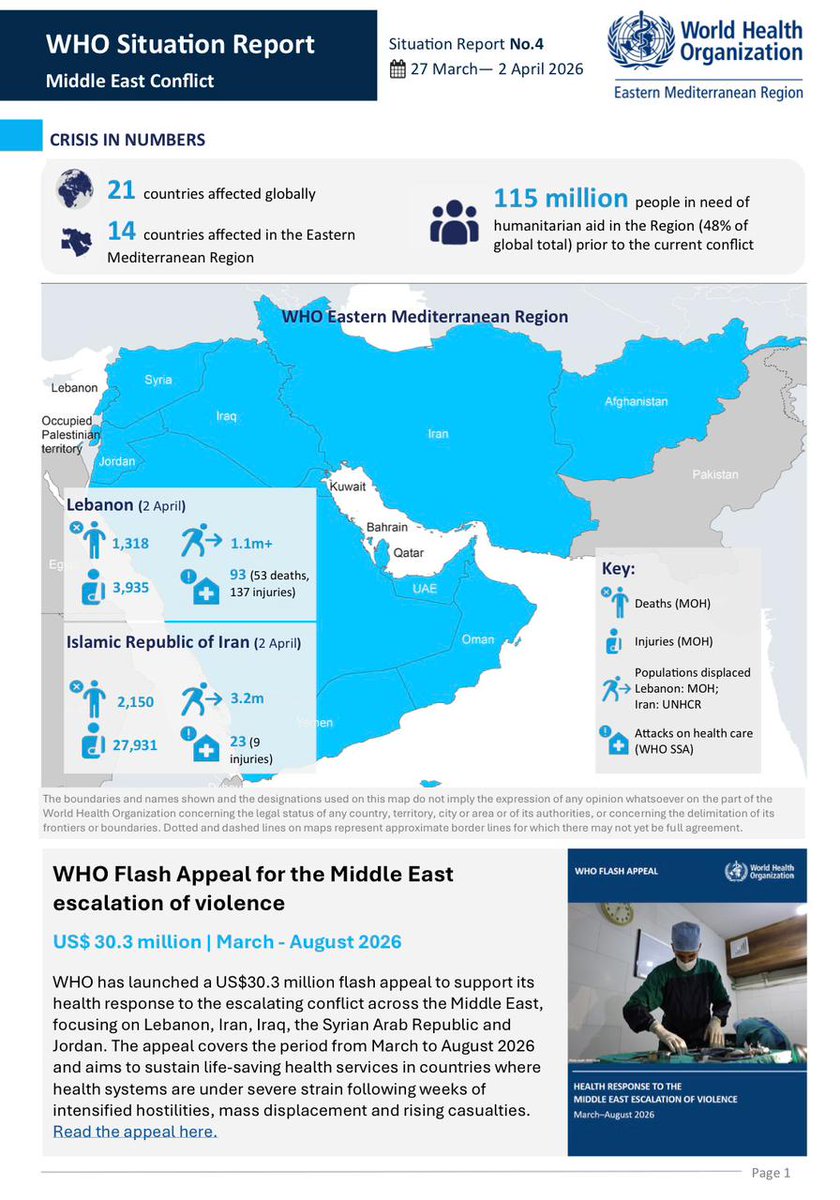
WHO’s latest Situation Report (26 March–2 April 2026) highlights a deepening public health emergency across the Middle East.
Conflict continues to disrupt access to care, strain health systems, and heighten environmental and disease risks.
During the reporting period, WHO delivered critical medical supplies, strengthened trauma and emergency care, enhanced disease surveillance and early warning systems, and provided technical guidance and coordination to strengthen overall health system preparedness.
Sustained support is urgently needed to maintain essential health services and protect vulnerable populations.
Read the full update: https://t.co/Pd6QThx4yQ
#QuitTobacco at any age and experience immediate and long-term health benefits:
🔵 improve your overall health
🔵reduce your risk of cancer
🔵reduce your risk of heart attacks🫀 and stroke🧠
Quit tobacco now and keep going beyond #Ramadan.
#ATimeForHealth#HealthyRamadan
This Ramadan, make your impact last every day.
WHO delivers life-saving health care in the world’s most fragile settings — consistently, reliably, and at scale.
By automating your daily Sadaqah, you help WHO reach people in crisis every day of Ramadan.
Donate today: https://t.co/pL4CPZzb9j
More than ten days into the recent escalation of conflict in the Middle East, health systems are under immense strain. Reports indicate over 1,300 deaths and 9,000 injuries in Iran, at least 570 deaths and over 1,400 injuries in Lebanon, and 15 deaths with 2,142 injuries in Israel.
Attacks on health care are increasing, with WHO verifying 18 attacks in Iran, 25 in Lebanon, and 2 in Israel since February 28, resulting in tragic losses among health workers. These attacks not only claim lives but also deprive communities of critical care when they need it most.
Public health risks are soaring, with over 100,000 people in Iran and up to 700,000 in Lebanon displaced under deteriorating conditions, facing limited access to clean water and sanitation. Vulnerable populations, especially women and children, are at heightened risk of illness.
The situation is compounded by numerous health facility closures. In Lebanon, 49 primary health care centers and five hospitals have shut down due to evacuation orders, while access to medical services is severely restricted in the occupied Palestinian territories and Gaza.
Disruptions in medical supply chains due to airspace restrictions are leading to significant backlogs in essential health supplies for over 1.5 million people across 25 countries.
WHO calls on all parties to protect civilians and health care, ensure unimpeded humanitarian access, and work toward de-escalation. The urgency for action is critical to prevent the collapse of already fragile health systems and to support the recovery of impacted communities.
Peace is the best medicine!
The World Health Organization (WHO) defines mental health as a state of well-being where individuals realize their abilities, cope with normal life stresses, work productively and contribute to their community. Conflict, displacement, disasters and economic hardship can affect mental health adversely, impacting people’s ability to:
• cope with fear and uncertainty in difficult situations;
• protect and support themselves and their families;
• make appropriate decisions; and
• contribute to rebuilding their communities.
There is no health without mental health.
@WHO guidance in emergency settings highlights that protecting and promoting mental health strengthens community resilience and recovery. When people feel supported, communities not only survive, they thrive.
🔎 Help is closer than you think. Find mental health and emergency services in your country:
https://t.co/DN51g9hMep
Conflict in the Middle East is affecting the very people and services working to save lives.
These attacks not only cost lives but deprive communities of care when they need it most.
Health workers, patients and health facilities must be always protected under international humanitarian law.
Health care is #NotATarget
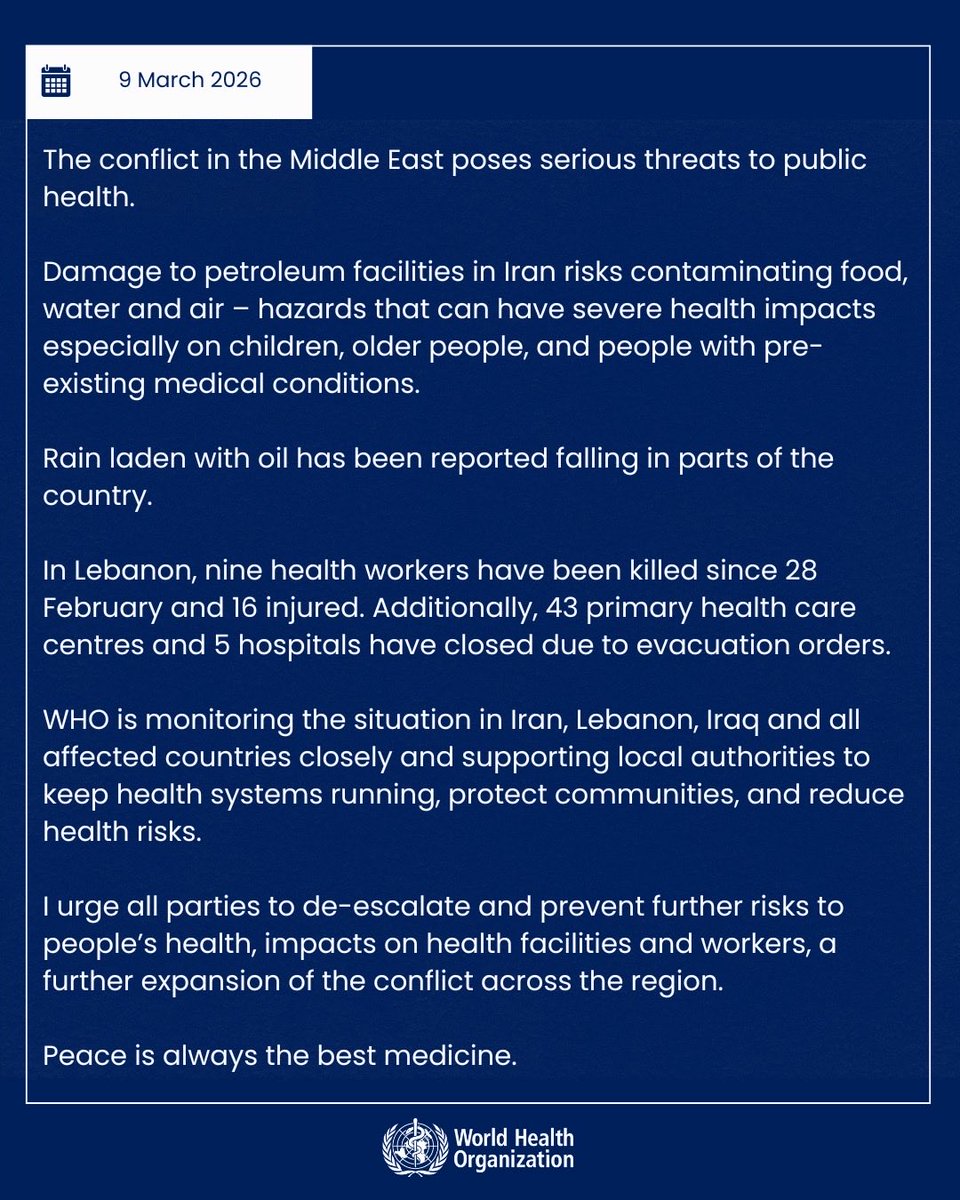
The escalating conflict in the Middle East, and the impact on public health, are of great concern.
Damage to petroleum facilities in #Iran risks contaminating food, water and air – hazards that can have severe health impacts especially on children, older people, and people with pre existing medical conditions.
Rain laden with oil has been reported falling in parts of the country.
In #Lebanon, nine health workers have been killed since 28 February and 16 injured. Additionally, 43 primary health care centres and 5 hospitals have closed due to evacuation orders.
WHO is monitoring the situation in Iran, Lebanon, Iraq and all affected countries closely and supporting local authorities to keep health systems running, protect communities, and reduce health risks.
I urge all parties to de-escalate and prevent further risks to people’s health, impacts on health facilities and workers, a further expansion of the conflict across the region.
Peace is always the best medicine.