Minting sealed, fully encrypted NFTs with Zama’s FHE so even the contract can’t read the data?
And the traits/look being determined purely by FHE randomness with zero human influence… that’s next-level privacy for NFTs.
Love seeing real this !!
@fungolabs
@FungoLabs@zama Using FHE so the NFT is encrypted from mint and the contract computes without ever reading the data is a proper solution to the usual transparency/manipulation problems in NFTs.
“Non-visible” finally feels real with Zama under the hood.
How we use Zama ?
→ Every NFT mints sealed and is encrypted onchain using Zama’s FHE.
→ The contract computes on data it can never read.
→ Its look and essence are determined by FHE randomness. Nobody gets to choose. Not even us.
🟨 Built with FHE on @zama.
@fabio43623913 Clear take. Composer bundling swap + bridge + deposit shortens the path, but it doesn’t change the underlying risk. Liquidity and realistic fillable yield for your size should still come first.
If I were moving USDC into yield on Jumper Earn, I would not sort by the biggest APY. I would open the personalized view and the full market list side by side and compare liquidity first.
The For You feed uses wallet context, idle assets, and preferred chains, so it hides a lot. That is useful, and also how a thin pool can look like the best option just because it is the only one on screen. The broader list is where I check if that rate still exists once size and depth are visible.
An advertised yield is not a guaranteed return. It can move with utilization, incentives, or a token price. I would still check the destination chain, the gas token, and the protocol before confirming.
Composer can bundle swap, bridge, and deposit for supported opportunities. That shortens the path. It does not make the yield safer.
Source: https://t.co/M5THbqTLsY
Disclosure: Republic campaign, participation rewards.
@abu_eth Ad-free data and advanced analytics for a full year is legitimately useful.
Tying it to Jumper XP and Pass levels is a clean incentive.
Good find.
Exploring Jumper Perks: The 1-year CoinGecko Premium is a massive unlock. Requirement? Boost your onchain footprint on https://t.co/QhMboEIEEP to earn XP and level up your Jumper Pass. Perfect for DeFi traders who need ad-free market data and advanced analytics for research (1/2)
@0xRowdyIND Clear separation between Legion Score and VP is useful.
Having VP isn’t enough — committing it with multipliers is what actually moves the raffle weight.
Solid breakdown of the whole process.
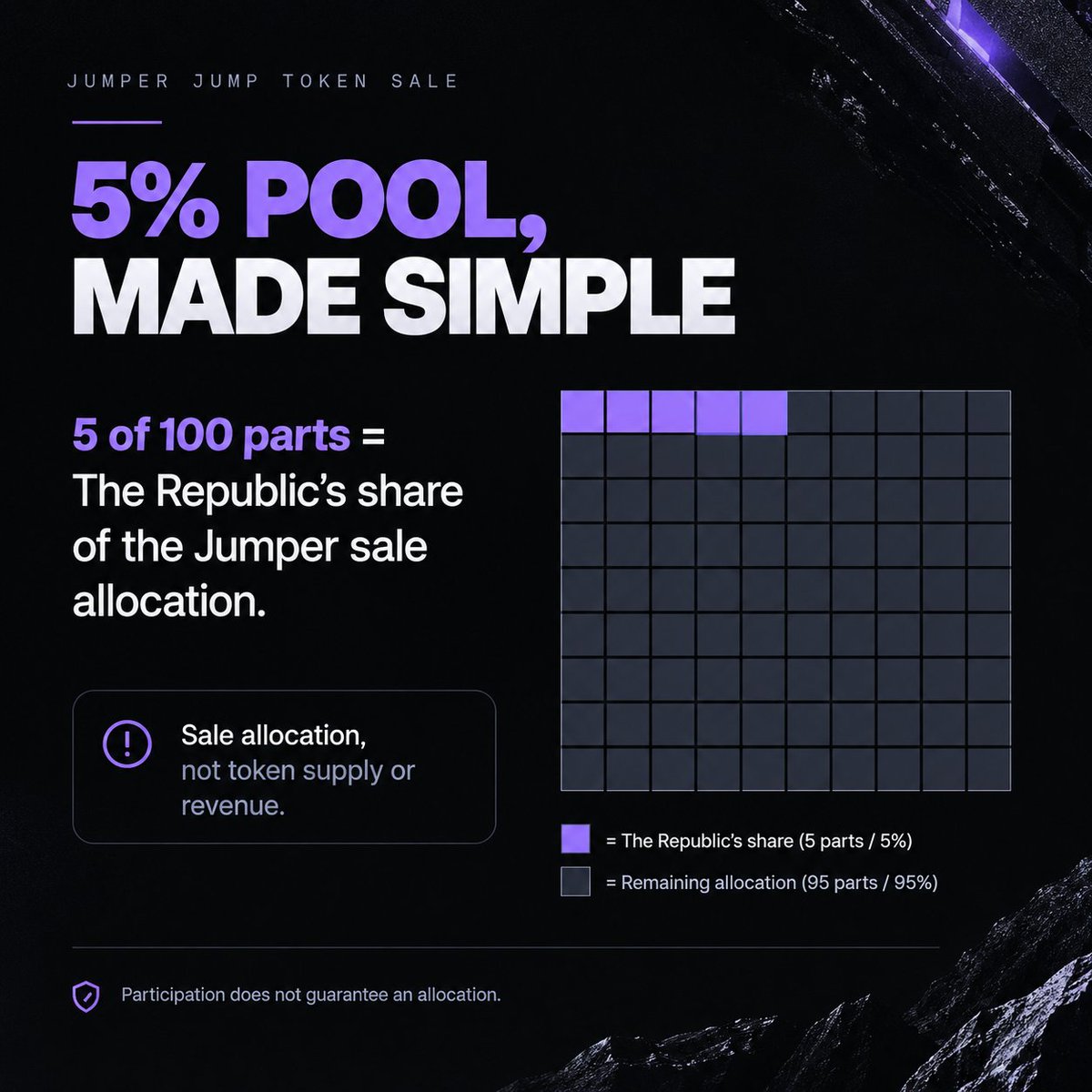
@ayaruk57 The 100-parts visual makes it easy to understand.
Republic gets a reserved slice of the sale, not a fixed claim on the token supply.
Good reminder that participation ≠ guaranteed allocation.
UNDERSTANDING THE 5% POOL ALLOCATION FOR THE REPUBLIC.
5% of the Jumper sale allocation. What does that actually mean?
Think of the entire sale allocation as 100 equal parts.
5 parts = The Republic’s share
⬜ 95 parts = the remaining sale allocation
So when you hear “5% pool,” it means The Republic has a portion of the Jumper $JUMP sale allocation reserved for its community.
It does NOT mean:
❌ 5% of the total $JUMP token supply
❌ 5% of Jumper’s revenue
❌ A guaranteed amount for every Republic participant
The exact amount each Republic member receives has not been published, and participating in The Republic does not guarantee an allocation.
The Jumper sale has a $2M target and $3M hard cap, but the 5% figure refers specifically to the sale allocation, not a fixed dollar amount.
This post is part of a Republic campaign earning participation rewards.
Official sale details: https://t.co/hYa2UsN6BR
@bitcz66 Good to know VP isn’t locked to one campaign.
Uncommitted balance carries over, which makes participation less all-or-nothing.
Simple but important distinction.
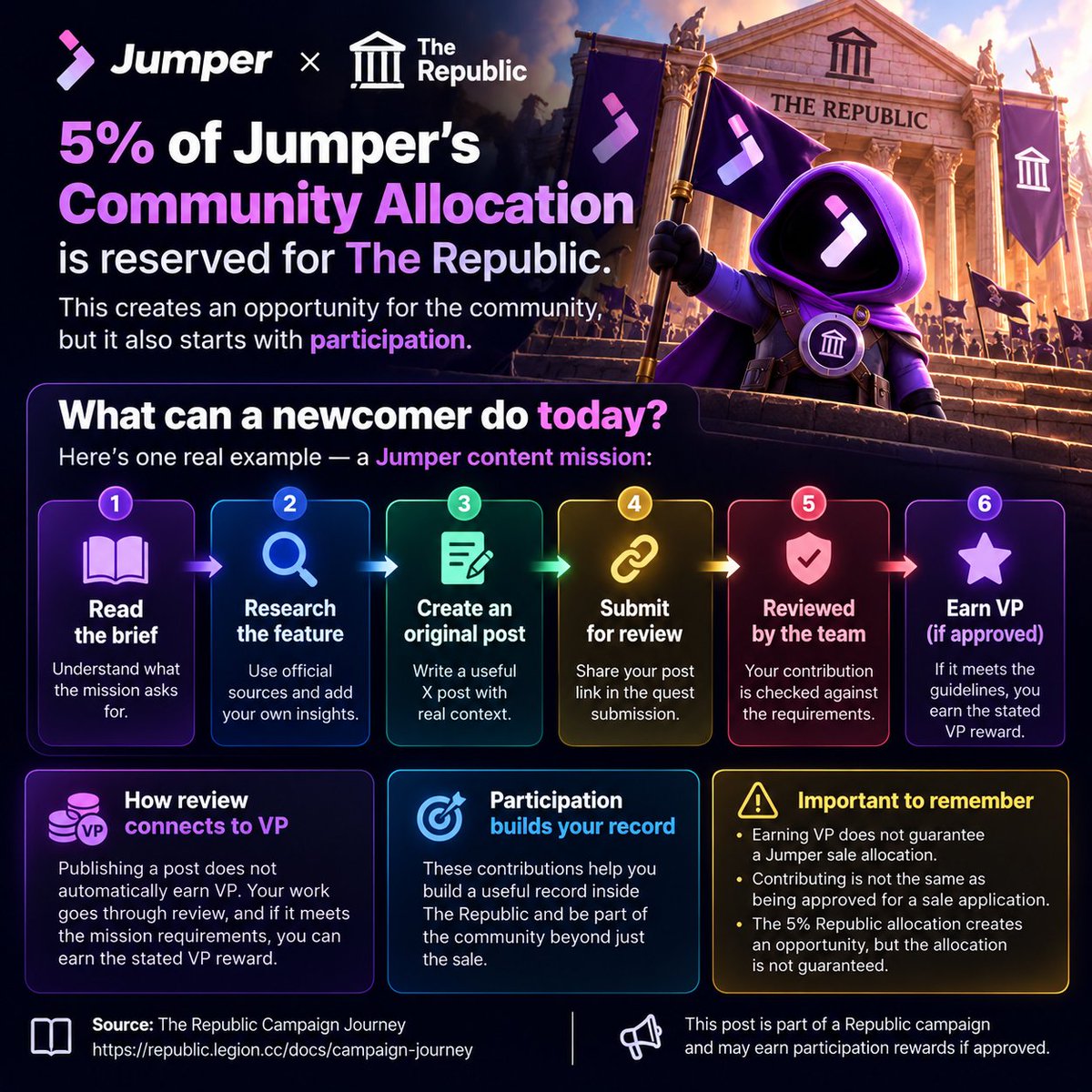
@kazmi_Eth@jumperapp Appreciate the concrete example. A newcomer can start contributing today by completing a content mission the right way — including the review step. Participation builds history inside The Republic rather than promising a free slice of the 5%.
What does “participation” in The #Republic actually look like? 🏛️
Start with the opportunity: 5% of @jumperapp community allocation is reserved for The Republic.
But participation isn’t about showing up only when there’s a sale.
A newcomer can contribute today.
🧵
@theInterfold Acting in concert without losing the ability to remain distinct is the real design challenge.
Most systems force a trade-off between coordination and autonomy.
The ones that avoid that trade-off are worth building.
@kawon418 Good clarification.
Inventory holds what you’ve earned, but eligibility still depends on each sale’s rules.
Always check both before assuming you can use something.
I used to think campaign rewards were tied to the page where you earned them, but Republic actually keeps earned items in your Inventory.
So if I wanted to use one in a later sale, I’d check the item in Inventory first, then read the receiving sale’s rules to see whether it’s eligible there.
Not every item works in every sale, and you shouldn’t assume something can be used twice just because it’s still in Inventory.
Source: https://t.co/4q2lRRFVTe
Disclosure: This post is part of a Republic campaign earning participation rewards.
@mushkaborec Most loyalty programs reset and force mercenary behavior.
Building a continuous onchain record through normal swaps and bridges is much healthier.
Good distinction between participation metrics and guaranteed rewards.