The same logic applies to censorship: restricting extreme opinions helps only under specific conditions on where the two groups stand relative to the truth, and can increase polarization otherwise.
Happy and proud to see this in press. It was a lot work, but also of fun thanks to with @DLSebastiano and @yveszenou1 : "Affective Polarization, Media Outlets, and Opinion Dynamics" is forthcoming at the Review of Economic Studies! Summary and link in the comments
— We derive exactly when correcting one group's information helps society as a whole (it works when the two groups' biases point in opposite directions and are large enough) and identify the single most effective agent to target to spread accurate information through the network
— With biased media, same-sign biases across the two groups can actually move opinions closer to the truth, while opposite-sign biases make polarization worse.
What we find:
— Affective polarization alone, with no media bias at all, is enough to generate lasting ideological division and disagreement within groups.
— Adding an unbiased media source doesn't automatically fix this; learning can still fail.
We model a society split into two groups. People update their opinions by conforming to their own group and rejecting the other's views, while also listening to a media outlet that may or may not be biased.
Our paper asks: when does affective polarization — favoring your own group and dismissing the other's views — stop a society from learning, even when better information is available? And when do policies meant to fix this backfire instead?
Polarization isn't just about biased media. Social networks and affective polarization determine whether information unites society, deepens divides, or fails to improve learning.
New paper by @DLSebastiano, @lmerlino1, and @yveszenou1
https://t.co/xwqquOpoqs
#REStud#EconX
Happy to see my joint paper with @lmerlino1 and @LiamWrenLewis on the long-term impact of childhood interracial contact on US residential segregation published in @JPubEcon!
It was a great honour to have @Paola_Profeta (@Unibocconi and @AxaGenderLab) join us for our inauguration. Her insightful talk on gender differences in political behaviour was truly inspiring. Thank you for accepting our invitation.
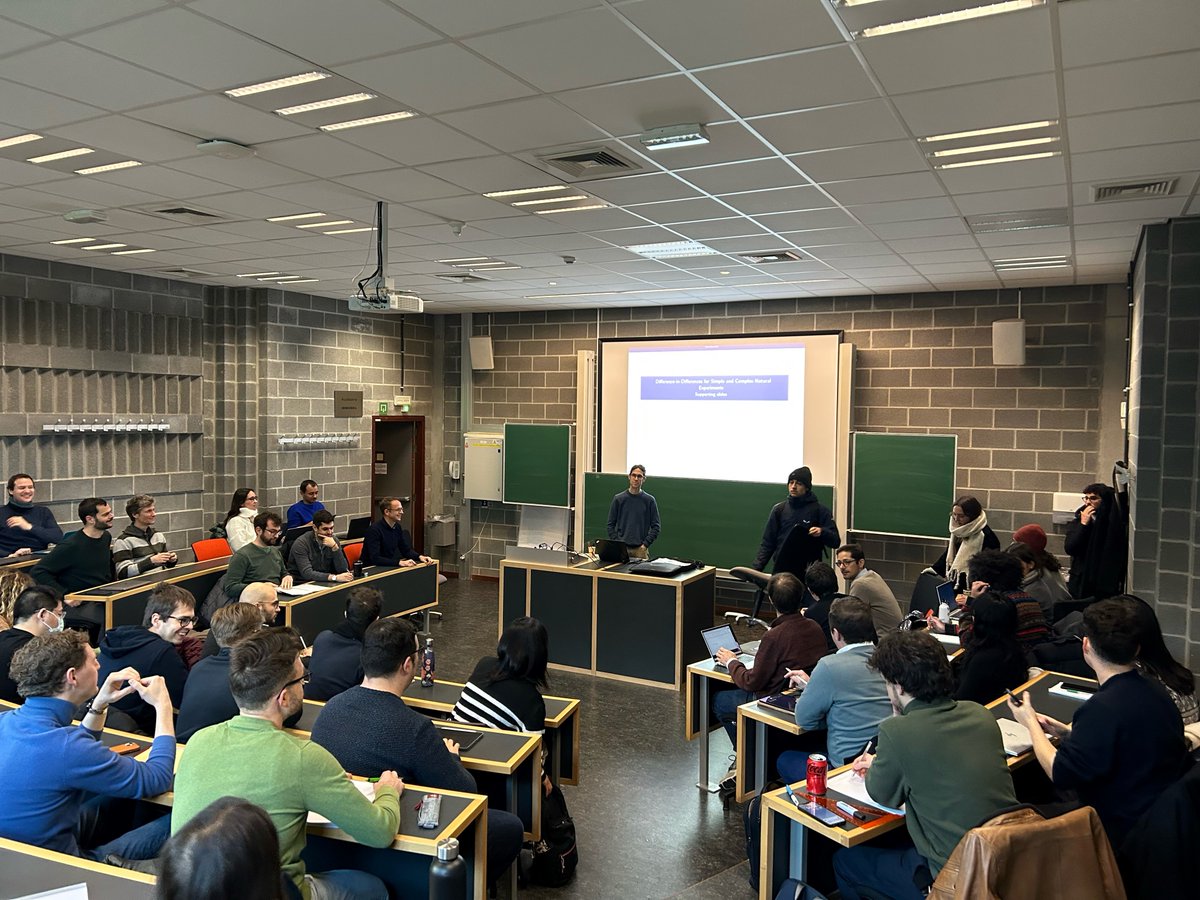
Exciting News! Join us for the 1st ECORES Lecture featuring Xavier D'Haultfoeuille on January 18-19, 2024! Don't miss out on this insightful session.
Register now 🚀 #ECORESLecture#XavierDHaultfoeuille
Xavier D'Haultfoeuille will give an ECORES PhD lecture on new DiD methods at @ecares_ulb on Jan 18-19! More info in the poster below, register here: https://t.co/gRqCoV2CbI
#LGBTQ+ people are facing unspeakable violence in #Uganda. We have a narrow window to help right now. Your donation will provide safe shelter, medical care, and legal support. #EndHomophobia#LoveWins https://t.co/eNuIg7CYxU