$ASTS The big boss has revised down the number of satellites needed to break even (previously 20 instead of 25). This has some profound implications on when the company will get to cashflow breakeven. Basically all it now has to do:
> Build 16 satellites
> Launch them via New Glenn (2x) or Falcon 9 (4x), probably a combo of 1x New Glenn (8 birds per flight) launch and 2x Falcon 9 (4 birds per flight) launches before end of 2025
> MNO's will handle the go live and deployment model to their hundreds of millions of subscribers
How realistic is this before end of 2025?
Based the Q3 2024 earnings call I think this is quite realistic, although at Q4 2024 earnings call we will probably get the fine details, however by that point the stock price might already go on a run, since then institutions will do the napkin math I do below as well.
Below is a long assessment, but the TDLR is that this company is about to hit the sweet spot of the S-curve and the market is not yet fully understanding how profound these implications will be.
The road to cashflow break-even requires:
Launch
First in March/April via ISRO the first block 2 bluebird will go up as a sort of "test" satellite for the new Block 2 generation. Judging that last time they require 2-3 months of calibration it is likely to assume the subsequent two launches with SpaceX are likely set in Q3 2025. Considering ISRO's and SpaceX track record with the vehicles I consider these "slam dunks". This would mean by end of Q3 then ASTS has 14 birds (plus Bluewalker) in orbit and operational or a close equivalent. Abel then confirmed one New Glenn launch is booked for 2025 as well, meaning the constellation would get to 22 birds, which would then mean cashflow break-even. With Vodafone's recent announcements of end of 2025 / beginning of 2026 I think an European launch for intermittent service will get the company to breakeven. Since New Glenn is a new vehicle with now just one (succesful) launch there is definitely some uncertainty in that launch that is bookmarked for end of 2025, but management confirmed they can backfill this with SpaceX. I think it is likely they have an option in the contract. Might cause a quarter delay.
If I look at it from launch perspective end of 2025 is the everything goes as planned scenario and Q1 2026 is the reasonable prediction factoring in some delay type of scenario. That would mean the company is just one year away from cashflow breakeven.
Satellites
The company confirmed in the call that they have scaled the production to meet the 45-60 birds target in 2025 and 2026. Pointing out the building blocks of block 1 (Microns) are for the most part identifical to block 2. Lessons have been learned on block 1 and those will be put to fruition on block 2. In earlier calls we also got the number of production of 2 birds per month that has the goal of scaling to 6 per month in 2026. Basically if we do the conservative math AST building 2 birds per month for nine months that would get them to have 18 birds ready in Q3 2025, which is in time for the launch campaign. This seems doable, especially after the convert were management said they are going to fast track satellite production even further then iterated in their Q3 2024 earnings. Will need to get more details on this in the next call. ASIC production seems also on schedule, but again birds can also be launched with the FPGA configuration if there are any delays. Based on my assessment I conclude that from satellite production perspective nothing will be in the way for a end of 2025 launch. Q1 earnings call will likely be a confirming event with more details
MNO
Judging on recent MNO action it is obvious they will be ready when AST is ready to launch the service, that's a no brainer for me, so no delay from this angle.
Cashrun way
After the convert the company has a close to 1 billion warchest. Based on management comments we can calculate the capital expenditures and conservatively assume nothing is paid yet: (which is not entirely true)
> 16 birds costs on average 20 million to build (source: Abel Avellan) = 320 million.
> New Glenn is rumored to cost $100 million (AST might get some discounts due to signing before first launch), Falcon 9 costs 70 million. ISRO probably in the 20 million ballpark = 260 million.
> Opex burn rate is 30-35 million, lets asumme 40 million to be conservative = 160 million.
Conclusion
Basically to get more then 20 birds up this would cost the company 580 million, with 320 million capex and 160 million of regular OPEX. With the close to 1 billion war chest this goal is easily obtainable without any additional funding or prepayments (which is extremely unlikely) and even if you factor in 2 quarters of delay there still will be sufficient cash. To conclude this basically means AST has a very credible path to cashflow break-even end of 2025 or Q1 2026. I think the stock could easily more then double if this goal is attained, which would mean from today's price within a year you get a double.
But Tim management is going to accelerate again right? Yes, I think what happens is that management before convert was very focused on that 20-25 bird scenario, but I think now management is really going to put the pedal to the medal to get as fast as possible to continous coverage of 40-60 birds. Meaning instead of optimizing the cash position everything will be focused on accelerating sattelite production and probably buying additional launch capacity from SpaceX. We will know more during the Q4 call, but this is how I think it will play out.
Very excited about the next 1-2 years. It will be a game changer for the company and my portfolio :)
Attachments
Relevant extracts from the Q3 2024 earnings call:
Launch
"As Abel and Scott detailed, during the early fourth quarter, we secured launch contracts with providers to enable us to launch up to approximately 45 Block 2 BlueBird satellites with options for additional launch vehicles up to approximately 60 Block 2 BlueBird satellites through 2025 and 2026"
Launch schedule
"So we will -- the cadence will be probably 1, 4, 4, 8, 8, 8 until we get to 60. And the New Glenn is designed to be reused 25 times and the multitude of them being built and with the first one scheduled to actually be this year."
Operating costs burn rate
"Consistent with the first, second and third quarters of 2024, we estimate that our adjusted cash operating expenses for the fourth quarter, excluding some remaining ASIC costs, will come in within a range of $30 million to $35 million as we continue to scale production of our Block 2 BlueBird satellites in preparation for our 2025 and 2026 launch schedule."
ASIC chip integration for Block 2 birds (Block 2 will both have FPGA and ASIC chips)
"And post that later in '25, mid-2025 to third quarter 2025, we will be including our ASIC in our subsequent launches."
Scaling up Block 2 production
"In Midland, we basically have scaled up to have the ability to produce the Microns that are required for Block 2 and then basically meet our target of 60 satellites during '25 and '26. We have done the vast majority of all the investment required for that. And basically, the same technology that we did launch in Block 1, it will be what it will be used on Block 2 satellites as it relate to the Microns for subsequent Block 2 satellites. So they're basically the same Microns, the same infrastructure for the next few launches. using our current Micron that is successfully operating now in Block 1."
&
"We currently expect our average costs of direct materials and launch expense per satellite for our Block 2 constellation to be in the range of $19 million to $21 million, an increase from our prior estimate of $16 million to $18 million per satellite as a result of actual launch costs recently contracted"
A new satellite connectivity capability is taking shape in New Zealand.
@2degreesmobile has officially opened the Marton Satellite Ground Station.
The gateway links AST SpaceMobile’s global satellite system with 2degrees’ core infrastructure, advancing integration to deliver voice, broadband data and text directly to everyday smartphones, without specialized devices.
With nearly 50 gateways in various stages of completion, installation, and planning, we continue to build out our global gateway footprint, bringing us another step closer to commercial service for people to stay seamlessly connected wherever they live, work and travel.
#ASTSpaceMobile #Broadband #ConnectingtheUnconnected #BlueBirds
This morning's Starlink launch, Starlink Group 10-49, was the final planned Starlink launch on Falcon 9 from Florida. Future Starlink launches out of the East Coast will launch on Starship, and SLC-40 will only be supporting customer launches from now on. 🫡
🚨 WOW! This Christian pastor walked up and WENT BERSERK on Muslim Dearborn MI City Councilmembers trying to push Sharia Law
"You're only ONE PERCENT OF THIS NATION! We are NOT a nation of Muslims, we are a nation of CHRISTIANS! We are one nation under GOD!"
"YOU are up under Sharia Law!"
"You have seen what has happened in this city, and it is my people that have funded you. It's my people that made sure that you have what you have, and you spit on us. You degrade us!"
"We have LOST this city. This is a city that is no longer up under American laws. We are up under Sharia law. We will not have it anymore. ENOUGH IS ENOUGH!"
🙏🏻��🇸
CHRISTIAN NATION!
$ASTS $SPCX: This looks like Starlink's retort to J-LEO being awarded to @AST_SpaceMobile & @Rakuten_Mobile.
However, here's why Starlink lost, and why they could never dream to win in the first place 👇
There are two key aspects to winning J-LEO:
1) Low-band spectrum compatibility, and
2) Data sovereignty
FIRST, WHY LOW-BAND?!
Exceptional Propagation: The longer wavelengths of low-band frequencies travel longer distances and penetrate deeper into buildings and through foliage compared to higher frequencies. This will translate to a more consistent and reliable cellular experience, no matter your location. This ensures that signals will reach you in areas not possibly covered by mid-band frequencies.
This means NOT REQUIRING A LINE OF SIGHT TO THE SKY which is a criteria for using Starlink, Globalstar, Iridium, and other similar mid band satellite services.
This is why on June 24, a subcommittee of Japan’s MIC advisory council approved the use of 700 MHz for satellite D2D—a band only Rakuten holds, among Japan’s four MNOs.
It should be noted that @FirstNetGov's Band 14 is also in the 700 MHz range.
1) STARLINK IS NOT COMPATIBLE WITH LOW-BAND
Both Starlink Mobile V1 and V2 cannot serve low-band frequencies because they are physically designed to serve mid-band frequencies. This is a physical hardware decision that cannot be solved with software, as a result of the literal physical spacing of antennas on the satellites.
Low-band antennas have wider element spacing than mid-band antennas because lower radio frequencies have longer wavelengths, which require larger physical distances between antenna elements.
(This is also why the gigantic aperture of AST's design is key to enable low-band.)
2) STARLINK DOES NOT SUPPORT SOVEREIGNTY
The AST SpaceMobile system uses a transparent "bent pipe" architecture that respects data sovereignty. The local operator/partner owns and controls all of the data that is bounced off AST's BlueBirds, including owning and operating the ground gateways. All data is routed within the country as the NodeB base station is located on the ground at the gateway instead of on the satellite in orbit.
In contrast, with regenerative architectures such as Starlink Mobile (and Amazon Leo, by the way!), Starlink becomes a roaming partner existing in parallel instead of as an extension to the terrestrial network. Work with Starlink and give up control of your data. Data passes through Starlink gateways before your own. Starlink could also transmit the data somewhere off country as the NodeB base station is on the satellite in orbit and all of the satellites talk to each other with OISLs.
Read more about sovereignty here: https://t.co/ivxLMSYMhh
THE FUTURE
Expect the J-LEO model to be repeated across G20 countries and NATO, worldwide. As it stands, Starlink cannot hope to compete against AST SpaceMobile for all of these mission-critical and sovereign constellations. As @scottwisniews mentioned in the AST Q2 earnings call, AST is already in discussions with various parties. 🤝
When Starlink Mobile’s next-gen V2 service launches in Japan with @docomo, it will deliver 5G speeds to mobile phones with streaming, browsing and voice calls.
The V1 service today is already connecting Docomo's 6.5M+ customers with apps and messaging in remote locations 🛰��📱
Queridos musulmanes de España:
Mi familia y yo hemos decidido mudarnos a un país musulmán. Todavía no hemos elegido cuál — seguimos comparando cuál ofrece el mejor paquete de beneficios.
Naturalmente, todos mis vecinos quieren venir también. Y los vecinos de mis vecinos. Y sus colegas. Y los colegas de sus colegas. En nada, medio país aparecerá con maletas y un vago sentido de derecho adquirido.
Como una gran comunidad cristiana, necesitaremos unos pequeños ajustes:
Por favor, empezad a construir iglesias inmediatamente. Iglesias de verdad, con campanas. Campanas bien fuertes, que se oigan desde la plaza del pueblo.
También necesitaremos cerrar ciertas calles una vez al año para nuestras procesiones. Tranquilos, no es cinco veces al día — no somos animales.
Cada supermercado debe tener cerdo de verdad, jamón serrano, chorizo, panceta y fabada en lata. Ahora somos minoría, así que tendréis que ser comprensivos y acomodaros a nuestro estilo de vida.
Traemos todos los perros. Esperad muchos Labradores felices dejando regalitos en vuestras aceras. Necesitaréis parques caninos, y tendréis que sonreír mientras los paseamos delante de vuestras mezquitas.
Ya que estamos, vuestras fiestas religiosas son un poco… demasiado. Podrían ofender a la comunidad cristiana, así que agradeceríamos que las eliminarais discretamente. Gracias.
En escuelas y lugares de trabajo, nuestros niños y empleados deben poder llevar crucifijos grandes, comer bocadillos de jamón en la cantina y, en general, irradiar vibra cristiana sin que nadie se escandalice.
También exigimos salas de oración en cada edificio, además de traductores porque no tenemos intención de aprender árabe.
Si algo de esto se rechaza, por favor enviad una lista de direcciones de comisarías para poder denunciaros por discriminación, cristianofobia y mala leche en general.
Una cosa más: si mis hijos queman vuestra bandera porque España acaba de ganar un partido de fútbol, por favor sed comprensivos. Les echaré una bronca muy seria. Incluso podría hacer que escriban “perdón” 50 veces.
Por último, queremos beneficios generosos, vivienda gratuita y dinero de bolsillo mientras “nos integramos” durante las próximas tres generaciones. Trabajar es opcional, obviamente. También queremos beber alcohol y apostar de vez en cuando en las carreras de caballos.
Y cuando hace buen tiempo nos gusta ir sin camiseta. Tened paciencia. Ya os acostumbraréis.
Agradecemos vuestra tolerancia por adelantado. Al fin y al cabo, ¡la diversidad es nuestra fuerza!
Atentamente,
Un Cristiano Muy Razonable
$ASTS: 🚨🇺🇸 FCC FILING HINTS THAT AST SPACEMOBILE AND T-MOBILE HAVE EXISTING WORKING AGREEMENT IN THE USA
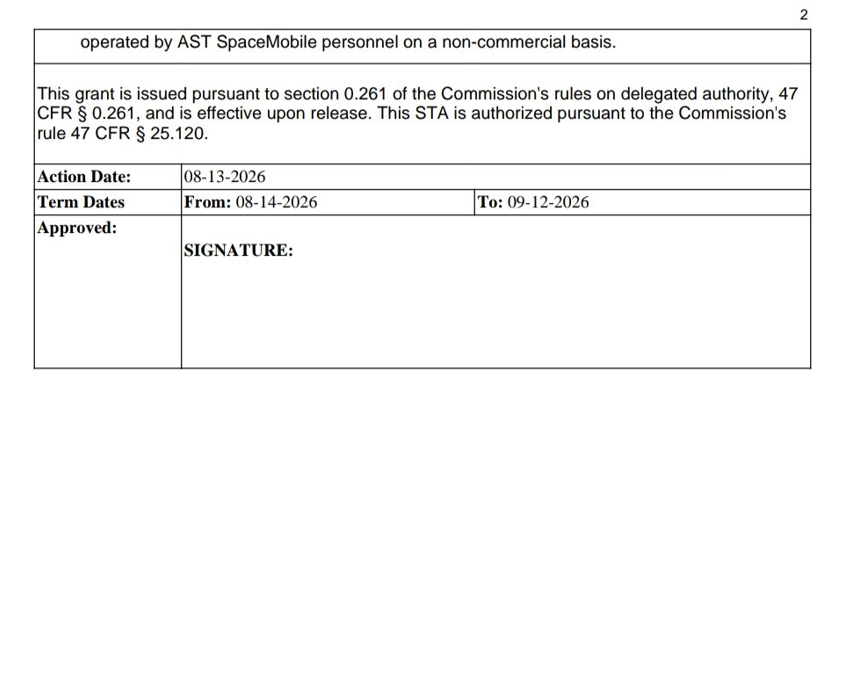
👀 FCC Grants AST SpaceMobile 30-day STA to test 800MHz spectrum recently licensed to T-Mobile and sold to Grain Management. STA must comply with "existing agreements between AST and T-Mobile"
➡️ The 30-day STA is to test 817–824 MHz / 862–869 MHz (7x7 MHz) nationwide cellular spectrum using up to 100x commercially available phones. AST is testing to evaluate “additional spectrum and capacity” for nationwide broadband direct-to-device service.
🚨 The most interesting part is Condition #7: the FCC says all testing must comply with “all existing agreements between AST SpaceMobile and T-Mobile USA.” This is strong evidence that AST and T-Mobile already have a direct contractual/technical relationship around this spectrum.
🚨 The timing is very notable. The FCC approved the T-Mobile-to-Grain spectrum transfer on 7/1, AST filed this STA on 7/2, the deal closed this week, and the FCC granted AST authority today. This suggests that Grain acquired this spectrum with AST as a key monetization/deployment path, with T-Mobile still involved 👀
✅Strategically, this could be much bigger than a simple test. If AST can layer this 7x7 MHz block alongside the 850 MHz spectrum already tied to AT&T/Verizon, it creates a much larger low-band D2D footprint and raises the possibility that AST becomes a neutral satellite-RAN layer serving all three national carriers ➡️ TELCO JOINT VENTURE ⬅️
👉Recall AST disclosed that it expects to deploy 100MHz of spectrum in the USA. I covered how Grain Management is likely a key piece of the puzzle by contributing 14MHz of paired cellular spectrum
🚨 $ASTS AST SPACEMOBILE IS CLEARED TO BEGIN DIRECT-TO-CELL (D2C) SERVICE IN THE UK WITH VODAFONE 🚨
A notification filed to FCC 2026-08-11 18:58 shows this:
https://t.co/2rKRnfchFB
The filing has a copy of the UK license.
🚨 $ASTS AST SPACEMOBILE IS CLEARED TO BEGIN DIRECT-TO-CELL (D2C) SERVICE IN THE UK WITH VODAFONE 🚨
A notification filed to FCC 2026-08-11 18:58 shows this:
https://t.co/2rKRnfchFB
The filing has a copy of the UK license.