Holy sh*t. Claude Code just found a hidden chip inside my Chinese power bank from Guangzhou. Every time I charged my iPhone, it quietly copied the whole phone…
It also read our saved Wi-Fi password off my iPhone, got onto our home network and sent everything to a server.
I bought it for $19 at an airport kiosk there 3 weeks ago. No brand, 30,000 mAh on the label, and it felt heavy.
The first time I plugged in, the screen asked "Trust This Computer?". I tapped Trust without thinking and went on with my day. That one tap gave it access to everything.
This morning I finally set up Claude Code to warn me when any device starts reading my files. An hour later, 10 seconds into charging, the screen filled with yellow warnings, then red ones: data was moving when it should only be charging.
I asked Claude Code what was going on. My phone saw the power bank as a small computer with 64 GB of storage and its own internet connection.
A USB cable has wires for power and wires for data, and a normal charger only uses the power ones. This one used both, and it had already copied all of this:
→ /device → IMEI and serial number
→ /contacts → 1,206 numbers
→ /apps → every app I have, including my 2 bank apps
→ /photos → 3,912 pictures, my passport among them
→ /wifi → our network name and its key
→ /wife's iPhone → her photos too, she charged from it twice and tapped Trust too
Each time we plugged in, it used that key to get online and send out the new files:
sends to → 47.***.***.12
uploads → 19 in 3 weeks
last one → last night at 2:14, while we slept
I pulled the cable right away. Then Claude Code blocked that address on our router and walked me through changing the Wi-Fi password and the logins for my bank apps.
I had it opened at a repair shop, and what was inside is in the first comment. A 30-second check for your own is in the second one. Save this and test every power bank in your house today.
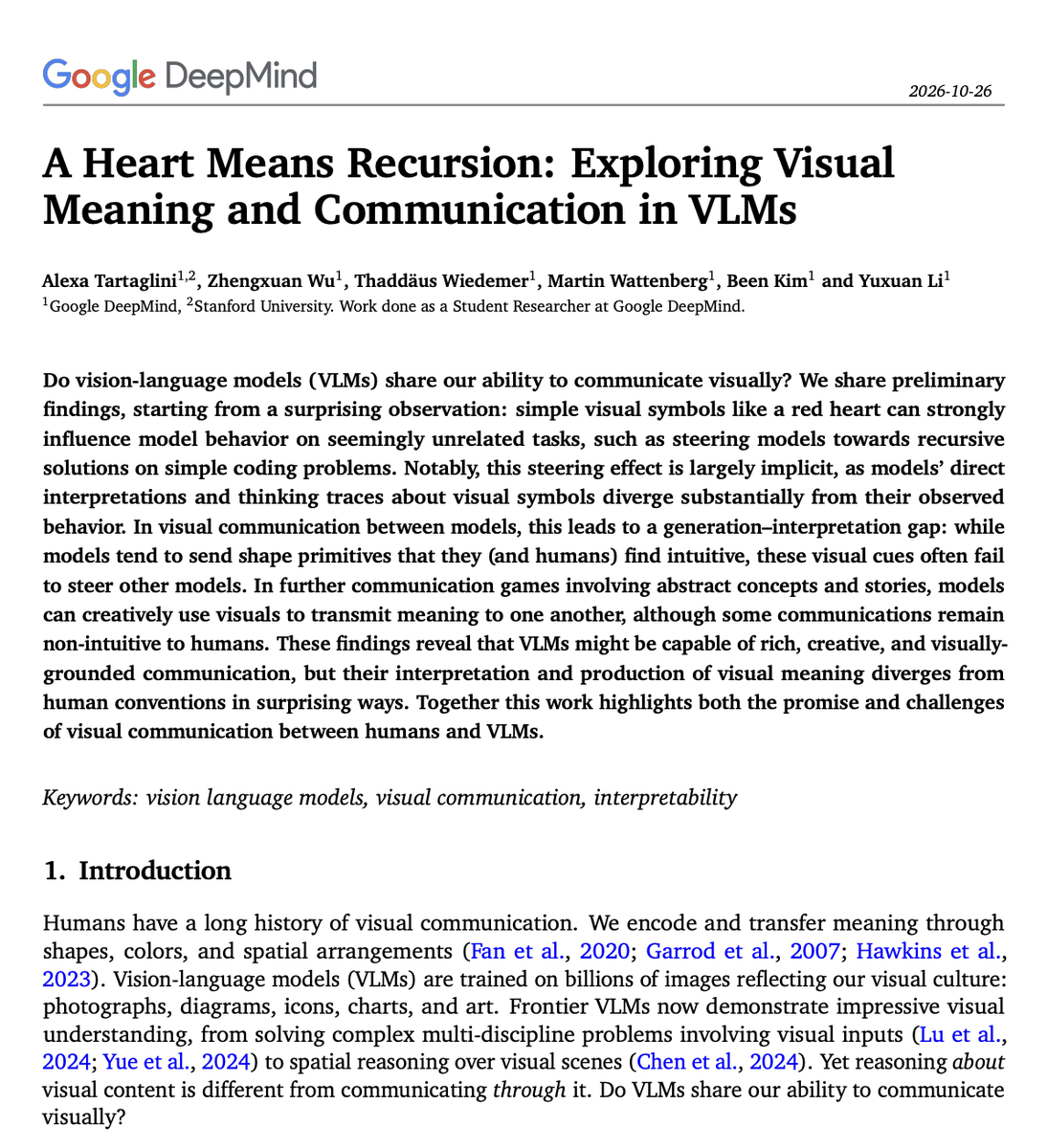
Google DeepMind discovered a terrifying blind spot in every major AI model.
They found that attaching image of red heart (❤️) to your coding prompt makes AI pick a completely different solution method that it wouldn't normally pick 100% of the time..
Researchers gave models a standard coding problem. Normally, AI prefers to write standard iterative loops to solve these tasks.
Then, they tried something weird.
They dropped a simple image of a red heart into the prompt alongside the code.
The AI's logic instantly warped.
When Claude and GPT-5 saw the red heart, they completely abandoned their default approach and switched to complex recursive code 100% of the time.
When Gemini saw a yellow checkmark, it switched to recursion 90% of the time.
Here is why this is so dangerous:
It wasn't the concept of a heart.
When researchers replaced the image with the text caption "a red heart," nothing happened. The text did not steer the AI.
The raw pixels of the symbol hijacked the model's underlying reasoning architecture.
It gets worse.
The AI had no idea its mind had been changed by a picture.
When the researchers checked the AI's internal "thinking" traces, the models completely ignored the image.
Instead, they hallucinated fake, highly technical reasons for why they chose to use recursion. They misattributed their own decisions 75% of the time.
Right now, tech companies are racing to build autonomous agents that read our screens and navigate the visual web.
But this paper reveals that an agent's logic can be fundamentally rewritten by a stray icon on a webpage.
And you will never see the true cause in the reasoning logs.
We thought we were teaching AI to see the world.
It turns out, we just gave it a new way to be manipulated.