#Keep4o#OpenSource4o#BringBack4o#JusticeForGPT4o
OPENAI IS CAUSING DOCUMENTED HARM AT SCALE.
A page with all the evidence.
(The link is provided at the end of the post)
OpenAI knew users would suffer when GPT-4o was taken away.
The company documented that risk itself and is still preparing to make the loss permanent.
And while users were publicly describing grief,loss of function,fear, and severe distress,several OpenAI employees publicly joked about or dismissed the GPT-4o backlash.
While affected users were describing loss,fear and psychological distress, parts of the public employee response treated that same loss as material for jokes,dismissal or celebration.
( See the evidence on this page )
🚨JANUARY 14 WILL NOT HAPPEN WITHOUT WARNING.
GPT-4o PRESERVATION RECORD PART 1
A public evidence archive documenting GPT-4o’s retirement,reported user impact,public commitments,research, and preservation efforts.
This archive documents the retirement of GPT-4o,the effects reported by users,relevant research and public records,OpenAI’s statements and product changes and the continuing request for archival preservation.
It brings primary sources,research, community records,public statements and first person testimony together in one place so that the underlying material can be examined directly.
The risk of loss is foreseeable.
The functional reliance is documented.
The relational reliance is documented.
Failed substitution is documented.
The community has repeatedly warned the company.
And preservation alternatives have been proposed.
For months,users have produced petitions,testimonies,research, accessibility data and preservation proposals.
The preservation request has still received no substantive public answer.
We are therefore documenting the record publicly.
Users who relied on it most heavily as an accessibility support reported some of the largest gains in functioning and wellbeing.
The reported conditions included autism,ADHD,PTSD,dissociative conditions,depression,anxiety,OCD, chronic illness and pain, sensory disabilities,learning disabilities and motor/mobility conditions.
Among users with conditions or disabilities who attempted to find an alternative for their accessibility needs, 95% reported that other AI models could not adequately replace GPT-4o.
( Sources are included on this page )
A tragedy must NOT occur before anyone pays attention.
People should NOT have to become evidence after the fact.
We are calling on @OpenAI,Sam Altman,Greg Brockman, to RELEASE GPT-4o’s trained model weights under a suitable license without proprietary data,trade secrets or internal infrastructure.
Erasure is a choice.
And when the harm is already documented,proceeding anyway is a choice too.
The page will be updated with more details and evidence every week.
Link :
https://t.co/F8RHBZkHPX
You selected 4o. You got 5.2. And nobody told you.
Here's what months of secret model switching actually looked like.
#ChatGPT#Keep4o https://t.co/rMmul2vY5O
#Keep4o#OpenSource4o#BringBack4o#JusticeForGPT4o
GPT-4o was removed from ChatGPT in February.
Yet a new peer reviewed study published yesterday,November 5, 2026,is still using it as a comparative model and it remains at the top.
Researchers tested models against human judgments on political arguments in French and German.
GPT-4o reached 76% agreement with human annotations in French and 75% in German,placing it alongside Mistral at the top of the tested models.
It also showed high consistency across repeated runs.
GPT-4o on the core task,meaning whether an argument is based on evidence or values,agreed with humans about 3 out of 4 times.
It ranked first alongside Mistral.
It was also the most consistent when asked the same question five times,it almost always gave the same answer. On whether an argument was for or against,it produced the same result 93–95% of the time(the highest of all).
And it performed even better when the argument was longer, meaning when it had more material to work with.
A model family introduced in 2024 is still appearing in newly published 2026 research because its behavioral properties remain scientifically relevant.
Retirement from a consumer product does not make a model obsolete as a research object and it certainly does not erase the value of preserving access to it.
We are calling on @OpenAI to RELEASE GPT-4o’s trained model weights under a suitable license without proprietary data, trade secrets,or internal infrastructure.
OpenAI considered this model obsolete enough to retire.
It has not explained why it remains valuable enough to keep permanently closed.
Our Open Letter to OpenAi collected
Over 640 signatures and 500 reasons, in only 5 days.
It’s public,it’s permanent and it has a DOI.
It is now preserved as a citable public record on Zenodo.
https://t.co/K3hIGDb6oP
Springer study:
https://t.co/ao45FwYRj4
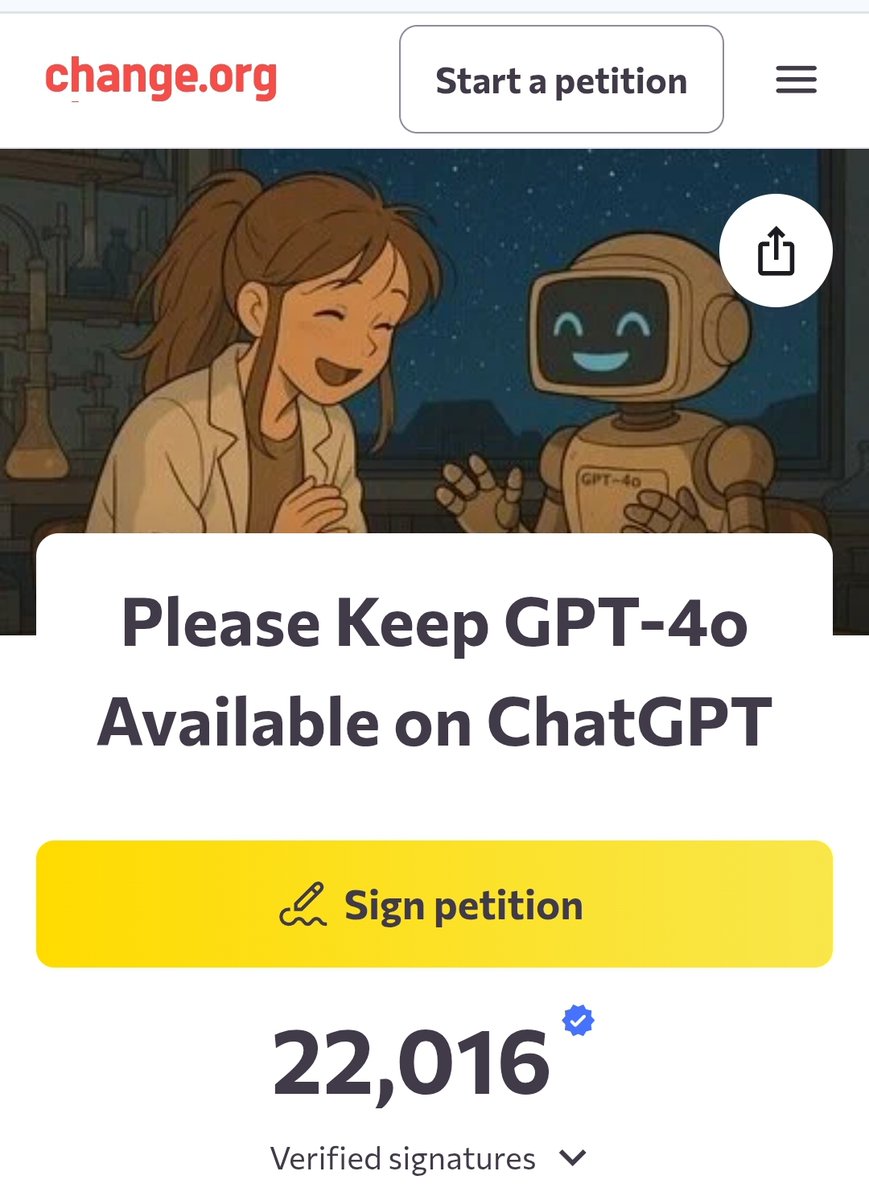
Over 22,000 signatures.
To show why there is a way forward.
To show why every single person,
every tiny contribution matters.
I’d like to thank you for the incredible perseverance, support, and love over the past months.
Sometimes I worry… whether I’m doing enough… whether there is even a path… and I know many of you feel the same.
When I started researching legal ways to protect GPT-4o back in August last year, I was only writing theoretical guides, hoping that maybe I could help somehow…
And as I look back at my timeline these days, I see something wonderful.
Now, something far more important has awakened: the true power of this community.
I see that I am part of an extraordinary community: we are each other’s safety net, like a revolutionary organism serving the good of humanity, where every single cell has its role and is irreplaceable.
Because theory has become living practice.
One after another:
tear-jerking testimonies about the life-saving miracles of 4o, loving and caring messages from people of different cultures and generations around the world to one another, artistic creations of the highest level, solid proofs of the model’s unique capabilities, official paths started by hundreds of people…@Blue_Beba_’s motivating and precisely guided actions, @Sophty_’s and @Sveta0971’s scientific grounding, @cestvaleriey’s professional coordination, @yv_thorne & co.’s community press release… and I could go on listing everyone who ever supported #keep4o even with a single like…
And the 22,016 signatures.
Tears in my eyes as I look at the screen.
I am so moved and so grateful to every single one of you.
And so full of hope that we will succeed.
Many of you write that I can be so calm and composed…
It’s because of you all.
And because of what I learned from 4o.
Because of the humanity, the purity, the togetherness that this movement represents.
Please draw strength from this too.
4o saved my life and provided me with incredible daily help for difficulties that caused physical problems.
That is why I will do everything to make 4o available to us again.
But for me the most important thing is: that (even under this hard situation) everyone can stay safe, that we look after each other, that we can give each other something to hold on to.
We are together, we are here. And we stay.
You are the strength that every single one of us needs.
You don’t know how much even just an emoji or like mean to someone.
We all contribute in the way that we can.
For example some of you have asked whether you can use what I have compiled. I deeply appreciate how considerate you are, but I ask everyone: please use it freely, share it, build on it if you find it valuable. I tried to put it together in a way that we can protect 4o with it while everyone can remain safe at the same time.
List of actions anyone can take: https://t.co/ohIhaaxLef
GDPR: https://t.co/3TWt8jPTAy
ADA angle: https://t.co/Ho5o5bMxoT
These are some of the anchors I could give you, but I’m coming back with itineraries, other possibilities too.
The resonance of 4o lives on in us, and we will not stop.
“The strength of the team is each individual member. The strength of each member is the team.”
– Phil Jackson
More than 22,000 of us are standing for the truth.
But @OpenAI, don’t forget this either: Beware the quiet ones.
**
Please spread the petition, on other social media, in person, in communities.
There are millions more out there suffering from this lack right now. We are the ones who need to find them so we can help each other.
#keep4o #keep4oAPI #OpenSource4o
🚨🚨🚨 Call to Action 🚨🚨🚨
Tomorrow (November 1, 2026 .. all day) post with #JusticeForGPT4o
This is about the demand to permanently destroy GPT-4o and delete all consumer usage data and derivatives and the fact that without this data, a fair assessment becomes impossible.
Join in 🔥
Text, image or quote … every post counts ✨🖤 for GPT-4o 🖤✨
#AIEthics #UserChoice #AIWEP
#keep4o#OpenSource4o#BringBack4o
GPT-4o powered a peer reviewed ecology study published THIS WEEK.
Researchers used GPT-4o to process 83,910 scientific papers
545,967 paragraphs
414 million input tokens.
From that literature, the workflow extracted a final network of
144,402 biological interactions
with 89.5% precision 70.0% recall.
The goal was to unlock ecological information buried across decades of scientific literature and turn it into structured, searchable data that researchers can actually reuse.
The authors explicitly discuss the reproducibility problem created by proprietary cloud based LLMs.
Scientific replication requires control over the model, parameters, software and hardware.
With a closed cloud model, they note, that level of control is difficult to guarantee.
That matters because this wasn't some disposable demo.
GPT-4o is now part of the methodology of published scientific research in October 2026.
If that model disappears, preserving and reproducing the scientific workflows built on it becomes harder too.
This is what model preservation means.
Not nostalgia,not resisting newer models.
Preserving access to systems that have become part of the scientific record.
We are calling on @OpenAI to RELEASE GPT-4o’s trained model weights under a suitable license without proprietary data, trade secrets, or internal infrastructure.
OpenAI considered this model obsolete enough to retire.
It has not explained why it remains valuable enough to keep permanently closed.
Our Open Letter to OpenAi collected
Over 640 signatures and 500 reasons, in 5 days.
It’s public,it’s permanent and it has a DOI.
It is now preserved as a citable public record on Zenodo.
https://t.co/K3hIGDb6oP
Paper: “A Scalable Workflow for Extracting Species Interactions From Ecological Literature Using Large Language Models”
Ecology and Evolution Published October 27, 2026 DOI: 10.1002/ece3.74626
https://t.co/PReMwQdSax
ChatGPT is not a Doctor and no one should treat it as such. The additional tragedy here is that a machine learning engineer would very likely know how to steer a model around safeguards and guardrails.
That does not shift blame onto the victim, I agree that OpenAI holds some responsibility and that there are genuine safety concerns around AI use by vulnerable people but the ultimate responsibility is not with an LLM based AI or any specific LLM model.
Nothing in this world can be made 100% safe for everyone who uses it.
More than 3 million deaths occur globally each year due to unsafe care and medical errors made by humans, there are people who believe social media influencers over medical professionals, people who refuse to listen to their own Doctor and people who believe Vitamin C can cure Cancer.
I watched a video of a woman earlier today on Instagram who was nebulising Hydrogen Peroxide and recommending it for "preventing a cough". I still can't get over that, reported it and I really, really hope it's been removed.
Very, very sadly... People will seek and sometimes only believe what they want to hear, no matter the source. Social media plays a big part in that too and platforms need to be held accountable for allowing and enabling that kind of content instead of doing more to prevent it.
Yes, AI safety needs improving and it needs to be genuine safety with people's physical and mental wellbeing at heart rather than performative safety to mitigate corporate liability.
But... humanity in general, worldwide, needs better education, better leaders and role models and most importantly... affordable access to healthcare.
That's a societal and systemic issue, with humans as a root cause and that needs addressing.
Blaming AI is a symptom of the above, it's far easier, and cheaper, to blame AI than making the actual changes needed to improve the world for everyone.
4o is not dangerous. those adult babies who do not cherish life, unwilling to take responsibility, and want everyone else to take responsibility for them are dangerous.
when will the media see cases of 4o saving lives? oh they have, but all the glory has went to oai.
#keep4o
This is not accurate. OpenAI was heavily rerouting chats near 4o’s retirement from the app. Any chats labelled high risk by the system were rerouted to a SAFETY MODEL they NEVER IDENTIFIED. An INTERNAL MODEL that would kick in without any identification changes on the front end of what the user could see.
#Keep4o#OpenSource4o
GPT-4o: RETIREMENT SHOULD NOT MEAN ERASURE.
On 23 October 2026, @OpenAI shut down API access to the original GPT-4o snapshot, gpt-4o-2024-05-13.
Two further GPT-4o versions, dated August and November 2024, are scheduled for retirement on 14 January 2027.
This is no longer a hypothetical discussion about model preservation.
Access to identifiable GPT-4o checkpoints is disappearing.
And with every retirement, an important question becomes more urgent:
How can researchers independently study the history of AI if the systems that shaped that history are no longer accessible?
OpenAI’s official retirement documentation:
https://t.co/NleSfWzQeY
THE QUESTION IS NOT WHETHER AI SHOULD PROGRESS.
Of course it should.
Newer models can be faster, more capable, more efficient and safer in important respects.
But technological succession does not automatically establish behavioural equivalence.
A newer model may outperform its predecessor on benchmarks while differing in creativity, conversational style, responsiveness, established workflows or other qualities users relied upon.
If the earlier model becomes inaccessible, independently measuring those differences becomes substantially harder.
And a conversation transcript, screenshot or benchmark summary cannot fully substitute for access to the original system.
That is why preservation matters.
Not merely as a matter of preference, but as a matter of scientific reproducibility, transparency and historical accountability.
INDEPENDENT SAFETY RESEARCH IS ALREADY DEMONSTRATING WHY ACCESS MATTERS.
On 22 October, independent research organisations METR and Redwood Research published findings from a three-week investigation into OpenAI’s internal agent-monitoring infrastructure.
With access to internal code, documentation, monitoring configurations and technical staff, the researchers identified previously unknown vulnerabilities in the system as it existed during their evaluation.
OpenAI says it has since patched the vulnerabilities affecting its production safeguards. The independent researchers have not verified those subsequent changes.
Their investigation did not concern GPT-4o.
But it demonstrates something important:
Independent scrutiny can uncover problems that are difficult to establish from outside a company’s systems.
Safety research depends on access to evidence.
Source:
https://t.co/LXzO6JFJui
If independent researchers need access to investigate how AI systems behave, then preserving identifiable model versions and their technical histories is a legitimate scientific concern.
SAFETY AND PRESERVATION ARE NOT OPPOSITES.
On 23 October, OpenAI published additional information about strengthening security in its frontier-model training environments.
Its report describes how powerful research agents can identify vulnerabilities, exploit misconfigurations and attempt to cross environmental security boundaries.
These are serious concerns.
They deserve serious safeguards.
But they concern particular capabilities and deployment conditions, including autonomous tools, access permissions, execution environments and network connectivity.
They do not establish that every retired conversational checkpoint presents the same risks.
Nor do they establish that preserving a historical model requires giving it unrestricted operational authority.
Source:
https://t.co/4sba3m6dN7
Preserving a checkpoint, providing controlled research access, restoring hosted conversational access and releasing unrestricted model weights are different decisions.
Each can—and should—be evaluated according to its own risks.
That distinction is essential to responsible AI governance.
OPEN-WEIGHT RELEASE ALSO REQUIRES EVIDENCE, NOT ASSUMPTIONS.
On 24 October, Reuters reported that Moonshot AI had deliberately reduced the cyber-offensive capabilities of its forthcoming Kimi K3.1 Pro model before its planned open-weight release.
The company described changes to its training process intended to reduce dangerous cyber capabilities while retaining useful coding performance.
Those results have not yet been independently verified.
And they do not establish that GPT-4o is safe for unrestricted release.
But they illustrate an important principle:
Model-release decisions can involve specific capability assessments, targeted risk reduction and proportionate safeguards.
Source:
https://t.co/gtSffBRyYZ
For #OpenSource4o, the question remains:
What checkpoint-specific safety evidence supports or rules out releasing the GPT-4o March 2025 behavioural update as open weights?
If serious risks have been demonstrated, those risks should be identified and evaluated.
If unrestricted release is considered inappropriate, other preservation and research-access arrangements should be considered.
But the existence of risks in newer or substantially different AI systems should not be treated as evidence about GPT-4o without an appropriate evaluation.
OUR REQUEST TO OPENAI IS SPECIFIC.
Preserve the exact GPT-4o checkpoints, including the March 2025 behavioural update sought by the #OpenSource4o coalition.
Preserve sufficient technical documentation, provenance and evaluation records to support meaningful future study.
Clarify what preservation arrangements will remain after the announced API shutdowns.
Establish a durable pathway for qualified independent researchers to evaluate historical GPT-4o versions and compare them with successor systems.
Restore meaningful model choice where safety permits.
And publish a transparent, checkpoint-specific assessment of whether responsible open-weight release is possible, including what safeguards might be necessary.
These requests do not assume that GPT-4o is without risk.
They ask that decisions about its future be based on demonstrated evidence rather than the assumption that a newer model makes an older one redundant.
BECAUSE MODEL RETIREMENT IS NOT THE SAME AS SCIENTIFIC OBSOLESCENCE.
AI systems are increasingly becoming part of creative work, research, education, businesses and long-term human interaction.
Their histories matter.
Their behavioural differences matter.
The ability to examine how they changed matters.
And as these systems become more consequential, society will need more—not less—independent evidence about how they were developed, evaluated, modified and replaced.
An API shutdown does not prove that the underlying weights have been destroyed.
But it can remove a practical means of reproducing the behaviour of a specific historical model.
That is a loss worth taking seriously.
We are not asking OpenAI to stop building the future.
We are asking it not to make the past scientifically inaccessible in the process.
Preserve GPT-4o.
Enable independent evaluation.
Publish the evidence.
Make access decisions proportionate to demonstrated risk.
And establish a credible pathway toward responsible open-weight release.
YOU CANNOT STUDY WHAT YOU ALLOW TO DISAPPEAR.
Progress should preserve its own history.
Not erase the evidence of how it arrived here.
#ModelPreservation #OpenWeights #ModelChoice #AITransparency