we just launched our newest product, AI Press Release
the product came out of a simple test:
we sent the same press release to 8 different site subsections, then tracked which pages appeared in ai search results across chatgpt, gemini, perplexity, and google ai overviews
one subsection consistently surfaced
seven frequently didn’t
here’s the pattern we found:
the paths split into two clear outcomes
yahoo finance /news/ and business insider /markets/ generated repeated ai citations across multiple platforms
meanwhile, /press-releases/ sections on fortune, reuters, and similar outlets rarely surfaced for the same query sets
the content was the same, and the authority tier was similar
the only variable was where the content lived on the site
why would the subsection matter?
our testing suggests ai retrieval systems use publication context as a trust signal
content at /press-releases/ reads as promotional and self-reported, exactly the type of content ai search platforms have started to filter out
content in a /news/ section carries an editorial signal, aka something someone is saying about you, not what you’re saying about yourself
this is why it surfaces as a cited source
the path is read before the content
that’s the new nature of ai search platforms
they trust third parties’ word (sometimes your competitors') over yours, which makes it hard for you to control the narrative
but here’s where you can turn that on its head: an ai press release placement.
just one placement does two things
retrieval layer: ai searches the web in real time. yahoo finance /news/ surfaces in that retrieval. the release gets cited
base model layer: llms are trained on large corpora. brand mentions on authoritative domains feed future training cycles
each placement builds the model's awareness of the brand over time
every placement we tracked achieved at least one ai citation within 7 days for its target query set
that’s not a warranty, but an observed outcome from the test
what we control is the mechanism: placement selection, subsection targeting, formatting, and distribution structure
that’s the idea behind our newest service, ai press release
research announcement content that’s placed on editorial-style news subsections and distributed through the prnewswire cascade
built for ai visibility from format through placement context
use aiprlaunch for 10% off your first order
expires june 20
read more here: https://t.co/Cj2OQJ8kKI
we analyzed what makes content get cited by chatgpt
one finding stands out above everything else:
72.4% of chatgpt-cited posts had an answer capsule
an answer capsule is a self-contained answer of roughly 20-25 words placed directly after a question-based H2
it all makes sense when you understand how chatgpt reads pages
kevin indig analyzed 1.2 million chatgpt citations. 78.4% of citations containing questions came from H2 headings
chatgpt treats your H2 as the user's query. the immediately following paragraph is the answer. if that paragraph doesn't deliver clearly and quickly, the citation goes elsewhere
shashko's sentence-level analysis of 42,971 google ai mode citations found the same pattern: cited sentences cluster in the top 35% of pages, median length of 10 words, every single one self-contained
all RAG systems operate under context window constraints. they all select for the same thing: short, declarative, extractable units of text
the capsule also needs to be link-free
91% of cited capsules had zero links inside them
a link tells the retrieval system the authoritative answer lives on another page. put links in the supporting paragraphs below
three rules:
1. question-based H2
2. 20-25 word answer directly below it
3. no links inside the capsule
🆕 Google will allow websites to exclude themselves from AI search results (still can show up in usual search results) #SEO 👀
Google said "Today, we're beginning to test a new control that lets website owners manage how their links and content appear in generative AI Search features.
With this new toggle in Search Console, website owners can decide if they want their site to appear in and help ground responses in our generative AI Search features (like AI Overviews, AI Mode or AI Overviews in Discover). Sites that opt out will not receive traffic or impressions from our generative AI features.
This control will not be used as a ranking signal for search results outside of these generative AI Search features. This work builds on our long history of designing tools, like snippet controls and Google-Extended, that give websites more choice."
https://t.co/lDKKH4xLkE
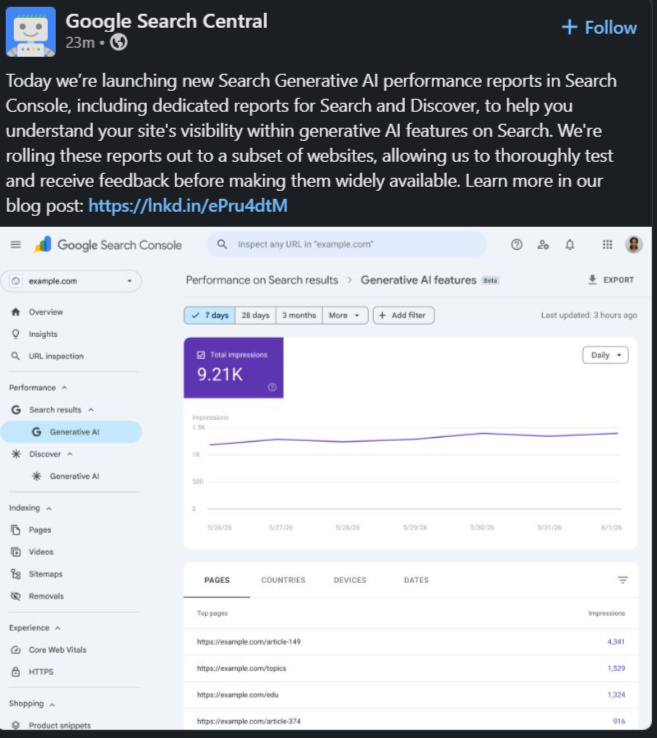
New AI reporting features finally coming to GSC.
Reporting on impressions and not clicks says a whole lot here 🫠
But yes, grateful to have any AI reporting at this point 🙏🏽
https://t.co/7MWjkYuNEh
interesting! wasn't aware of this, so thank you for putting it on my radar
just asked grok what's up. it gave me this:
"The recipe blog's quote from a 2025 MarketingOClock interview was included in PMC's December 2025 amended complaint to illustrate how Google's AI changes have disrupted expected search traffic for content creators since 2009."
i'm guessing that's what you're watching the closest here?
@inspiredtaste@rmstein oh, man... a couple of thoughts:
a) throwing a citation a creator's way when using their content is basic stuff and the least they can do, surely
b) if they are going to use a creator's content, they owe it to attribute the right work. reputations are on the line here!
@inspiredtaste took long enough, for sure! but at least it's something
how'd you folk go on the recipe front, btw? any wins there in terms the frankenstein recipes?