Developer, BlockChain & DeFi enthusiast, father of 2, europhile 🇪🇺, french 🇫🇷, Alpian ⛰️. Views are my own and can't be related to any of my employers.
Now that you can read this, here's what changed over the past few months:
@ambire is the best wallet, Rabby still great.
@ether_fi has the best crypto card, no competition, even if @MikeSilagadze refuses to giv me VIP status.
Sadly, Zeal is slowly winding down,
@getrebind is an awesome alternative if you have a Gnosis Pay card.
ENS got taken over, .gwei domains are the new cool ones.
Many projects that raised in 2021 cycle and previous ones that failed to find PMF are winding down; it's not sad, it's a healthy consolidation, a new generation will come.
As an investor, be aware that no bull market will resurrect a token of a dead project; inspect your bags and accept parting ways, many zombies out there slowly eating their treasury before eventually winding down.
DeFI is now entirely split into two paths,
The dominant one is OpFi (Open Finance): bend the knee to TradFi and become part of the current system. "Become a tool for the banks." It's the Morpho vision.
The other is DeFi in the original sense, an actual paradigm shift toward decentralized finance.
"Beat the banks at their own game."
It's losing momentum right now, but it's why I've spent over a decade in this madhouse.
The comeback story will be legendary.
It's still early.
Since more than a decade, I've been supporting builders with small angel checks.
My thesis is simple: I'm good at generating money for both the projects I work on and myself, and I have a decent, low-profile lifestyle, with a reasonable house and a "boring" EV rather than mansions and supercars.
So part of my money is reinjected toward builders in verticals I want exposure to and want to support in their development.
- Most of these checks saw no return, money gone, it's part of the game.
- Some of them were quite profitable and bankrolled the next wave of investments
- And some yielded nothing, but I'm still proud of the product built.
https://t.co/5N0e0erYQ3 is a good example. While as an investor I saw no return yet, I love their product suite and think @PhilippZentner is a chad.
Sometimes I bet on a team, sometimes I have a thesis and bet on a whole vertical hoping one of them ship a good product.
For example, a couple of cycles ago I was convinced MetaMask was a bad wallet that was hurting the global EVM user experience, so I invested in many alternatives.
When Rabby came out, I wasn't an investor. I still pushed them regardless because it was genuinely the best wallet. I think I contributed to its adoption in the ecosystem, and I'm proud of that, even if that meant no yield for me and less exposure to the ones I was invested in.
In the context of Aave, thinking a $20k angel check vested over years can influence an 8-figure position in a project I spent my sweat and blood on is a bit delusional.
My thesis on Aave has always been to carefully curate the best team in a vertical and contribute to kingmaking them. When you're managing onchain lending, you need to be opinionated, in terms of relationships and pure risk surface. One good king at $10B TVL is simply superior to 5 unequal guys at $2B each on average. This has yielded amazing results with Lido, Etherfi, Ethena (my pushback on Resolv saved Aave), Maple, and Pendle.
For Kelp, we onboarded them, after pushing back and voting against due to a weak oracle, locked up with only borrowing wstETH and with clear caps to generate an LRT <> LST <> WETH flywheel generating dozens of millions of dollars of revenue that is currently financing the paychecks of the people who seem less focused on "leaving no ghost behind", which was our mantra under my tenure, and more focused on trying to point fingers.
Expanding the scope of assets it was allowed to borrow is something I pushed back on for a while because it was conflicting with our existing relationships.
Liquid (re)staking in a protocol like Aave is a delicate balance with incredibly valuable users who hold their position literally for as long as the carry is profitable. Adding competitors to these guys can increase borrow costs, and throwing Lido users under the bus to benefit some LRT users might be a good short-term idea, but if not carefully tailored (as we did with Etherfi), it will eventually backfire.
Reality is more pragmatic. I do not pretend to own domain expertise on every topic, otherwise I was severely underpaid 😭. The rsETH<>wETH borrow proposal was launched in one of the most stressful periods of my life, when I witnessed years of my efforts being destroyed in a few weeks, and when the proposal received a green light from both risk teams and tech analysis. I did exactly what Stani and everyone else did: I didn't push back and voted yes.
I have no issue taking my own weight own responsibility in this and will not pretend otherwise.
But I'm not allowing anyone to say my decision was influenced by an angel check.
As the Aave DAO is about to vote on the largest funding proposal in its history involving a controversial contributor, Aave Labs, we published a full audit of their (lack of) performance.
It's a very long read, but I invite everyone to dive in and form their own opinion based on evidence.
The answer is simle: Marc Zeller.
AAVE stands out as one of the rare DAOs that resembles executive-led organizations.
Many DeFi protocols faced challenges when founder-led projects transitioned to the DAO model while their founders semi-retired. AAVE successfully navigated this transition because it had a leader capable of steering the ship.
DAOs are destined for failure unless people stop ignoring the accumulated corporate governance experience and best practices. DAOs can only survive if they resemble corporate organization schemes and prioritize the advantages of on-chain governance, such as adaptability and transparency, rather than ‘decentralization of governance,’ which can lead to anarchy and political infighting for resources, ultimately draining the system of its vitality.
economic security ATH & 10x flippening
Ethereum: $150B
= 35.7M ETH × $4.2K/ETH
Bitcoin: $15B
= 1B TH/s × $15/(TH/s)
Ethereum is the embodiment of security. 100% uptime. Rich client diversity. 8K consensus participants. Massive slashable economic security. There is no second best.
BTW @saylor—offer still stands. Let's debate Bitcoin's security. You can't outrun fundamentals: halvings gut the security budget, fees are 1% of miner revenue ☠️
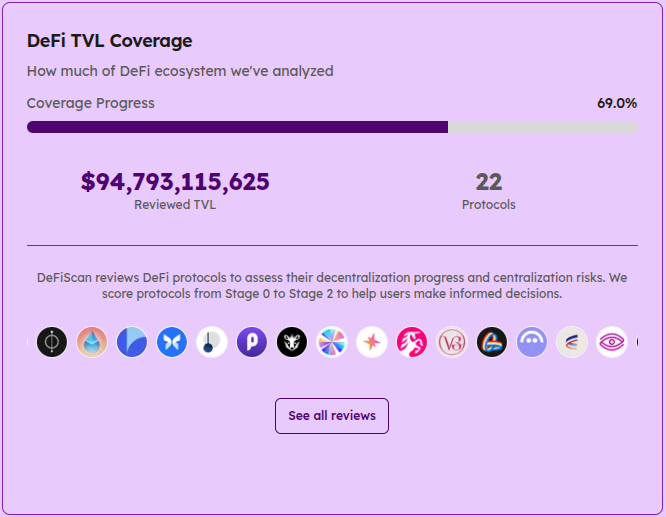
Nearly $100 billion!
69% of DeFi TVL reviewed for centralized dependencies on https://t.co/dcvzm2Pmlh.
Follow us and read our reports to learn about DeFi decentralization maturity!
Yesterday Ethereum turned 10. Today, lean Ethereum is unveiled as a vision—and personal mission—for the next 10 years.
We stand at the dawn of a new era. Millions of TPS. Quantum adversaries. How does Ethereum marry extreme performance with uncompromising security and decentralization?
TLDR: next-generation cryptography is central to winning both offense and defense.
Disclaimer: This is a Drake take™ aimed at a broad audience. A technical deep dive into hash-based post-quantum signatures and SNARKs will follow. A healthy diversity of views across Protocol, the EF, and the broader Ethereum community is expected and welcome. It strengthens us.
defense—fort mode
Ethereum is special. 100% uptime since genesis. Unrivaled client diversity. $130B in economic security (35.7M ETH staked × $3.7K)—maybe soon $1T.
Ethereum is poised to become the bedrock of the internet of value, securing hundreds of trillions over decades, even centuries.
Ethereum must survive anything: nation states, quantum computers. Whatever comes. Call it fort mode. If the internet is up, Ethereum is up. If the world is online, the world is onchain.
offense—beast mode
Ethereum is hungry. “Scale L1, scale blobs” is a strategic urgency inside the EF’s Protocol cluster. Expect low-hanging performance gains over the next 6–12 months.
Longer term? Think gigagas L1, teragas L2. Call it beast mode.
→ 1 gigagas/sec on L1: 10K TPS, ambitious vertical scale
→ 1 teragas/sec on L2: 1M TPS, sprawling horizontal scale
Scale vs decentralization? Why not both. The moon math we need is now tamed:
→ real-time zkVMs for lean execution
→ data availability sampling (DAS) for lean data
A delicious cherry on top: full chain verification across every browser, wallet, phone.
lean upgrades
Lean Ethereum proposes bold upgrades across all three L1 sublayers:
→ lean consensus is beacon chain 2.0: hardened for ultimate security and decentralization, plus finality in seconds; formerly branded as “beam chain”
→ lean data is blobs 2.0: post-quantum blobs, plus granular blob sizing for a calldata-like developer experience
→ lean execution is EVM 2.0: a minimal, SNARK-friendly instruction set (possibly RISC-V; pronounced “risk five”), boosting performance while preserving EVM compatibility and its network effects
The consensus layer (CL), data layer (DL), execution layer (EL) have each been reimagined from first principles. Together, they unlock fort mode and beast mode.
The goal: performance abundance under the constraint of non-negotiable continuity, maximum hardness, and refreshing simplicity.
lean cryptography
Hash-based cryptography is emerging as the ideal foundation for lean Ethereum. It offers a compelling, unified answer to two megatrends reshaping the ecosystem:
→ the explosive rise of SNARKs
→ the looming quantum threat
Imagine the leanest cryptographic brick—the hash function—singlehandedly powering L1:
→ CL: hash-based aggregate signatures upgrade BLS signatures
→ DL: hash-based DAS commitments upgrade KZG commitments
→ EL: hash-based real-time zkVMs upgrade EVM re-execution
A cryptographic jewel in each of lean CL, lean DL, lean EL.
lean craft
Lean Ethereum is more than a blueprint for hardening and scaling Ethereum. More than just doubling down on security, decentralisation, and cutting-edge cryptography. It is an aesthetic. An art form. A craft. Think Jiro in Dreams of Sushi. When we can go the extra mile, we do.
Minimalism. Modularity. Encapsulated complexity. Formal verification. Provable security. Provable optimality. These are subtle yet important technical considerations. Stay tuned for the post on post-quantum cryptography that will make them explicit.
lean legacy
After 10 fantastic years, lean Ethereum is a generational oath. To keep Ethereum online no matter what. To scale it without compromise. To make it worthy of those who come next.
This is about legacy. We are builders, we are missionaries. We are Ethereum. I hope you join us.
@TokenBrice I haven't touched W since XP... Yesterday, I had a class on W security in my IT architect curriculum. I can't believe what a complicated mess it has become... Aside from ego, what's stopping them from admitting they messed up and starting over on solid ground?
@aboutcircles Who wants an invite to @aboutcircles? DMs are open—hit me up with proof of your humanity! A doxxed X account that’s 5+ years old is a great start.
LinkedIn + prolific GitHub profiles = instant access.
This is real proof of work! 😁