Imagine being a washed 1 hit wonder artist that was lucky enough to be invited to tour with one of the world's biggest artists and then think "hell yeah, I'm going to hijack this tour to start a political rally against his wishes!" A truly astounding display of narcissism.
If the chiefs win today, I have $25,000 to someone that likes and comments & RT this tweet .
I also have $250,000 in presents for the starting O lineman.
I told my YouTube video when making this bet.. I have 250k for the big man. New YouTube video tomorrow
&
GO CHIEFS!!!
SWDI #1 YouTube
@gamdom #2
$PENG's $650m convert sold off 11% AH.
Wrong read.
It's a refinance, not a raise.
The old 2029/30 notes are struck low and deep ITM — count went 53m→62m in 2 quarters.
They retired that paper, added capped calls, repaid $100m revolver.
Leak plugged.
Not advice.
$PENG turned scarcity into revenue.
Samsung made memory stretch.
Micron locked down wafers.
Korea broke the wrapper.
this week, the book looked flat but the stack was being repriced ↓
Under a flat headline, the market made a clear choice: pay for what can turn scarcity into revenue now.
Storage, networking, AI cloud and cooling led.
HBM / packaging and power / grid lagged.
$PENG, Samsung, Micron and Korea explain the rotation.
REVENUE NOW - $PENG
Penguin was the receipt.
Q3 revenue grew 48%. Integrated Memory more than doubled. Operating income rose more than 5x.
The point is not just that memory is tight. Penguin gets paid to turn memory, clusters and infrastructure software into a working AI system.
Scarcity matters but making it usable pays sooner.
MEMORY ELASTICITY - SAMSUNG
Samsung's Blackwell test added a 1TB CXL pool for KV-cache offload. When local DRAM filled, throughput collapsed. The CXL-backed system kept running near DRAM speed (approximately 92% of DRAM performance in multi-GPU configurations).
Not because CXL replaces HBM but because not every byte needs the fastest, most expensive tier.
The hierarchy is widening:
HBM → DRAM → pooled CXL → storage
The caveat: this required host changes, a custom in-house kernel and modifications to the LMCache stack. Engineering proof, not plug-and-play adoption.
But it shows where the next memory trade may form: deciding where each byte belongs.
SUPPLY SECURITY - MICRON
Micron put $500M behind GlobalWafers' 300mm Texas plant and signed a 10-year supply agreement.
That is more revealing than another demand forecast.
When the customer finances the supplier, the bottleneck has moved from the presentation deck to capital allocation.
AI memory profits are being recycled into the layer beneath memory: wafers, materials and geographic resilience.
RACK TIME VS GRID TIME
Transformer queues now stretch beyond three years. High-voltage breakers are not far behind.
Yet cooling rallied while Power & Grid fell.
The physical constraint did not vanish. The market separated two clocks:
Cooling gets installed with the rack.
Grid equipment gets paid after permitting, financing and construction.
Same density problem. Very different route to cash.
DEPLOYABILITY BEAT DESTINY
Networking and retimers outperformed photonics / CPO. $ANET led; $CRDO gained.
That is not a verdict against optics. CPO may still be the architectural destination. But copper, retimers and systems already shipping can earn during the transition.
The market paid for what can deploy before the perfect end state arrives.
SAME ASSET, DIFFERENT PLUMBING
SK hynix's U.S. ADR jumped on debut.
The next trading day, its Seoul shares fell more than 15%, Samsung fell sharply, the KOSPI fell ~9% and trading halted. Reuters calculated a roughly 37% ADR premium after the rout.
Same company, same HBM exposure, but different access, liquidity, leverage and flows.
Korea did not prove that the HBM thesis was broken. It proved that the wrapper can overpower the asset.
THE THREE CLOCKS
1. Revenue now: storage, networking, AI operations, cooling.
2. Scarcity later: power, fabs, packaging, substrates.
3. Elasticity: CXL, retimers, liquid cooling, orchestration.
That is the map for this week:
$PENG = turn scarcity into revenue.
Samsung = make scarce memory go further.
$MU = secure the layer underneath.
Korea = price the instrument, not only the asset.
The bottleneck did not disappear.
The market started asking a harder question:
How long until it becomes cash?
Full weekly: https://t.co/mddQ0NudWa
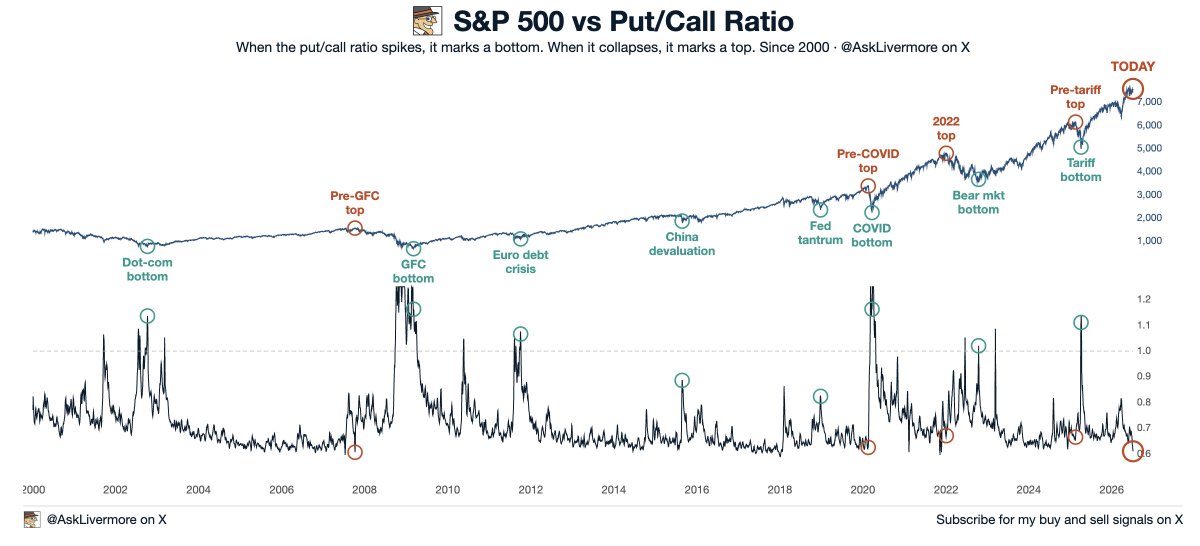
This is all you need to time the stock market. Save this. Screenshot it. You will need it.
The put/call ratio tells you when everyone is panicking and when everyone is too comfortable.
Every single time the put/call ratio spiked above 1.0 since 2000, it marked a generational buying opportunity:
- Dot-com bottom (2002)
- GFC bottom (2009)
- COVID bottom (2020)
- Tariff crash (2025)
Every single time it collapsed below 0.70, a pullback followed:
- Pre-GFC top (2007)
- Pre-COVID top (2020)
- 2022 top
- Pre-tariff top (2025)
Right now? The put/call ratio just hit 0.61, the lowest since December 2020. That means options traders are the most bullish they've been in nearly 6 years.
Does that mean sell everything? No.
But it means this is the time to stay balanced, not all-in into one sector. The best buying opportunities will come soon, stay patient.
When everyone is greedy, be cautious.
When everyone is fearful, be aggressive.
Today I went through the $AAOI filings looking for what the market hasn't priced.
Six findings, all primary-source.
→ The tax shield. The FY25 10-K (Note O) discloses ~$250.6M in federal NOL carry-forwards, $217M of which never expires, plus $86M Taiwan and $40M China NOLs and ~$15M in R&D credits. When profitability arrives, cash taxes stay near zero for years. Models applying a statutory rate are overstating the drag.
→ The deferred earnings event. A $95.8M valuation allowance sits against those tax assets. Once profits are sustained, releasing it produces a one-time non-cash GAAP earnings benefit. A $7.6M net deferred tax asset appeared in 2025, the first indication management sees realizability.
→ The index path. S&P index inclusion requires GAAP profitability. FY26 guidance calls for >$140M in non-GAAP operating income. Sustained GAAP profit is the eligibility trigger, and eligibility precedes passive inflows.
→ The compensation signal. A May 2026 Form 4 shows executive PSUs for the 2023-2026 performance period settled at maximum performance. Three-year internal targets were exceeded, not merely met.
→ The operational tells. Auditor upgraded from Grant Thornton to PwC. $31M in equipment prepayments on the balance sheet, a leading indicator of committed tooling. A $20.85M Texas Semiconductor Innovation Fund grant. And a lease arrangement under which the landlord pays $AAOI $200K annually from 2027.
→ The overlooked expansion. Coverage focuses on Texas. The 15-year Taiwan leases have received almost no attention. Companies do not sign 15-year commitments for a two-year cycle.
The fine print shows a management team investing, contracting, and compensating like a company that expects to be several times its current size.
The filings are ahead of the narrative.
Not financial advice. DYOR.
$MRVL estimated to do $2.8B / $13B in 27 / 28 for their CXL business.
$PENG is a $3.5B MC at $68 / share expected to do $1.6B in revenue and $2.3+ in EPS for the fiscal year closing in <2 months, while also bringing to market their MemoryAI™ KV Cache Server, a 11-TB CXL based server where the KV cache is offloaded to a dedicated, high-capacity CXL-based server, eliminating AI inference memory bottlenecks.
$PENG
Starting to break out into new highs ahead of earnings on July 7.
One catalyst away from a move into triple digits, and a strong earnings reaction could be exactly what sends it there.
Earnings trade idea: 7/17 100C