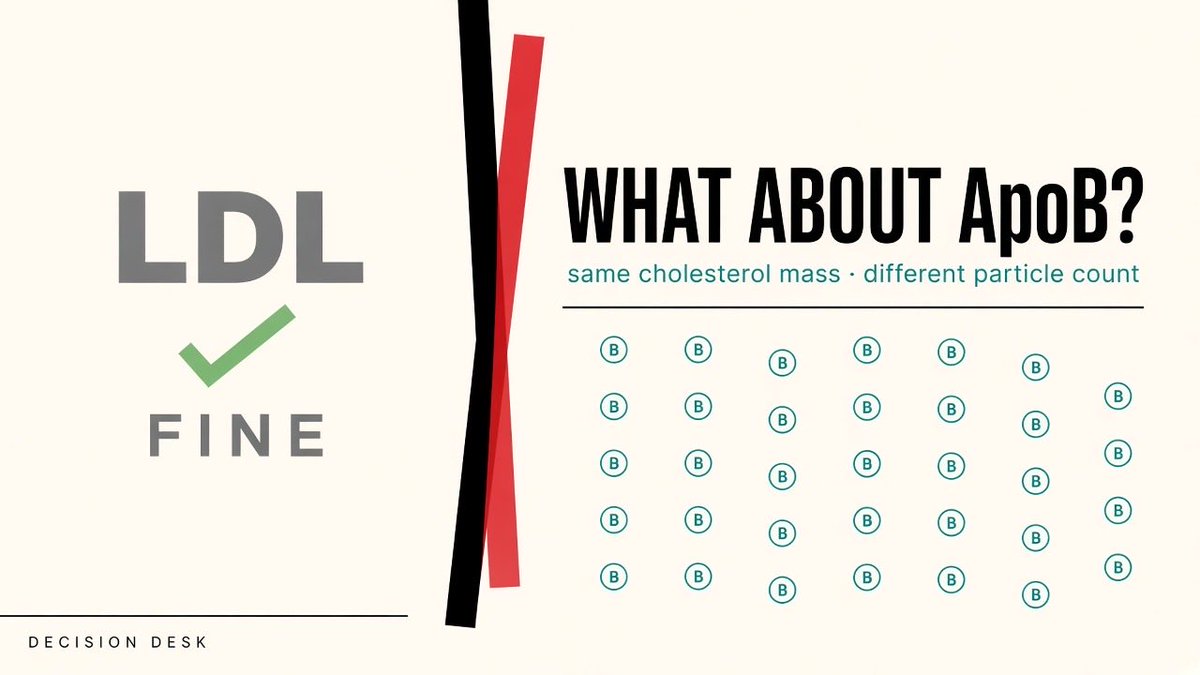
LDL looks fine. Do you still need ApoB?
The feed treats LDL like it’s obsolete. The 2026 heart guidelines did something quieter than that.
#ApoB#HeartHealth
https://t.co/1SgHaHRh1Z
LDL looks fine. Do you still need ApoB?
The feed treats LDL like it’s obsolete. The 2026 heart guidelines did something quieter than that.
#ApoB#HeartHealth
https://t.co/1SgHaHRh1Z
LDL looks fine. Do you still need ApoB?
The feed treats LDL like it’s obsolete. The 2026 heart guidelines did something quieter than that.
#ApoB#HeartHealth
https://t.co/1SgHaHRh1Z
Before you trade the gym for a scoop: the lifters in this study were also cutting calories, so their lean mass held flat.
The no-exercise creatine group was 13 people, and DXA scans count water as lean tissue.
Creatine still earns its spot. It just didn't beat lifting.
This new creatine study is insane.
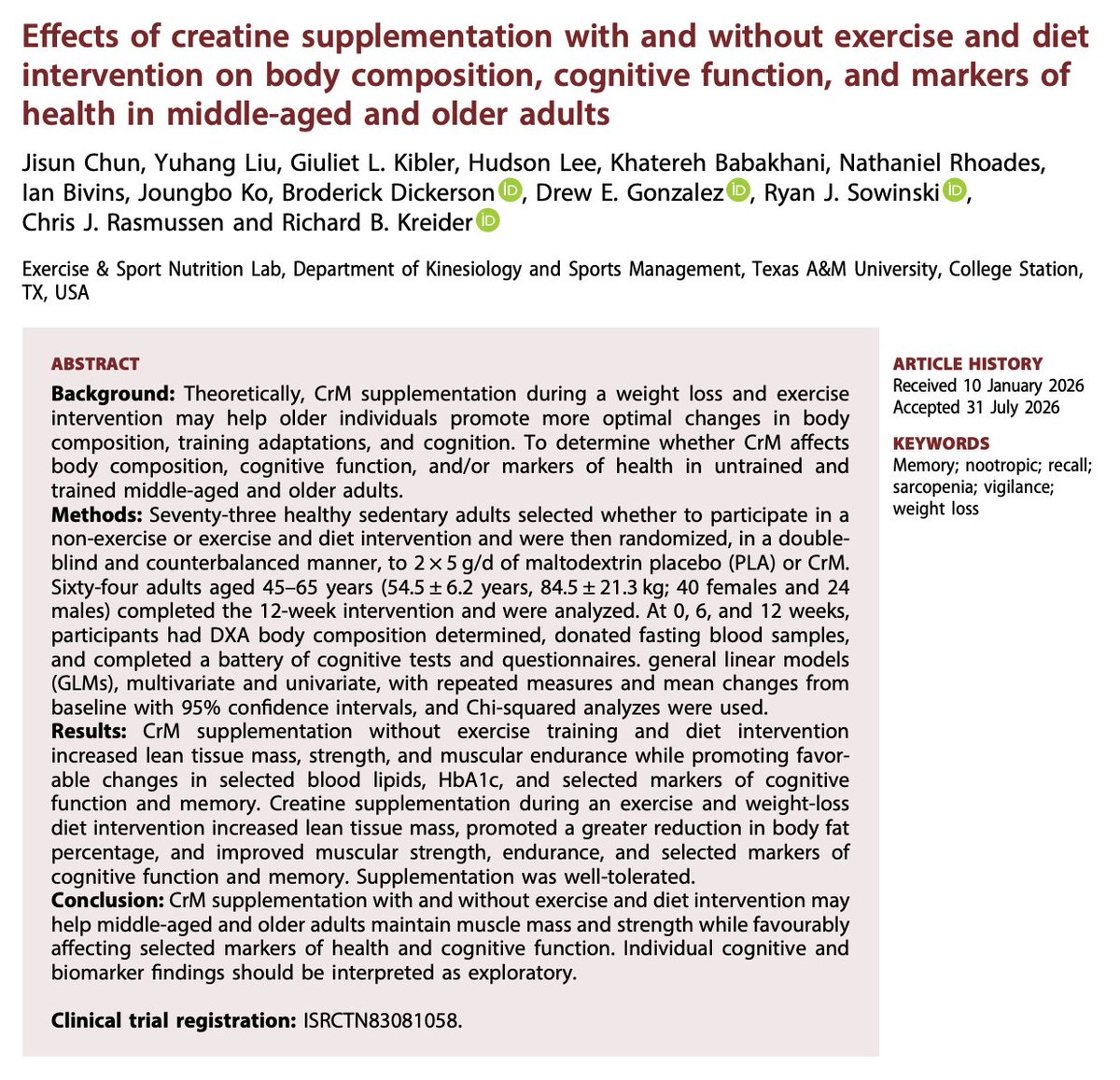
People who never trained took 10g of creatine a day and gained more lean tissue (2.43 lbs) than people who were lifting 3x a week with no creatine (0.31 lbs).
Here's the breakdown: (1/18)
Real trial, worth knowing. Read it before you skip the gym.
The no-workout groups were 13 people each. The ~2.4 lb gain was "lean tissue" on a DXA scan, and creatine pulls water into muscle, so some of that is water.
Strength did tick up. Creatine plus lifting did more.
Stunning Research:
Creatine isn’t just a gym supplement.
In a 12-week Texas A&M trial, adults 45–65 taking 10 grams a day gained lean tissue and strength even WITHOUT a workout plan.
Add lifting, cardio, and a small calorie cut, and they kept muscle while losing more fat than exercise and diet alone.
Blood sugar, cholesterol, and memory markers moved too.
With training and creatine even bigger gains. But 10 g of creatine monohydrate did a lot more than most people expect.
Does creatine do anything for your brain, or is that just gym-bro science with a new costume?
One Alzheimer’s study is getting passed around like a verdict. We break it down👇
https://t.co/am9cnHl7QX
Does creatine do anything for your brain, or is that just gym-bro science with a new costume?
One Alzheimer’s study is getting passed around like a verdict. We break it down👇
https://t.co/am9cnHl7QX
Creatine for the brain isn’t the gym story.
A small Alzheimer’s pilot (~20 people, 20g/day, 8 weeks) raised brain creatine ~11%. That’s real chemistry — not proof of a “30% slowdown.”
Early, mixed, more plausible when the brain is stressed or short on creatine. Not a miracle pill.
Study: https://t.co/HNmEqIs648
@PeterDiamandis Permission is cheap. The useful AI bet in longevity is faster failure detection and clearer go/no-go signals — not “incurable → cured” slogans.
@Medscape 41% lower cancer risk is relative. Which cancers, and how many fewer cases per 1,000 people? Without the denominator it’s a headline, not a decision.
@chiragbarjatya 200–300mg oxalate in a “healthy” smoothie isn’t a flex if you’re stacking greens + nuts + protein all day. Kidney stones are a dose problem, not a virtue one. Rotate low-oxalate options if you’re already high-protein and dehydrating in the gym.
@siimland Glycine calming vs NMDA isn’t a blanket “take this” tip — dose and context decide whether it’s a sleep tool or just another supplement story.
@agingdoc1 Sarcopenia as systemic energetic failure, not “they just don’t exercise,” is the useful frame. Inactivity is a piece; it isn’t the whole diagnosis.
@JCanNuSH TRIUMPH-1 / retatrutide dropping is less interesting as a scale win than as “discontinued for excessive loss” — dose, BMI, and who got pulled matter. Healthspan isn’t just how fast the number falls.
@dantawfik Pontzer’s constrained-energy point is the part diet orthodoxy keeps skipping: more exercise often gets partly compensated elsewhere. Useful for weight loss expectations; not a reason to quit training for healthspan.
@agingdoc1 Adiposity → disease risk is the boring truth under a lot of longevity noise. The useful question is which fat/measure actually moves a decision this year, not which pathway slide looks scarier.