I was proud to have been part of the team, led by @mackinprof, that comprehensively updated the previous ACSM Position Stand on resistance training prescription, published earlier this year (PMID: 41843416).
This was a massive undertaking: an umbrella review of 137 systematic reviews encompassing >30,000 participants were synthesized to determine how resistance-training variables influence strength, hypertrophy, power, and physical function.
Some key takeaways:
For muscle hypertrophy:
--Higher weekly volume appears beneficial, with ≥10 sets per muscle group/week enhancing growth
--Hypertrophy can be achieved across a wide range of loads (30–100% 1RM)
--A high level of effort is required to optimize results but training to momentary muscle failure does not appear necessary
--Higher training frequency does not independently enhance hypertrophy when volume is equated
--Periodization, repetition duration, and exercise order did not consistently affect hypertrophy
For strength:
--Heavier loads (≥80% 1RM) are advantageous
--Training ≥2 days/week is beneficial
--2–3 sets per session and a full range of motion can enhance strength
--Prioritize exercises you want to improve by performing them earlier in the session
For power:
--Moderate loads (30–70% 1RM) are favored
--Intentional high-velocity/power training and Olympic-style weightlifting can enhance power
--Lower-to-moderate training volumes appear preferable
Perhaps the biggest take-home: Resistance training itself matters far more than obsessing over most individual programming variables. Many commonly debated aspects of program design had little or inconsistent influence on outcomes. #justlift
https://t.co/NJLmUflaRD
Does having a naturally muscular physique actually mean you’ll build more muscle from lifting? Are ectomorphs necessarily hard gainers while mesomorphs are genetically built to grow?
A new study from my lab put these questions to the test. We investigated whether baseline somatotype predicts muscular adaptations to resistance training. Forty untrained young men completed a supervised, whole-body resistance training program twice per week for 9 weeks. We assessed somatotype using the Heath–Carter method and measured changes in muscle size and multiple aspects of physical performance.
What did we find?
Greater mesomorphy showed some positive associations with muscle growth, but the effects were small to trivial and unlikely to be practically meaningful. Once the other components of somatotype—endomorphy and ectomorphy—were accounted for, there was little evidence that mesomorphy independently predicted hypertrophy.
The same general pattern emerged for performance: being more mesomorphic did not meaningfully predict overall improvements in performance. One interesting exception was bench press strength, where greater baseline mesomorphy showed a modest positive association with gains—but this exploratory finding requires further research.
We also found that greater African genetic ancestry was associated with higher mesomorphy scores, suggesting that ancestry may contribute to differences in body morphology. Importantly, however, greater mesomorphy did not translate into superior overall training responsiveness.
Take-home: Having a naturally muscular build does not necessarily mean you have a greater capacity to build muscle. Likewise, having a more ectomorphic—or naturally slender—physique does not mean you’re destined to be a “hard gainer.”
Important caveat: This was an exploratory analysis involving a relatively small sample of young, previously untrained men over just 9 weeks. We need larger and longer-term studies before drawing more definitive conclusions on the topic.
Kudos to my master’s student @thechrisparnell for leading the project and, as always, to the students in my Applied Muscle Development lab for bring it to fruition
https://t.co/rTFxoXBWQf
There’s compelling evidence that training with light loads can build muscle just as effectively as heavier loads when sets are taken sufficiently close to failure. However, some influencers claim that high-reps should be avoided because they induce substantial fatigue.
It’s true that some acute research suggests greater strength impairment and perceived discomfort after light vs heavy load (e.g., PMID: 32401690).
Why?
High-rep sets produce substantial metabolic stress and acidosis, which can make training feel particularly demanding and associated neuromuscular effects conceivably may linger. However, there’s an important caveat: light-load training is unfamiliar to most lifters. Because novel exercise tends to produce greater muscle damage and fatigue, these acute findings may overstate the recovery demands of light-load training when performed regularly. Indeed, repeated exposure ultimately attenuates these effects.
To this point, our lab conducted an 8-week study examining the effects of light (25–35RM) versus heavier (8–12RM) loads performed to failure in trained men (PMID: 25853914). During the first week, several participants in the light-load group puked, and all reported high levels of discomfort. By the second week, however, these adverse responses had largely resolved.
Importantly, the overwhelming body of longitudinal research shows similar whole muscle hypertrophy with light vs heavy load training, indicating that fatigue does not influence results.
From a practical standpoint, using a range of loading zones may be a viable approach to maximize hypertrophy while providing variety in training. Also, some research shows that different loads may preferentially stimulate different muscle fiber types, which could be synergistic to hypertrophy (evidence remains equivocal).
Take-home: Acute research cannot necessarily be extrapolated to long-term results. Light loads are an effective hypertrophy stimulus—but “lighter” doesn’t necessarily mean “easier.” High-rep sets near failure can be extremely demanding and may temporarily prolong recovery, but evidence indicates any initial effects on fatigue don’t compromise long-term gains.
Resistance training works—and it doesn’t need to be complicated🏋️
ACSM’s review of 137 systematic reviews; train regularly, progressively, and with sufficient effort. Volume matters for hypertrophy; heavier loads favor strength
Consistency > complexity
https://t.co/Myq7i19uGX
Does cardio kill your gainz? The “interference effect” has long suggested that combining aerobic and resistance training may be detrimental to hypertrophy.
But what does the research actually show?
A systematic review and meta-analysis from Tommy Lundberg’s lab (PMID: 34757594) compared concurrent aerobic + resistance training with resistance training alone. Across the hypertrophy analysis, 15 studies involving 389 participants were included.
The result?
Virtually no difference in muscle growth.
Contrary to some previous metas, the analysis also found no evidence that the hypertrophy results differed based on factors such as whether aerobic training involved cycling vs. running, training frequency, age, or training status.
Take home: Want to build muscle but also enjoy cardio? The available evidence suggests that adding aerobic exercise to your resistance-training program does not meaningfully compromise muscle hypertrophy.
I’d note that the findings of the analysis are specific to performing a low-to-moderate amount of cardio. Things may change as cardio volume gets higher, but we simply don’t have enough research to say with confidence where—or even whether—a meaningful interference effect kicks in. It’s logical to assume that at some point there will be a negative effect from nonfunctional overreaching.
The role of cardio intensity is also unclear, although it’s reasonable to think that intensity and volume interact, with high amounts of both potentially increasing the risk of compromising muscle development.
Finally, there is relatively little evidence in highly trained individuals. It’s conceivable that as someone gets closer to their “genetic ceiling,” the margin for further adaptation becomes smaller, potentially making concurrent cardio more likely to interfere with optimizing muscular gains.
https://t.co/nuCcUr1b5Q
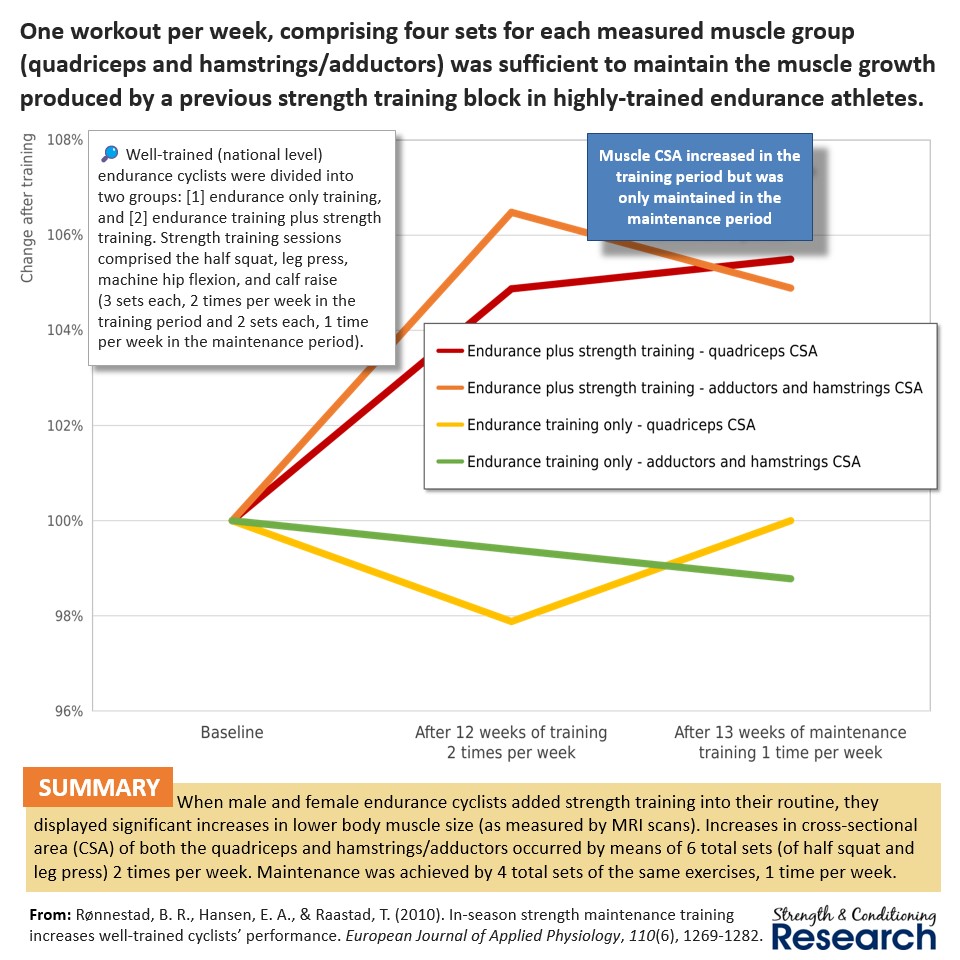
The maintenance literature routinely shows that 3-4 sets, once per week can only maintain net hypertrophy across the week. In contrast, 1 set twice per week causes growth. This shows that atrophy happens within a training week and that frequency is important.
Muscle growth has diminishing returns per session. 📉
🏋️4 hard sets/week? Try 2+2 across two sessions: same volume, potentially better set quality and less fatigue.
https://t.co/NVee1C9y7k
Bro-split vs distributed volume for gains?
A new study from the lab of Calzavara & Barroso compared two ways of distributing the same weekly training volume in resistance-trained men:
--RT1: 9 lower-body sets performed in 1 session/week
--RT3: The same 9 sets distributed across 3 sessions/week
All sets were performed at 80% 1RM to concentric failurefor 6 weeks.
What happened?
Distributing the sets across 3 days allowed participants to perform substantially more total work:
--Back squat: +58% volume load
--Leg press: +76% volume load
--Leg extension: +38%
However, the increase in volume load did not translate into statistically significant increases in strength or hypertrophy across the 6-week study period.
On the surface, the results seem suggest that it makes little difference whether weekly training volume is concentrated into a traditional bro split or distributed across multiple sessions. However, closer examination of the results paints a more nuanced picture. Strength gains showed a directional advantage for the 3-day condition, particularly for the squat. Similarly, increases in vastus lateralis muscle thickness favored the 3-day condition, with the effect size suggesting a modest benefit to distributing training volume. Importantly, the small sample size limited the study’s ability to detect potentially meaningful between-group differences, highlighting the limitations of relying on statistical significance testing to interpret findings in the applied sciences.
Take home: Spreading your weekly sets across multiple sessions can help accumulate substantially more volume load without adding sets or increasing the load. There may also be an advantage for strength and hypertrophy, although the study wasn’t sufficiently powered to draw strong conclusions on these outcomes.
https://t.co/YVzdtp2XUc
The dumbbell bench press and dumbbell fly are staples of chest training—but does one produce better pec growth?
Our new study, just accepted in JSCR, set out to answer this question. We randomized recreationally trained men to perform either the dumbbell bench press or dumbbell fly twice per week for 10 weeks. Training volume was individualized based on each participant’s previous chest-training volume, and muscle thickness was assessed at multiple regions of the pectoralis major using ultrasound.
The results: Both exercises appreciably increased in pec muscle thickness, with no notable differences between groups at any of the measured regions. Overall increases in summed muscle thickness were approximately 13% for the dumbbell bench press and 15% for the dumbbell fly.
Interestingly, we hypothesized that the fly would produce greater hypertrophy because of its presumed greater resistance moment arm when the pecs are lengthened. This hypothesis was not supported.
Practical takeaway: If your primary goal is pec hypertrophy, both dumbbell presses and flyes appear to be viable options. On a basic level, exercise selection can therefore be based, at least in part, on personal preference, comfort, and individual training goals.
It should be noted that the study involved recreationally trained men and lasted 10 weeks, so we can’t necessarily generalize the findings to women, highly trained lifters, longer training periods, or other chest exercises.
Importantly, exercise selection doesn’t have to be an either/or choice. This begs the question: Could combining presses AND flyes provide greater pec development than performing either exercise alone? More research is needed on the topic but, until shown otherwise, it's generally a good strategy to include some variation in movements if your goal is to optimize hypertrophy.
https://t.co/G1nsiUwzUD
Even very low-volume resistance training can work. 💪
In trained adults, 1 set/exercise, 2×/week for 8 weeks increased muscle size and strength. Training to failure may slightly favor hypertrophy vs 2-RIR.
Effective ≠ optimal.
https://t.co/ksLap3A5ss
Can different exercises preferentially grow different parts of a muscle group? Our study in resistance-trained individuals suggests they can (doi: 10.1007/s42978-024-00299-4).
After 8 weeks of supervised resistance training, we found:
--Leg extensions preferentially grew the rectus femoris ( 8.9% vs. 4.7% with the leg press).
--Leg presses preferentially grew the vastus lateralis (8.7% vs. 2.9% with the leg extension).
--For the calves, straight-leg plantar flexion preferentially grew the gastrocnemius compared with bent-leg calf raises.
-- Results for the soleus showed a small hypertrophic advantage with the bent- versus straight-leg calf raise, although there was greater uncertainty regarding whether this represented a true benefit.
Practical takeaway: Exercise selection isn't just about training a muscle—it can influence where the muscle grows. If your goal is comprehensive muscle development, relying exclusively on a specific exercise may leave some growth on the table. Our findings suggest that combining multi-joint and single-joint exercises may provide more complete development of the quads, and that varying knee position may influence regional calf development. Importantly, optimizing results requires careful attention to biomechanical and anatomical principles—simply varying exercises haphazardly won’t get the job done.
https://t.co/w2GAi66fmr
Progressive overload is a fundamental exercise science principle for continued gains from resistance training. Many people think that progression always means putting more weight on the bar? But is this really the case…?
My lab investigated this question by comparing two approaches in resistance-trained men and women (PMID: 36199287): One group progressively increase the weight while keeping reps within the same range while another group kept the weight constant while progressively performing more repetitions. Regardless of group allocation, participants trained their lower body twice per week for 8 weeks, performing 4 sets each of squats, leg extensions, and two calf-raise exercises. All sets were performed with a high degree of effort.
What did we find?
Both strategies produced substantial muscle growth, with average increases of ~7–13% across measurement sites. For most muscles, there were minimal differences between increasing load and increasing reps. Interestingly, rectus femoris growth modestly favored the REPS condition, although this finding should be considered preliminary.
Strength gains slightly favored progressively adding weight, but the difference was small and uncertain. Local muscular endurance improved similarly between conditions.
Take-home: Progressive overload doesn't necessarily require continually adding weight to the bar. Adding reps with the same load can be an effective form of progression for building muscle, at least over an 8-week training period.
The results suggest that lifters have considerable flexibility in how they structure progression, which may be particularly beneficial when heavier loads are unavailable or when continually increasing load is impractical or undesirable. The findings also provide some support for the viability of double-progression training, whereby repetitions are progressively increased within a predetermined range before subsequently increasing the load.
Bottom line: Progressive overload is about progressively challenging your muscles—not just lifting heavier.
https://t.co/jn1Bf99HbI
Does slowing down your reps lead to greater muscle growth?
To answer this question, we conducted a meta-analysis examining how manipulating the tempo of the concentric (lifting) and eccentric (lowering) phases of a repetition affects muscle hypertrophy. The analysis included 14 studies involving 278 participants.
The main finding: Rep tempo doesn’t seem to matter much for muscle growth.
Both faster and slower repetition tempos produced meaningful muscle growth, with only trivial differences between them and considerable uncertainty in the estimates. These findings were generally consistent across concentric and eccentric tempos and for both upper- and lower-body muscles.
It’s important to note that although slower eccentrics do not appear to enhance hypertrophy, lowering a load too quickly could theoretically increase stress on the joints. Thus, it seems prudent to maintain control of the load during the eccentric phase to help minimize potential joint-related injury risk.
Practical takeaway: You probably don’t need to obsess over a specific repetition cadence for maximizing hypertrophy. The available evidence supports using a fairly broad range of concentric and eccentric tempos—roughly 0.25 to 4.5 seconds per phase—and selecting a cadence based on preference, comfort, and training goals. Other programming variables, particularly training volume and proximity to failure, likely deserve greater attention.
One caveat: this shouldn’t be interpreted as “tempo can never be too slow.” There is relatively little research on very slow tempos and, based on the limited evidence we have, an upper threshold may exist beyond which hypertrophy is compromised.
https://t.co/MJDFvCtJri
The concept of “muscle confusion” (i.e., frequently changing exercises to provide a novel training stimulus) has been popular in fitness circles for years. But does constantly varying your exercises actually produce better gains?
Our research group investigated this question in resistance-trained men, comparing a traditional program using a fixed selection of exercises with a program in which exercises were randomly varied from session to session using a fitness app (PMID: 31881066). Participants trained 4 d/wk for 8 wks, with training volume equated between conditions.
Results were interesting:
For muscle growth, both groups increased quadriceps muscle thickness, with no statistical differences between groups for any of the muscles assessed. However, rectus femoris hypertrophy was modestly greater for the fixed exercise group
Both groups also increased squat and bench press 1RM, again with no statistical differences between conditions. However, bench press increases were modestly higher using fixed exercises.
Differences emerged for motivation, with greater intrinsic motivation observed when exercise selection was randomly varied compared with maintaining a fixed exercise selection.
Take-home: Randomly varying exercises doesn’t appear to provide a “muscle confusion” advantage for hypertrophy or strength, and it may actually attenuate gains. However, exercise variety may help keep training fresh and increase motivation, which could conceivably have important implications for long-term adherence.
There may also be a trade-off to too much variation. Constantly rotating complex exercises may interfere with motor learning and potentially compromise muscular adaptations. A reasonable strategy may be to keep complex exercises (e.g., squats, deadlifts, and rows) relatively consistent while incorporating more variety into simpler exercises such as leg extensions, machine presses, and curls.
As always, context matters: variation can be a useful tool, but variation for the sake of variation isn’t necessarily better. Importantly, exercise selection should be purposeful based on individual goals, taking biomechanics and applied anatomy into account.
https://t.co/22Nas4VM0R
An example of a time-efficient, minimum effective dose resistance training routine you can do with just a set of dumbbells and make appreciable gains 💪
https://t.co/E38KtDzIWb
Training closer to failure seems to tilt the gradient of the force-velocity profile towards more force dominance, primarily by reducing maximum velocity. This is likely the result of muscle fiber type shifts caused by calcium ion accumulation in the final couple of reps of the set.
Muscle growth isn’t linear💪
A meta-analysis of 480 studies found larger gains early in resistance training, with diminishing gains over time.
At 10 weeks, modeled growth was ~7%. The curve flattens—it doesn’t stop📈
https://t.co/wIHLojj6kn
Building 1 kg of skeletal muscle may require ~3,200–3,700 extra kcal, according to a new physiological model. 💪
But 3,500 kcal ≠ 1 kg muscle—training, protein & individual response matter.
https://t.co/w90G7Yr06x
As we age, muscle power declines more rapidly than muscle strength, potentially increasing the risk of debilitating falls. This raises an important question: Should older adults prioritize power training in addition to traditional strength training?
Our systematic review and meta-analysis, led by @ExerciseBiology, compared power training—performing the lifting phase of an exercise as fast as possible while controlling the lowering phase—with traditional, slower-velocity strength training. The analysis included 20 randomized controlled trials involving 566 older men and women (mean of ~70 years of age).
Results showed that power training produced a statistically significant advantage across multiple measures of physical function. Although the overall magnitude of the effect was relatively modest (SMD = 0.30), these improvements could conceivably be practically meaningful and potentially help reduce the risk of falls in older adults.
Importantly, power training does not require specialized or unconventional exercises. In most studies, participants performed traditional resistance exercises, with the key distinction being an instruction to lift the weight as fast as possible during the concentric phase while maintaining control during the lowering phase.
Take-home: Traditional resistance training remains highly beneficial for older adults, but performing the lifting phase with maximal intended velocity may provide an additional benefit for muscle power and physical function without compromising strength or muscle development. This doesn’t mean that power training needs to be performed across all sets all the time; simply devoting a portion of training to
I’d the that the certainty of the evidence was relatively low, with most studies involving small samples and relatively short (~12-week) interventions. Thus, the findings should be considered promising rather than definitive.
https://t.co/PFh9lmhqv8