Assistant Professor of Political Science at BYU
Research political conversations and persuasion. Political psychology and computational social science.
Can AI simulate human behavior? 🧠
The promise is revolutionary for science & policy. But there’s a huge "IF": Do these simulations actually reflect reality?
To find out, we introduce SimBench: The first large-scale benchmark for group-level social simulation. (1/9)
In a Perspective, @lpargyle, @davidwingate and colleagues discuss the challenges and opportunities related to scientific inference with LLMs in the political and social sciences.
➡️https://t.co/MikUoNu0Hw
🔓https://t.co/2uVNcHiyfp
🧵(9/13)
If big companies have our data, can they use in conjunction with LLMs to persuade people on hot-button political issues? Our new study, published in PNAS, puts LLMs to the test persuading people on hot-button political topics. 🧵[1/6]
Bottom line: AI can shift opinions at scale, but personalization and chat didn’t add much. If you’re curious about the ability of AI to persuade-and its limits-check out our full open-access paper:
https://t.co/zClco9ozWz [6/6]
Lisa P. Argyle, Assistant Professor of Political Science at Brigham Young University, will be a keynote speaker for #IC2S2 2025 in Norrköping, Sweden.
🎙Artificial Insights? The Promise and Pitfalls of AI in Social Science.
Learn more: https://t.co/CKlVXgMxX3.
I held a class on doing research that I thought I would share. The slides contain writing tips, using ChatGPT, advice for non-native speakers, editing, and my biggest advice: Be hard on the writing, not on yourself. Self-worth is not at stake. https://t.co/Mv3A6Uxx6x
What began as a @BYU_CSED poster project with @klehshey and Heather Walker is now forthcoming at @The_JOP! Immensely grateful for @lpargyle and @JeremyCPope for their mentorship and for helping us turn our research into a paper!
Republicans high in white identity do not differ from other Republicans on ideology or policy preferences. But high white identity Democrats are more conservative in ideology and issue positions than other Democrats
https://t.co/zUEW2up6J3
Computational Political Scientists: @EthanBusby and I are organizing a CWC at @spsanews on Generative Language Models. Apply by August 16; Conference in Puerto Rico Jan 8 - 11. Please apply and circulate widely! https://t.co/4LgFdf3e5c
Computational Political Scientists: @EthanBusby and I are organizing a CWC at @spsanews on Generative Language Models. Apply by August 16; Conference in Puerto Rico Jan 8 - 11. Please apply and circulate widely! https://t.co/4LgFdf3e5c
Computational Political Scientists: @EthanBusby and I are organizing a CWC at @spsanews on Generative Language Models. Apply by August 16; Conference in Puerto Rico Jan 8 - 11. Please apply and circulate widely! https://t.co/4LgFdf3e5c
Feeling nervous about talking politics with your friends and family this election season? New research by @BYUPoliticalSci professor @lpargyle finds that engaging in positive self-affirmation can affect the way people engage in political conversations.
https://t.co/7eduyltZ0M
Computational Political Scientists: @EthanBusby and I are organizing a CWC at @spsanews on Generative Language Models. Apply by August 16; Conference in Puerto Rico Jan 8 - 11. Please apply and circulate widely! https://t.co/4LgFdf3e5c
New Article! Using text analysis and survey experiments, we show that although people talk about cancel culture in terms of democratic values, in-group vs. out-group partisan dynamics are what actually shift people's support for "canceling" different actors. @EthanBusby
In #FirstView by Elle Diether (@UTAustin), Suzy Yi (@BYU), Lisa P. Argyle (@BYU), and Ethan C. Busby (@BYU): "The Political Psychology of Cancel Culture: Value Framing or Group Identity?" https://t.co/qoWzWbdBju
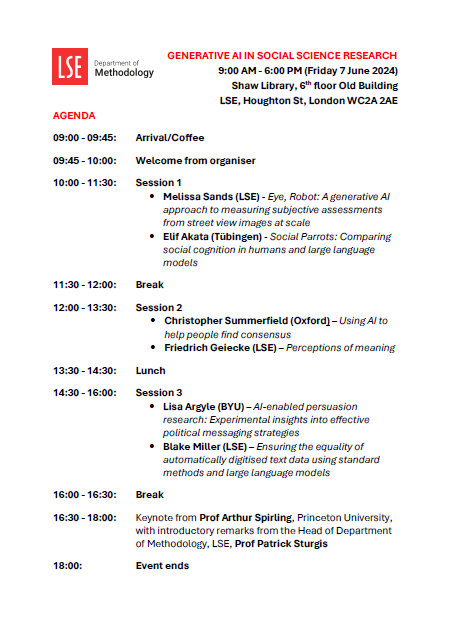
🚨Don't forget to join us tomorrow at Shaw Library (Floor 6, Old Building, LSE) for a full-day event showcasing latest research on generative AI in social science research from scholars at @LSEnews, @UniofOxford, @BYU and @uni_tue.
We look forward to welcoming you all!
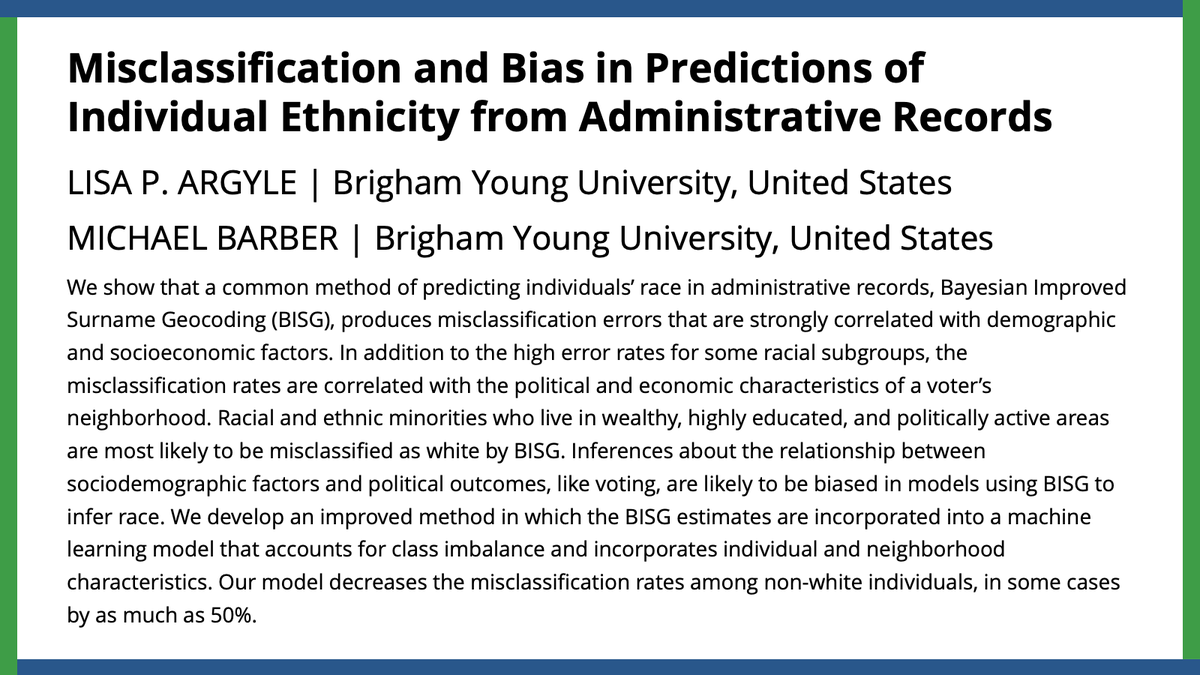
In this #APSRNewIssue article, @lpargyle & @mbarber83 introduce a new machine learning influenced method to correct for misclassification in Bayesian Improved Surname Geocoding (BISG), reducing the misclassification error by up to 50 percent.
https://t.co/eAKXaqyIjF
🚨CAN GENERATIVE AI IMPROVE SOCIAL SCIENCE?🚨 I spent the last year trying to answer this question with the help of some very thoughtful reviewers (and editors) for the Proceedings of the National Academy of Sciences (ungated) : https://t.co/M148OatUNl
Talking about political topics can be difficult, and it’s even harder to do this online! Researchers at @BYU & @DukeU wanted to see if using AI could help make these chats kinder. Learn more in our newest adapted article: https://t.co/RMtLdIYrF6 @lpargyle@EthanBusby@chris_bail
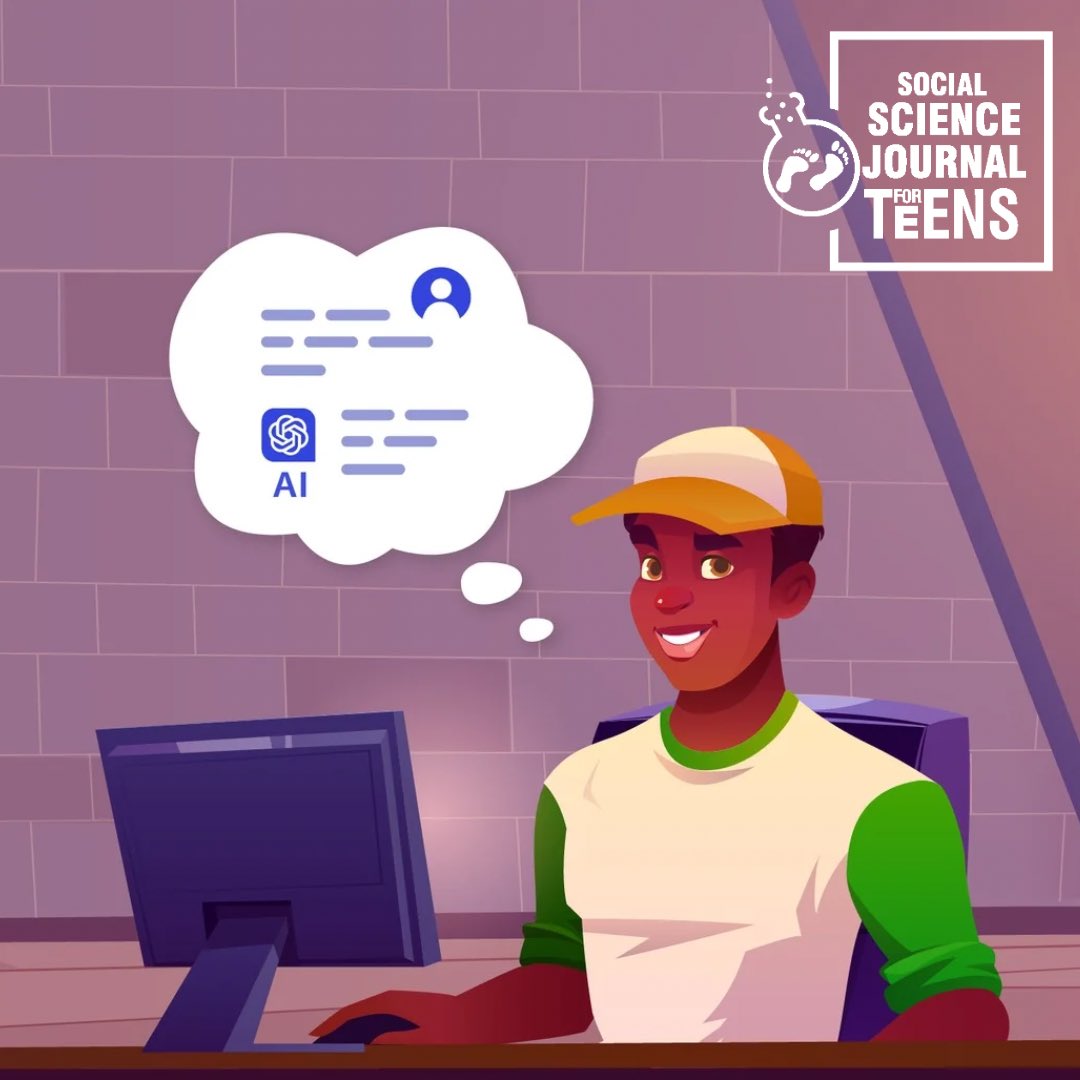
Science education is so vital. Check out the amazing work of "Science Journal for Kids" which recently covered our research on using AI chatbots: https://t.co/EfHs412fub Lots of other amazing content created by a small but mighty team. Please share or support them!