Did you know that metal ions are required or control more than 90% of metabolic pathways, and that physiological concentation changes affect most od the proteome and signaling system? Tour de force from our Simran Aulakh! https://t.co/6djvPUROJ1
Starting autumn, we will have a new #PhD position available in #Microbiology, to use spatially resolved #Metaproteomics to study metabiolic interactions in the gut #microbiome. Reach out if interested, or forward of you know anyone who might! https://t.co/J0DBu23LCH
I am excited to see our performance assessment of the successor of Scanning SWATH on the Zeno TOF7600+ mass spectrometer - ZT Scan DIA - pre-printed (https://t.co/qu4POAppGQ).
@stevetate_absx We are super thrilled to see ZT Scan DIA leading to insight from miniscule proteome samples, in clinical proteomics and functional proteomics studies that depend on highly precise protein quantification from large sample series.
Agree. I am convinced that this is what one sees in FAIMS...and most likely any flavour of ion mobility separation, also see here:
https://t.co/wI8InrZkuy
-> described in Supp. Fig. S3 & associated discussion
New preprint! We show that photo-crosslinking dramatically improves structural insights into protein complexes compared to traditional crosslinking MS methods.
https://t.co/sKlI9KTtRh
We’re excited to present this integrative analysis of single-cell proteomics and transcriptomics of the human HSPC hierarchy. Amazing teamwork with @NilUresin, @_sabrinarichter, @fabian_theis, @erwinschoof, @Bo_Porse
https://t.co/H0e8IyTtX4
🧵
Happy to see #quantms out https://t.co/j26W0VvpUD. Thanks to the main authors Dai & Julianus. The @OpenMSTeam@OKohlbacher & @DemichevLab for the support with OpenMS and DIANN. Thanks to @lukas_k for his incredible work with the data. Thanks to @nf_core & @nextflowio platforms.
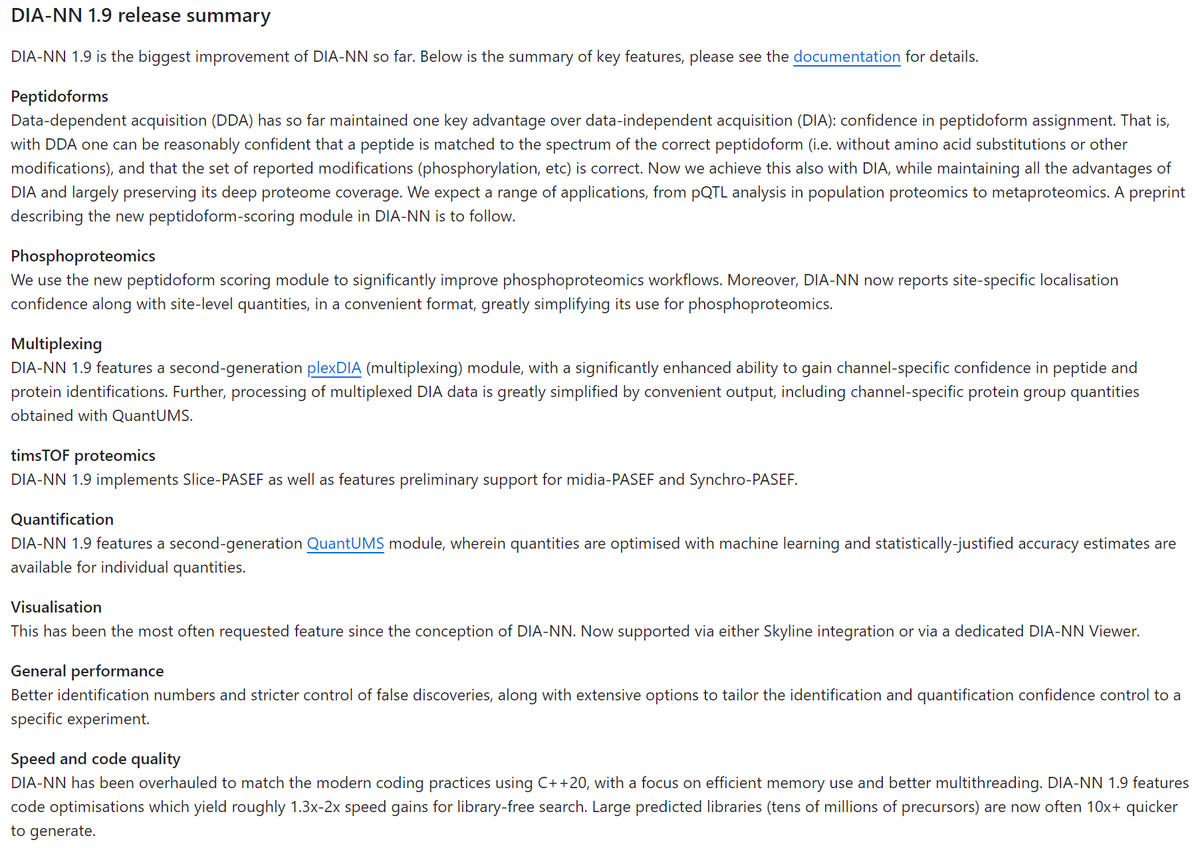
Excited to announce DIA-NN version 1.9, our software suite for proteomics data processing!
A range of cool new features and general performance improvements. We consider it the most significant update in the history of DIA-NN.
https://t.co/RKzniysMLg
Many will remember heavy debates in the yeast aneuploidy field. Are excess proteins dosage compensated, and if, how? Are there general signatures of aneuploidy? These problems solve studying natural strains. Time's back to study wild species, Biologists! https://t.co/lXYimEhQxG
Want to do absolute quantitative plasma proteomics, with an internal standard that costs you less than 1€ per sample? Have a look at our OSPP https://t.co/OuoBLuHLka
You ever wanted to do high-throughputproteomics on yeast, and contribute to solve the challanges created by the antimicrobial crisis? This might be the postdoc job for you https://t.co/3CxkHC3Wyk
Finally out 🥳
Quantitative Glycoproteomics at cohort scale ⏩
It was a great experience for me to work with @whit3matt and @chr_messner on this project ☺️
Fast chromatographic gradients and glycoproteomics? In our latest study we show that the scanning dimension in scanning SWATH can be used to assign precursor masses to oxonium ions for glycopeptide quantification @whit3matt@RalserLab https://t.co/Xo7KriU8OB
Want reliable quantities? Brilliant students in my lab @ZiskaKistner@JustusGrossmann figured out how. We present QuantUMS, an ML-based algorithm for step-change better quantitation in proteomics and statistical confidence in individual quantities https://t.co/9AhXScJfhl
QuantUMS is integrated in DIA-NN (beta version referenced in preprint), but we also plan to release it as an open-source tool, for use on various kinds of data, not just DIA.
We further anticipate significant gains to be achieved by integrating the accuracy metric reported by QuantUMS with existing packages for statistical analysis of proteomics data.
Some benchmarks are in the twitter thread below.