Seedance 2.0 on OpenArt AI
Prompt:
Main subject: young Korean woman, early 20s, natural everyday appearance, faded charcoal-grey sleeveless crop top, loose high-waisted light-wash jeans, black canvas sneakers, black cord necklace, black wavy hair in a messy side ponytail with wispy bangs. Realistic skin texture, minimal makeup, warm and approachable personality. Maintain consistent identity, clothing, hairstyle, and appearance throughout the entire video.
Location: Authentic Korean residential neighborhood during a calm late morning. Narrow concrete alleys, low-rise homes, small terraces, potted plants, laundry lines, bicycles, utility poles, overhead wires, mature trees casting moving shadows, quiet residential atmosphere. No stores, advertisements, cafés, crowds, or commercial activity.
Visual Style: Ultra-realistic documentary realism. Genuine candid behavior. Natural body language. Unscripted slice-of-life feeling. Strong environmental authenticity. Rich real-world details and believable human motion.
Camera Style: Early-2000s consumer DV camcorder aesthetic. Friend casually recording everyday moments. Heavy handheld shake, imperfect framing, frequent autofocus hunting, lens breathing, exposure pumping when moving between sun and shade, occasional motion blur, subtle rolling shutter, mild digital compression artifacts, faded colors, soft contrast, slight sensor noise. No stabilization. No cinematic camera moves. No modern color grading.
00:00–00:02
Outside a small house entrance. She sits on a low concrete wall adjusting her ponytail with both hands raised. A light breeze moves loose strands of hair. She smiles naturally while the camera struggles to hold focus.
00:02–00:04
The camera follows her into a narrow alley lined with potted plants and concrete walls. She notices a stray cat approaching and crouches down. Framing drifts off-center as the operator tries to keep up.
00:04–00:06
She gently pets and feeds the cat. Autofocus repeatedly shifts between her face and the animal. Morning sunlight flickers through leaves overhead.
00:06–00:08
Small front yard beside her house. She hangs laundry on a clothesline while fabrics sway in the breeze. Exposure changes as clouds briefly pass overhead.
00:08–00:10
On a quiet terrace with a ceramic coffee cup. She sits comfortably watching the neighborhood, occasionally brushing hair behind her ear. Loose handheld side angle with natural camera drift.
00:10–00:12
Close side profile. Someone off-camera greets her. She turns, raises her hand, smiles warmly, and casually says, “Annyeong.” The camera catches the moment slightly late.
00:12–00:15
Walking slowly down a tree-lined residential lane holding her coffee cup. She notices the camera, gives a small genuine smile, then looks away and continues walking. Recording cuts abruptly to black mid-motion as if the camcorder was switched off.
Audio: Natural ambient sound only — morning birds, distant motorcycles, light wind, leaves rustling, faint neighborhood chatter, cat sounds, footsteps on concrete, fabric moving on clotheslines, subtle residential ambience. No music. No sound design. No narration.
Goal: Authentic Korean neighborhood life captured like a forgotten home video from the early 2000s — candid, imperfect, realistic, warm, and deeply believable.
The Machine Intelligence Research Institute calls for restricting AI research itself.
It lays out a research-control regime for monitoring researchers and organizations, including penalties that "could plausibly include prison sentences."
This new paper catalogs 28 mechanisms, including intelligence gathering, international search warrants and inspections (of properties, computers, and files), polygraphs; inference-content monitoring (of user prompts, tool use, model outputs), sting operations, AI-assisted code review (which may extend to codebases, experiment logs, and research documents), embedded auditors, employee-monitoring software, chip-use monitoring, training-data review, and model allowlists.
@libsoftiktok Poor guy, didn't have a machete yo kill it's neighbors had to use non conventional tools. Maybe the state will sponsor a proper weapon on hos next rampage?
A milestone for China-#LatinAmerica finance cooperation!
🇧🇷#Brazil becomes the first #LatinAmerican country to register for sovereign Chinese yuan-denominated #pandabond issuance.
Brazil to raise up to 5 billion yuan ($735 million) with its first-ever issuance of panda bonds, the largest debut of yuan-denominated debt by a foreign nation in China.
Brazil's Finance Minister Dario Durigan made it clear, this is a "test" to help private Brazilian firms deepen their presence in the world's second-largest economy.
NVIDIA just released an optimized GLM-5.2 on Hugging Face
A 753B parameter MoE with 1M context,
quantized to NVFP4 for Blackwell GPUs—
nearly matching FP8 accuracy.
@francoisfleuret because open source wins?
not just good models, trained on chinese chips.
but my call is that they will start serving inference on a scale and can get more valuable training data without distilling.
also a VS code fork is worth the same as https://t.co/SGfO66JfoO
The G7 AI lunch showed that frontier AI leaders have become part of the room where geopolitical choices are made.
The meeting put Sam Altman, Dario Amodei, Demis Hassabis, Arthur Mensch, Aidan Gomez, Uljan Sharka, Victor Riparbelli, Robin Rombach, Alex Wang, Marc Benioff, and leaders from Sarvam and Sakana into the same room as national leaders.
Sam Altman, who sat between President Donald Trump and Egyptian President Abdel Fattah el-Sisi, was the first CEO to speak at the hours-long lunch.
The power shift is clear: governments can pass laws, but only a few private labs can build the models, test their dangerous abilities, restrict access, or provide the infrastructure needed to run them.
In G7, the immediate fight is over frontier AI access, because Anthropic’s Fable 5 and Mythos 5 triggered U.S. export controls after officials worried advanced models could help find software weaknesses at scale.
----
From "Forbes" YouTube channel, (link in comment)
BREAKING: GLM-5.2 is now 1st on Design Arena.
With an Elo of 1360, GLM-5.2 has jumped ahead of the now unavailable Claude Fable 5.
And it's open weights.
This is an improvement of 4 positions and 27 Elo points to achieve one of the highest Elo scores in our code categories since Design Arena started.
Huge congratulations to the @Zai_org on the release!
AMD acaba de dar un golpe fuerte en la IA local.
Lisa Su subió al escenario con un mini PC del tamaño de un libro grueso en una sola mano y ejecutó en vivo un modelo de 235 mil millones de parámetros. Sin datacenter. Sin cloud. Sin alquilar GPUs.
El protagonista es el Ryzen AI Max+ 395 (Strix Halo). Es el primer chip x86 que une CPU y GPU con 128 GB de memoria unificada. En Linux, el GPU puede usar hasta ~110 GB de esa memoria.
Para ponerlo en contexto: una RTX 5090 tiene 32 GB y una 4090 tiene 24 GB. Este pequeño equipo ofrece más del triple de memoria accesible para modelos grandes, en un chasis compacto.
En pruebas específicas de inferencia (como DeepSeek R1), superó en más de 3x al rendimiento de una RTX 5080 cuando el modelo no cabe en la VRAM de la tarjeta de Nvidia.
El precio real del equipo con 128 GB (GMKtec EVO-X2) suele estar entre $1,800 y $2,500 según ofertas (el kit oficial de AMD es más caro).
Para quien usa mucho IA, esto cambia las cuentas: en vez de pagar cientos de dólares al mes en suscripciones (Claude, ChatGPT Pro, Cursor, etc.), puedes correr modelos potentes localmente con Ollama, LM Studio o similares. Privacidad total, sin límites de tokens y sin que te corten el servicio a las 3 a.m.
No es que las suscripciones vayan a desaparecer mañana, pero para muchos casos de uso (RAG con documentos privados, prototipos, agentes locales, etc.) esta opción se vuelve muy atractiva.
Estamos viendo el inicio de una nueva etapa de IA local accesible y potente??
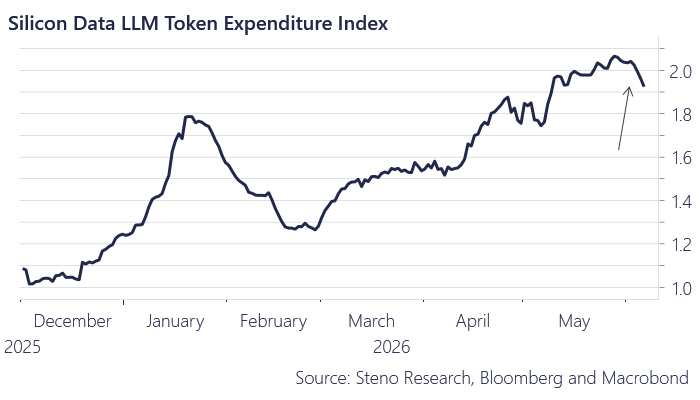
This is the chart that everyone should be watching.
If the Token Pricing rolls over, everything from the memory trade to the broader hard-ware and data-centre trade is over for this cycle imho.
The whole setup depends on this..
Before the week ends, let's acknowledge one of the most INSANE week ever for open AI, with 25+ notable open-weight drops across every modality:
🧠 LLMs
→ NVIDIA Nemotron 3 Ultra: 550B hybrid Mamba-MoE, only 55B active, 1M context, MMLU 89.1. NVFP4 variant claims ~5x throughput on Blackwell. First openly-weighted 550B hybrid Mamba-Transformer, closing the gap with frontier closed models.
→ Google Gemma 4 12B: fully open dense any-to-any (text/image/audio/video), 256k context, encoder-free, 140+ languages, AIME 2026 at 77.5. Shipped with a 23-checkpoint QAT wave (mobile ONNX + MLX). Most deployable model of the week.
→ StepFun Step-3.7-Flash: 198B sparse MoE VLM, ~11B active, SWE-Bench PRO 56.3. Apache 2.0.
→ Liquid AI LFM2.5-8B-A1B: edge MoE, just 1.5B active, 128k ctx, MATH500 88.8, MLX-ready. Best on-device option this week.
→ JetBrains Mellum2-12B-A2.5B-Thinking: their first open MoE, near-Qwen3-14B coding at 2.5B active. Apache 2.0.
🎨 Image gen (the surprise of the week)
→ Ideogram 4: their FIRST-EVER open weights. 9.3B flow-matching DiT trained from scratch. #2 overall behind GPT Image 2, top open-weight model on Design Arena + LMArena. Strongest open checkpoint for text-rich images, full stop. It has taste. Still can't believe this is open weights.
🔊 Audio & Speech (a breakout week for open TTS, 4 labs shipped)
→ Boson Higgs Audio v3 4B: 102 languages, 21 emotions, singing/whispering/shouting, sub-second TTFA.
→ RedNote dots.tts: the only fully continuous (no codec) open TTS pipeline, Apache 2.0.
→ Google Magenta RealTime 2: real-time music gen, <200ms latency, text+audio+MIDI. multimodalart ported it to PyTorch within hours with live ZeroGPU demos.
→ NVIDIA Nemotron-3.5 ASR: 600M streaming, 17x more concurrent streams vs Parakeet RNNT 1.1B.
👁️ Vision & VLMs
→ PaddleOCR-VL-1.6: SOTA document parsing at 1B params, Apache 2.0.
→ Baidu NAVA: 6.3B joint audio-video gen, best-in-class A/V sync, Apache 2.0.
🎬 Video, 3D & World Models
→ NVIDIA Cosmos3-Super: 64B omnimodal world model coupling action trajectories with video+audio gen, for Physical AI.
→ JD JoyAI-Echo: up to 5-min multi-shot text-to-video on LTX-2.3.
→ ByteDance Bernini-R + VAST TripoSplat (single-image-to-3D Gaussian splats, MIT).