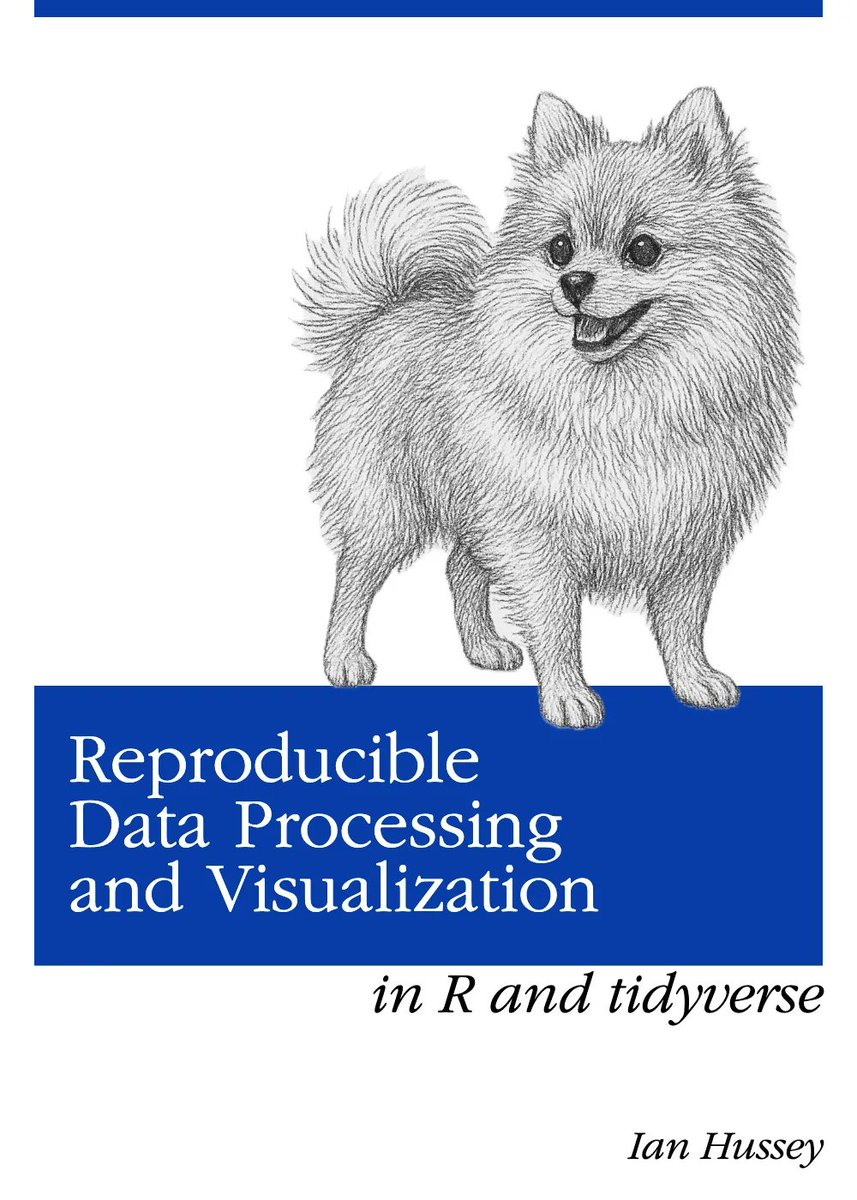
Rを使ったデータハンドリングや可視化の素晴らしいサイトを発見しました👀
コードを自分で書かないご時世でも、基礎や背後にある発想を知ることは、ある程度重要だと思います。
Ian Hussey: Reproducible Data Processing and Visualization
https://t.co/RGzQprSnzV
I teach a course called "Agentic Programming".
achieved today in 2h:
-install WSL2 on 19 student laptops
-get 40 students an openrouter API key
-install opencode on 40 laptops and connect to openrouter
-it was hard, but we did it! Now for the fun part
https://t.co/BtrOnvQ5xJ
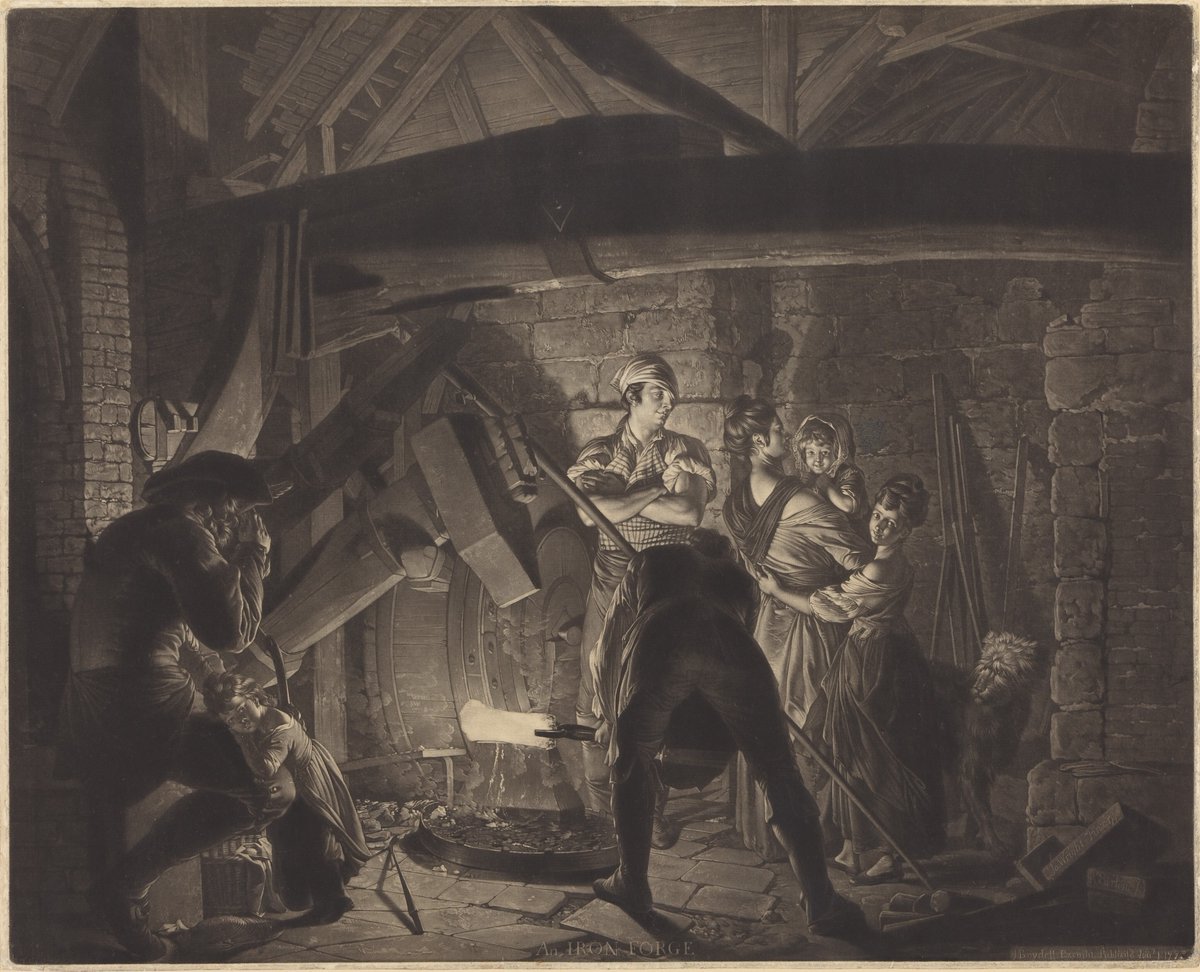
🧵1/10 Given the recent reactions of mathematicians over rapid advances in AI, I think it is important to remember that technological change has historically been a very personal event for people.
Over the history of technological progress, looms have fallen silent, switchboards have gone dark, and factory lines have shrunk bringing with them a human crisis of identity and what it means to be a master of one's craft.
Sé que a nadie le importa a estas alturas, pero el debate Krugman-Aghion/Garicano fue un poco como la controversia del capital: Krugman ganó por debatir mejor y pq los otros estaban algo perdidos, pero no tenía razón.
La mejor síntesis del debate:
https://t.co/PeXoXRBhKP
Cualquier vídeo de dos minutos de ella es ochenta veces mejor que todos los monólogos de Henar juntos, escritos por un ejército de guionistas. Pero mejor en guión e interpretación. Esto es tener gracia. Lo de ver a Henar es comer cristales.
IF YOU'RE 45 WITH KIDS WHO ARE GROWING UP FAST, I NEED TO WARN YOU ABOUT THESE 12 THINGS BEFORE IT'S TOO LATE.
1. The window to be their favorite person is closing much faster than you realize.
I tend to mute people whose entire feed is "look at this horrendous photo of a child whose limbs have been blown off, which might be from Gaza, from an earlier conflict like the Syrian civil war, or might be AI." I'll pass. I dislike attempts at emotional manipulation.
Acabo de colgar en mi página web el libro electrónico “La educación de un economista: Escritos en Nada es Gratis y Hay Derecho, 2009-2017”. Es una edición de las 625 entradas que escribí en Nada es Gratis y las seis en Hay Derecho durante aquellos años, así como de mis 3.453 comentarios: más de 860.000 palabras y casi 2.000 páginas de texto sobre la crisis financiera en España, las reformas que nuestra economía necesitaba (y necesita) y economía en general:
https://t.co/ZuDOBriLCg
He añadido una breve introducción para recordar cómo creamos el blog y cuáles eran sus líneas editoriales iniciales (que luego cambiaron), unas reflexiones sobre las principales lecciones que saqué de aquellos años y los criterios de la edición.
He dejado todo tal y como salió y solo he corregido algunas de las erratas más obvias. Sí he borrado la mayoría de las imágenes, que tienen sentido en un blog, pero no en un libro electrónico. Algunas entradas han envejecido francamente bien (como las de aprendizaje profundo de 2016). Otras, algo menos. Cada lector podrá juzgar el balance final de unas frente a las otras.
La edición no está cerrada. Iré corrigiendo más erratas que vea y, quizás algún día, escribiendo unas memorias más detalladas.
Esta obra se distribuye bajo una licencia Creative Commons Reconocimiento-SinObraDerivada 4.0 Internacional (CC BY-ND 4.0). Esto quiere decir que se permite descargarla, copiarla y redistribuirla por cualquier medio, siempre que se haga de forma íntegra, sin modificaciones y citándome, pero no se permiten obras derivadas.
El libro está dedicado a Pablo Vázquez, que nos dejó demasiado pronto.
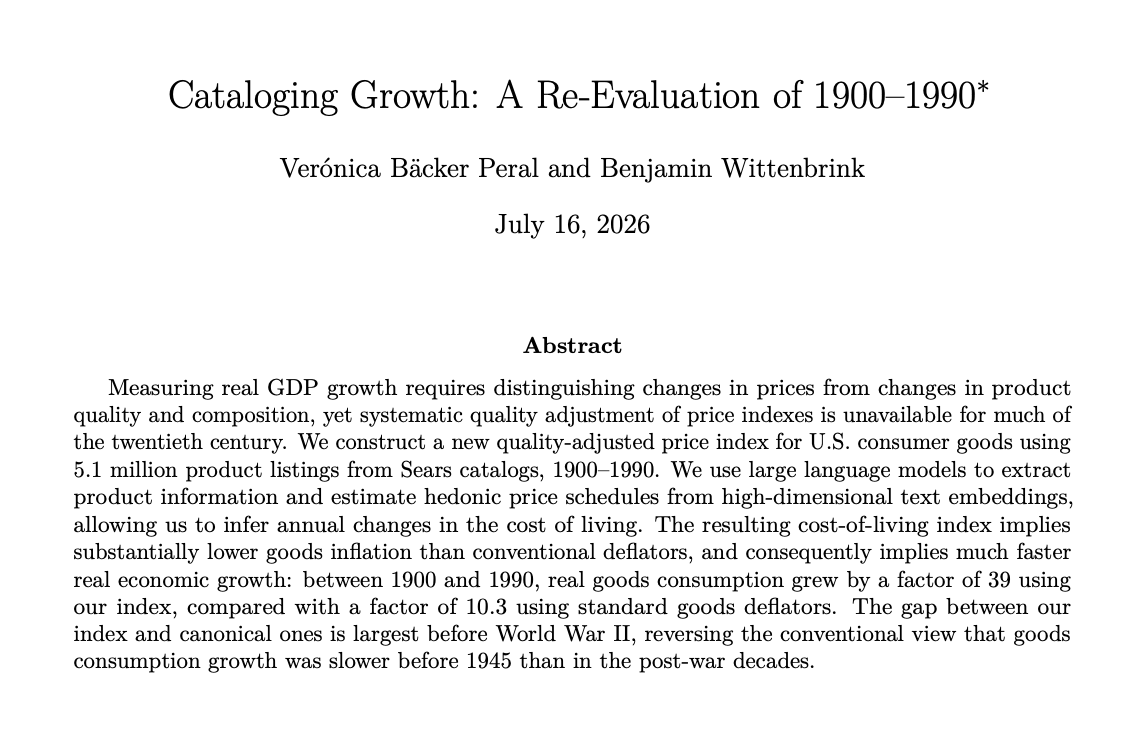
Excited to share our new working paper: how much did the US standard of living really rise over the twentieth century — and when? With @bhwittenbrink
Using 5.1 million Sears catalog listings, we build a quality-adjusted price index for consumer goods, 1900–1990. Two headline findings: growth was much larger than official statistics imply, and its peak came before WWII, not after. (1/9)
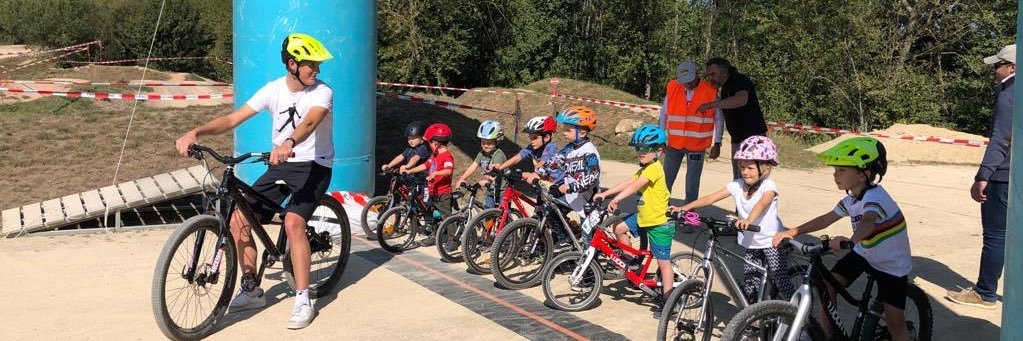
Va muy bajo, posiblemente la bicicleta no es de su talla, lleva zapatillas que ni en coña y su postura transmite inseguridad. ¿Dos minutos después se cayó de la bici?
A young person asked me today for a few papers that would be great to read early on in one’s career. Here is a list I came up with (I posted a shorter list earlier in reply to a comment). There are many other great papers (and I apologize if I didn’t include yours), but my goal was to focus on papers that a 21-year-old undergrad would enjoy a lot. A paper on the asymptotic properties of the bootstrap or on some subtle point about New Keynesian models, as important as it might be, is not what I am looking for. Also, of course, the list reflects my deeply biased taste. So, feel free to add in the comment section other papers you love!
Philippe Aghion and Peter Howitt (1992), “A Model of Growth Through Creative Destruction,” Econometrica.
George A. Akerlof (1970), “The Market for ‘Lemons’: Quality Uncertainty and the Market Mechanism,” Quarterly Journal of Economics.
Armen A. Alchian (1950), “Uncertainty, Evolution, and Economic Theory,” Journal of Political Economy.
William J. Baumol (1967), “Macroeconomics of Unbalanced Growth: The Anatomy of Urban Crisis,” American Economic Review.
Gary S. Becker (1973), “A Theory of Marriage: Part I,” Journal of Political Economy.
Douglas W. Diamond and Philip H. Dybvig (1983), “Bank Runs, Deposit Insurance, and Liquidity,” Journal of Political Economy.
Xavier Gabaix (1999), “Zipf’s Law for Cities: An Explanation,” Quarterly Journal of Economics.
Xavier Gabaix and Augustin Landier (2008), “Why Has CEO Pay Increased So Much?,” Quarterly Journal of Economics.
Luis Garicano (2000), “Hierarchies and the Organization of Knowledge in Production,” Journal of Political Economy.
Edward L. Glaeser, Bruce Sacerdote and José A. Scheinkman (1996), “Crime and Social Interactions,” Quarterly Journal of Economics.
Sanford J. Grossman and Joseph E. Stiglitz (1980), “On the Impossibility of Informationally Efficient Markets,” American Economic Review.
Oliver Hart and John Moore (1990), “Property Rights and the Nature of the Firm,” Journal of Political Economy.
Friedrich A. Hayek (1945), “The Use of Knowledge in Society, American Economic Review.
Bengt Holmström (1979), “Moral Hazard and Observability,” Bell Journal of Economics.
Charles I. Jones (1995), “R&D-Based Models of Economic Growth,” Journal of Political Economy.
Charles I. Jones (2005), “The Shape of Production Functions and the Direction of Technical Change,” Quarterly Journal of Economics.
Michael Kremer (1993), “Population Growth and Technological Change: One Million B.C. to 1990,” Quarterly Journal of Economics.
Michael Kremer (1993), “The O-Ring Theory of Economic Development,” Quarterly Journal of Economics.
Paul Krugman (1991), “Increasing Returns and Economic Geography,” Journal of Political Economy.
Robert E. Lucas, Jr. (1978), “On the Size Distribution of Business Firms,” Bell Journal of Economics.
Kevin M. Murphy, Andrei Shleifer and Robert W. Vishny (1989), “Industrialization and the Big Push,” Journal of Political Economy.
Paul M. Romer (1990), “Endogenous Technological Change,” Journal of Political Economy.
Sherwin Rosen (1981), “The Economics of Superstars,” American Economic Review.
Alvin E. Roth (2007), “Repugnance as a Constraint on Markets,” Journal of Economic Perspectives.
Thomas C. Schelling (1971), “Dynamic Models of Segregation,” Journal of Mathematical Sociology.
Andrei Shleifer and Robert W. Vishny (1993), “Corruption,” Quarterly Journal of Economics.
Michael Spence (1973), “Job Market Signaling,” Quarterly Journal of Economics.
Robert M. Townsend (1979), “Optimal Contracts and Competitive Markets with Costly State Verification,” Journal of Economic Theory.
Martin L. Weitzman (1974), “Prices vs. Quantities,” Review of Economic Studies.
Ronda’s most famous bridge was built after the first one collapsed into the gorge and killed around 50 people.
That happened in 1741.
The town still needed a way across El Tajo, the gorge that cuts Ronda in two, so they tried again.
The replacement became the Puente Nuevo.
Construction took decades. It was finally completed in 1793, with the bridge rising roughly 98 meters from the bottom of the ravine.
If you’ve ever seen a photo of Ronda, you’ve probably seen it.
What I didn’t realize at first was how important the bridge actually was to the town. El Tajo doesn’t sit somewhere outside Ronda. It runs right through it, with the Guadalevín River far below and neighborhoods on either side.
The bridge wasn’t built to look impressive.
People needed to get across.
Much of the stone used to build it came from the gorge itself, which explains why the bridge looks almost like part of the cliff when you see it from below.
I wouldn’t come here, take the usual photo and move on.
Walk across the bridge first. Look down into the gorge. The drop is enough to make you watch where you’re standing.
Then get below it.
That’s where you really understand how big the thing is. From town, it’s a bridge. From the bottom of the gorge, it looks like someone built a stone wall nearly all the way up to Ronda.
There’s plenty beyond the bridge too.
The old quarter still follows streets laid out long before the Puente Nuevo existed, and Ronda’s Islamic past is still visible in places like the Arab baths near the river.
There are older crossings as well. It’s called the New Bridge because Ronda already had bridges before it.
I’d stay overnight if I could.
Ronda is the kind of place that’s easy to turn into a quick stop on an Andalusia itinerary. Arrive, photograph the bridge, eat lunch, leave.
I’d rather be there later, when some of the day-trippers are gone.
Walk through the old streets. Cross the bridge again. Have dinner somewhere nearby and come back to the gorge without watching the clock.
The Puente Nuevo is impressive even if you know nothing about it.
But knowing that an earlier bridge collapsed, that the town spent decades building another one, and that people have been crossing it since 1793 makes it a lot harder to look at it as just another photo stop.
The photo might get your attention. The story is usually what makes you care about the place.
If that sounds like your kind of travel, subscribe to my newsletter.
https://t.co/eW2kBY27EE
“La calvicie llegó de manera todavía más elegante.
No la descubrí ante el espejo. De frente todo seguía siendo defendible con buena luz y cierta distancia diplomática.
La descubrí en la cámara de vigilancia de un cajero de La Caixa.
Mientras sacaba dinero, levanté la vista y vi en el monitor la coronilla de un señor calvo situado detrás de mí.
Me giré.
No había nadie.
Volví a mirar.
El señor seguía allí.
Era yo.”
https://t.co/wc0uC1nFir