Luis González de Alba fue un hombre de izquierdas que nunca renunció a criticarlas. Sus advertencias sobre López Obrador, escritas entre 2002 y 2005, resultan hoy inquietantemente actuales.
Mi columna en @nexosmexico
https://t.co/cp9dmkeDsu
A lo largo de su sexenio, el presidente López Obrador se empeñó en repartir un folleto con una versión condensada de la Cartilla Moral de Alfonso Reyes. Y es que, según él, la izquierda había llegado para “moralizar la vida pública".
Es de suponer, entonces, que él y su movimiento se sintieron calificados para dirigir a México por una nueva senda moral. La pregunta evidente era si todos los políticos que lo acompañaban leerían y seguirían los preceptos de la citada cartilla moral.
Difícil, muy difícil hablar de la moralización de la vida pública de la mano de Cuauhtémoc Blanco, Félix Salgado Macedonio, Adán Augusto López, Rubén Rocha Moya, Jaime Bonilla, Cuitláhuac García, Manuel Bartlett, Marina del Pilar, Rocío Nahle, Américo Villareal e incluso de Andy, entre muchísimos otros.
De Raudel Ávila:
https://t.co/CEwHe7IIIC
No creo que Nefro deba ser de entrada directa.
A ver, no sea ocurrente , plebe.
Poner un acceso, con capacitación buena, hasta un enfermero lo hace con los ojos cerrados. Lo que se supone que compra uno con tantos años de entrenamiento no es la mano: es el criterio.
Y tampoco nos hagamos pendejos entre nosotros.
Si al nefrólogo le quitas dos años de Medicina Interna, sale medio pendejo como su servidor.
Si hace MI completa más Nefro, sale pendejo y medio y esto es pro el piche ego.
Y si encima publica tres papers, lo invitan a dos congresos y ya camina como si él hubiera inventado la nefrona, la vanidad le suma otros tres puntos de pendejez corregida por superficie corporal.
Ahora imagínese entrada directa.
Van a salir recitando el túbulo proximal como rosario, poniendo catéteres con una mano y con la otra buscando por qué el paciente está hipotenso, febril, ictérico y con dolor abdominal.
Mucho riñón, poco enfermo.
No, plebe. Primero aprenda medicina. Luego ya se enamora del glomérulo.
Porque el riñón no viene en una hielera aparte: viene pegado a un cabrón entero, con corazón, hígado, pulmones, infecciones, medicamentos, mañas y tragedias.
Si no, vamos a fabricar nefrólogos con olor a taller de yonke:
muy especializados, muy cromaditos por fuera…pero con el motor clínico lleno de aceite quemado y mugre vieja.
An Ideal Doctor—
Available 24 hours a day, 365 days a year.
Call him anytime -day or night. Send WhatsApp messages, reports, photos he should reply instantly.
Whenever you need him, whether it’s 5 a.m. or Diwali night, he must be available for treatment.
Every treatment he gives must be 100% accurate.
No disease should be missed.
No complications should ever occur.
Even the laws of nature should not apply to him.
OPD consultation fee should be almost nothing.
After all, we’re “just talking,” so why should there be any fee?
If admitted to the hospital, he should give huge discounts on operation charges,
so we can afford a Deluxe Room and order whatever we want from the canteen or Zomato for a party.
He should prescribe medicines that are easily available everywhere,
and one prescription should last for 4 years — no need for follow-ups, tests, or re-evaluations.
He should consider accepting even a single pen from a pharma company as a sin,
but somehow he must automatically stay updated with all the latest, most expensive, and most effective new medicines.
He must keep studying continuously,
attend conferences and CMEs regularly,
but his clinic should never be closed.
He should have the latest machines, state-of-the-art operation theatres, and the best staff,
but the treatment cost should be like that of a government hospital.
He must personally see every report,
give every patient enough time,
but we should never have to wait when our turn comes in OPD.
He should be available on phone, WhatsApp, video call, messages, and email on every platform,but should never expect that his time also has any value.
We should be able to question him on every piece of advice we get from Google, YouTube, neighbours, relatives, or social media,
but he should never feel bad about it.
He should have 15–20 years of education and experience,
but readily accept defeat in front of our 15-minute internet research.
His hospital should have five-star hotel-like facilities,
but when we see the bill, it should feel like government rates.
He should treat every patient like his own family,
but his own family should be used to the fact that the doctor stays more in the hospital than at home.
He should have no personal life.
No holidays.
No festivals.
No illness.
No tiredness.
And most importantly —
If everything goes well, it is God’s grace.
And if anything goes wrong,
it is only the doctor’s fault.
Because in the eyes of the public, an ideal doctor is someone who:
Carries the responsibility of God,
possesses the honesty of a saint,
and gives the availability of a machine.
Are you an ideal doctor?
Standardisation of care pathways works well for patients with straightforward problems. But medical practice is often complex and non-linear. Good clinicians use guidelines as a foundation for clinical practice and then add clinical judgment, experience and adaptability.
@LarcombePeter@Azeem_Majeed I pretty much said this to one of the residents last week.
If Medicine was only about pathways and guidelines, then there is no need for doctors.
If one feels uncomfortable about treating outside guidelines, then one doesn't know enough.
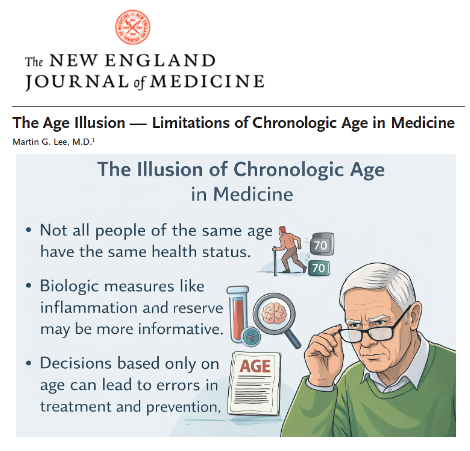
The age illusion in medicine: why your number may not reflect your biology. Biologic age refers to how your body functions and adapts to stress, which may differ from the number of years you have lived. Lee and colleagues describe in a new viewpoint in the New England Journal of Medicine how relying on chronologic age can mislead clinical decision making.
Key Points:
- Chronologic age is frequently used as a shortcut for health status, despite large differences in function between individuals of the same age.
- Biologic measures such as physiological reserve, inflammation and epigenetic markers better predict outcomes than age alone.
- Overreliance on age can lead to missed treatments in older adults and missed prevention in younger adults.
My take: This is a powerful reminder that medicine is still too focused on a number instead of on the person. If we want precision care, we need to measure what truly matters which is resilience, function and biology.
Here are 5 points that resonated w/ me:
1- Age alone is a poor proxy for health and may lead to wrong decisions.
2- Two folks the same age can have very different brain and body resilience.
3- Biologic markers may better guide treatment decisions than simple age cutoffs.
4- Personalized care will require moving beyond age based algorithms.
5- The future of medicine will focus on function, biology and reserve rather than just years lived.
https://t.co/pRLHtz0hnY #parkinson #alzheimer #dementia