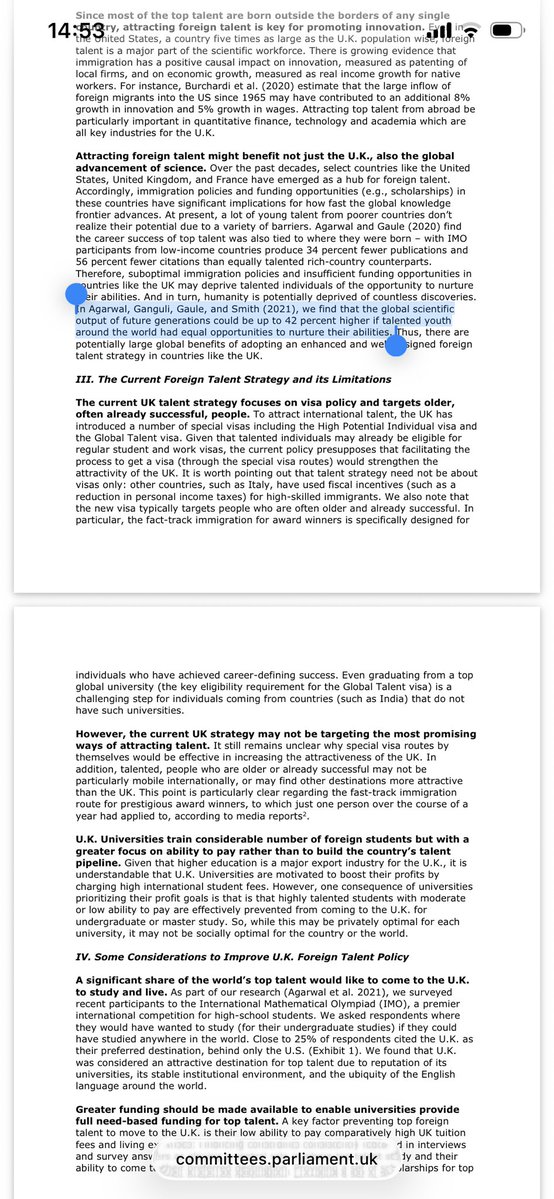
Researchers @RuchirAgar@patrick_gaule estimate that global scientific output could be up to 42% higher if talented young people around the world had equal opportunities to develop their abilities.
We spend enormous effort optimising research funding, capital allocation and institutions.
But if even part of that 42% estimate is right, then discovering exceptional people earlier and giving them access to opportunity may be one of the highest-return investments a society can make.
Source: https://t.co/U5nwmZl7eF
I think we misunderstand what ambition looks like.
People assume ambitious founders begin with a plan to build a trillion-dollar company.
I’m not convinced that’s true anymore.
The most ambitious founders I meet aren’t obsessed with the size of the outcome. They’re obsessed with a problem they can’t stop thinking about.
The ambition is in the intensity, not the forecast.
Ironically, trying to predict exactly what your company will become may be one of the least ambitious things you can do. It assumes today’s understanding is enough to map tomorrow.
The founders with the biggest outcomes often don’t start with certainty.
They start with unusually strong conviction that they’ve found something real.
Then they let reality shape the opportunity.
In a world changing as quickly as ours, perhaps the most ambitious thing isn’t having a detailed vision of the future.
It’s being willing to pursue something important without knowing where it will ultimately lead.
This is me talking to my computer without making a sound.
After just a month of collecting data, our model is already approaching dictation in accuracy. We were surprised to see that it generalizes to unseen participants as well!
(1/n)
Every AI-native services company faces the Goldilocks Problem.
Automate work that today’s models already handle well, and margins can look like software. But the work is easy for competitors to replicate and customers to bring in-house.
You’ve built a commodity.
Go the other direction and build highly customized, human-in-the-loop workflows for every customer. You become deeply embedded and difficult to replace, but delivery starts to resemble traditional BPO or consulting.
You’ve built “your mess for less,” (BPO term) now with AI.
The opportunity lies between these extremes:
Work that is difficult enough to require customization and human judgment today, but structured enough that model improvements can steadily automate more of it tomorrow.
The best AI-native services companies may therefore start with lower margins and significant human involvement. But every exception handled should become training data or context optimization, every workflow should become more repeatable, and every model improvement should expand margins without reducing customer value.
That is the real Goldilocks test:
Too standardized, and you’re a commodity.
Too customized, and you’re a consultancy.
The challenge is finding the model that's just right.
2E is back! Our fall camp in San Francisco for irrationally passionate teens.
Know a geeky teen (can be in any area)? Encourage them to apply by August 2nd -- it could literally change their life!
See our post about 2E in the comments.
Something else I don’t hear discussed much:
High ROCE industries naturally attract capital.
AI lowers the cost of entering knowledge-intensive industries.
As inference costs continue to fall, the hurdle rate for vertical integration falls with them.
That’s why pharma is so interesting.
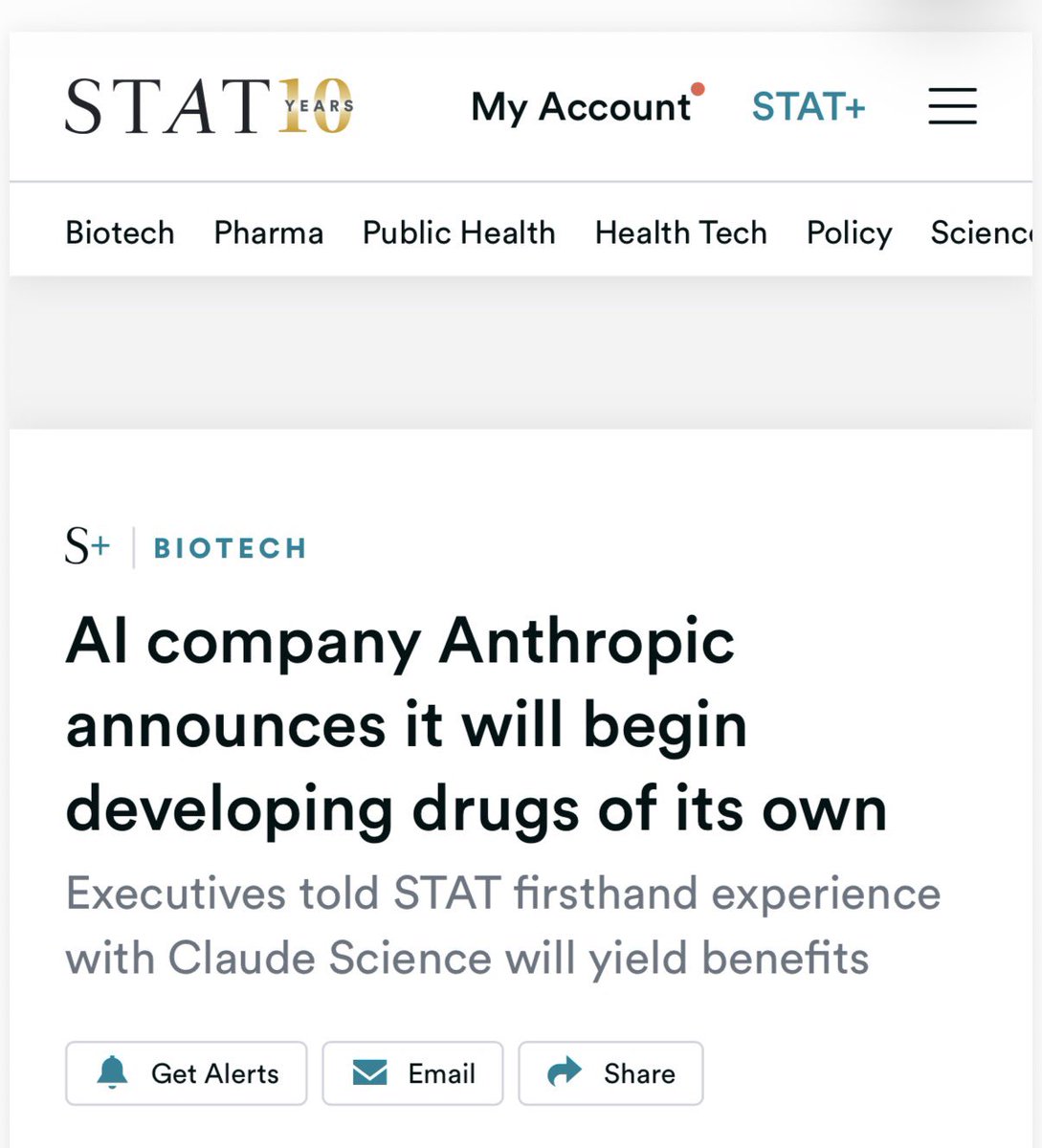
Frontier models won’t necessarily stop at selling tools to pharmaceutical companies. If they can capture enough of the workflow, they have an incentive to move further up the value chain into drug discovery itself.
But there’s another angle.
Equity investors at least get paid if that story works.
The lenders financing the AI infrastructure boom don’t.
Their upside is capped at the coupon, while their downside depends on the same uncertain future demand, utilisation and cash flows.
I’d add one more invariant in what won’t change in next 10 years:
Information gets cheaper. Judgment gets more valuable.
The ability to know what to trust, what to ignore, and what actually matters becomes a scarcer advantage
The faster technology moves, the more I think about Bezos' question
What won't change in the next 10 years?
Things I've been writing down over time:
- Humans will always need shelter, food, energy, and healthcare.
- The desire for ownership and the accumulation of wealth.
- The physical world will move more slowly than the digital one.
- Every increase in technological capability, especially AI, will require more energy.
- People and businesses will continue to need access to capital.
- Capital will continue to seek returns that exceed inflation.
- Underwriting methods evolve, but demand for credit (loans) is persistent.
- Trust remains scarce and becomes increasingly valuable as content, code, and fraud become cheaper.
- Verified identities and reputation becomes more important as information becomes abundant and synthetic.
- Long-term wealth creation and dynastic (multi-generational) thinking predate modern technology, and will persist.
- Coordination and transaction costs never fully disappear; market friction will continue to justify the existence of firms and intermediaries.
- People will continue to compete for status.
- Consumers will pay a premium for products and services that confer status.
- Time remains fixed at 24 hours per day.
- But attention is a finite resource and an enduring constraint.
- Products that credibly save time (or enable delegation) have a perpetual market.
- Inaccessible, proprietary data will be a persistent moat. The more inaccessible and difficult to aggregate, the deeper the moat.
- People want accountability, recourse, and clearly identifiable responsibility when things go wrong.
- Regulation consistently lags technological innovation.
- Compliance requirements, licensing, and regulatory moats persist even when machines can perform the underlying task.
- Local knowledge remains valuable and difficult to replicate.
- Heterogeneous markets (like real estate) continue to reward people with deep contextual understanding.
- Incumbent organizations tend to underinvest in disrupting their own businesses, which always creates opportunities for challengers.
Bezos' insight on what wouldn't change in 10 years was "Customers will always want lower prices and faster delivery."
It's boring/ true, but I think that's the point.
Everything we build today can and will be rebuilt more cheaply, faster by someone else.
Build on the invariants, not the trends.
What have I missed?
My work is finding exceptional people early, so I see this constantly. The most interesting person I speak to in any given week is usually someone no institution has a category for.
Didn't do Olympiads or hackathons. Not because they couldn't, they were heads down building, never knew those things existed or just didn’t have access. Too early for investors because there's no track record yet, which is what early means. Wrong shape for employability programmes, those are built for students and grads.
If they stopped out of uni then they've lost the whole ecosystem too. Peers, professors, people who take you seriously by default.
Meanwhile the people who fall between these institutions burn out quietly or take a sensible job because their parents told them too. Nobody tracks that loss. There's no statistic for companies that never got started. Which is partly why nobody's fixing it.
Creating environments where these people can find each other, get resources, and earn belief before the credentials show up is what I do. This isn’t charity. It’s fixing a market failure. When capable people without the pedigree end up in the same room, they form the kind of network none of them could have bought into.
Inspiring work. Lots of debates why the UK loses frontier companies, but firms follow people, and official data can’t see them: HESA and LEO track averages, and LEO can’t see anyone who leaves the UK at all, since it’s built on tax records. So if the 15 best graduates in a cohort of 10,000 leave for SF, the averages barely move but those 15 are where the next frontier firms come from. The UK’s most important talent loss happens exactly where its data is blind, and you can’t fix what you can’t measure. At Phareyes we’re already mapping where that right tail ends up. Proposed scaling it through British Progress 🚀 🇬🇧
Was very pleased to see this from @RonitKanwar. Great work from everyone involved at @RenPhilanthropy, including @KumarAGarg and the wider team.
One thing that’s become increasingly clear to me is that we’re getting much better at funding ambitious ideas quickly. Long overdue, I’d say.
I think the earlier bottleneck is identifying the people who are likely to produce those ideas in the first place.
Recently I met @ArshiaTourani, a medical school / computer science student dropout building AI-powered tools to support decision-making in pharmaceutical development.
What stood out was an obsessive drive to build, his ability to teach himself difficult subjects, explain them with clarity, and bring others into the mission
If AI continues to increase the return on exceptional human capital, identifying people like this earlier becomes increasingly important, not after they’ve founded a company, built a track record, published a paper or won a fellowship, but while the underlying capability is already visible.
That’s why, with the support of @SecondHome_io, Arshia will soon be joining our residency alongside other exceptional young people. Funding matters. So do time, community and early belief.
Very excited to share the launch of fast grants from @BritishProgress.
@tylercowen’s shown fast grants are a great way to source talent across the UK and get their ideas from zero to one. We need more of these efforts to support UK progress and dynamism.
Someone will reply “but market timing matters more.” True, except you can’t practice timing. You can only practice building. So the advice holds even if the attribution of success is wrong: optimise the variable you control.
If you want to start a startup, don't learn "entrepreneurship." Learn how to build things. The hard part of startups is not "entrepreneurship" but product: to know what to build, and to be able to build it.
People often talk about America’s advantages individually
The dollar. AI. Silicon Valley. Deep capital markets. World-class universities
I think what’s more interesting is how they build on each other
Capital attracts talent. Talent builds companies. Those companies create wealth, which attracts more capital. Strong institutions make people willing to invest for the long term.
Got me thinking about Argentina….
Around 100 years ago, it looked exceptional too! Was among the richest countries in the world and attracted people from across Europe looking for opportunity
Over decades, political instability, populism and weakening institutions gradually chipped away at the foundations that had made the country successful
The US isn’t Argentina, and history rarely repeats (neatly)
But no country stays exceptional by default. Institutions are slow to build and easy to undermine
Frontier AI labs don’t need to dominate every industry.
They only need to dominate the industries where:
• ROCE is high
• Expertise is expensive
• Knowledge work is largely digital
• Inference becomes materially cheaper than human labour
Pharma is an obvious candidate.
Legal, tax, engineering and parts of financial services may not be far behind.
Something else I don’t hear discussed much:
High ROCE industries naturally attract capital.
AI lowers the cost of entering knowledge-intensive industries.
As inference costs continue to fall, the hurdle rate for vertical integration falls with them.
That’s why pharma is so interesting.
Frontier models won’t necessarily stop at selling tools to pharmaceutical companies. If they can capture enough of the workflow, they have an incentive to move further up the value chain into drug discovery itself.
But there’s another angle.
Equity investors at least get paid if that story works.
The lenders financing the AI infrastructure boom don’t.
Their upside is capped at the coupon, while their downside depends on the same uncertain future demand, utilisation and cash flows.
It’s well within Anthropic’s rights to compete in any market they choose.
What’s funny, in this instance, are the number of Pharma companies, who through their unchecked use of Anthropic, are driving revenues into what they think is a model provider but is in fact a competitor lurking in the shadows thereby accelerating their own demise.
I suspect any end market with reasonable ROCE that could be AI accelerated is on the table.
If I were them, I’d probably do the same.