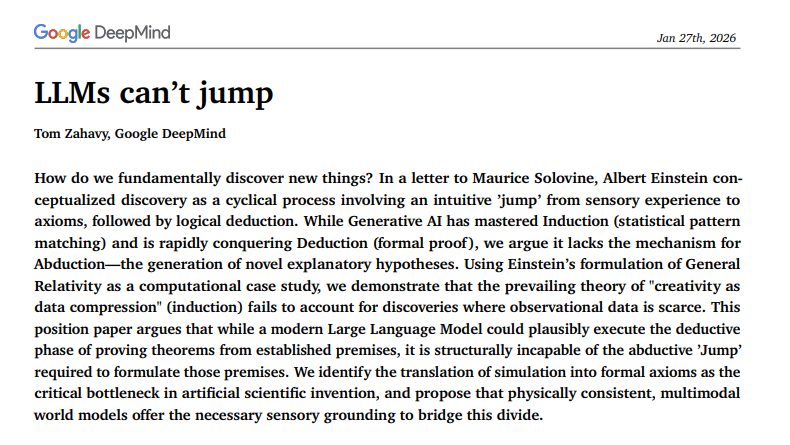
La inteligencia artificial, como la conocemos hoy, NO puede inventar cosas nuevas.
Uno de los mejores investigadores de Google publicó una investigación en la que llegó a esa conclusión.
Él es uno de los que construyó AlphaProof, el sistema de DeepMind que demuestra teoremas al nivel de un medallista olímpico. Su argumento arranca de una idea clásica que dice que razonamos de tres formas:
- Deducción: es decir, sacar la conclusión a partir de las reglas, demostrar.
- Inducción: mirar un montón de casos y encontrar el patrón que se repite.
- Abducción: el salto que no se deduce de nada, para inventar la explicación que todavía no existe.
La IA de hoy domina las dos primeras, pero de ese salto de fe mágico, de esa gota de inspiración, está muy pero muy lejos.
Si agarrás una IA, le cortás todo el conocimiento posterior a 1905, pero dándole acceso a cada paper y cada ecuación de esa época, jamás llegaría a la teoría de la relatividad, porque la física de Newton, en ese momento, no estaba en crisis. Andaba casi perfecta: lo que se podía medir daba exacto hasta el noveno decimal.
Y eso es clave, porque toda la IA generativa aprende buscando el error para corregirlo. Si no hay problema, no tiene hacia dónde empezar a moverse.
Un modelo de lenguaje está entrenado para una sola cosa, adivinar la palabra más probable que sigue. Es una máquina de dar la respuesta más esperable. Inventar es lo contrario: es divergir, irte para donde los datos no apuntan, apostar a algo improbable y ridículo. Einstein empezó preguntándose algo tan trivial como "¿por qué cuando una persona está cayendo no siente su propio peso?" y se puso a tirar de la cuerda de su imaginación.
Los modelos de lenguaje saben decir "gravedad" sin haberse caído nunca. Es la diferencia entre memorizarte recetas de cocina y haber probado realmente la comida. Por eso Yann LeCun, uno de los padres de la IA moderna, viene diciendo que la máquina necesita un modelo del mundo adentro, ser capaz de meterse en una simulación, de sentir la vida real.
Porque pensar y hablar nunca fueron lo mismo.
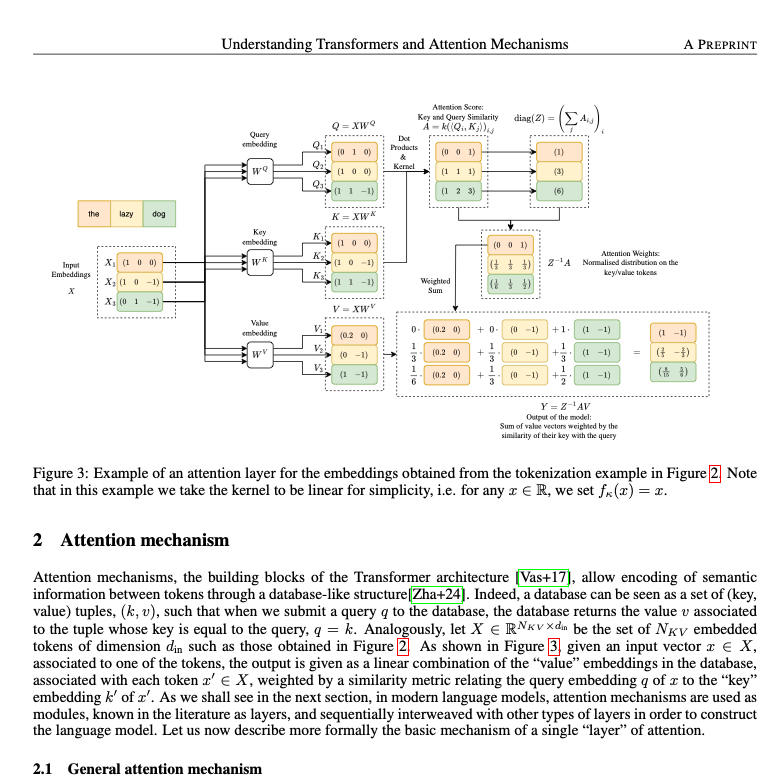
"Understanding Transformers and Attention Mechanisms" is a very interesting paper that presents the Transformer architecture from the perspective of applied mathematics.
It starts by representing text as vectors and explains mathematically how the attention mechanism processes these vectors to encode contextual information. It then develops Multi-Head Attention and shows how the main components of the Transformer architecture are constructed.
The paper also discusses more recent methods designed to reduce the computational and memory costs of attention, including KV caching, Grouped Query Attention, and Latent Attention. I think it is a useful reference for anyone interested in understanding Transformers beyond their high-level architecture and in seeing the linear algebra behind modern language models.
https://t.co/Rlun9QT7zx
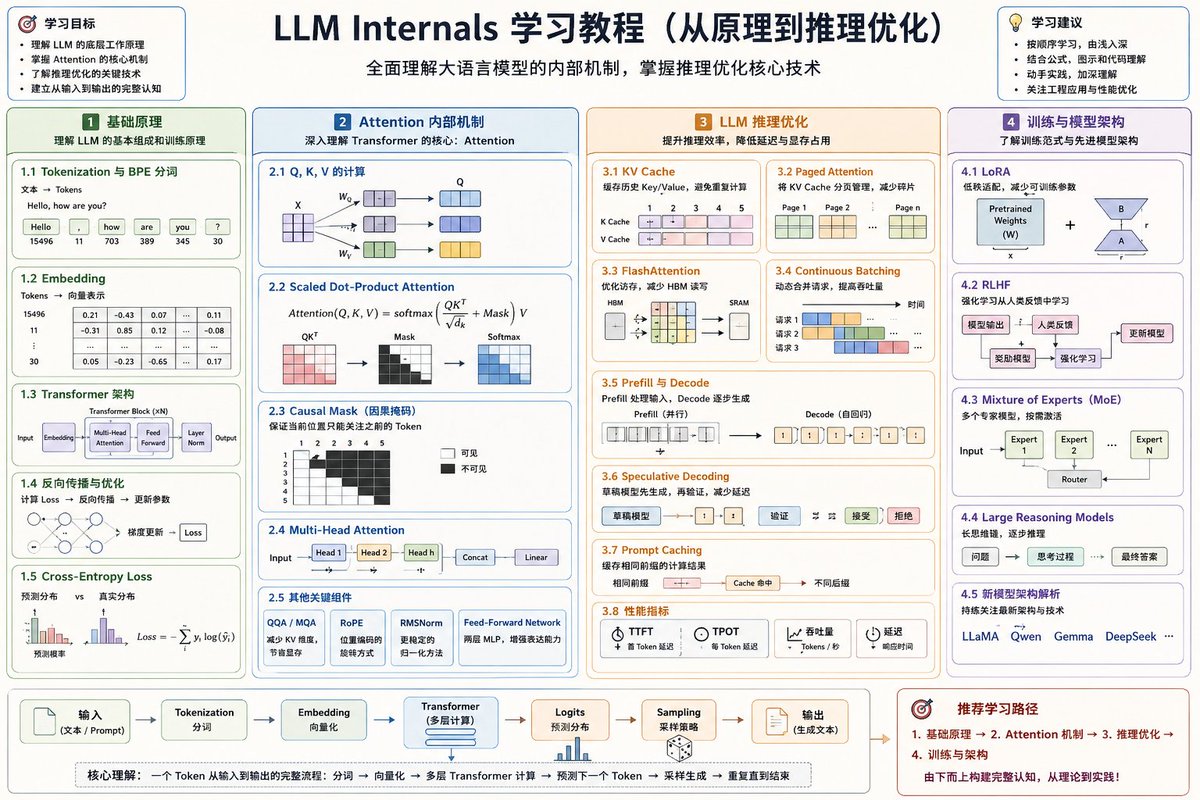
As an AI engineer, please learn:
- Learn the roofline model and why decode is memory-bound
- Deploy vLLM and SGLang, then read their schedulers
- Understand paged attention from the code, not the blog post
- Build observability before you optimize anything
- Track TTFT, inter-token latency, throughput, queue depth
- Use Grafana + Prometheus for inference dashboards
- Turn on prefix caching and find which workloads it helps
- Learn continuous batching and chunked prefill
- Run load tests with 1000+ concurrent requests
- Report p50, p95, p99, never just the mean
- Master quantization tradeoffs (FP8, INT4, AWQ, GPTQ)
- Learn speculative decoding and where it stops helping
- Set up KV cache eviction for long contexts
- Try disaggregated prefill and decode serving
- Learn Kubernetes for AI workloads and autoscale on queue depth
- Learn how inference costs break unit economics
- Build your own model router by cost, latency, quality
- Create a token budgeting system per request
- Build one inference service and benchmark it publicly
- Read inference research instead of model release news
- Start sharing your optimization benchmarks
I put together a 10-week plan that covers every one of these at 30 minutes a day. It is 50 sessions, split between reading the theory and building on your own service, and all of them feed one artifact: an inference service you deploy, instrument, load test past 1000 concurrent requests, tune, and publish as a reproducible benchmark.
It is open on GitHub and contributions are welcome, especially newer sources worth adding. I am working through it myself and will share more content on this going forward, so stay tuned.
GitHub repo: https://t.co/UTxKAzhzJQ
(don't forget to star 🌟)
You are in an AI engineer interview at Google.
The interviewer asks:
"Our data is spread across many sources (Salesforce, Gmail, etc.)
How would you build a unified query engine over it?"
You: "Embed them in a vector DB and do RAG."
Interview over!
Here's what you missed:
Many devs still think context retrieval is a linear pipeline:
Chunk → Embed → Retrieve → Generate
This works great for simple demos, but production systems need something fundamentally different.
To understand better, consider this query:
"Compare our Q4 sales performance in the Chicago region against last year's projections formulated in a meeting with stakeholders."
This single query requires:
- Sales data from your SQL database
- Graph relationships (organizational hierarchy)
- Vector search over projection reports
- Time-based filtering (Q4 this year vs last year)
- Permission checks (for user authorization)
No single embedding lookup can handle this complexity!
To actually solve this problem, you'd need to build an Agentic context retrieval system with five critical layers (as described in the graphic below):
> Indexing layer:
Different content needs different indexing:
- Semantic chunking for docs
- Hierarchical indexing for nested content
- Special indexing for sources like Calendar, Slack, etc.
> Routing layer:
Before retrieval, you need intelligent routing that decides:
- Should the query hit a graph DB?
- Does it need a structured SQL query?
- Or semantic search for conceptual matching?
> Query construction layer:
The original query might need to be:
- Decomposed into sub-queries
- Translated into different query languages (SQL, Cypher, vector similarity)
> Retrieval layer:
- Apply permissions and access checks
- Run multiple retrievals in parallel
- Rerank based on relevance/recency
> Generation layer:
- Synthesize a citation-backed response
The diagram below depicts this whole process.
That said, four of these five layers run after a query arrives. Indexing runs before, which caps what the other four can do.
Even with perfect routing, query decomposition, and reranking, the system returns only what the chunks preserved.
My co-founder wrote about a better unit for that indexing step. The technique:
- cuts corpus size by 40x.
- reduces tokens per query by 3x.
- improves vector search relevance by 2.3x.
And it doesn't change the retrieval algorithm, the reranker, or the embedding model.
Read it below.