May Europe one day wake up and start striving for this level of capitalistic homerun. Dump the degrowth nonsense, celebrate progress, and once again reach for the stars.
Un padre con demencia lleva horas desaparecido. Su hijo no puede localizarle porque La Liga bloquea Internet de forma indiscriminada para “combatir la piratería” dejando la app del GPS sin servicio.
No es la primera vez. Y el Estado mirará para otro lado.
Ver al Dr. Barbacid pedir financiación para seguir investigando me parte el alma. Pero por la mitad. Y me pone de muy mala hostia. 30M necesita. 1220M de € costó RTVE en 2025.
Marc Andreessen's rule of thumb for a successful tech sector: "The principle is just 'Do the opposite of the EU.'"
David Sacks: " When they talk about AI leadership, what they mean is that they're taking the lead in defining the regulations."
"They get together in Brussels and figure out what all the rules should be, and that's what they call 'leadership.'"
@pmarca@DavidSacks
Marc Andreessen's rule of thumb for a successful tech sector: "The principle is just 'Do the opposite of the EU.'"
David Sacks: " When they talk about AI leadership, what they mean is that they're taking the lead in defining the regulations."
"They get together in Brussels and figure out what all the rules should be, and that's what they call 'leadership.'"
@pmarca@DavidSacks
NEW: Is the internet changing our personalities for the worse?
Conscientiousness and extroversion are down, neuroticism up, with young adults leading the charge.
This is a really consequential shift, and there’s a lot going on here, so let’s get into the weeds 🧵
Eric Schmidt says intelligence is about to decouple from us.
“The computers are now doing self-improvement.. They don’t have to listen to us anymore.”
Within six years: a mind smarter than the sum of humans -- scaled, recursive, free. We have no language for what’s coming.
Huge companies are a huge win for society. They get huge by delivering huge value to society. We can be a force for the good if we get our act together. Hate Elon if you want, but learn from him: we should aim high. Way higher. Let’s build our future
A couple reflections on the quantum computing breakthrough we just announced...
Most of us grew up learning there are three main types of matter that matter: solid, liquid, and gas. Today, that changed.
After a nearly 20 year pursuit, we’ve created an entirely new state of matter, unlocked by a new class of materials, topoconductors, that enable a fundamental leap in computing.
It powers Majorana 1, the first quantum processing unit built on a topological core.
We believe this breakthrough will allow us to create a truly meaningful quantum computer not in decades, as some have predicted, but in years.
The qubits created with topoconductors are faster, more reliable, and smaller.
They are 1/100th of a millimeter, meaning we now have a clear path to a million-qubit processor.
Imagine a chip that can fit in the palm of your hand yet is capable of solving problems that even all the computers on Earth today combined could not!
Sometimes researchers have to work on things for decades to make progress possible.
It takes patience and persistence to have big impact in the world.
And I am glad we get the opportunity to do just that at Microsoft.
This is our focus: When productivity rises, economies grow faster, benefiting every sector and every corner of the globe.
It’s not about hyping tech; it’s about building technology that truly serves the world.
@factorenergia, hace 3 minutos que me han llamado haciéndome creer que me llaman de mi compañía eléctrica (Naturgy) @Naturgy para aplicarme unos descuentos e intentando que firme un contrato de Factor Energía. Estas prácticas son totalmente deleznables y dan verdadera pena.
LVMH CEO BERNARD ARNAULT: FRANCE ALSO NEEDS TO APPOINT SOMEONE TO SLASH BUREAUCRACY
“I've just returned from the USA, as you so kindly noted, and I was able to see the wind of optimism prevailing in that country.
And when you come back to France after spending a few days in the USA, it's a bit of a cold shower, I must say.
You get the impression that in the USA, you're welcomed with open arms, taxes are going to drop to 15%, the workshops you can build in the USA are subsidized in a whole series of states, and the American president encourages this.
The market is growing fast.
Just look at the new boutique Pietro has opened in New York, which is an incredible success.
Frankly, there are 100-meter-long waiting lines.
It's really quite exceptional.
And yet, it's very, very elitist.
So when you come to France and see that we're about to raise taxes by 40% on companies that manufacture in France, it's almost unbelievable.
So we're going to tax Made in France.
If you want to cool down optimism, it's hard to beat that.
It's the ideal way to encourage relocation [of companies to other countries].
We offered other solutions.
Obviously, bureaucracy [prevents that].
To do that, we'd have to do what they do in the U.S., appoint someone to slash the bureaucracy a bit.
But as soon as you try to do that, you're sued, it's impossible.”
Source: LVMH/Nouvel Obs, January 28, 2025
Announcing The Stargate Project
The Stargate Project is a new company which intends to invest $500 billion over the next four years building new AI infrastructure for OpenAI in the United States. We will begin deploying $100 billion immediately. This infrastructure will secure American leadership in AI, create hundreds of thousands of American jobs, and generate massive economic benefit for the entire world. This project will not only support the re-industrialization of the United States but also provide a strategic capability to protect the national security of America and its allies.
The initial equity funders in Stargate are SoftBank, OpenAI, Oracle, and MGX. SoftBank and OpenAI are the lead partners for Stargate, with SoftBank having financial responsibility and OpenAI having operational responsibility. Masayoshi Son will be the chairman.
Arm, Microsoft, NVIDIA, Oracle, and OpenAI are the key initial technology partners. The buildout is currently underway, starting in Texas, and we are evaluating potential sites across the country for more campuses as we finalize definitive agreements.
As part of Stargate, Oracle, NVIDIA, and OpenAI will closely collaborate to build and operate this computing system. This builds on a deep collaboration between OpenAI and NVIDIA going back to 2016 and a newer partnership between OpenAI and Oracle.
This also builds on the existing OpenAI partnership with Microsoft. OpenAI will continue to increase its consumption of Azure as OpenAI continues its work with Microsoft with this additional compute to train leading models and deliver great products and services.
All of us look forward to continuing to build and develop AI—and in particular AGI—for the benefit of all of humanity. We believe that this new step is critical on the path, and will enable creative people to figure out how to use AI to elevate humanity.
I'm German.
16 years ago, the EU and US economies were neck and neck.
Today, the US economy is 50% larger than the entire EU combined.
Here's the devastating truth behind Europe's ongoing economic suicide 🧵:
🇪🇺 eu/acc
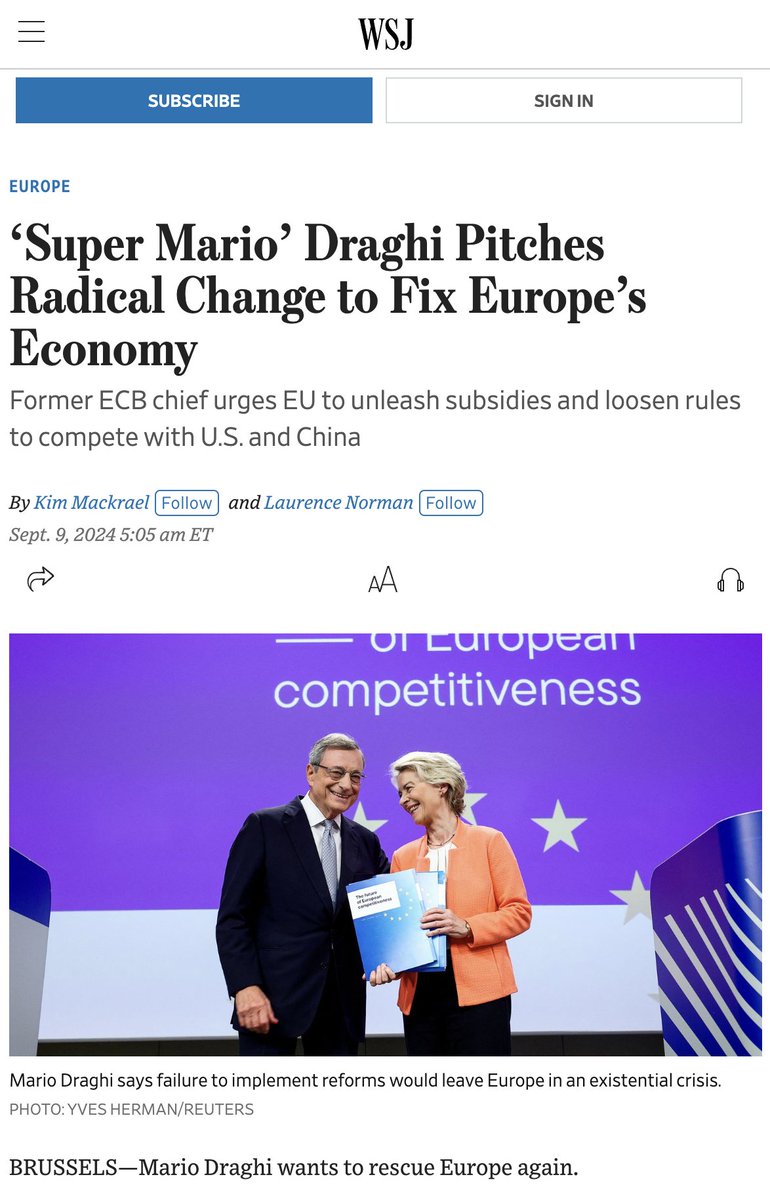
A few weeks ago Mario Draghi asked my recommendations for his report that came out today about European competitiveness
I had a call with him and summarized my problems with doing business in the EU
I wrote this which is included in the report presented to the European Union today:
1. Minimum revenue cut offs for current and new regulation
Exempt small businesses with annual revenues below €10 million from complex regulations like VATMOSS, GDPR, the EU AI Act, and certain labor laws. This approach encourages innovation and growth by allowing startups to focus on product development and market validation without the heavy burden of regulatory compliance. Once these businesses surpass €10 million, they will have the resources to comply with regulations, ensuring that growth is not stifled.
2. Simplify starting a pan-EU business with an EU-wide Incorporation (Inc.) business form
Currently, starting and operating a business across the EU is complex due to 27 member states, each with its own company registration requirements. To streamline this process and make it easier for entrepreneurs to operate across Europe, there should be a single, standardized business entity that applies uniformly across all EU countries. I call this the European Inc.
3. Start an EU business fully online, no physical offices, notaries, lawyers etc
To continue, right now starting a business in most EU member states it’s complicated, very time and resource intensive, and often involves lawyers and notaries. Instead, it should be as simple as going online to a centralized EU website, where entrepreneurs can register their business and details in just a few clicks. The entire process should be streamlined and efficient, allowing businesses to start operating immediately.
The EU government taxes and bookkeeping of this business should also be fully online in an EU portal/dashboard.
4. 0% corporate tax for first 3 years of any new business
Countries like Singapore have successfully attracted new businesses from around the world by giving them a massive tax discount during the first 3 years of business. Because they know that’s the most difficult time of a business: figuring out what product it makes and if there’s a market for it. That takes pressure off startups and business founders that they can focus on creating a great product and innovating.
5. Change tax on stock options: don't tax when a stock option is exercised, but tax it when the stock is sold
The current tax policy in the EU taxes stock options at the time they are exercised, creating a significant financial burden on employees who have not yet realized any tangible financial gain. This approach stifles innovation, discourages entrepreneurship, and places the EU at a competitive disadvantage compared to other regions like the United States.
I propose a simple change: Tax stock options when the stock is sold, not when the option is exercised.
6. Don’t see tech or AI as an enemy, but as a burgeoning and essential industry
The most popular companies in tech are focused on AI right now for a reason. It’s the next frontier of computing. The European Union seems to consider AI the enemy. Any technology can be used for good or bad. By regulating it even before Europe has made much contributions (Europe has almost no tech companies leading in AI), it has stifled any potential innovation in AI from the start.
Apart from the regulation itself, the optics of it make the EU look bad on a global scale. Why would tech founders move to Europe to start a business if the EU is actively positioning itself as Anti-AI?
AI has gigantic potential to be used for good: think of the medical field for diagnosis of diseases, generally in programming (it helps programmers to create software faster/better), etc.
This goes further than AI. The same applies to tech in general. It seems the EU is on a crusade against technology while not being able to compete in it itself. It feels a case of sour grapes: if we can’t build great technology in EU, nobody is allowed to do so!
7. Teach tech/coding/AI topics in all schools and unis
It would help a lot if the EU has a focus on teaching AI and tech in schools and universities. Making the new generation competitive in this field instead. To secure the future prosperity of the European Union, we must prioritize education in technology, coding, and AI across all levels of schooling, from primary education to universities. This strategic focus is not just an educational reform—it’s a critical investment in the future competitiveness, innovation, and economic resilience of the EU.
🇪🇺 eu/acc
A few weeks ago Mario Draghi asked my recommendations for his report that came out today about European competitiveness
I had a call with him and summarized my problems with doing business in the EU
I wrote this which is included in the report presented to the European Union today:
1. Minimum revenue cut offs for current and new regulation
Exempt small businesses with annual revenues below €10 million from complex regulations like VATMOSS, GDPR, the EU AI Act, and certain labor laws. This approach encourages innovation and growth by allowing startups to focus on product development and market validation without the heavy burden of regulatory compliance. Once these businesses surpass €10 million, they will have the resources to comply with regulations, ensuring that growth is not stifled.
2. Simplify starting a pan-EU business with an EU-wide Incorporation (Inc.) business form
Currently, starting and operating a business across the EU is complex due to 27 member states, each with its own company registration requirements. To streamline this process and make it easier for entrepreneurs to operate across Europe, there should be a single, standardized business entity that applies uniformly across all EU countries. I call this the European Inc.
3. Start an EU business fully online, no physical offices, notaries, lawyers etc
To continue, right now starting a business in most EU member states it’s complicated, very time and resource intensive, and often involves lawyers and notaries. Instead, it should be as simple as going online to a centralized EU website, where entrepreneurs can register their business and details in just a few clicks. The entire process should be streamlined and efficient, allowing businesses to start operating immediately.
The EU government taxes and bookkeeping of this business should also be fully online in an EU portal/dashboard.
4. 0% corporate tax for first 3 years of any new business
Countries like Singapore have successfully attracted new businesses from around the world by giving them a massive tax discount during the first 3 years of business. Because they know that’s the most difficult time of a business: figuring out what product it makes and if there’s a market for it. That takes pressure off startups and business founders that they can focus on creating a great product and innovating.
5. Change tax on stock options: don't tax when a stock option is exercised, but tax it when the stock is sold
The current tax policy in the EU taxes stock options at the time they are exercised, creating a significant financial burden on employees who have not yet realized any tangible financial gain. This approach stifles innovation, discourages entrepreneurship, and places the EU at a competitive disadvantage compared to other regions like the United States.
I propose a simple change: Tax stock options when the stock is sold, not when the option is exercised.
6. Don’t see tech or AI as an enemy, but as a burgeoning and essential industry
The most popular companies in tech are focused on AI right now for a reason. It’s the next frontier of computing. The European Union seems to consider AI the enemy. Any technology can be used for good or bad. By regulating it even before Europe has made much contributions (Europe has almost no tech companies leading in AI), it has stifled any potential innovation in AI from the start.
Apart from the regulation itself, the optics of it make the EU look bad on a global scale. Why would tech founders move to Europe to start a business if the EU is actively positioning itself as Anti-AI?
AI has gigantic potential to be used for good: think of the medical field for diagnosis of diseases, generally in programming (it helps programmers to create software faster/better), etc.
This goes further than AI. The same applies to tech in general. It seems the EU is on a crusade against technology while not being able to compete in it itself. It feels a case of sour grapes: if we can’t build great technology in EU, nobody is allowed to do so!
7. Teach tech/coding/AI topics in all schools and unis
It would help a lot if the EU has a focus on teaching AI and tech in schools and universities. Making the new generation competitive in this field instead. To secure the future prosperity of the European Union, we must prioritize education in technology, coding, and AI across all levels of schooling, from primary education to universities. This strategic focus is not just an educational reform—it’s a critical investment in the future competitiveness, innovation, and economic resilience of the EU.