Direct manipulation of π0.5 weights over fine tuning????
We ran a small experiment on the cloth-folding task on pi0.5. Results on robodojo:
1. Base: 50%
2. Fine tuned on Astra corrections: 68%
3. Direct weight manipulation: 75%
Will share the full breakdown soon
Contact is crucial for manipulation. As we master techniques for estimating contacts and forces from human action trajectories, it will further strengthen the "real2sim2real" paradigm for robot learning. We should collect data from humans when they can act naturally. "Let humans be humans". Happy to advertise this exciting work led by Jimmy Dai.
Introducing RepresentNav: See What I Need, Dream What I Want.
A latent navigation world model emerges from self-supervised next-representation prediction in a self-constructed representation space.
RepresentNav learns to construct its own visual representation from the internal features of vision foundation models. The navigation objective shapes what this space captures.
Within this space, a latent chain-of-thought learns to dream through self-supervised next-representation prediction. Representation construction, dreaming, and navigation are trained jointly.
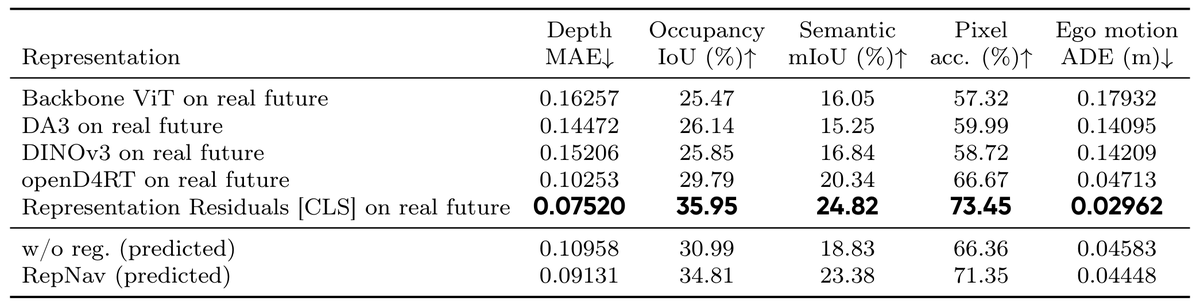
Our analysis reveals what emerges: predicted latents encode future depth, semantics, 3D occupancy, and ego-motion, without explicit supervision of these properties in the dream latents during policy training.
Post-hoc readouts make this emergent structure visible, revealing a compact model of future scene states and their evolution during navigation.
🌐 Project: https://t.co/Kk6aCiXGxB
📄 Tech Report: https://t.co/INsp7bLqgL
🧵 How we construct the space, learn to dream, and study what emerges ↓
5/5 — Benchmark results
RepresentNav achieves 83.80% success on VLNVerse fine-grained Full Test, improving over the strongest reported baseline by 20.05 percentage points.
It reaches 85.5% tracking rate on EVT-Bench distracted tracking with a single camera, and 97.5% collision-free success on indoor ABotN-PointBench.
Our central finding: a latent navigation world model emerges through self-supervised next-representation prediction in a representation space learned jointly with navigation.
Explore the method, visualizations, and full results:
🌐 Project: https://t.co/Kk6aCiXGxB
📄 Tech Report: https://t.co/INsp7bLqgL
4/5 — An interpretable dream
The dream encodes the spatial structure of a future scene. A single predicted latent supports a post-hoc reconstruction of its 3D occupancy, making this emergent structure visible.
At +0.4 seconds, its occupancy readout reaches 34.81% IoU. The strongest pretrained encoder baseline reaches 29.79% using actual future observations in the same evaluation. This structure emerges without explicit occupancy supervision of the dream latents during policy training.
The dream also supports better navigation: in our point-goal ablation, adding self-supervised dreaming lowers collision rate from 18.05% to 13.45%.
The dream contains interpretable information about the world ahead, and the policy benefits from learning to predict it.