Are we in an intelligence explosion? This is one of the most important questions facing society right now. @lugaricano and I tried to put structure on this question and provide estimates based on currently available data.
METR recently reported that frontier capability growth roughly doubled after October 2025---but this is accompanied by annualized R&D spending growth of ~6x and technical staff ~3x over the same window. That highlights a crucial distinction between scaling laws--exponential capability gains bought with exponentially rising inputs--and an intelligence explosion (IE), where AI begins substituting for external inputs so each advance makes the next one easier.
We estimate several versions of a research production function (building on @ChadJonesEcon, @bfjo, and @Ph_Aghion) where a key parameter crossing a threshold signals an IE, while values below it correspond to an "ideas are harder to find," diminishing-returns world. Across specifications, our estimates sit below that threshold. Allowing for a break at METR's October 2025 cutoff points to a one-time step up in research effectiveness, with the rate of diminishing returns being nearly identical on both sides of the cutoff.
A few things to note. First, this exercise is not a forecast. It's an attempt to put structure on some of the important questions being debated right now: RSI, IE, scaling laws all depend on how outputs scale with inputs, and how feedback loops accelerate/decelerate this process. These estimates can change, and change very quickly.
Second, we are very explicit that the results are based on publicly available data; it is very much possible that METR had access to data that would change the estimates.
Third, we might be wrong! Let us know what you think:
https://t.co/xMLZlSlxdY
I'll be hosting a Student Researcher at @GoogleDeepMind
Big achievements, from building cities to scientific breakthroughs, come from many people working together. Can 1000+ AI agents do the same?
📍 London
🚀 Start date: Jan/Feb 2027
🗓️ 4-6 months, 100%
Links below👇
Will AI accelerate the pace of scientific progress and discovery? If so, which fields are poised for faster rates of innovation & which fields might face bottlenecks that AI alone may struggle to overcome?
Very excited to share new research on the economics of AI for science.
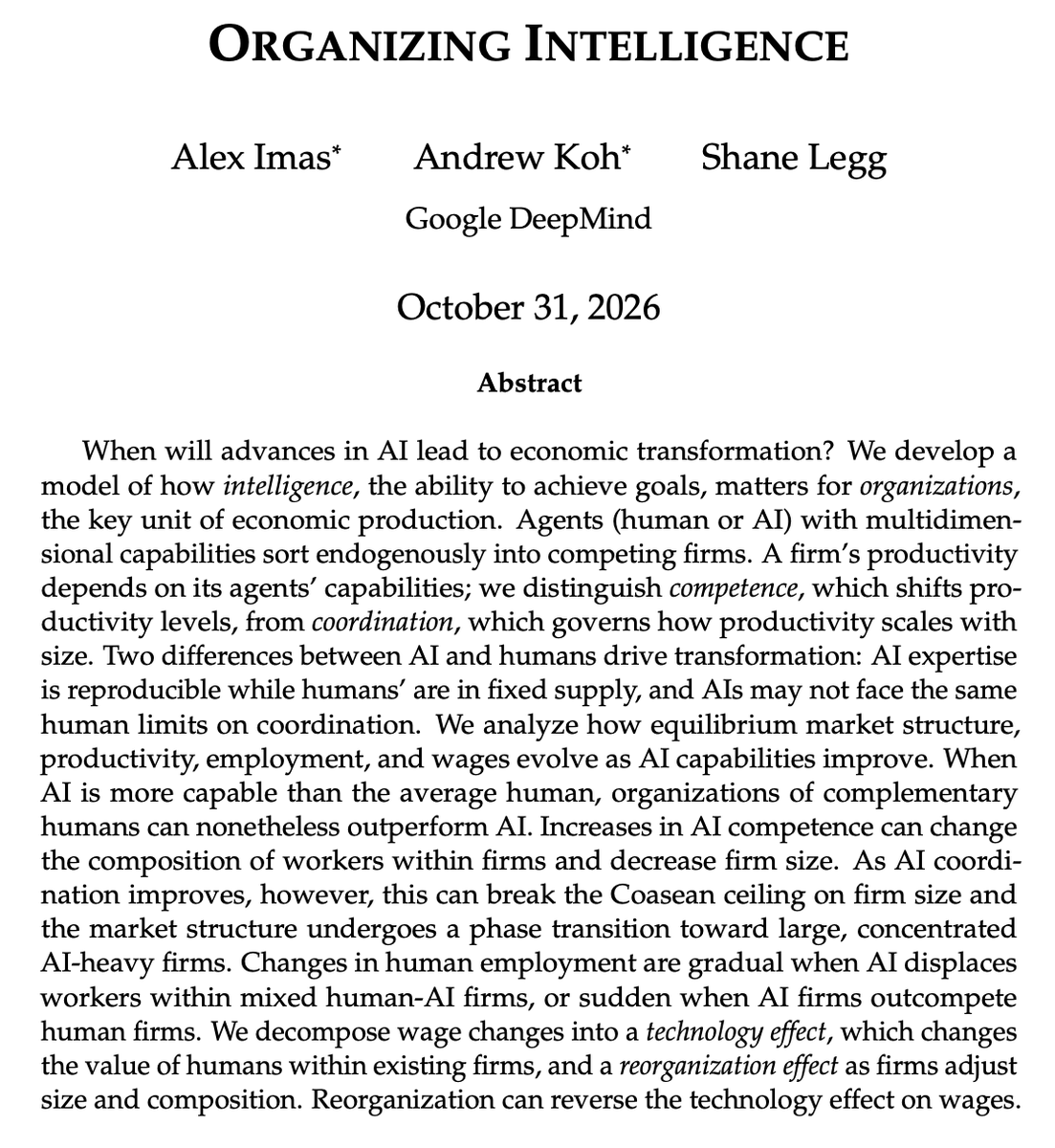
New paper with Alex Imas (@alexolegimas) and Shane Legg (@ShaneLegg). We build a model of how intelligence is organized into firms, who wins and loses, and when the economy will be transformed: https://t.co/xmv7FooI2a
Blog post: https://t.co/HI1eLiJv3P
This is a foundational piece for the economics of transformative AI, you should check it out! Can confirm is a fun read even for empiricists.
Massive congratulations to @andrewjkoh@alexolegimas and @ShaneLegg
I joined @GoogleDeepMind to develop a research program on the economics of AGI. Today, together with Andrew Koh (@andrewjkoh) and Shane Legg (@ShaneLegg), we are incredibly excited to release The Economics of Intelligence, the first in a series of projects from our group on how AGI will change the economy.
How do capability improvements transform the economy, and when? In this project, we define thresholds of economic capabilities, e.g., minimal AGI, based on how they transform the economy. We then track how the economy–market structure, employment, and wages–changes during the transition across capability regimes.
We have seen exponential increases in what AI agents can do but the broader economy seems almost remarkably unchanged. Part of the reason is that the solo AI agent is the wrong economic object; economic transformation is an equilibrium outcome where organizations compete. Looking at how intelligence functions within organizations, transformation will depend on when two key capability thresholds are crossed: competence (gains on individual skills, e.g., coding, math) and coordination (gains on ability of agents to cooperate and work together).
We show that what economic transformation looks like depends on whether AI becomes supercompetent, supercooperative, or both—the regime of artificial superintelligence (ASI). Tracking this transition shows why the real visible transformation may come from improvements in coordination—a capability most benchmarks don’t yet track. Past a certain threshold, AI capabilities can break the Coasian ceiling on firm size and lead to an economy that looks drastically different than the one we see today.
Two main takeaways:
1. To understand the path of transformation, we should be tracking agentic coordination more closely.
2. The impact of AI will likely show up in wages before market structure or employment.
We are really excited about this paper. Excited to hear people’s thoughts.
Link: https://t.co/9DTGSeKoSA
New essay in @ForeignAffairs with James Manyika and @elerianm on steps that can be taken to help AI deliver on its economic promise, drawing on lessons from cooperative game theory as a guide.
Most conversations treat AI as a general-purpose technology (GPT), and some compare it to the Industrial Revolution. But we think it is more than that: it is also a method for creating new inventions, like the microscope or the scientific method. Economist Zvi Griliches famously called such discoveries IMIs--inventions of a method of invention. Seen this way, AI carries the potential of the Industrial Revolution and the Enlightenment combined.
Yet realizing this potential is a coordination problem. Delivering on the promise of AI requires progress not just on furthering its capabilities, but on building out infrastructure, deep adoption across the economy, and buy-in from many different groups. This is unlikely to happen if people do not feel they have a stake in the upside of the technology. Promises of abstract scientific and medical breakthroughs in the future won't change this when anxieties about near-term disruption are running hot.
Rather than treating AI like a zero-sum game, we argue that it is useful to look to cooperative game theory as a guide. Because models, compute, organizational change, and human upskilling are strong complements, AI has the structure of a "convex game": Each group that joins makes everyone else's contributions more valuable. That makes it possible to form stable coalitions of workers, communities, firms, and developers where incentives are aligned and everyone has a stake in the gains.
The cooperative approach will of course not be easy, but we will make the case that coalitions can start small and grow as the mutual gains become tangible. We provide concrete examples of how this can be done in practice and at scale.
Link to essay here: https://t.co/6rVsCdLgVF
I had a wonderful time talking to @AnneliesGamble about our AI in Science paper. You should check out her other interviews, she has very cool (much much cooler than me!) folks there.
Link to paper: https://t.co/kRmOCusgPc
There’s a lot of uncertainty around AI & its economic effects. Much focus so far has been on 1st order questions, but 2nd order questions are also important.
Today we lay out an AI research agenda for @Stripe Economics & invite thoughts & proposals.
https://t.co/wIoOXBmuWt
New essay for the @GoogleDeepMind Institute with James Manyika on AI x Science, "Bending the Curve of Discovery".
While accelerating existing scientific practices is certainly useful, the real promise of AI is its potential to act as an invention of a method of invention (IMI) a la Griliches--e.g., the microscope or statistical inference--which would unlock questions and whole modes of discovery that were previously beyond human reach.
Today, LLMs and specialized models like AlphaFold act as economic complements. LLMs handle analysis, coding, and writing, while specialized tools handle domain-specific predictions. Most handoffs between them run through the scientist.
What may the future of science look like? LLMs orchestrating those handoffs automatically--prompting specialized models, auditing outputs, and looping until either the question is answered or a non-automated stage is reached (e.g., wet lab testing). The scientist's role shifts from running each step to designing this loop. We saw a glimpse of this workflow with Anthropic’s enzyme discovery a few weeks ago, and we're seeing this in our own work too.
This raises foundational epistemic questions:
1. What will scientific understanding look like when discoveries are made by black-box models whose output is increasingly difficult to interpret?
2. How do we extract underlying mechanisms, not just outputs, as science becomes more automated? What will theory look like?
3. If AI automates the writing and junior lab work, how do we train the next generation of scientists to push the frontier?
4. What will motivate scientists in this epistemic reality?
There's an economics angle too. Hypothesis generation gets cheap, so bottlenecks move downstream to verification and to choosing which questions are worth asking. Realizing AI’s full potential will take investment in infrastructure and institutional reform--making this as much an organizational challenge as a technical one
We don't have the answers yet, and I'd love to hear what others think.
Paper here: https://t.co/kvHCFMIFmL