https://t.co/ETleC1R5bk
Very happy to see my new article "Did 3G Make Afghan Insurgents Fight More Effectively? A Disaggregated Study" published in the Journal of Conflict Resolution.
https://t.co/TtvHqx8F67
Delighted to share that my article, “State Control over Telecommunications, Surveillance, and Militant Mobilization,” is now published in International Studies Quarterly @ISQ_Jrnl
https://t.co/TtvHqx8F67
Delighted to share that my article, “State Control over Telecommunications, Surveillance, and Militant Mobilization,” is now published in International Studies Quarterly @ISQ_Jrnl
The results show that an increase in the state’s share of telecommunication companies is associated with a longer mobilization duration for armed groups.
I would particularly like to thank all those who generously engaged with this project and offered thoughtful comments at the workshops and conferences where I presented it.
https://t.co/ETleC1R5bk
Very happy to see my new article "Did 3G Make Afghan Insurgents Fight More Effectively? A Disaggregated Study" published in the Journal of Conflict Resolution.
Focusing on Afghanistan, it explores how advances in mobile communication technologies influence conflict dynamics and offers a fresh perspective on the role of ICTs in contemporary warfare.
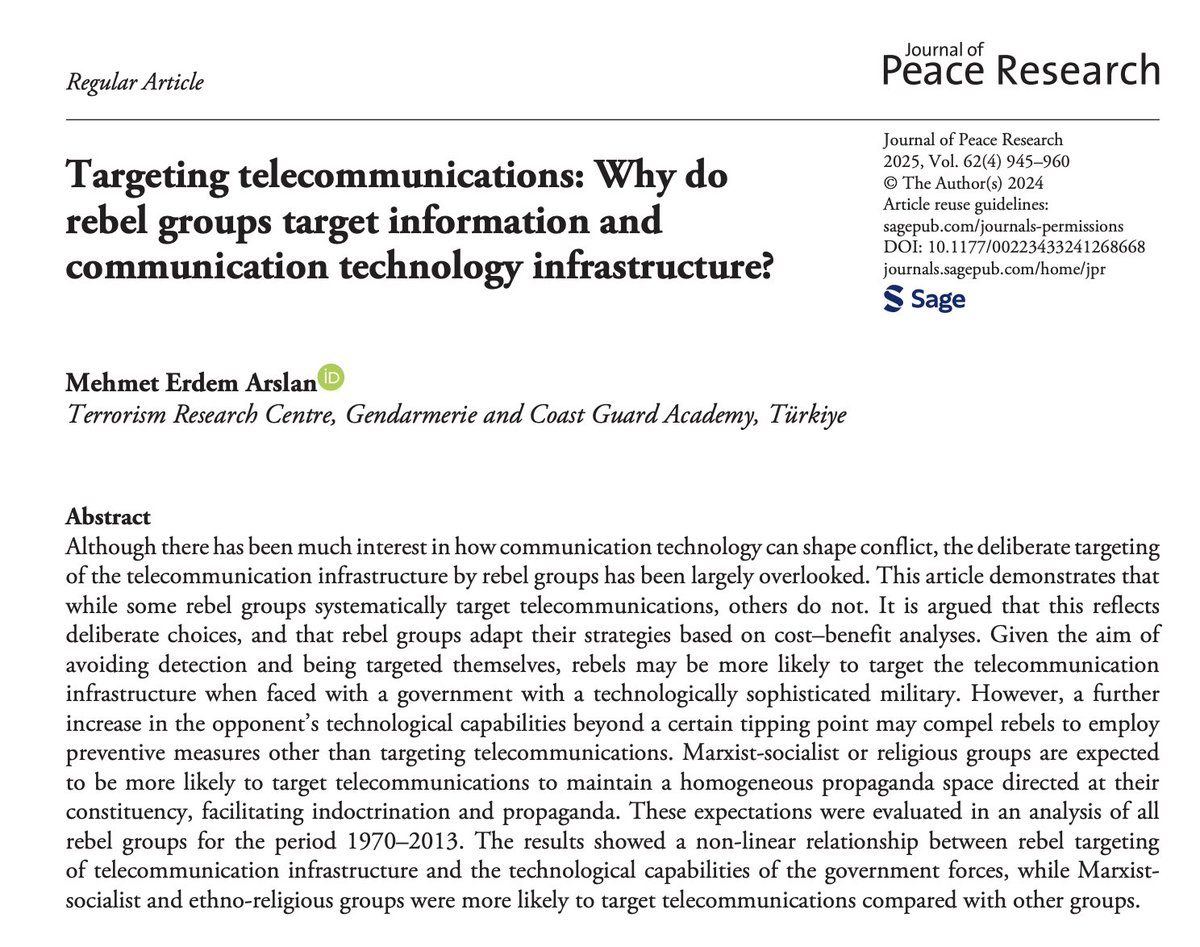
Pleased to finally see my very first solo article published in the @JPR_journal. Contributing to the recent literature on ICTs and conflict, I take a look on the other side of this relationship and ask why rebel groups target ICT infrastructure.
https://t.co/GoZxcjjHBA
Why do rebel groups target information and communication technology infrastructure? @m_erdemarslan unpacks this puzzle by developing a theory according to which targeting is based on a cost-benefit analysis.