Solid mathematical ideas almost always outperform contrived engineering tricks.
For years deep learning has been dominated by increasingly complex architectural hacks: CNN blocks, attention layers, channel mixers, residual pathways, normalization stacks.
Every few years a new architecture is announced as if it were a revolution.
One of the most famous examples was Kaiming He and Residual Networks (ResNet). At the time he was paraded around the AI world like a celebrity because residual connections supposedly “solved” deep learning.
But these were largely engineering patches.
Now something much more interesting appeared.
A new architecture called CliffordNet returns to mathematics — specifically Clifford Algebra, developed in the 19th century by William Kingdon Clifford.
Instead of stacking arbitrary modules, the model is built around the geometric product
uv = u·v + u∧v
A single algebraic operation that simultaneously captures inner product structure and geometric interactions.
In other words: the math already contains the interaction mechanism.
No attention blocks.
No mixer layers.
No architectural spaghetti.
The result:
• 77.82% accuracy on CIFAR-100 with only 1.4M parameters
• roughly 8× fewer parameters than ResNet-18
And with strict O(N) complexity.
The paper even suggests that once geometric interactions are modeled correctly, feed-forward networks become largely redundant.
A good reminder for the AI community.
Engineering tricks can dominate for years.
But eventually mathematics shows up and deletes half the architecture.
Paper:
https://t.co/9rQuZYvZ0o
19th century geometry just walked into computer vision.
📢 New paper: RUBATO: Decoupled Clocks Allow Full-Duplex Models to Think as Fast as They Can
Current full-duplex models tie thinking to the conversation's pace. RUBATO decouples them, giving each stream its own clock, so thinking runs as fast as the hardware allows.
Alibaba open-sourced the AI code reviewer its own engineers have used for two years.
Open Code Review served tens of thousands of Alibaba developers and caught millions of code defects before it went public. 48K stars.
→ reads your changes, then the full files and the rest of the codebase for context
→ puts each comment on the exact line
→ "ocr scan" audits whole folders, even code with no git history
→ works with your own model and API key
In Alibaba's test on 200 real pull requests, it beat Claude Code on precision with the same model, using about 1/9 of the tokens. It flags fewer issues overall, by design, so you get fewer false alarms.
Install:
npm install -g @alibaba-group/open-code-review
ocr config provider
cd your-project && ocr review
Apache-2.0.
https://t.co/q5Bu1oWR9s
The guy who gave us QLoRA, says DeepSeek's inference system is on par with OpenAI's stack and better than what Anthropic runs, at least at their scale.
Now check the license. Apache 2.0.
Until today a production stack at that level existed inside a handful of companies. It was the thing that made their API fast and their margins fat, and none of them ever showed it to anyone.
Today any startup, any university, any cloud in any country can download it, read it and run it. It runs on NVIDIA Blackwell and on Huawei Ascend, so it isnt tied to 1 chip vendor either.
This is what I mean when I say open weights are about more than downloading a chatbot. DeepSeek is giving away the knowledge that only a few labs had, and that changes who can build an AI company at all.
Respect @deepseek_ai
🚨 Web styling has been rewritten, again. In Rust!
🎨 Introducing Zyzz 🎨
- CSS standard syntax.
- First-class Base UI support.
- Compile to atomic styles.
- Inferred types and lint rules.
- 58x faster than StyleX.
- 3x smaller than Tailwind.
16.6 MB RAM vs. 70 KB. 🤯
1,000 databases. ONE PGX process. 🐘
One idle PostgreSQL server: 16.6 MB.
VS
One idle PGX database: just 70 KB!!
Measured on a 4 vCPU / 8 GB VM:
⚡ 128–155 MB RAM - 1,000 untouched DBs
⚡ 213 MB - all queried once
⚡ 283 MB - 100 active databases
⚡ 0.33–0.43% of one CPU core at idle
This is why we built PGX. 🐘
Every AI agent deserves its own database. Not its own server.
https://t.co/Su2Mkl6ijb
Watch Crysis 2 Remastered seamlessly run on the iPhone 17 Pro Max.
Your iPhone can now run real Windows PC games natively.
No jailbreak, No cloud, No PC streaming.
Open-source project make it possible GTA V, RDR2, God of War and more already working.
This is quietly one of the biggest mobile gaming breakthroughs of the year.
- https://t.co/RKIJh2ngMK
zedBSD on VisionFive 2✨ I wrote a Vulkan driver for PowerVR IMG BXE-4-32, and this is what JH7110 can really do! Linux never got good performance out of it, but that was a graphics stack problem, not the hardware.
JH7110+1GB RAM+4GB eMMC+7"LCD=$40 in Shenzhen👍
Introducing Flint, @Recursive_SI’s first model: a fast local coding model built with our automated research system, the Eureka Machine.
• Best-in-class fast local coding
• Up to 2x faster than comparable models: 125+ tokens/sec on a MacBook Pro, 150+ on RTX Spark
• Built from scratch in under 4 months
Private, unmetered intelligence on your own machine. Open weights available now on @huggingface, run it locally on your favorite framework or try it for free on @opencode or @pidotdev.
LayerFS v1.0.0 is out 🎉 Open-source (MIT)
Recursive filesystem for AI agents.
6 core ideas:
1. Ephemeral computing: agents spend ~80% thinking, so each Bash call mounts a Workspace, then commits
2. Decentralized agents: every agent commits to one Store, no DB server
3. Multiagent coordination: every tool call is a Commit; same-file clashes refused
4. Recursive filesystem: forks copy no files, at any depth
5. Ultra storage: dedup, then compression: 10 copies → 0.31
6. Instant bootstrap: ignored files stay in every Commit. ~5 min install vs 0.05 s mount
And 4 more:
7. Auto checkpoints: fork from any step
8. Append-only objects: content-addressed, never rewritten
9. .lww: lockfiles and caches take the newest edit
10. Big file, small edit: a write keeps only its bytes
Here are our links:
github: https://t.co/hwcUUBzhYw
website: https://t.co/8LInNxyN77
Watch the video below, and have Fun!!!
gpuix apps can now render in the terminal
create GUIs, use them as TUIs
- embed them in VSCode, Zed, Codex
- split GUIs into panes
- use all terminal power features for your GUIs
powered by the Kitty Graphics protocol
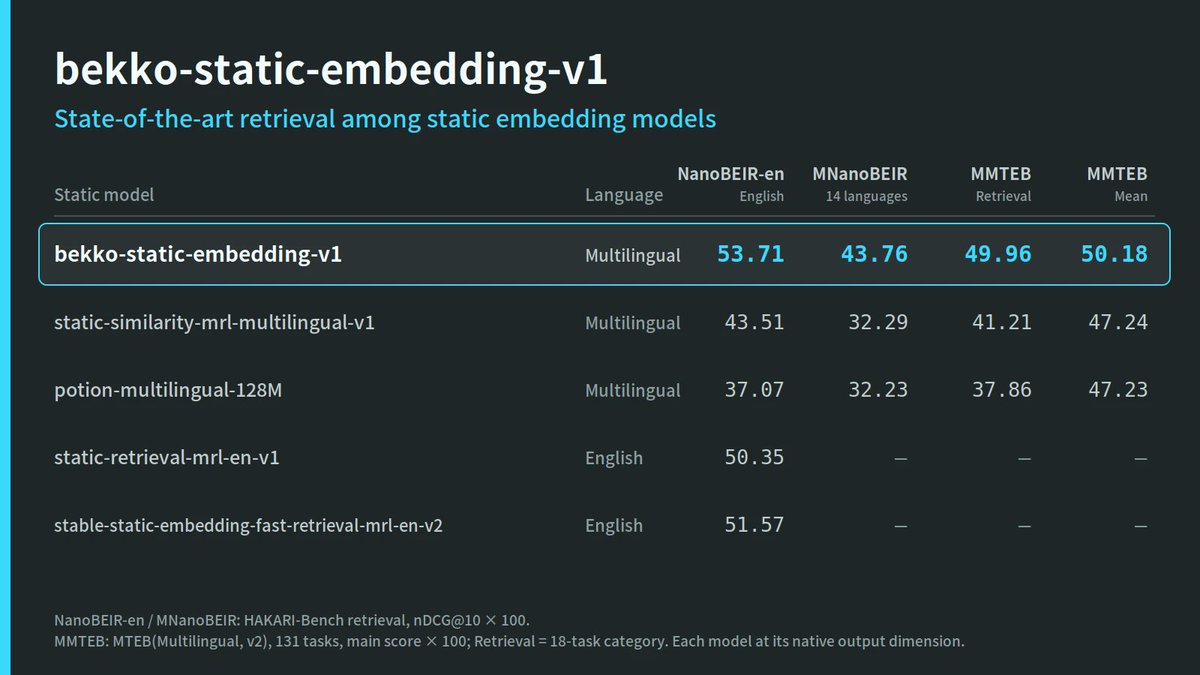
I released bekko-static-embedding-v1 🚀, a multilingual static embedding model with state-of-the-art retrieval among static embeddings.
No Transformer layers, no GPU: just token lookup + mean pooling. 40 languages, fast on CPU.
https://t.co/6VtP3oYgun
I turned the audio encoder of Google's EmbeddingGemma 2 into offline speech-to-text on Android (LiteRT) with a small trained reader. Galaxy S26: a 54-minute audiobook read in 74 s on the NPU, 44× real time, WER 4.3 % (3.8 % on the GPU). Files and app: https://t.co/PVR6iEKkgW
مدير تنزيل اسمه Plexo
يجمع لك أكثر من اتصال إنترنت عشان يسرّع تحميل الملفات
مثلاً عندك واي فاي سرعته 50 ميجابت، ونت جوالك عبر USB سرعته 30 ميجابت، Plexo يستفيد من الشبكتين لتحميل أجزاء مختلفة من ال��لف، ثم يجمعها لك بملف واحد
مفتوح المصدر
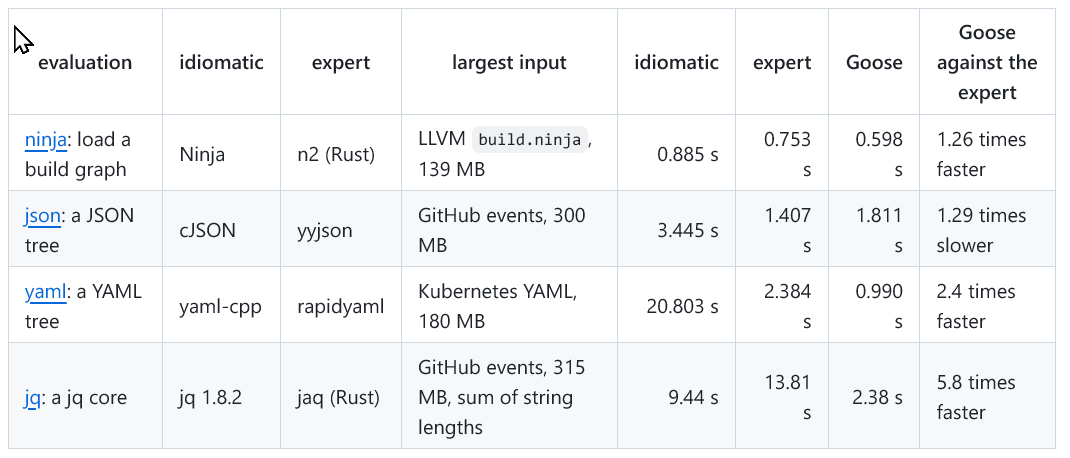
The "rewrite it in Goose" movement is already gaining steam, see here some early results of rewriting expertly written ninja/json/yaml/jq parsing in Goose and getting large speedups: https://t.co/ytWaMY0qV9
Introducing Pixel - a library for building GUIs in the terminal
- 120 FPS pixel-perfect graphics
- Embeddable inside existing TUIs
- Built in chromium webview component
https://t.co/rZJ6lyHgJD
Strata 0.2.0 is now live in beta! It includes its own in-app harness and terminal-serving interface.
https://t.co/83diJSeb8I
A lot of performance improvements and support for low-end devices 👇
Two years of work, and PySR v2 is finally out!
If you haven't used it before: PySR is a machine learning library that finds short equations that fit your data.
I've always wanted a PyTorch for symbolic learning. PySR v2 is a big step towards that: