🚨 Guarda esta CLASE MAGISTRAL de 46 minutos sobre inteligencia artificial.
Geoffrey Hinton, conocido como el padrino de la IA, lanza una frase que lo resume todo:
“SI DUERMES BIEN ESTA NOCHE, QUIZÁ NO HAYAS ENTENDIDO ESTA CONFERENCIA.”
Y no lo dice alguien cualquiera.
Hinton es una de las figuras más importantes de la historia de la inteligencia artificial.
Sus ideas ayudaron a construir gran parte de la IA moderna.
Pero ahora también es una de las voces que más advierte sobre sus riesgos.
En esta conferencia explica, con una claridad brutal, cómo funciona realmente la IA y hacia dónde puede dirigirse.
No es otro vídeo superficial sobre herramientas.
Es una clase para entender la tecnología que ya está cambiando el mundo.
- Habla de aprendizaje profundo.
- De redes neuronales.
- De inteligencia emergente.
- De capacidades que no esperábamos.
- Y de por qué debemos tomarnos en serio lo que viene.
46 minutos para entender mejor la revolución tecnológica más importante de nuestra época.
Guárdala, porque después de verla, puede que mires la IA de otra forma.
The Largest Machine Ever Built: The Large Hadron Collider at CERNIt’s not just a machine. It’s a 27-kilometre ring of pure engineering ambition buried beneath the Swiss-French countryside — the biggest, most complex device humans have ever constructed.Weighing in at 10,000 tonnes of superconducting magnets, the LHC operates at an astonishing -271.3°C — colder than the vacuum of outer space itself. In fact, it is the coldest extended region anywhere in the known universe.This extreme chill is non-negotiable. The superconducting magnets must hover just a fraction of a degree above absolute zero to completely eliminate electrical resistance. Even the slightest warming, and the entire system fails in a spectacular “quench” — a runaway release of stored energy powerful enough to melt the magnets https://t.co/E7OPBINxTB 2008, one such quench caused $40 million in damage and kept the collider offline for 14 months. A brutal reminder of just how unforgiving this technology is.Yet when the LHC is firing on all cylinders, the numbers become almost unbelievable:Protons race around the ring at 99.9999991% the speed of light
They complete 11,245 laps every single second
Up to 600 million collisions occur each second inside the detectors
The experiments generate 15 petabytes of data every year
Keeping a 27-kilometre machine at near-absolute zero, year after year, while orchestrating hundreds of millions of particle collisions per second is an engineering triumph that borders on the miraculous.The physics discoveries are legendary.But the sheer audacity and precision required to make it all work might be the most impressive achievement of all.
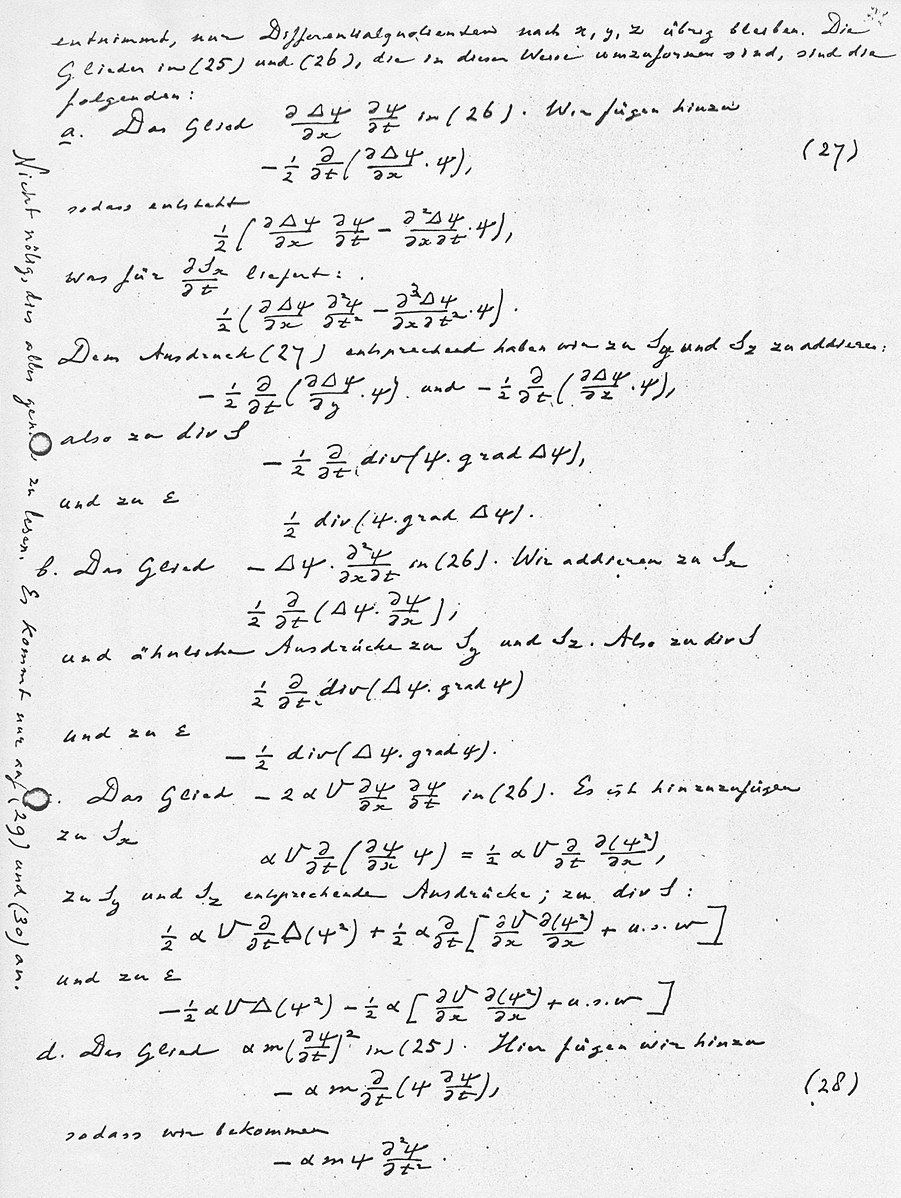
June 19, 1926, a letter written by Hendrik Antoon Lorentz to Erwin Schrödinger concerning wave quantum mechanics.
In this correspondence, Lorentz, at the age of 73, demonstrates his profound command over the newly established wave mechanics, leaving a significant impression on its originator, Schrödinger.
Vida popular en el fiordo" (Folkeliv på fjorden) es una destacada obra del pintor noruego Hans Dahl. Creado en 1885, este óleo sobre lienzo (66 × 48 cm) captura la esencia del romanticismo, inmortalizando la radiante luz, el agua en movimiento y la vida rural de los fiordos.

Romántico idealista. Dahl es célebre por su técnica impecable para pintar reflejos y agua en movimiento, así como paisajes iluminados por el sol.
Solía retratar alegres escenas campestres, fiordos noruegos y campesinas vistiendo trajes tradicionales.
Dahl se formó en la Escuela de Düsseldorf y se negó a seguir el cambio hacia el naturalismo y el modernismo.
Su obra fue muy popular entre los turistas alemanes, aunque criticada por otros artistas de su época. 
Voyager 1 and the Epic Journey Through the Oort Cloud Even though Voyager 1 has already entered interstellar space, it’s still deep inside our Solar System in the grandest https://t.co/YIDuNUmSWK will take roughly 300 years for humanity’s farthest spacecraft to reach the inner edge of the Oort Cloud — the vast, spherical shell of icy comets and frozen debris that marks the true outer boundary of our Solar System.Once there, crossing the entire Oort Cloud will take another ~30,000 years.That means Voyager 1 will spend tens of thousands of years silently drifting through this enormous region — a cosmic wilderness stretching up to 100,000 AU (nearly 2 light-years) from the Sun, filled with trillions of icy https://t.co/jPDvNrVMBY the time it finally emerges on the other side, it will have been traveling for over 30,000 years since leaving the planets behind… and it will still be only barely beginning its true journey into the wider Milky Way.A humbling reminder of just how vast our Solar System really is — and how small we are in the grand timeline of space exploration. Voyager’s voyage is only getting started.
Vista de Delft es el paisaje urbano más famoso de la Edad de Oro holandesa, pintado por Johannes Vermeer entre 1660 y 1661. Esta célebre pintura al óleo sobre lienzo mide 96.5 cm × 115.7 cm y se conserva en el museo Mauritshuis de La Haya en los Países Bajos.
En la parte de abajo de la imagen podemos ver la vista de Delft en 2019.
La pincelada del maestro británico J.M.W. Turner revolucionó la historia del arte al pasar de una precisión topográfica a un estilo altamente gestual, libre y abstracto que anticipó el impresionismo.
Conocido como «el pintor de la luz», Turner utilizaba el óleo y la acuarela no solo para describir formas, sino para capturar las fuerzas puras de la naturaleza mediante una textura y un dinamismo radicalmente avanzados para el siglo XIX.
Lagrange points are positions in space where the gravitational forces of two large masses, such as the Sun and the Earth, balance each other out. This means that a small object, such as a satellite, can orbit at these points with minimal fuel consumption. There are five Lagrange points, labeled L1 to L5, for any pair of orbiting bodies. L1, L2, and L3 are on the line connecting the centers of the two large masses, while L4 and L5 form the vertices of two equilateral triangles with the centers of the two large masses.
The Swiss mathematician Leonhard Euler identified the three collinear Lagrange points (L1, L2, L3) around 1750. This discovery preceded by about a decade the finding of the remaining two points by the Italian-born Joseph-Louis Lagrange.
Neutrino’s Non-Zero Mass:
For a long time, it was believed that neutrinos, subatomic particles produced by the decay of radioactive elements, had no mass. However, the discovery of neutrino oscillation, which was awarded the Nobel Prize in Physics in 2015 (jointly to Takaaki Kajita and Arthur B. McDonald), necessitates that neutrinos have a non-zero mass. The exact masses of the neutrino flavors are still unknown and are a subject of ongoing research in particle physics.
(Image credit: Argonne National Lab)
Viviani's theorem, named after the Italian mathematician Vincenzo Viviani (1622–1703), states that,
the sum of the distances from any interior point to the sides of an equilateral triangle ▲ is constant.
This theorem is a neat geometric result with applications in optimization and geometry.
Mathematician and polymath John von Neumann could speak eight languages by the age of six, including Ancient Greek and Latin. He could divide eight-digit numbers in his head at the age of six. He was familiar with differential and integral calculus by the age of eight.
He entered the University of Budapest at the age of 15 and earned a degree in chemical engineering at the age of 19. He obtained his Ph.D. in mathematics from the University of Berlin at the age of 22.
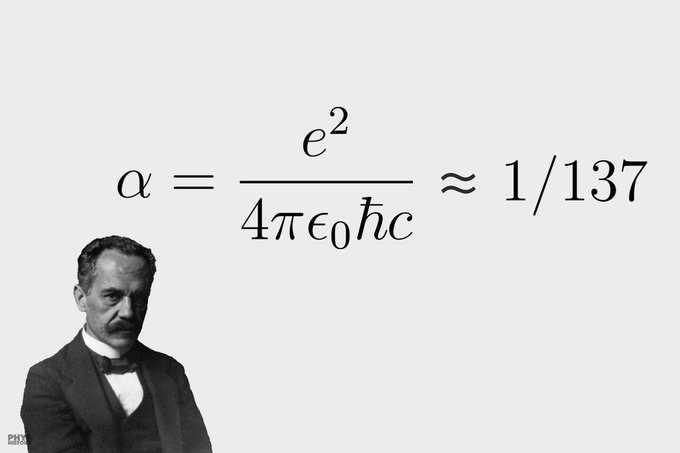
Fine-Structure Constant (approx. 1/137) is a dimensionless constant that characterizes the strength of the electromagnetic interaction between elementary charged particles. Its value is approximately 1/137, and it's one of the fundamental constants of nature whose origin remains a mystery.
It was first introduced into physics by Arnold Sommerfeld in the 1920s to account for the relativistic splitting of atomic spectral lines.
In the 1960s, Stanislaw Ulam, while doodling during a boring presentation, discovered a surprising pattern when he arranged numbers in a spiral and highlighted the primes. This spiral revealed a striking pattern and structure in the distribution of prime numbers.
📷visualizing math
Clube Sci-SAIFR: livros e séries - Emergência Radioativa debaterá os aspectos científicos abordados na #minissérie brasileira da Netflix. Na próxima quarta-feira (29/04), em formato virtual, com a participação da professora Elisabeth Yoshimura, da #USP. https://t.co/ynJlLYW9Gd
A quantum protocol can extract the maximum asymptotic work from many copies of a system without knowing its exact state beforehand, using symmetry and minimal state estimation within the thermal process. @NatureComms https://t.co/mGVx9sxb8T https://t.co/SylEp8959c
CMS reports a 5-sigma excess consistent with toponium, a fleeting top–antitop bound state. This candidate would be the most massive composite particle ever observed. https://t.co/mmP4Ca8aNB