Kaspa is still hardly known in finance, industry and broad public worldwide. They will all discover it, not through hyped stories and false expectations, but by experiencing the true value of security, processing speed and smarter, (clean) energy use
The Architectural Edge: Why Kaspa Outpaces Ethereum for DEX Infrastructure
Building a Decentralized Exchange (DEX) on a traditional single-chain blockchain like Ethereum is like trying to run a high-frequency trading firm on a narrow, one-lane highway. While Ethereum pioneered automated market makers (AMMs), its sequential design forces every transaction to wait in a single queue.
Kaspa’s BlockDAG architecture—complemented by the Toccata hard fork—rebuilds the Layer 1 foundation to handle the intensive demands of decentralized trading natively. Kaspa offers several architectural advantages that make it a superior backbone for a modern DEX compared to Ethereum.
Parallel Processing vs. Sequential Bottlenecks
Ethereum processes transactions sequentially. One block is added at a time, roughly every 12 seconds. When thousands of traders rush to swap assets during market volatility, the network bottlenecks, causing a massive surge in gas fees.
Kaspa replaces the single blockchain with a Directed Acyclic Graph (**BlockDAG**). Using the GHOSTDAG protocol, the network processes multiple blocks **in parallel** simultaneously (~10 blocks per second on mainnet). For a DEX, this means transactions don’t get jammed in a single queue; trades are woven together concurrently without degrading network performance.
Structural Defense Against Predatory MEV
Because Ethereum relies on a public mempool where a single block producer dictates the exact sequential order of transactions every 12 seconds, **Maximal Extractable Value (MEV)** bots thrive. They spot a pending trade and "sandwich" the user—buying right before them and selling right after—forcing the trader to execute at a worse price.
Kaspa's Advantage: Real-time decentralization dismantles the mechanics of MEV bots. With Kaspa producing blocks at a rapid-fire pace, there is no single consensus leader holding a monopoly over transaction ordering for long intervals. Rapid parallel block creation and real-time sequencing make it virtually impossible for bots to accurately predict the state and insert predatory sandwich attacks. Traders get the exact execution price they expect.
Sub-Second Latency (CEX Speed, DEX Security)
Waiting 12 seconds for a block—and minutes for true finality—is a lifetime in live trading. While Layer 2 rollups speed up execution, they fragment liquidity, introduce bridge vulnerabilities, and complicate the user experience.
Driven by the Rusty Kaspa engine, the network features sub-second block times. After just 10 seconds, a trade has accumulated roughly 10 layers of confirmation deep within the DAG structure. A DEX on Kaspa delivers the instant, responsive user experience of a Centralized Exchange (CEX) while settling entirely on an ultra-secure, decentralized Layer 1.
.
Predictable, Sub-Cent Transaction Fees
High traffic turns Ethereum into a playground for whales, where a simple token swap can easily cost $20 to $100+ in gas fees.
Because Kaspa scales horizontally at the base layer rather than relying on vertical scaling, the throughput handles massive volume natively. Transaction fees remain consistently sub-cent (<$0.01), making micro-swaps and algorithmic high-frequency trading economically viable for retail users.
Kaspa has a massive advantage that’s flying under the radar 🗣️
Its decentralized programmability (through smart contracts, covenants, and vProgs) gives it real utility beyond just being money🔥
That matters for three key reasons👇
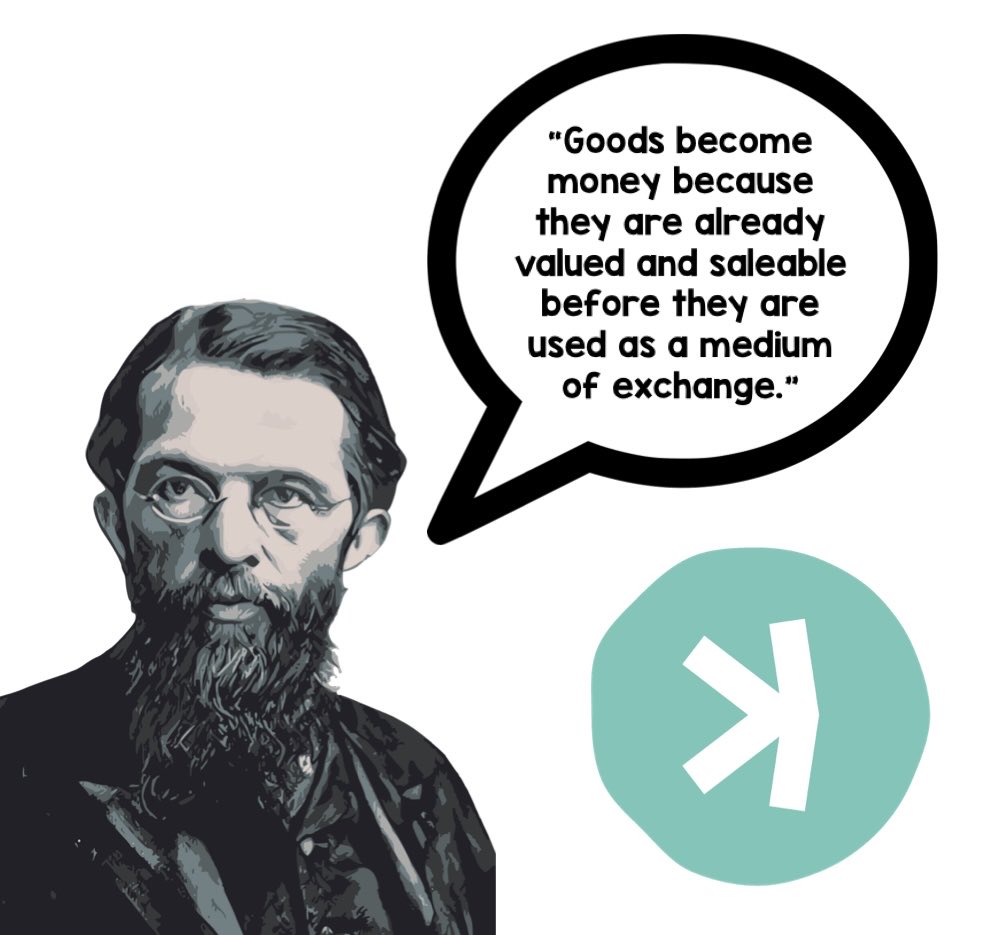
1.) The Regression Principle 👉 In Principles of Economics (1871), Carl Menger argued that money doesn’t appear out of nowhere. Goods become money because they were already useful and widely demanded. Before something can function as money, it needs intrinsic value or a clear use case. That prior demand forms a stable foundation. Over time, the most marketable goods (those that are divisible, durable, and easy to trade) naturally evolve into mediums of exchange. This idea later influenced Ludwig von Mises’ regression theorem: the value of money today ultimately traces back to its original non-monetary use.
2.) Resistance to Synthetic Supply
👉 Assets with no non-monetary utility are easier to “inflate” through synthetic supply (like paper claims or derivatives). But when an asset has real-world use beyond its monetary role, that creates baseline demand you can’t replicate artificially. A claim on something useful isn’t the same as the thing itself — it can’t be consumed or used. That inherent demand acts as a constraint on artificial expansion.
3.) Long-Term Security Budget 👉 Every fixed-supply Proof-of-Work network eventually depends on transaction fees to sustain security. If a network has no utility beyond being “money,” it relies entirely on people transacting for monetary reasons. But when programmability introduces non-monetary use cases, transaction demand expands. You’re no longer just paying for transfers of value — you’re paying for execution, settlement, and functionality. That broadens the fee base and strengthens long-term network security.
Sound Money ✅
Sound Settlement ✅
These are the two demands Kaspa’s tech inherits. But the thing is, the supply is fixed…
The question is, do you have enough? 🤔
#Kaspa $KAS 💚
Kaspa’s core purpose is two-fold: perfect money and enabling large-scale coordination via “coordination markets.” We cover this and this week’s news, as Kaspa crossed ~95% of its supply, while Kasplex integrated Bridgers (50+ chains) and launched a USDC/KAS pool. Moreover, we saw IGRA DAO assume LP ownership, and developers debated covenant indexing. https://t.co/iOwIHEgnxR
After Toccata, and then DAGKnight, Kaspa stops being legible as “just another fast PoW coin” and starts revealing itself as the base layer crypto has been trying, and mostly failing, to build for fifteen years.
Toccata is the first rupture. Covenants, native assets, ZK verification, sequencing commitments, and the early framework for vProgs move Kaspa beyond simple monetary settlement without dragging the L1 into the swamp of global-state bloat.
That distinction is everything.
Ethereum scaled by exporting execution into rollup fiefdoms. Solana scaled by compressing time around a privileged leader. Kaspa is moving toward a third path entirely: execution at the verifiable edge, settlement on a leaderless proof-of-work public clock.
Then comes DAGKnight.
Not “faster finality” in the cheap marketing sense. DAGKnight is consensus becoming responsive to reality itself. Instead of freezing latency assumptions into the protocol like a brittle machine pretending the world is static, Kaspa moves toward adaptive ordering under real network conditions.
That means PoW begins approaching the physical boundary of distributed agreement while preserving the one property crypto cannot afford to lose: Nakamoto-grade neutrality.
This is why the market is still mispricing Kaspa.
It is being valued like a payment coin while its roadmap points toward a neutral settlement engine for assets, ZK systems, conditional finance, high-frequency coordination, and sovereign programmable applications.
Top 10 is not a fantasy if Toccata lands cleanly and developers actually show up. That is the market re-rating Kaspa from “fast PoW” into “programmable PoW settlement infrastructure.”
Top 3 is the deeper thesis.
If DAGKnight proves that proof-of-work can preserve neutrality while compressing settlement toward real time, the market will eventually be forced to ask the obvious question:
Why should crypto’s future settle on slow chains, centralized clocks, or sequencer cartels when proof-of-work can finally move at the speed of the Internet?
What is HASH?
#HASH isn’t a project, or a tool. It’s a mission. An identity. A movement.
It started as a thought experiment, and in many ways it still is. I had an idea and decided to see if I could make it real. Instead of wasting energy arguing with maxis, trolls, or people who haven’t done the homework, I want to channel that effort into something tangible. Something visible. Something that actually moves things forward, by coordinating action and giving people a reason to move together.
I want to be clear: there’s no team behind this initiative. Right now, it’s just me. Someone who got tired of sitting on the sidelines and decided to try and start something.
For context, I’m not some full-time operator, builder or anon mastermind. Outside of the twitterverse, believe it or not, I am not an angry muppet. I’m a regular 9–5er working a full-time job, and a father to two kids under 4. Most of my time is already spoken for, and whatever’s left I split between things I enjoy ... photography, guitar, football, writing ... and $KAS.
#Hash isn’t some polished, fast-moving rollout. It’s something I’m building and working on when I can, because I want to see it exist. That also means it will take time. Saying that, this isn't just a passion project ... it's something I truly believe can be meaningful and impactful.
I’ve seen people asking for timelines and more info. I hear you. It’s coming. There’s more happening behind the scenes than it might look, including conversations with some great builders, especially with covenants on the horizon. I’ll share more as it develops. But I’m not rushing this.
But here’s the key: #HASH isn’t me, and it isn’t you. It’s us.
#Kaspa has no leader, and that’s one of its greatest strengths. The same applies here. No permission needed, no one to wait for ... just a shared belief and the willingness to act on it. Right now, most efforts are small, sporadic, disconnected. Hash is about changing that. More coordination. More consistency. More global presence.
We can hold Kaspa in silence, or we can hold it and be noisy. I’m choosing noise, but not the kind that stays trapped on CT. Real-world, visible, repeatable signal that compounds over time.
Because if we want adoption, if we want attention, we can’t sit around waiting for Binance or a Saylor-type figure to show up and do the marketing for us. And we don’t need them. We already have the tech, the research, the builders, and most importantly ... the community. That’s the lever we can actually pull.
And based on the response to my last post so far, it’s clear people want to get involved, cause a bit of chaos, and do something that actually moves the needle. That’s what this is about. I can spark and coordinate, but this only works if we all participate.
Next, I’ll start getting more into the plan and how I intend to encourage and incentivize that participation in writing Kaspa on the walls.
None of the above, WarpCore on Kaspa $kas, is far superior in almost every metric and much greater in reach terms of feature set. We are nearing full production readiness with some minor tweaks for the upcoming Toccata Fork. Will leave these faux ISO projects in the dust. There is nothing comparable.
"The early Internet did not win because it was a prettier network. It won because it introduced a neutral protocol layer that let independent systems interoperate without asking a central operator for permission. That was the breakthrough. Open architecture networking turned fragmented machines and networks into a shared communications substrate. TCP/IP was not just “faster telecom.” It was a new base layer for information transfer.
That is the right frame for Kaspa.
Kaspa is not interesting because it is “another fast chain.” That misses the point. The deeper similarity is architectural. It is trying to do for value transfer what the Internet did for information transfer: create an open, high-speed, permissionless protocol layer that others can build on top of, without rebuilding trust every time.
That is why the BlockDAG matters. Instead of forcing economic activity through a single serialized lane, Kaspa’s GHOSTDAG orders parallel block creation in consensus. The result is not just more speed. It is a different kind of base-layer design, one built for open settlement under real network conditions.
And this is where the comparison gets stronger.
The Internet did not stop at packet delivery. Higher layers emerged on top of the common base and unlocked entirely new classes of applications. Kaspa’s research direction points toward a similar expansion. Verifiable programs push computation offchain, then prove correctness back to the base layer. That preserves speed without turning the foundation into bloated global state.
Same pattern. Keep the base layer lean. Keep it open. Let the protocol scale the civilization built on top of it."
Kaspa is anarchic infrastructure powering a libertarian economy.
And it’s the first system to merge both at scale.
Read that again.
Really sit with what it implies and the value it offers humanity.
Because I promise you 99.9% of the cypherpunk world is missing it because they’ve been fed lazy narratives: “Bitcoin 2.0” or “Digital silver.” and immediately dismiss studying further. They’ve been misled. And they’re missing one of the greatest structural discoveries of the modern era ... literally.
This isn’t just about money. I do not see Kaspa as "money', although it can be used as such. It’s about a new economic layer, where the market governs itself. Backed not by banks, bureaucrats, or courts, but by real-time sequencing, by trustless order, by incorruptible time.
I am now fairly certain $Kaa is more discovery vs invention. It's a new way for humans to coordinate at scale without rulers .. not just money, but truth, property, and time itself. BTC can do this but in one domain... value. Kas is multi domain making it a structural evolution in political coordination itself... i.e a discovery in political physics... not just a tech evolution, but a discovery in the laws that govern decentralized human coordination. I am essentially suggesting that just as physics reveals how the universe works, Kaspa reveals how society could work when trust is programmatic and control is eliminated. As Bitcoin discovered digital scarcity,
Kaspa discoverd digital order.
Not "order" as in imposed control, rather temporal order (the master sequencer) , which all systems of property, law, identity, and coordination depend on. This is political physics. A fundamental shift in how humans can organize without hierarchical enforcement- revealing a new structure that, once seen, changes everything.
When electricity was first discovered, people saw it as just an upgrade... a brighter candle, a safer gas lamp, a novel way to light homes. That was the mindset of the time: we already had lighting, and this was simply a better version. But electricity wasn’t just an improvement it was a new structure of coordination. Once understood and widely adopted, it enabled the modern power grid, instantaneous global communication, digital computation, industrial automation, and large scale human coordination. It separated energy from location, effort from time, and coordination from proximity. It revealed a new structure for how humans could live, build, and organize, not by improving the old world, but by unlocking an entirely new one.
Kaspa is the same kind of discovery. At first glance, it looks like “Bitcoin but faster.” Another coin. Another chain. Just quicker confirmations. But that’s the candle mindset. In reality, Kaspa is a structural discovery - the emergence of anarchic infrastructure for trustless order. It doesn’t just improve blockchain tech; it opens a new axis of human coordination. It sequences time itself.. globally, in real-time, and without rulers - and from that, everything else becomes possible: value, contracts, identity, data, reputation, and truth.
#TruthNet #TrustNet @MarkYusko
Yonatan Sompolinsky has just set a clear deadline. Kaspa is expected to launch OP_CAT++ by mid-June true, programmable covenants directly on the UTXO basis at full BlockDAG speed. That would be a technical quantum leap. While Bitcoin has been stalling the covenant debate for years, Kaspa, as the first scalable L1, could enable true programmable digital assets and thus attract precisely the institutional assets Grayscale is currently discussing. Anyone who views KAS as merely a means of payment is missing the actual shift: from a fast currency to the first practical, decentralized asset platform.
The biggest coordination failures in history aren’t Prisoner’s Dilemmas. Words from Kaspa founder @hashdag
They’re Stag Hunts..
No one wants to defect. Everyone wants the stag. The only problem: no one knows if the others will show up.
What if a mechanism could make showing up binding, atomic, and trustless?
That’s what Kaspa’s stack is actually building toward.
RTD for real-time settlement. vProgs for programmable execution. Coordination Markets for binding, conditional, multi-party commitment no leader required.
The intendo: a cryptographic conditional commitment. “I will contribute X if enough others do the same.”
Threshold met → atomic execution. Everyone acts at once.
Threshold not met → commitments dissolve. No one loses anything.
No first-mover disadvantage. No exposure risk. No trusted third party.
The internet gave us costless expression at global scale. Polls, petitions, likes — all cheap talk.
The missing layer was never better communication.
It was binding intent.
$KAS isn’t just money. It might be the first unit of account that doubles as a unit of accountability.
You can���t vote without staking. You can’t stake without being held to it.
The ballot is the bond. The vote is the contract.
🫎@Themooseisloos5 has presented this very nicely and special courtesy to him 👇🏻
fed the Google whitepaper to Claude with the prompt:
"take a look at the Google paper, pick out the key parameters, and give me your analysis of the relative strengths, weakness and adaptability for both Bitcoin and Kaspa in table form"
there's literally no parameter for which $KAS Kaspa is not superior, security wise
the narrative for the past few years, that somehow $BTC is more secure as a POW chain, has now gone out the window in face of the quantum threat
Oracles are still one of the hardest unsolved problems in DLT. @eliottmea's research on the consolidated order book is exactly the kind of work the ecosystem needs. (https://t.co/OijHDc3BBa) Kudos to @Kaspa_KEF for backing it!
wrote an outlook for the upcoming “Toccata” hard fork -- native L1 covenants, based zk apps, why the activation window moved, and what the road from feature freeze to mainnet looks like:
https://t.co/JFRkYp6Yd4
The confirmation time problem has been unsolved since Bitcoin. $KAS is the first serious academic attempt to fix it at the protocol level 📊
DAG KNIGHT is the first parameterless consensus protocol ever built
No hardcoded latency bound. Confirmation times adapt to real network conditions instead of worst case assumptions baked in at launch
Every protocol before this had the same flaw. Set k too low and you're vulnerable. Set it too high and you're slow even when you don't need to be
DAG KNIGHT fixes that:
→ Confirmations scale with actual network speed, not assumptions
→ Attacked or congested network = slower, but never broken
→ Minimum k selected dynamically, never predetermined
→ Self-stabilizes after 51% attacks without human intervention 🔧
Pass and Shi proved no responsive protocol can tolerate 50% byzantine corruption
KNIGHT circumvents that by responding to adversarial latency rather than observable latency
Most L1s compete on marketing. #KAS is competing on computer science 📈
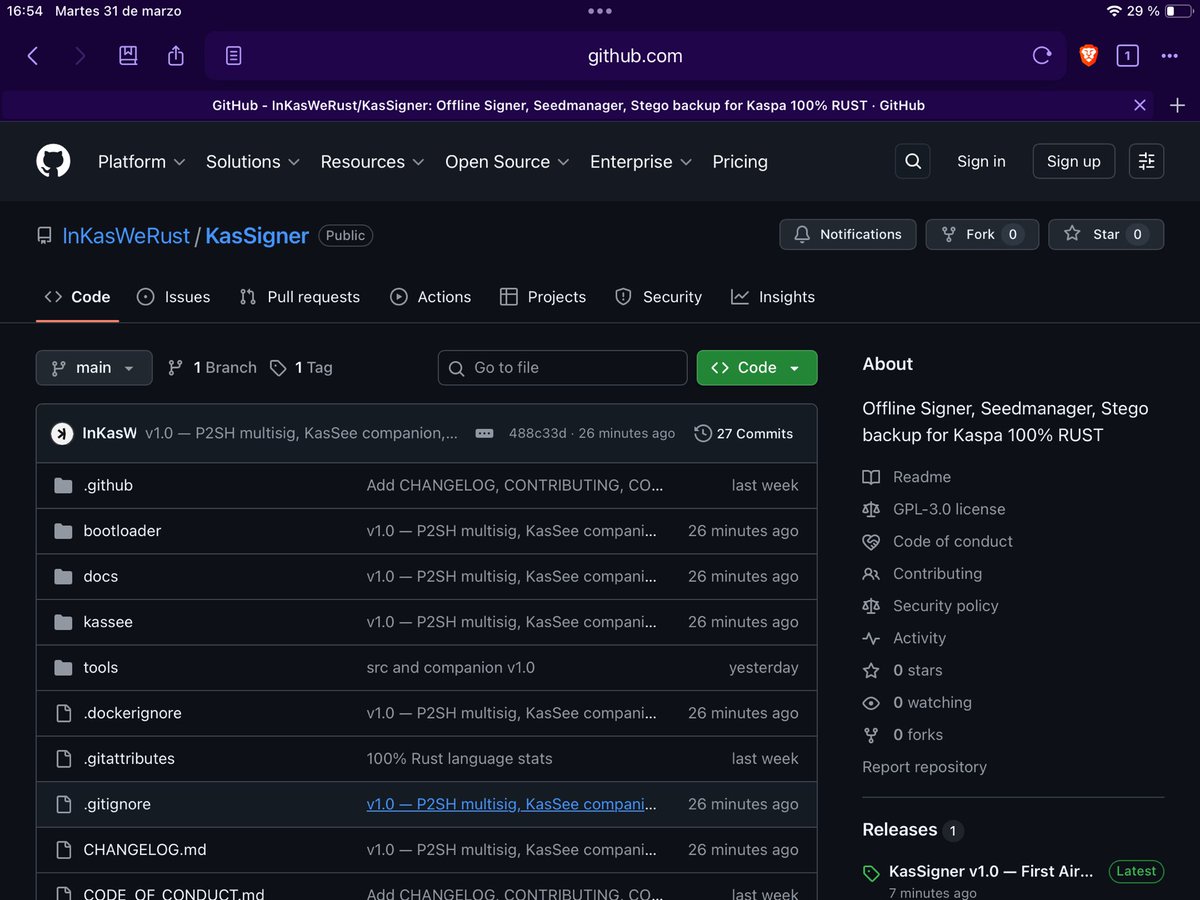
So… Today is the day for KasSigner to going public… now we need people to try, audit and develop… Kaspians, that’s on you. Once a tool in my head, now a software for you all ;-) https://t.co/0iKWz23m0Z