@thsottiaux Thanks for the reset, Tibo. Codex is genuinely better at making decisions, but I keep going back to Opus 5.5 because it's so much faster. The endless testing and rechecking in Codex make even simple tasks drag on. Really wish the harness could catch up with the model
I think the reality is that, despite the quality of decision-making being much higher (and I have tested it multiple times now), the harness that governs Opus 5.5 is much better. For coding tasks, 5.5 is much quicker in its responses. Hence, as you must have seen, most serious folks have shifted to Opus 5.5 as their daily driver.I have been trying to point out the issues with turn completion, slower response speeds, constant testing, and rechecking, which lead to good quality but make the experience extremely frustrating. And, of course, you must have seen this reflected in the current usage patterns as well, pre- and post-Opus 5.5 release. So, to get the most out of the higher quality, given the speed issues, most tasks end up going beyond 5 hours. Hence, we, too, are confused: will we not be able to work continuously? What is the point of double usage if a task that has already started and is still ongoing gets stopped at 5 hours?
We have tons of improvements we need, but here are a few that are very urgent, in logical sequence:
a) Fix this regression: /status does not show account login credentials anymore and shows very garish colours for selection.
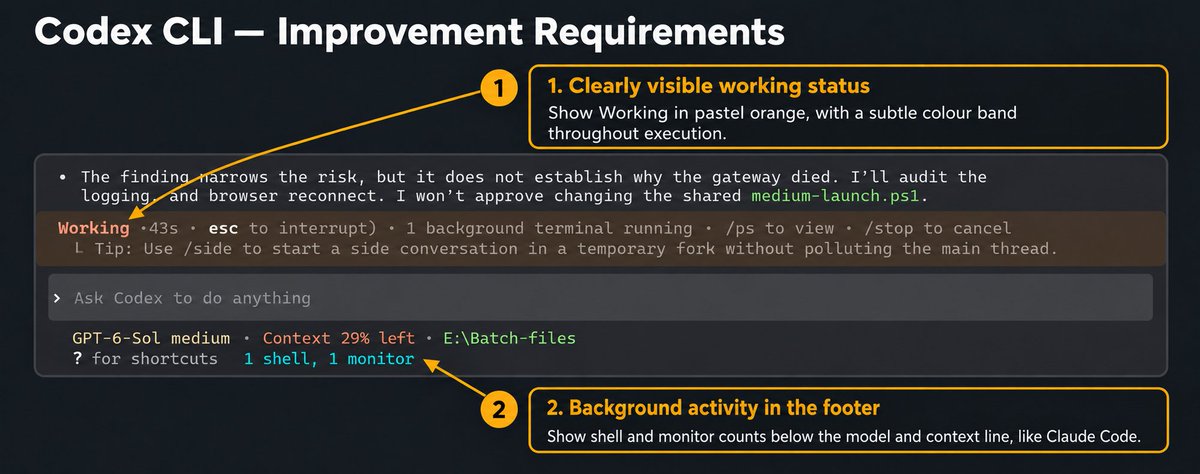
b) Allow running background tasks and show them below the status line. Support monitors, watchers, and cron jobs that can be started, and while you are at it, allow configuration of the status line (see Claude Code).
c) Clearly demarcate "working" with a different colour.
We have tons of improvements we need, but here are a few that are very urgent, in logical sequence:
a) Fix this regression: /status does not show account login credentials anymore and shows very garish colours for selection.
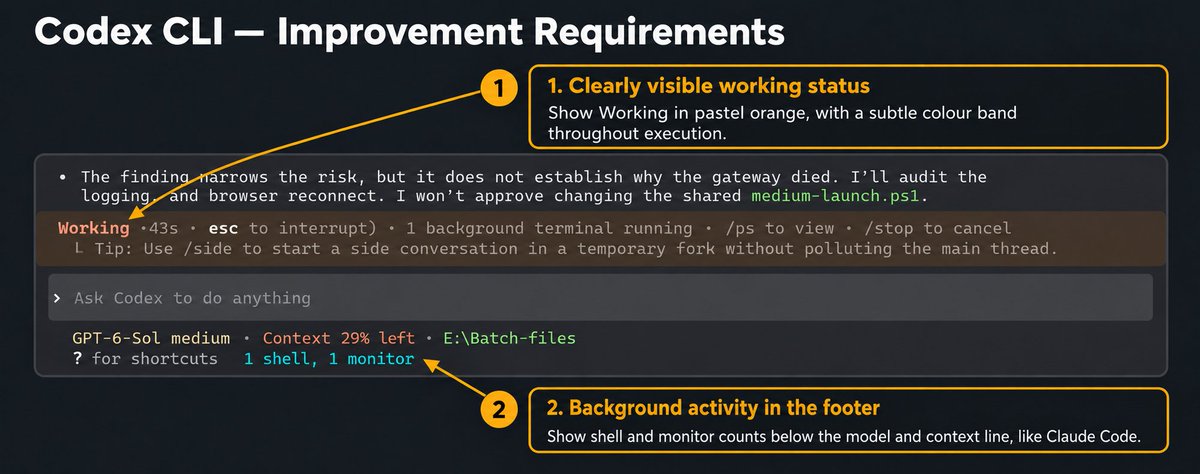
b) Allow running background tasks and show them below the status line. Support monitors, watchers, and cron jobs that can be started, and while you are at it, allow configuration of the status line (see Claude Code).
c) Clearly demarcate "working" with a different colour.
This is happening with both OpenAI and Anthropic models. The Claude Code harness is so good that it compensates to some extent. It broke with Opus 5, but they recovered with Fable 5.1 and carried those improvements forward to Opus 5.5 and Sonnet 5.5. Meanwhile, the problem has worsened with OpenAI models. If @thsottiaux wants to help us - then resolve these issues, this needs to be addressed.
Continuity breaks: Agents lose track of the intended outcome, earlier decisions and working capabilities across versions, environments and context changes.
Work fragments: Unclear ownership and stale instructions lead parallel agents to duplicate work or impose conflicting requirements.
Patches replace root-cause fixes: Reviews address individual cases without testing the general rule across the affected class.
Complexity compounds: Agents add checks, wrappers and evidence artifacts; simplifying, consolidating and removing rarely have explicit owners.
Caution conceals regression: Refusing, holding or suppressing uncertain behaviour reduces supported capability without recording the loss as a regression.
Activity substitutes for progress: Completed steps, generated artifacts and passing checks become the goal, while usable capability fails to improve consistently.
Verification must serve the outcome: Checks should demonstrate usable capability or protect necessary correctness, safety and reliability. Otherwise, verification becomes work in its own right.
What we are after is very snappy and fast output, like what we see in Opus 5.5, but with the reliability and veracity of Astra/Sol. Actually, 50 is not working at all—it just keeps running without any indication of speed, so no, we do not see any visible change.
We also need some improvements in the CLI:
a) Features keep regressing—for instance, /status suddenly no longer shows account login credentials and uses very garish colours for selection.
b) We have been asking for a long time to allow running background tasks and showing them below the status line. Support monitors, watchers, and cron jobs that can be started, and while you are at it, allow configuration of the status line (see Claude Code).
c) Clearly demarcate "working" with a different colour.
We have tons of improvements we need, but here are a few that are very urgent, in logical sequence:
a) Fix this regression: /status does not show account login credentials anymore and shows very garish colours for selection.
b) Allow running background tasks and show them below the status line. Support monitors, watchers, and cron jobs that can be started, and while you are at it, allow configuration of the status line (see Claude Code).
c) Clearly demarcate "working" with a different colour.
The community needs to give OpenAI and
@thsottiaux
credit for completely reinvigorating the competition—we, the users, benefit from that! He has single-handedly managed this end-user communication post-GPT-5.6 release. While these GPT models—extremely good at code review, finding needles in haystack, and less prone to hallucinations—were and still are token hogs and had turn-continuation issues, Codex App and Codex CLI are also distinct branches with very little communication and regression testing between them, let alone across versions of the same branch. But they have been listening to us and will hopefully continue to listen in the future. The net effect has been Opus 5.5 and Sonnet 5.5 becoming very fast, snappy models—now it is their turn to react!
The community needs to give OpenAI and @thsottiaux credit for completely reinvigorating the competition—we, the users, benefit from that! He has single-handedly managed this end-user communication post-GPT-5.6 release. While these GPT models—extremely good at code review, finding needles in haystack, and less prone to hallucinations—were and still are token hogs and had turn-continuation issues, Codex App and Codex CLI are also distinct branches with very little communication and regression testing between them, let alone across versions of the same branch. But they have been listening to us and will hopefully continue to listen in the future. The net effect has been Opus 5.5 and Sonnet 5.5 becoming very fast, snappy models—now it is their turn to react!
Actually, both desktop versions have many issues, as vertical, chat-based interfaces force them to lay out information in a very broken manner. This is not useful for coding, and one misses out on a lot of context as it gets hidden very quickly. If you go back to Claude with mods now, you will know what you are missing.
Snappier and more organized, like Claude Code CLI. Both Opus 5.5 and Sonnet 5.5 are so snappy. Astra and Sol are more grounded with fewer hallucinations, but they get lost in turn continuation and block themselves with over-testing, which kills speed. So: CLI improvements and snappiness, as defined earlier. And some of that we already see in DOTs - so it is close!!!
@thsottiaux The new DOT setup is super easy! But @thsottiaux, Sol 6.1 still feels painfully slow beside Opus 5.5 and Sonnet 5.5. You promised snappiness for lower quotas. Where is it? Speed and logical turn completion are the foundation. Everything else depends on getting this right.
@thsottiaux Agree with @mecp as Opus 5.5 has changed our usage. So both top level Claude models have suddenly raced ahead so much that unless you provide value at levels - least matching or more - no incentive for us.