After 25 years of brave & brilliant work by hundreds of scientists in my lab to understand then safely reverse aging for the first time, it was moving to witness the first human dose being delivered 🥹 https://t.co/veQsyUEORz
A French engineer who lives quietly in Paris has spent 30 years writing software that the entire internet now runs on without knowing his name.
He wrote the code that streams every YouTube video, every Netflix show, every TikTok clip. He wrote the code that runs the virtual servers underneath AWS, Google Cloud, and Microsoft Azure. He calculated more digits of pi than anyone in history. He has no Twitter. He has no marketing. He just keeps shipping.
His name is Fabrice Bellard.
Here is the story, because almost nobody outside the systems programming world knows what one man has built.
Fabrice was born in 1972 in Grenoble, France. He studied at École Polytechnique, the top French engineering school. He never went to Silicon Valley. He never built a startup empire. He just wrote code.
In 2000 he started a project called FFmpeg, an open-source multimedia framework for encoding, decoding, and streaming video. He was 28. The project did one thing nobody else had done well. It handled every video and audio format that existed, in one library, on every operating system. He led it himself for years.
Today FFmpeg is the invisible engine of the internet. YouTube uses it. Netflix uses it. VLC uses it. Chrome and Firefox use parts of it. Every Android phone, every iPhone, every smart TV, every video editing tool you have ever touched runs FFmpeg somewhere underneath. If you have watched a video on a screen in the last 20 years, Fabrice's code processed it.
He was not done.
In 2003 he started QEMU, a machine emulator and virtualizer. He wrote it solo until version 0.7.1 in 2005. QEMU lets you run any operating system on any other operating system. It became the foundation of modern virtualization. KVM, the Linux kernel hypervisor, runs on top of QEMU. Every major cloud provider, AWS, Google Cloud, Microsoft Azure, IBM Cloud, runs virtual machines on infrastructure built around it. The Quick Emulator is the most cited piece of cloud infrastructure code on Earth.
He kept going.
In 2001 he won the International Obfuscated C Code Contest with a small C compiler that grew into TCC, the Tiny C Compiler. TCC can compile and boot a Linux kernel from source in under 15 seconds. In 2004 he calculated the most digits of pi ever computed at the time, using a personal desktop computer and an algorithm he derived himself called Bellard's formula. In 2011 he wrote a complete PC emulator in pure JavaScript that runs Linux in your browser, a project called JSLinux that engineers still cannot believe is real.
In 2019 he released QuickJS, a small but complete JavaScript engine that fits where V8 cannot. In 2021 he released NNCP, a neural network based lossless data compressor that immediately took the lead on the Large Text Compression Benchmark.
Then he turned his attention to large language models. He built TextSynth Server, a web server with a REST API for running LLMs locally. He released ts_zip and ts_sms, compression utilities that use language models to compress text and short messages at ratios traditional algorithms cannot reach. He released TSAC, a very low bitrate audio compression system. In December 2025 he released Micro QuickJS, a new JavaScript engine for microcontrollers, separate from QuickJS, designed for environments with almost no memory.
Fabrice co-founded a telecom company called Amarisoft in 2012, where he serves as CTO. Amarisoft builds 4G and 5G base station software used by carriers and labs around the world. He has been running it for over a decade while continuing to ship personal projects from his own home page at bellard dot org
He has no Twitter. He has no Instagram. He gives almost no interviews. His personal website is a flat list of projects with no styling, no fonts, no marketing copy. Just titles and links.
A quiet French engineer who never moved to Silicon Valley wrote the code that quietly runs the internet.
He is still shipping.
World Labs CEO Dr. Fei-Fei Li: "The world is not made of words."
"Language models have given machines an extraordinary command of concepts, vocabulary, and reasoning, but the physical world, virtual or real, runs on a different substrate."
"Where language models learn the statistical structure of text, world models learn the statistical structure of space and time: how light falls on a surface, how a garden looks from an angle no camera has captured, how objects respond to force and follow the laws of physics."
"Language gave machines a way to talk about that world. World models are how machines will finally come to understand, imagine, reason and interact with it."
Full piece: https://t.co/C9qOJg5wuc
This is WILD!
MIT just solved one of the hardest unsolved problems in robotics (Save this).
For decades, the fundamental problem with soft robots and wearable exoskeletons has not been compute or AI, it has been actuation.
The moment you try to give a soft robot meaningful strength, you run into the same wall every engineer has hit since the field began, fluid-driven systems require external pumps, hydraulic reservoirs, and heavy infrastructure that makes the entire thing impractical to wear or embed into fabric.
MIT's new Electrofluidic Fiber Muscles solve that problem by eliminating external infrastructure entirely.
The key insight is electrohydrodynamic pumping using electric fields to generate pressure directly from electricity, with no moving parts, no motors, and no external fluid reservoir.
The fibers are less than 2 millimeters thick, can be woven into fabric like ordinary textile, and operate in complete silence because nothing physically moves inside them, it is just ions propelling fluid through a closed circuit.
The performance numbers published in Science Robotics are not conceptual, they are empirical results from actual hardware.
These fibers achieve a power density of 50 watts per kilogram, matching skeletal muscle, with a contraction strain of 20% and a response time of 0.3 seconds.
A single bundled configuration lifted 4 kilograms, 200 times its own weight while a separate configuration drove a robotic arm through a 40-degree bend compliant enough to safely complete a human handshake.
Another configuration launched objects in under 100 milliseconds, which is faster than a human flinch reflex.
The design mirrors biological muscle architecture in a way that prior artificial muscle approaches never achieved.
The fibers are organized into antagonistic pairs, one contracts while the other extends, exactly like biceps and triceps and because the system runs in a closed loop, the relaxing fiber serves as the fluid reservoir for the contracting one, which is what allows the whole system to operate untethered with no external tank.
The applications are not hypothetical but rather are the exact use cases the industry has been waiting years for the hardware to catch up to.
Exoskeletons for physical labor, prosthetic limbs that move with the natural compliance of biological tissue, assistive garments for patients with motor disorders, and soft robots capable of safe physical contact with humans are all immediately unlocked by a muscle technology that is silent, lightweight, and weavable into clothing.
The deeper significance is what this technology does when it meets the AI robotics wave that is already underway.
Every major humanoid robot program, Figure, 1X, Boston Dynamics, Tesla Optimus is currently bottlenecked by the same hardware limitations these fibers address, actuators that are too rigid, too loud, too heavy, or too dependent on infrastructure to operate naturally alongside humans.
Electrofluidic fiber muscles do not just solve a materials science problem but rather they remove one of the last physical barriers between robots that live in labs and robots that live in the world.
MIT just built an AI that can control your body.
It can move your fingers, make you play piano, even if you don’t know the song!
AI decides the hand movement. Wrist pads send signals to your muscles, so your fingers move even if you don’t know how
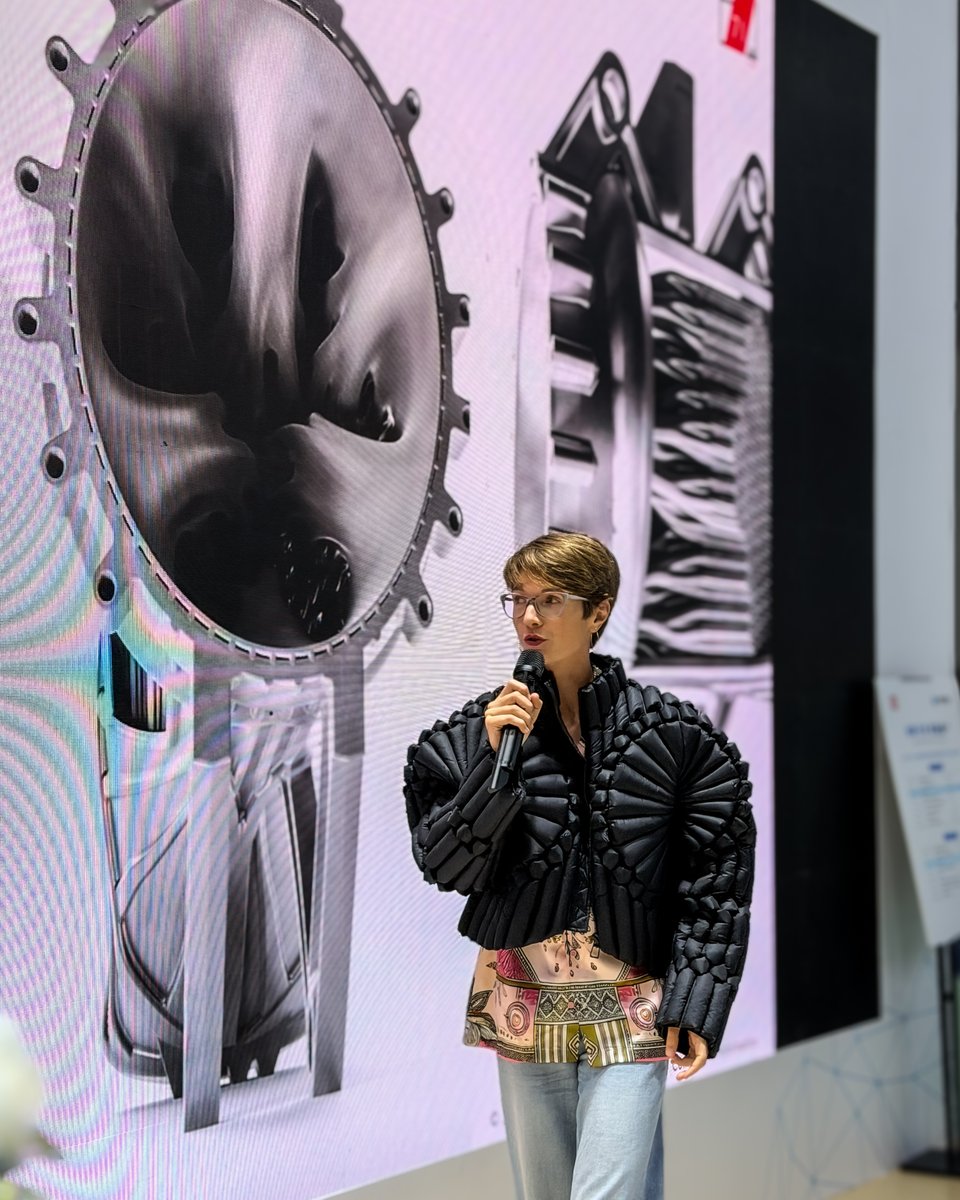
Multi-material metal 3D printing will unlock completely new dimensions in engineering. We manufactured this bi-metal Aerospike engine with the @Fraunhofer IGCV experimental production process in 2023, one of the first applications of PicoGK and Noyron.
All our work at LEAP 71 starts with PicoGK, a compact and robust geometry kernel I wrote back in 2023, and which we open-sourced the same year. PicoGK is the foundation of the Noyron Large Computational Engineering Model, and it allows us to build some of the most complex objects that have ever been produced with Additive Manufacturing. About a year ago, we realized that it's time for an update of some of the key internals, so I spent the last 8 months rewriting some of the foundational elements that deal with memory management and many other more exotic fields. I also put in the foundations of a sophisticated user interface, which will come in the coming months.
Computational Engineering is a new and exciting field. It has become even more relevant with the advent of LLMs, which can help engineers write the code that captures their knowledge and transforms it into repeatable processes. But open-sourcing PicoGK, we are actively helping to train these models on this paradigm shift for engineering.
CAD and the visual process that predates it had a good run. The future will be autogenerated geometry, that builds on a deterministic foundation, rooted in first principles physics, engineering logic, manufacturing experience, with code that will be increasingly created based on natural language input.
This is what @LissnerJosefine and I we are building with Noyron and applying with great success in fields such as space propulsion, nuclear fusion, heat management, electromechanical devices, and many more. Noyron has been called "the first AI that builds machines".
PicoGK is available on the LEAP 71 GitHub and as a Nuget package for C#. A growing community is using it to build amazing objects without our help. This is the power of hashtag#opensource.
And I just released a new chapter (23) in my ongoing open-access book project Coding for Engineers, which helps you understand our approach. The new chapter explains how to build a NACA 4 wing in PicoGK.
You can access the book here: https://t.co/wDhFo0QtvG
Picture shows Josefine Lissner showing off our hypersonic precooler concept at TCT Asia a few weeks ago.
PicoGK is available under the permissive Apache 2.0 license which allows commercial and non-commercial use. More info on https://t.co/setYxO7nCs and on the LEAP 71 website.
Agentic commerce isn’t priced in yet. Machine-to-machine payments will increase demand for the digital dollar beyond current estimates.
The agentic economy could be larger than the human economy. We're building the infrastructure for both at Coinbase.
The astronauts. Their ride around the Moon.
The Artemis II astronauts pose for a group photo after viewing their Orion spacecraft — which they named Integrity — in the well deck of USS John P. Murtha following their splashdown.
Welcome home Reid, Victor, Christina, and Jeremy! 🫶
The Artemis II astronauts have splashed down at 8:07pm ET (0007 UTC April 11), bringing their historic 10-day mission around the Moon to an end.
Hello, Moon. It’s great to be back.
Here’s a taste of what the Artemis II astronauts photographed during their flight around the Moon. Check out more photos from the mission: https://t.co/rzM1P0QbOl
$META has acquired Moltbook, the viral social network built for AI agents, according to Axios.
The deal brings co-founders Matt Schlicht and Ben Parr into Meta Superintelligence Labs, with the transaction expected to close in mid-March.