Entrepreneur and Civil Engineer! My parents came here legally when I was a child. Moved to Boston in 2008 from San Diego. Moved to Florida in March, 2021.
@Mark_Dee_33 I heard you got the vaccine. I explains your stupid posts. My uncle bought a pharmacy in Boston so he could issue 35,000 covid shots for police, nurses and they all went in the trash. Imagine if they actually got the shot how many we would have lost to mental illness or death.
@Mark_Dee_33 We all LOVE TRUMP! America has the best economy, making more money in the stock market, the best jobs and technology only everyone else are jealous of. Trump always wins and is a leader. He was a Democrat like R Reagan and Elon and all switched to R when they smartened up.
During $NVDA Q2 earnings, Jensen highlighted a slew of new Neocloud entrants. All from outside the Western world.
Land and power are not the universal constraint people make them out to be. There is enormous geographic arbitrage available, something that $NBIS is actively doing.
These countries are not bogged down by the same permitting friction, local opposition, grid interconnection delays, and political constraints that make new infrastructure increasingly difficult to build in the U.S. and parts of Europe.
The proliferation of newer regional operators is also a major tailwind for $NBIS asset-light model. Bona fide AI factories are difficult to build. Capital, GPUs, land, and power are only the starting point. The harder part is the operating layer: networking, redundancy, reliability, orchestration, cooling, cluster performance, and ultimately delivering the uptime and performance enterprise customers require.
$NBIS provides the blueprint for all of this, and the credibility for operators without a track record to secure enterprise contracts.
Here are some of the players Jensen highlighted:
🇲🇾 YTL: 72MW JDC1 operational, Johor park scalable to 600MW
🇮🇳 Yotta: 52MW NM1 + 30MW D1 + 1MW G1, Navi Mumbai park scalable to 1GW
🇦🇲 Firebird: 15MW Armenia AI factory operational, 125MW Phase 2 planned
🌍 Cassava: Egypt project starting at 20MW, scalable to 200MW
🇦🇺 Firmus: 900MW+ contracted, 2 AI factory sites operational
🇹🇼 GMI Cloud: 30k+ GPUs deployed globally, 16MW Taiwan AI factory operational
🇮🇳 Neysa: 400MW Hyderabad AI data center MoU
It’s increasingly looking like $NBIS' early bet on open models will be a massive win.
Nebius basically started adding open models to its token factory a year ago, at a time when closed models were still dominating and very few people could have predicted that open models would soon start closing the gap.
Luckily, Arkady was one of the few willing to bet a big part of the Nebius business on this thesis playing out.
And I think that very likely comes from his almost three decades of experience building a software business.
During that time, Arkady and the Yandex team watched the world’s best software businesses increasingly get built on stacks that were often 90% or more open-source building blocks created by the community, with only a relatively small portion relying on paid proprietary software and SaaS.
And they also lived through the early-2000s open-source wars firsthand.
Back then, Microsoft CEO Steve Ballmer was dooming Linux and open-source software in a very high-energy way. He famously called Linux a “cancer” in 2001 as Microsoft fought to protect the economics of proprietary software.
But Linux and open source didn’t get canceled. Instead, they won in a very high-energy way and became one of the foundations of modern software. In the end, Microsoft itself embraced Linux, which became a major part of its Azure cloud.
As for Ballmer, today he’s probably remembered more for stage antics like “developers, developers, developers” than for being a visionary CEO. Or a CEO, for that matter.
The point is, Arkady and Yandex had a front-row seat to all of this. And I think they simply projected that experience onto their vision for the future of AI software: agentic AI.
In agentic AI, builders are essentially assembling teams of AI workers. One model isn’t enough. And that makes it near impossible to build a thriving AI ecosystem by relying on a select few closed models to power every possible agentic application.
It’s also fundamentally anti-democratic because it concentrates pricing power and the alpha in the hands of very few companies. And it’s a major stumbling block to building a thriving token economy, which needs cheap tokens to scale in very much the same way the oil economy needs cheap oil.
In a way, having only a few labs supplying the intelligence for an entirely new economy would mean living with perpetual underlying inflation. Remember every time we got bad news from Hormuz and oil prices jumped? Suddenly, we heard about the threat of inflation and the Fed hiking rates to combat it.
Tokens aren’t fundamentally different in a token economy. If intelligence becomes a basic input into economic activity, its price matters enormously. It needs to be cheap and abundant, or the nation risks losing its global competitiveness.
I also think Nebius understood early that model makers would eventually run through most of the useful public internet data available for training. Once everyone is training on roughly the same data and using increasingly similar techniques, frontier models naturally start looking more alike. And I think we’re already starting to see that happen.
And once frontier models start looking increasingly alike, it’s only natural for enterprises to create their own alpha and differentiate by taking a generic model, fine-tuning it on proprietary data and workloads, and potentially adding an ontology on top.
That’s basically what we call sovereign AI: enterprises building and owning their own intelligence.
And that’s pretty much the idea behind Nebius’s recent partnership with Palantir.
Finally, once you align around an AI ecosystem that is open, economically efficient, diverse, and capable of generating enormous token demand, you naturally get NVIDIA on board. NVIDIA was always going to align itself with whatever the idea maximizes demand and pricing power for its accelerators.
And naturally, NVIDIA took a stake in Nebius and partnered with Palantir around sovereign AI.
So we now have this pretty powerful NVIDIA–Nebius–Palantir triangle: chips, inference, and ontology.
This is another reason I have so much conviction in Nebius:
Arkady and his team seem to understand where AI is going well before it becomes obvious to everyone else, and they’ve been making the right calls consistently.
In my view, this is an exceptionally well run business with S+ tier management.
(Not investment advice.)
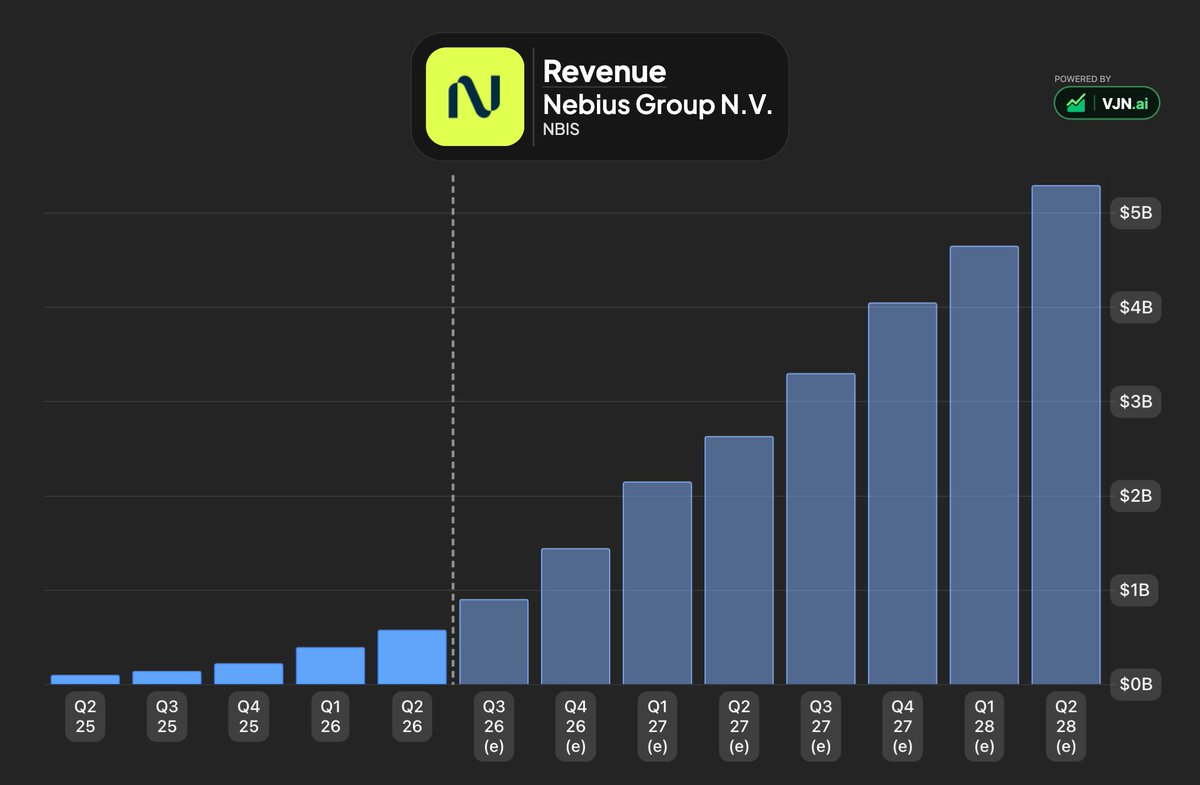
$NBIS revenue chart is set to go PARABOLIC into 2028 with over 500% YoY revenue growth
Just imagine what will happen to the stock price if these estimates become true...
I won't be surprised to see this stock trading at upwards of $1000+ in 2 years, this is one of the best opportunities in the market right now
Nebius is the AWS of the AI era and here is why (Save this).
AWS became more than a company that rented servers because it built the infrastructure, databases, storage, networking and developer tools that allowed customers to run entire businesses inside one platform.
Nebius is following a similar strategy but it is building specifically for AI.
At the bottom of the stack, Nebius provides the physical infrastructure needed to train and run AI models and this includes GPU and CPU compute, InfiniBand connected clusters, storage, networking, managed Kubernetes, and SLURM environments.
However, raw computing capacity is only the foundation.
The software layer gives developers access to open source models such as Llama, Mistral, and DeepSeek, along with MLOps tools, workflow software, and vector databases. and this allows customers to build, train, deploy, and manage AI applications without combining products from several different providers.
Nebius is also expanding further into inference, which is the process of running a trained model to answer questions or complete tasks for users.
Token Factory gives customers managed infrastructure for deploying open source and custom models in production so instead of building their own serving systems, customers can use Nebius for model endpoints, automatic scaling, orchestration, and inference optimization.
The company’s recent acquisitions fill important gaps in this platform.
Eigen AI improves inference at the model level by making models run faster and more efficiently while Clarifai adds system level optimization by helping Nebius manage how models use GPUs and other infrastructure.
Tavily pushes Nebius further toward the application layer by giving AI agents access to current information from the internet and Nebius can now provide the compute that runs an agent, the inference platform that serves its model, and the search technology that helps it complete useful tasks.
This creates a stronger business than basic GPU rental because a customer may initially come to Nebius for computing capacity but Nebius can also provide storage, networking, model deployment, inference, search, and other managed services.
Every additional product gives that customer another reason to spend more and makes moving the entire workload to another provider more difficult.
Nebius can also place its platform on infrastructure owned by outside partners because under this model, the partner finances and operates the physical data center while Nebius provides the architecture, software, services, and customers.
Nebius can expand its cloud without paying for every data center and GPU itself.
I’m already positioned around Nebius inside Milk Road because the platform is expanding from raw compute into inference, software, search, and managed AI services.
You can see the exact position, my updates, and the rest of the neocloud names I’m tracking using the link below.
https://t.co/Hkywss4Ugh
Massachusetts, 2026
Video 1: Women cheering a bill that lets doctors abort babies up until birth.
Video 2: Women supporting Lindsay Clancy who aborted her kids up to 5 years after birth.
Both videos from Massachusetts.
$NBIS will 100% build in the UAE. For one Raja Agarwal, VP of EMEA is based out of Dubai.
Having worked in Dubai for a year myself, making regular trips to other Emirates and communicating with government entities...
One thing that is painfully obvious is the government's desire to turn desert into GDP. It is literally an infinite money printing glitch. Hence the repeatable real estate boom and bust cycles.
Another is how cheap oil is at the pump. Cars and phones are mostly dominated by Chinese brands, and Chinese state-owned enterprises routinely bid on and build major infrastructure projects at very competitive costs.
Few places in the world offer a friendlier environment for datacenter development across power, land, and construction costs.
Only thing is we'll probably need anti-drone netting and defense drones to combat the Iranian threat 😅
https://t.co/87EIVWzeUb
@QQQ275Soon Immature buyer shouldnt be buying. Everything is down since. Nothing to do with NBIS. People that want to flip like you always lose no matter what they buy. I bought $23-$29 January 2025. I know it'll be $500 no later than mid year next year.
$NBIS Madrid data center is officially live with $NVDA RTX PRO 6000 and B300 GPUs.
This is another piece of Nebius European buildout moving from planned capacity to live AI compute with phases two and three adding more supply over the coming weeks.