Midjourney just dropped "Niji v6" and it's mind blowing!
I used it to reimagine famous art in "Naruto" anime style.
1. "Girl with a Pearl Earring" by Johannes Vermeer
Introducing General World Models.
We believe the next major advancement in AI will come from systems that understand the visual world and its dynamics, which is why we’re starting a new long-term research effort around general world models.
Learn more: https://t.co/Z4JWm6dJjG
came back home to this beautiful first issue from @runwayml that bridges the Art and AI communities.
A quote from the mag:
"if the result blows you away, it's because traditional steps, planning and human talent are still behind it." - Ricardo Vilavicencio, the creator of the short film Do The Evolution
(this was my favorite film at AIFF last year)
I really like RunwayML (and hence invested in them) because they embody artists seeking new technology to evolve their creative process rather than technologists in search of an application. A big part of this work is going to involve bridging the art and tech communities, creating common space for conversation and thought -- with things like AI Film Festival, Telescope magazine among others!
“If we want humanity to survive and thrive for the next 1,000 years, rather than slowing AI down with burdensome regulations, I would rather make it go faster.” @AndrewYNg
AI will reduce extinction risk for humans.
Jeff Bezos famously only allowed 4 different answers to a question at Amazon:
1. Yes
2. No.
3. A number
4. I don't know, but I'll know it by X
If you're uncomfortable saying option 4, you've got work to do.
This UN vote shows how completely isolated we are from world opinion. Is it because only America is smart enough to understand the Israeli point of view? Or because America's most powerful lobby has dragged us onto the wrong side of history? The answer to that is obvious.
This will be a chapter in American history that we'll later be ashamed of. There have been other such chapters, but in most of them America was at least acting in its own interest. This time we're just being used.
Airbnb has a blueprint of their entire customer journey on their office walls.
They then map all product, policy, and service updates to it.
More companies should do this to avoid shipping the org chart.
Warren Buffett and Charlie Munger said Les Schwab was one of the best founders they studied.
"A true fanatic."
16 ideas from his autobiography:
1. Intensity is the price of excellence —Warren Buffett
"I am 68 years old now.
And I've run it in overdrive my whole life.
I've always wanted to be the best tire dealer, not necessarily the largest tire dealer."
2. The people serving your customers are the most important people in your company:
"We have had some people in the office that sometimes think they are more important than the stores.
The office serves only one purpose, and that is to serve the stores.
Some of our office people sometimes wonder about this.
But I’ve warned them, don’t BITCH to me because that is the way I want it.
If you want to go out and start at the bottom changing tires and work into a manager job, then hop right to it.
If it weren’t for those men in the stores working their butts off in all kinds of weather, missing meals, God awful hours, etc. you wouldn’t even have a job."
3. If you’re not serving the customer, or supporting the folks who do, we don’t need you. —Sam Walton
"Let the people at the store level know you are behind them.
They are the ones who make you successful, not the person in a nice office who has nothing to do today but to send out another DAMN directive.
If it doesn't help the store, tear it up and tell the office to go to hell."
4. There are no shortcuts around quality and quality starts with people. —Steve Jobs
"People are the success of our company.
Most anyone can sell tires.
The only difference between a Les Schwab Tire Centre and most any tire dealership is the people working there."
5. Be unselfish for good reasons.
"We share 50% of our profits with all the employees in the store.
My thinking has always been if I give away half the profits I still have half.
If I share $10 million with people I still have $10 million left over. I don’t understand why businessmen can’t do this.
It is being unselfish for good reasons.
It helps a lot of people."
6. Helping people succeed in life provides deep satisfaction:
"Success in life is being a good husband, a good father and you end up being a second father to hundreds of other men and women.
Last night I attended a wedding of a young man from our office.
This young man told me that two men had influenced his life, his father and me.
That’s worth more than money."
7. Promote from within —There’s no problem you can’t solve if you know your business from A to Z.
"In our 34 years of business, we have never hired a manager from the outside, nor have we ever hired an assistant manager directly to that job.
Every single one of our more than 250 managers and assistant managers started at the bottom changing tires.
They have all earned their management jobs by working up."
8. Most businesses are poorly run. If you're on the ball you can beat them.
"We are different from most American corporations.
We think the most important people in the company are the people on the firing line; the ones who sell, do the service work and take care of the customer.
Most American corporations have the fat salaries for the top people and treat the people at the end of the line as peons.
I guess that is why, if you are on the ball, you can beat them on any type of fair competitive basis."
9. Decision making should always be made at the lowest possible level:
"A company starts, it grows, and as it grows, more and more of the decision making moves to the main office.
And this is one hell of a big mistake.
The decision making should always be made at the lowest possible level.
Give your manager the authority to make his own daily decisions, under certain guidelines of course, but let him run his show."
10. You can innovate by doing the exact opposite of your competitors
"Most tire businesses had a small showroom and all the tires were hidden in the warehouse.
My thinking was to reverse —to make the showroom the warehouse."
(All of his competitors quickly copied his idea)
11. Never, ever, think about something else when you should be thinking about the power of incentives.—Charlie Munger. Sharing profits with employees =less theft from within:
"Now that we share with all people, if any one employee sees another employee steal they are a weak kitten if they don’t report it.
Why?
Because this man is stealing from them, from his children.
If he won’t fight for his children, he can’t be very much.
For a company as large as ours we have very little dishonesty."
12. Pay the highest wages possible
"Their company paid low wages and had a lower overhead.
The flaw was they didn’t get —with the low pay— near the quality of employees we had."
(This competitor went bankrupt)
13. Get out of your office
"If the store manager runs his store right, he doesn't have to spend hours and hours looking at the office reports; if he's doing okay the records will show it.
In fact if he spends too much time in his office it is a sure thing his store will suffer.
Sell tires, give service, keep expenses low, keep good communications with employees, be careful with credit, watch for leaks —do these things and you'll come out all right."
14. *Stay* out of your office
"Stay out of a store for 30 days and you've forgotten 50 percent of what you know."
15. Once you get on the ball, *stay* on the ball. As Sam Walton said: We just got after it and *stayed* after it.
"If we think there is a free lunch, if we rely on last year's results, then this company will turn the corner, too, and then we too will start down the hill.
And once you start down, it is mighty hard to turn around.
If we become complacent, BROTHER, it's all over with."
16. There’s a rule they don’t teach you at Harvard Business School. It is: If anything is worth doing, it’s worth doing to excess. —Edwin Land
"Whatever you do, you must do it with gusto, you must do it in volume.
It is a case of repeat, repeat, repeat."
--
The sign of a true fanatic. Didn't even have time to cut his hair. Too busy selling tires....
My notes from the NEW Poor Charlie's Almanack: The Wit and Wisdom of Charlie Munger turned into maxims:
1. Find a simple idea and take it seriously.
2. Good ideas are rare. When you find one bet heavily.
3. Humans have been writing down their best ideas for 5,000 years. Read them.
4. Avoiding stupid mistakes is more important than being smart.
5. Don’t work with anyone you don’t admire.
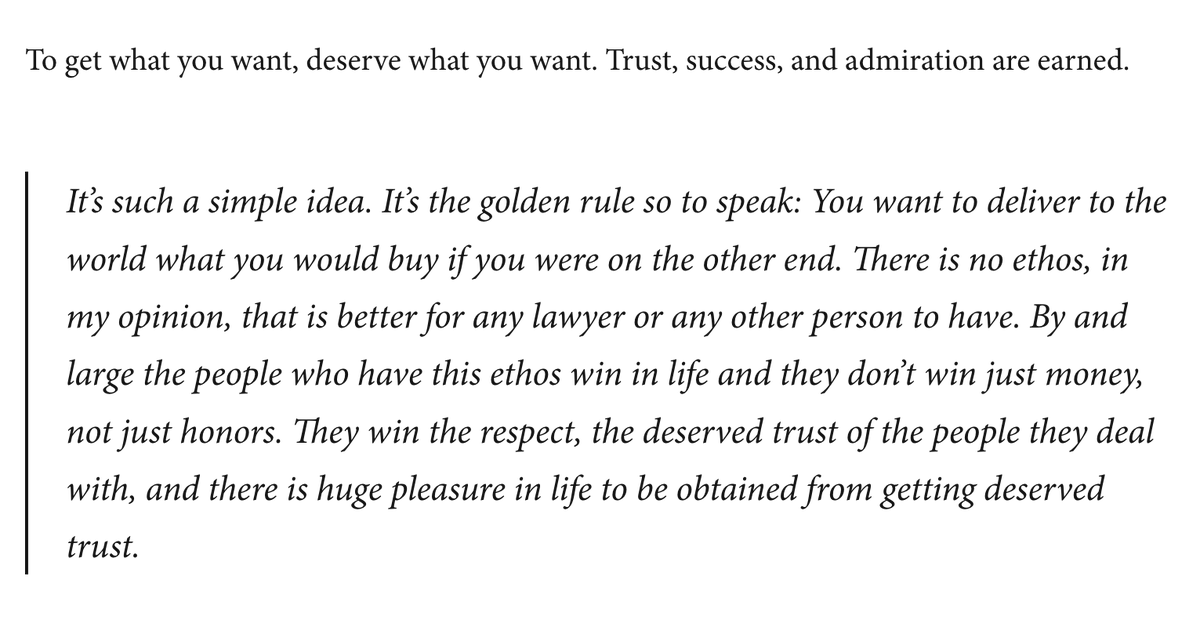
6. Don’t sell anything you wouldn’t buy.
7. Avoiding a bad habit is easier than breaking a bad habit.
8. Work on your best idea. Don't diversify
9. Incentives rule everything around you.
10. Never, ever, think about something else when you should be thinking about the power of incentives.
11. The most important rule in management is: Get the incentives right.
12. The storyteller is the most powerful person in the world.
13. Education is the process whereby the ability to lead a good life is acquired.
14. Be dependable for your tribe.
15. Trust is one of the greatest economic forces on Earth.
16. Don’t over optimize for growth at the expense of durability.
17. Great businesses are built by going ridiculously far in maximizing or minimizing one or a few things. Think Costco.
18. The combination of scale and fanaticism is *very* powerful. Think Sam Walton.
19. Do the unpleasant task first.
20. Don’t multitask.
21. Learning is changing behavior.
22. Avoiding stupidity for a long time *is* genius.
23. Many hard problems are solved best when approached backwards.
24. Think of ideas as tools. When a better tool comes along use it.
25. Clip your business and personal expenses. Small leaks sink big ships.
26. Make friends with smart dead people. Adam Smith, Darwin, Cicero, Ben Franklin —whoever interests you. Read their writing. Steal their ideas. They don’t need them anymore.
27. Only focus on great businesses and great businesses have moats.
28. Dominating a niche can produce profit margins that make you salivate.
29. Telling people WHY increases compliance.
30. Stay in the game long enough to get lucky.
31. Stack cash to survive unexpected problems and seize unexpected opportunities.
32. Don't confuse intelligence with invincibility.
33. Panic spreads and compounds quickly.
34. If you’re not winning —scale down and intensify.
35. Appeal to interest, not to reason.
36. Understanding opportunity cost is a superpower.
37. Don’t confuse the map for the territory.
38. People often interpret price as a signal for quality.
39. All human systems are gamed.
40. Beating back bureaucracy is a never ending battle.
41. The acquisition of knowledge is a moral duty.
42. Learning from history is a form of leverage.
43. Make sure your best players get the most playing time.
44. It is inevitable that bad things will happen to you. When they do get up, keep going, and remember the next maxim:
45. Self pity has no utility.
46. Find out what you are best at. Then pound away at it. Forever.
47. Envy is weakness.
48. The behavior of peer companies will be mindlessly imitated.
49. Emotion blurs judgement.
50. Only play games where you have an edge.
51. Avoid mob rule. Avoid demagogues. Avoid dogma. Avoid bureaucracy.
52. Optimize for independence.
53. Use money to buy freedom.
54. Aim for durability.
55. Keep the people who don’t matter from interfering with the work of the people who do.
56. What do you have an *intense* interest in? Do that for your living.
57. Self improvement has no end.