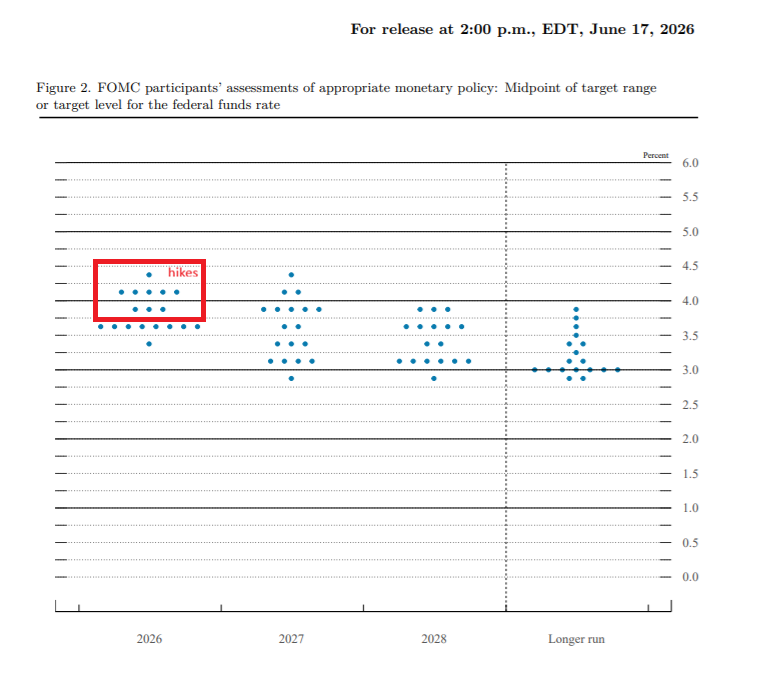
Fed Chair Kevin Warsh has drastically rewritten the FOMC statement.
The new statement is far leaner, stripping out much of the standard forward-guidance language, including the lines about carefully assessing incoming data and being prepared to adjust policy as appropriate if risks emerge. It adds a blunt new declaration: the committee "will deliver price stability."
The statement passed 12-0, with the prior meeting's dissents gone. The dot plot now pencils in a rate hike for 2026, a sharp hawkish shift.
This is excellent!! Was going to write something similar, but Radigan beat me to it, and did it far better. You all should read this👇👇 We’re nearing the point of no return…
Gold and silver are not acting well in a period of rapidly rising geopolitical risks. We have an Iran War, Strait of Hormuz blockade, rising volatility. In the old framework, that setup should be close to ideal for gold. But once you understand what is now driving gold, this move makes perfect sense.
Something fundamental changed after the US and Europe froze Russian reserves in 2022. For decades, surplus countries parked their excess savings in US dollar assets, mostly Treasuries. The freezing of Russian reserves combined with the current administration's explicit push to discourage foreign countries from parking excess savings in US financial assets, forced surplus countries to rethink where they store reserves.
And those countries haven't changed their domestic policies that generate the excess savings, so those savings have to be placed somewhere. The result is that gold and silver have increasingly become the obvious “neutral” reserve assets.
That’s why gold decoupled from the three factors that used to explain it…real interest rates, volatility, and liquidity. Now reserve accumulation flows have become the primary driver.
That shift has a consequence I don’t think most investors have thought through. If gold is now primarily driven by reserve flows from surplus countries, then gold has become pro-cyclical.
Reserve growth is driven by export revenues, trade surpluses, economic growth in surplus economies. When the global economy is strong and surplus countries are generating large export revenues, their excess savings grow, their reserve accumulation accelerates, and gold catches a bid. When that surplus generation is disrupted, the bid weakens or reverses.
This is exactly what is happening with the blockade of the Strait of Hormuz.
The GCC countries are major reserve/gold buyers and now their export revenues are collapsing. They likely need to liquidate some reserves to cover fiscal obligations, and gold is one of their most liquid assets. Even if the reserve sales aren’t excessive yet, the market can see their reserve accumulation has stalled and probably reversed. That flow, which was a meaningful source of gold demand, has gone to zero at best.
There are also secondary effects on other surplus economies. China is the world's largest oil importer. An energy shock of this magnitude slows Chinese growth, and compresses Chinese surpluses, which slows Chinese reserve accumulation. That same growth shock ripples through Korea, Taiwan, Japan, and the rest of Asia.
The whole chain that has been driving gold higher, surplus countries generating excess savings that need a home outside the dollar system, is being disrupted by an event that in the old model would have been unambiguously bullish for gold.
This doesn't mean the structural case for gold is broken. The dollar standard is still ending. Surplus countries still need an alternative to Treasuries and gold is still the most obvious destination. But it does mean gold is going to be more volatile along that structural trend than most people expect, and the volatility will correlate with global growth and surplus generation rather than with the old drivers. Gold rallies when surpluses expand. Gold sells off when surpluses contract. Even if the reason for the contraction is rising geopolitical risk that, under the old model, should have sent gold to the moon.
Going to leave you with this tonight:
The best thing you can do for yourself is actively increase your surface area for luck to hit you.
Go outside, travel more, go to new cafes, museums, events, take a new route home, go for hikes, see cities, countrysides, take your notebook, speak to people, ask questions, start businesses - go on more side quests.
You can literally just do things, and the more you do, the more serendipity and synchronicity will find you.
Night gang.
JUNE 2028.
The S&P is down 38% from its highs. Unemployment just printed 10.2%. Private credit is unraveling. Prime mortgages are cracking. AI didn’t disappoint. It exceeded every expectation.
What happened?
https://t.co/JzzwCrbJgS
People think of central bank independence as a natural state of affairs. It absolutely is not. In most countries, it is fairly recent. Over the course of the last 30 years, western countries have taken monetary policy, and increasingly fiscal policy too, out of the political processes. US politics is reclaiming it back. Once gone, it won't return. We expect this trend to hit a central bank near you too. Story outside off the paywall today.
https://t.co/xhrTyJS1Hq
🔥BREAKING: The secret to living to 100+? HIGH CHOLESTEROL!
A massive Swedish study tracking over 800,000 people for 35 years just revealed: Every single centenarian had HIGH total cholesterol. The higher your LDL, the longer you live.
Mind blown yet? Dr. Ben Bikman exposes the lies about cholesterol being "bad."
Key findings from the Sweden AMORIS study:
- All centenarians: High total cholesterol, high iron, low glucose.
- Highest LDL-C = longest lifespans (backed by Dr. Uffe Ravnskov & Dr. Malcolm Kendrick).
Dangers of low cholesterol:
- LDL <70 mg/dL → 3X higher risk of brain-bleeding strokes.
- Total <180 mg/dL → Skyrocketing cancer & dementia rates.
- <150 mg/dL → Increased chronic diseases like cancer & autoimmunity.
- Statins? They don't extend life—damage mitochondria & hormones instead.
Why your body CRAVES cholesterol:
- Builds every cell & powerhouse mitochondria.
- Absorbs vital vitamins A, D, E, K.
- Powers digestion via bile acids.
- Supercharges immunity against infections, viruses, bacteria, pathogens—even cancer.
- Fights depression, suicide, dementia & cognitive decline.
- Shields from toxins, heavy metals, strokes, heart disease & osteoporosis.
- Fuels ALL steroid hormones (low chol = low testosterone & libido).
- Lowers all-cause mortality risk.
Pro tip: Go low-carb, load up on nutrient-dense animal foods. Grass fed beef, pastured eggs, wild caught seafood...Dump seed oils, sugar & processed garbage. Target TG/HDL ratio <1.5 for elite heart health.
Tight budget like me?? Seek out a local farmer, butcher & farm market & make a 'bulk large sale deal' for beef at $5/lb & eggs $4/Dz
Are you ditching your statin yet? Tell me in the comments, I read every reply & do my best to respond to every question! If I miss your question...PLEASE DM direct message me! I truly care about you & your health!👇🔥
Klasa światowa bardzo często… NIE była topem na starcie.
Na łamach „Science” ukazał się fantastyczny, analityczny przegląd badań o tym, jak rodzi się talent i jak osiąga się szczyt w sporcie, nauce, muzyce oraz szachach.
I na początek najważniejsze, bo to wcale nie jest intuicyjne:
„Młodzieżowe gwiazdy” i „dorośli mistrzowie świata” to zwykle NIE SĄ ci sami ludzie. W wielu analizach różnica w tym obszarze sięga nawet ok. 90 proc. - czyli tylko niewielka część (ok. 10 proc.) „najlepszych dzieciaków” zostaje „najlepszymi dorosłymi”. Badacze pokazują dwa powtarzalne wzorce, dlaczego tak się dzieje.
Wczesna elita (szczyt możliwości w dzieciństwie):
- szybki progres,
- dużo treningu/specjalizacji w jednej dyscyplinie,
- mało dodatkowych aktywności.
Światowa klasa (szczyt możliwości w dorosłości):
- rozwój bardziej stopniowy,
- więcej doświadczeń wielokierunkowych na początku (różne aktywności/dziedziny),
- mniej obsesyjnej, wąskiej specjalizacji od pierwszych lat życia.
Co z tego wynika (i to jest sedno)?
Większość „elitarnych” programów selekcyjnych (sport, edukacja, szkoły talentów) jest ustawiona pod wyławianie i wspieranie tych, którzy błyszczą bardzo wcześnie. Tylko że to świetnie produkuje młodzieżowy top, ale już niekoniecznie dorosłych mistrzów świata.
Dlaczego szeroki rozwój może działać lepiej?
Autorzy proponują trzy sensowne mechanizmy:
- Search & match: próbujesz kilku rzeczy i trafiasz w tę, która jest naprawdę skrojona pod Ciebie (predyspozycje + motywacja),
- Kapitał uczenia się: różne aktywności budują lepsze uczenie się, które procentuje w przyszłości,
- Mniej ryzyk: mniejsze przeciążenie, niższe ryzyko wypalenia, kontuzji i psychicznej awersji do dyscypliny.
Jeśli jesteś rodzicem/trenerem/nauczycielem, naukowcy mają dla Ciebie prosty wniosek. Nie panikuj, że dziecko nie jest „top 1 proc.” w wieku 10–14 lat. To może być normalne. A czasem nawet korzystne. I odwrotnie: wczesny talent to nie wyrok sukcesu, bo koszt wąskiej specjalizacji bywa wysoki, a przewaga na starcie często nie dowozi umiejętności do mety.
Praktyczna zasada:
Wczesna specjalizacja pomaga wygrać juniorom. Wielokierunkowy rozwój częściej buduje seniorów.
A jak to było u Was?
bfiałek