dunia luar: "we launched this new harness that can help navigate your browser real time helping with day to day task, and it is open source! Everyone can fork and do anything with it!"
Malaysia: "Software engineer are not real engineer"
What does JEPA actually learn? We can finally prove it 🌍
So excited to share our theory of identifiable World Models: LeJEPA recovers the latent variables of the world.
Plan in the learned World Model as if it were real, same shortest path.
📄: https://t.co/lC9KK1AxVd
Best paper I've read so far this month:
All elementary functions (sin, cos, tan, exp, log, powers, roots, hyperbolic functions, π, e, and even basic arithmetic) can be generated from just one binary operator:
eml(x, y) = exp(x) − ln(y)
…plus the constant 1.
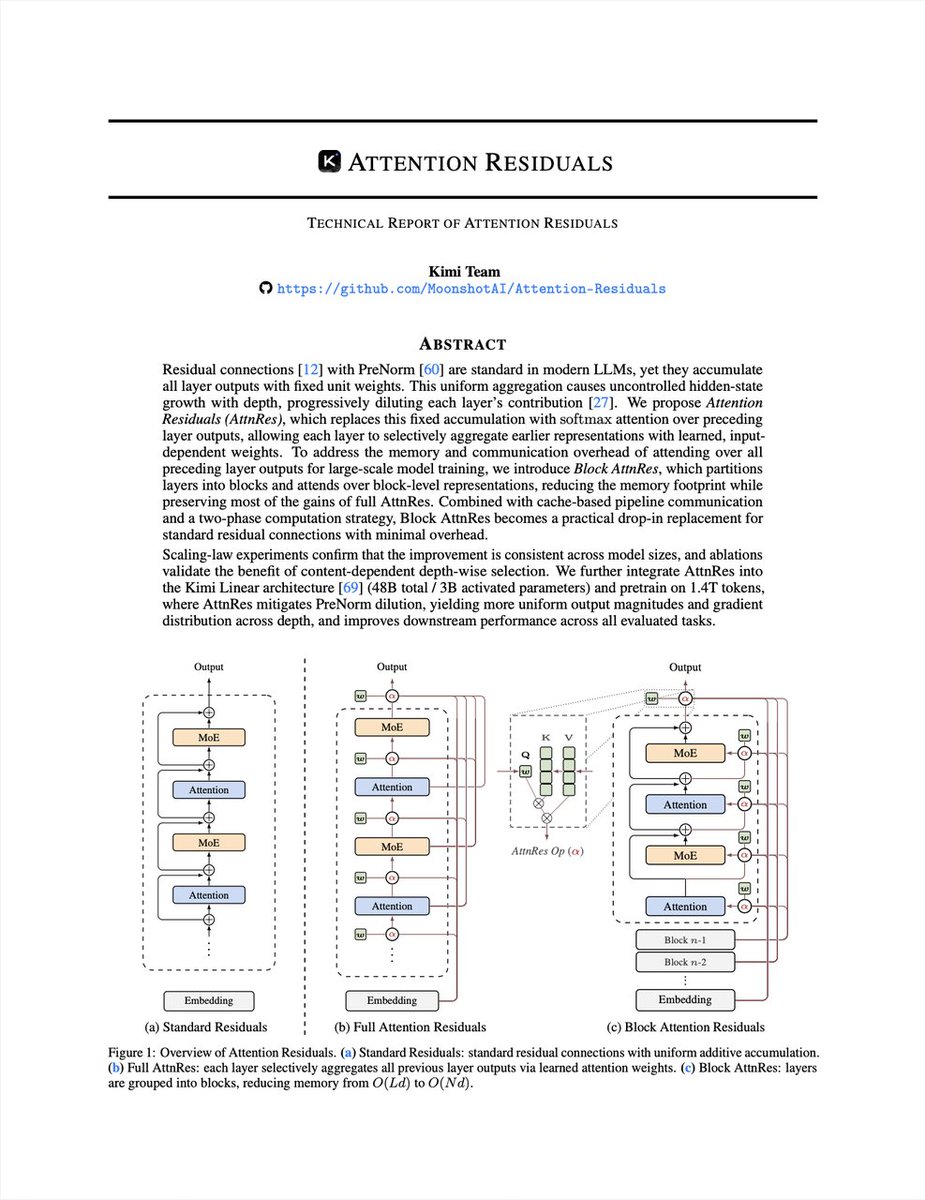
Introducing 𝑨𝒕𝒕𝒆𝒏𝒕𝒊𝒐𝒏 𝑹𝒆𝒔𝒊𝒅𝒖𝒂𝒍𝒔: Rethinking depth-wise aggregation.
Residual connections have long relied on fixed, uniform accumulation. Inspired by the duality of time and depth, we introduce Attention Residuals, replacing standard depth-wise recurrence with learned, input-dependent attention over preceding layers.
🔹 Enables networks to selectively retrieve past representations, naturally mitigating dilution and hidden-state growth.
🔹 Introduces Block AttnRes, partitioning layers into compressed blocks to make cross-layer attention practical at scale.
🔹 Serves as an efficient drop-in replacement, demonstrating a 1.25x compute advantage with negligible (<2%) inference latency overhead.
🔹 Validated on the Kimi Linear architecture (48B total, 3B activated parameters), delivering consistent downstream performance gains.
🔗Full report:
https://t.co/u3EHICG05h
LLM Knowledge Bases
Something I'm finding very useful recently: using LLMs to build personal knowledge bases for various topics of research interest. In this way, a large fraction of my recent token throughput is going less into manipulating code, and more into manipulating knowledge (stored as markdown and images). The latest LLMs are quite good at it. So:
Data ingest:
I index source documents (articles, papers, repos, datasets, images, etc.) into a raw/ directory, then I use an LLM to incrementally "compile" a wiki, which is just a collection of .md files in a directory structure. The wiki includes summaries of all the data in raw/, backlinks, and then it categorizes data into concepts, writes articles for them, and links them all. To convert web articles into .md files I like to use the Obsidian Web Clipper extension, and then I also use a hotkey to download all the related images to local so that my LLM can easily reference them.
IDE:
I use Obsidian as the IDE "frontend" where I can view the raw data, the the compiled wiki, and the derived visualizations. Important to note that the LLM writes and maintains all of the data of the wiki, I rarely touch it directly. I've played with a few Obsidian plugins to render and view data in other ways (e.g. Marp for slides).
Q&A:
Where things get interesting is that once your wiki is big enough (e.g. mine on some recent research is ~100 articles and ~400K words), you can ask your LLM agent all kinds of complex questions against the wiki, and it will go off, research the answers, etc. I thought I had to reach for fancy RAG, but the LLM has been pretty good about auto-maintaining index files and brief summaries of all the documents and it reads all the important related data fairly easily at this ~small scale.
Output:
Instead of getting answers in text/terminal, I like to have it render markdown files for me, or slide shows (Marp format), or matplotlib images, all of which I then view again in Obsidian. You can imagine many other visual output formats depending on the query. Often, I end up "filing" the outputs back into the wiki to enhance it for further queries. So my own explorations and queries always "add up" in the knowledge base.
Linting:
I've run some LLM "health checks" over the wiki to e.g. find inconsistent data, impute missing data (with web searchers), find interesting connections for new article candidates, etc., to incrementally clean up the wiki and enhance its overall data integrity. The LLMs are quite good at suggesting further questions to ask and look into.
Extra tools:
I find myself developing additional tools to process the data, e.g. I vibe coded a small and naive search engine over the wiki, which I both use directly (in a web ui), but more often I want to hand it off to an LLM via CLI as a tool for larger queries.
Further explorations:
As the repo grows, the natural desire is to also think about synthetic data generation + finetuning to have your LLM "know" the data in its weights instead of just context windows.
TLDR: raw data from a given number of sources is collected, then compiled by an LLM into a .md wiki, then operated on by various CLIs by the LLM to do Q&A and to incrementally enhance the wiki, and all of it viewable in Obsidian. You rarely ever write or edit the wiki manually, it's the domain of the LLM. I think there is room here for an incredible new product instead of a hacky collection of scripts.
Yann LeCun and his team can't stop cooking
"LeWorldModel: Stable End-to-End Joint-Embedding Predictive Architecture from Pixels"
One of the biggest bottlenecks of JEPA is they are hard to train, and this new research changes that.
They propose LeWorldModel, which shows that a small model can learn a usable world model directly from raw pixels end-to-end.
Sitting at 15M parameters, they made it without needing heuristics and avoiding anti-collapse hacks while staying competitive and planning up to 48x faster.
Making JEPA based modeling much more accessible, cheaper, and stabler.
@IjatVlog Beliau bukan pakar bidang IR/geopolitik. Background beliau literature/pendidikan dan beliau bukan scholar/professor. Ada benda yang beliau cakap tu betul, ada yang boleh buat pakar facepalm.
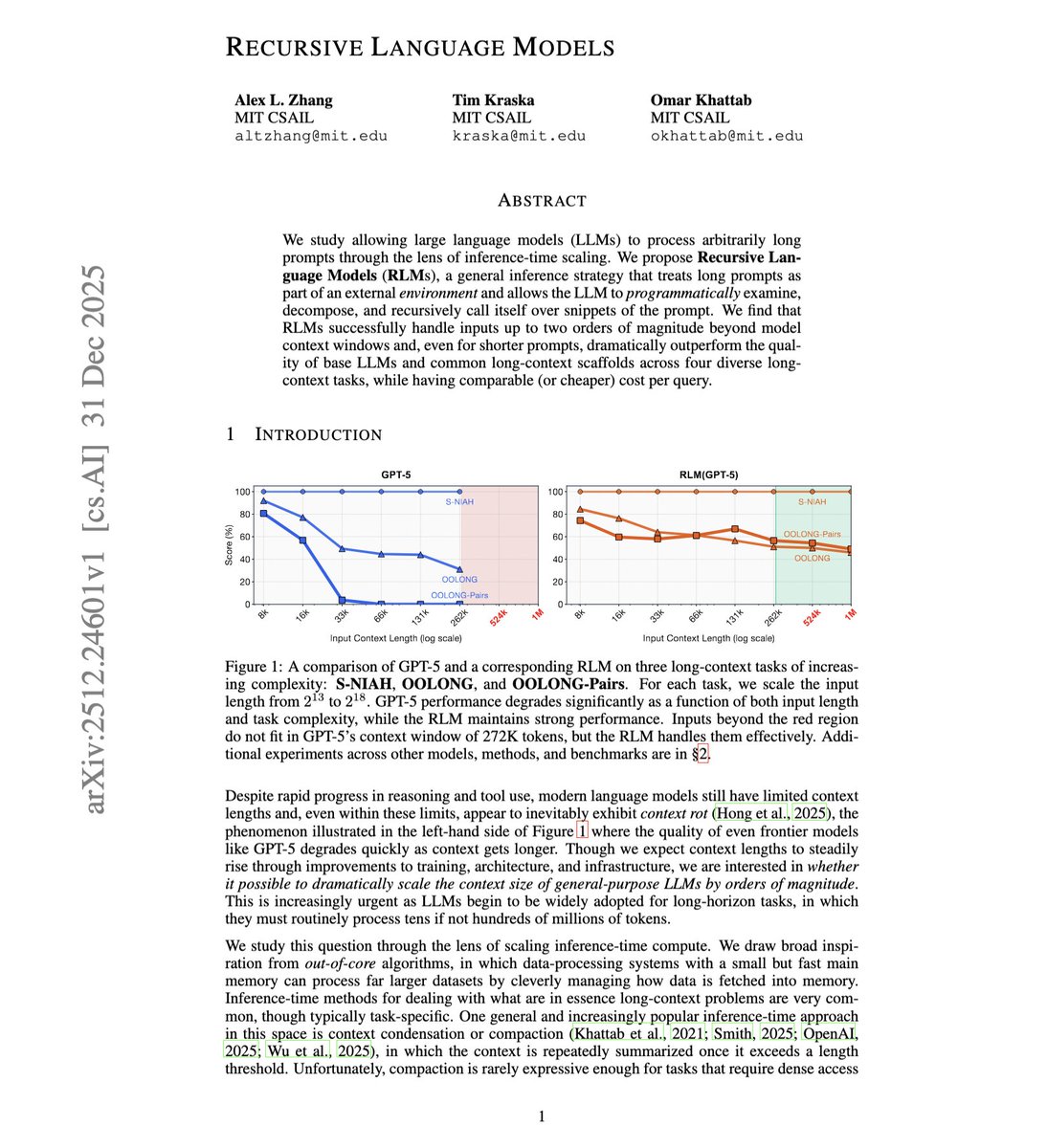
"Recursive Language Models"
A potentially big direction for LLMs in 2026 from MIT researchers
In their approach, a prompt isn’t “run” directly, instead it’s stored as a variable in an external Python REPL, and the language model writes code to inspect/slice/decompose that long string, observes execution outputs, and then constructs sub-tasks where it recursively invokes an LLM on just the relevant snippets. Stitching the result together when the recursive process ends.
so it can solve 10M+ token tasks with far less “context rot” and often lower cost than summarization/RAG, turning long-context scaling into an inference-time algorithm rather than just a bigger context window.
Doing a long, super-technical podcast on the state-of-the-art in AI. Let me know if you have question, topic suggestions. Everything from details of LLM training pipeline & architectures, to coding, robotics, scaling, compute, business, geopolitics, etc.
Besides topics & questions... add papers, blogs, posts, rants, perspectives that you'd like to see covered.
Spend good weekend reading the winner of NeurIPS 2025 best paper. The paper from Qwen team.
FYI, Qwen team is not the first to introduce gating in attention. That attention should be given to Google Research.
You can read it here
Medium:
https://t.co/9zR3Jrapq2
Isunya tak ramai rakyat Malaysia yang suka borak pasal isu 'dalam' AI. Kalau borak pasal AI semuanya pasal ChatGPT lah, imej ghibli lah, video AI lah. Jarang sangat dengar orang borak pasal sains/math di sebalik AI.
Padahal bagi aku, benda tu lagi syok...
Bagi aku bila RTM dan TV3 dah mula guna AI secara meluas, ia satu petanda yang tak bagus sebenarnya.
Aku memang proponent AI. Tapi untuk memahami, bukan untuk menggunakan