@UFLiteracy@HollyLanePhD
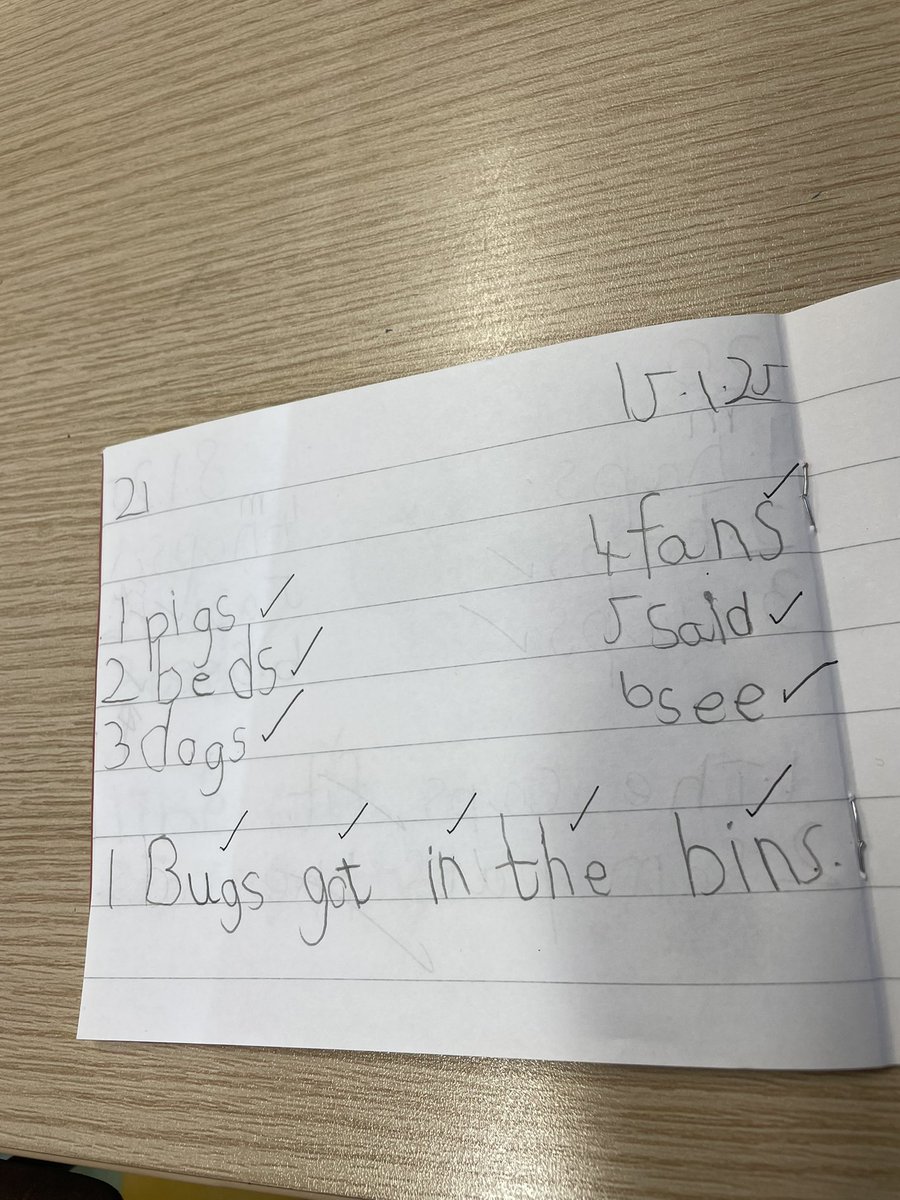
The proof is in the pudding, as they say! The progress in one child’s skills after only 3 months of UFLI lessons. These spellings and sentences are dictated. The improvement in letter formation and handwriting is also clearly evident.
@MrFerguson85@greeborunner@englishspecial@DavidDidau Professional critique absolutely welcome and should be expected, however I don’t think your comment in this instance is that. A lot of work was done to create a Canon of suggested texts which included many Irish and local authors, however that has not been included unfortunately.
@MrFerguson85@greeborunner@englishspecial@DavidDidau Yes, it categorises knowledge and learning under his disciplinary lenses but I’d argue that’s as far as the similarities go within the Primary content. Also, your comment undermines all the work done by myself and others (not just David) to produce it.
“Encoding is not simply a step to writing; it is a vital but underappreciated route to reading. It requires a deeper and more consistent practice of identifying the individual speech sounds in words and linking those sounds to letters. It engages children from the beginning with meaningful words, not isolated skills.
The segmentation and construction of spoken words build essential neural networks and provide a meaningful route to phoneme awareness and phonics, as children learn to master the ingenious code of letters that makes spoken words visible.” ( Herron & Gillis, 2020).
Read this do-not-miss article, Encoding as a Route to Phoneme Awareness and Phonics: A Shift in Literacy Instruction, by Jeannine Herron and Margie Gillis, here:
https://t.co/mtEbLCHaFj
🎄 12 Days of Christmas: Building Better Literacy Instruction 🎄
Over the next 12 days, I’ll be sharing curated, evidence-aligned literacy resources designed to help educators move from research to instructional precision. Each resource is selected to support teachers, coaches, and leaders in making informed, effective decisions about instruction, practice, and intervention.
🔹 Day 1: A Padlet of resources related to The Instructional Hierarchy (Haring & Eaton, 1978), Types of Practice, and Cognitive Load Theory
I started here intentionally. The Instructional Hierarchy provides a critical decision-making framework that helps educators determine:
- What type of instruction students need
- When practice is appropriate—and when it is not-
- How fluency, generalization, and maintenance fit within MTSS
- Why mismatched instruction leads to stalled progress
When we ignore where students are in the learning process, even strong materials and good intentions fall short. This resource supports implementation fidelity and instructional alignment.
🔗 The Day 1 resource and all others to follow can be found at this link: https://t.co/pXD63OBHKF
Follow along for the next 12 days as together we unpack practical tools that strengthen literacy systems and classroom practice.
Reading Recovery should have no place in our schools. The evidence is increasingly clear that it can hinder long-term outcomes. Not long ago it was promoted by Scotland’s curriculum body. I sincerely hope it is now nowhere near Scottish classrooms.
It is so easy to be wrong – and to persist in being wrong – when the costs of being wrong are paid by others.”
Thomas Sowell’s line could be the motto of English education. Policy-makers get plaudits; teachers get the blame; children pay the bill.
Link below
I was privileged to hear Dr. Holly Lane speak at @researchEDScot1 sharing insights from UFLI and the power of effective instruction.
She emphasised how routines aren’t just helpful, they’re essential. Reducing daily novelty in lessons reduces cognitive load. @HollyLanePhD
*NEW* the ‘Just tell them’ trap
Telling students stuff is sensible. But if you’re *just* telling them, you’re not actually teaching.
https://t.co/tY6NHZZoVI
One of my favorite routines for partner reading of decodable texts: 1) Students underline sentences in alternating colors. 2) Students determine which color they will read. 3) Students read the text a few times and then swap colors. It’s easy and keeps the students engaged!🤓📖
Let’s end this myth: there aren’t many ‘learning styles’ for reading. Learning to read is the most studied human behavior—we have FMRI scans to prove it. ALL kids, including dyslexic & struggling readers, benefit from evidence-based literacy instruction. Every. Single. One!
@reading_league@DyslexiaIDA
Experts draw on long-term memory; novices rely on limited working memory. This contrast urges us to focus on building durable and retrievable knowledge rather than chasing illusions of expanding WM.
So many unfocused discovery activities exist only because “it’s good for them.”