I curate a daily briefing on China concept stocks (中概股) — a roundup of public information, translated and synthesized from Chinese-language sources that most English readers never see.
What this gives you — in one place, every day,https://t.co/iwaTN4KG5Y:
🔴 The real pulse of China's economy, through its most important companies:
① Platform giants — Alibaba, https://t.co/P381jcqv6M, Pinduoduo, Baidu. These companies operate China's largest commercial ecosystems. Watching them means watching Chinese consumption, regulation, and the digital economy in real time.
② Frontier AI & tech — From Alibaba's Qwen to Baidu's Ernie, China's AI race is unfolding right now. I track it through the lens of the companies building it, not Western speculation.
③ New energy vehicles — NIO, XPeng, Li Auto, BYD. China's EV sector moves faster than anywhere else on earth. If you're not following it at the source, you're already behind.
What you won't miss:
- Policy signals (PBOC, NDRC, CSRC — the agencies that actually move markets)
- Earnings, analyst notes, and material announcements — same day, in English
- The connective tissue between all of it: how a subsidy tweak in Beijing flows through to a stock move on the NYSE
The promise: No information gap. No Western-media filter. Just what's happening, why it matters, and what it means — so you can form your own view from the same raw material the best China investors are reading.
Always happy to answer questions, dig deeper on a ticker, or explain the context behind the headlines.
$baba $jd $pdd $bidu $nio
We've been optimistic about AI's positive impact on Alibaba for three months , but unfortunately, the company was bogged down by the decline in its e-commerce business at the time.
Now, it looks like the pace and scale of their loss reduction in the flash sales business have significantly improved, so the stock price should be due for a re-evaluation.
$BABA
$BABA with a PE of approx 15 is a GIFT from GOD!! They are the leader in AI, cloud, robotics, chips and data centers in China. They are the all in one package!!! That’s right my time in China I spent time talking to $BABA employees and got some valuable 411. I told you on my trip I have never been more bullish and that hasn’t changed.
NIO's ES9 surpassing 10,000 deliveries at a 443,000 RMB average selling price, coupled with its battery-swapping business turning profitable, creates a powerful second-order effect.
The initial success of high-ASP models validates $NIO 's premium brand positioning. More importantly, the profitable swapping network reduces the total cost of ownership for buyers, enhancing customer loyalty and reducing churn.
This structural advantage fosters a self-reinforcing ecosystem where new high-value customers are attracted by the economic benefits and convenience, decreasing $NIO's customer acquisition costs and strengthening its long-term competitive moat against rivals.
This is a non-obvious, pricing-relevant consequence.
For deep-dive data and original sources, check the link in the comments below. 👇
PDD Holdings' surge in compliance risks and counterfeit allegations collide with the robust growth of logistics partners like $J&T Express and $ZTO Express. While J&T's daily parcel volume exceeding 100 million in Q2 signals strong e-commerce activity, $PDD's platform issues will force a shift. Increased regulatory pressure on product authenticity means $PDD must impose stricter merchant controls and potentially higher service quality demands on its logistics network.
This will inevitably translate into increased operational costs for merchants, which will either be absorbed or passed on, eroding $PDD's core low-price, subsidy-driven growth model. The market has not priced in this margin compression from compliance-driven logistics inflation.
For deep-dive data and original sources, check the link in the comments below. 👇
The tightening CoWoS capacity at $TSMC, highlighted by industry reports, acts as a leading indicator for $BIDU's Kunlun Chip ambitions. While $BIDU's Kunlun Chip targets a $50 billion IPO valuation, scaling production of advanced AI accelerators requires access to cutting-edge packaging. $TSMC's CoWoS is critical for this. Constraints here imply potential delays in volume manufacturing or higher per-unit costs for Kunlun chips.
This upstream bottleneck can directly impact Kunlun's ability to meet its product roadmap and profitability projections, subsequently affecting the revaluation thesis for $BIDU 's asset. The market's current valuation might not fully price this in.
For deep-dive data and original sources, check the link in the comments below. 👇
Alibaba's cloud computing revenue growth accelerating to 45% and faster-than-expected narrowing of local services losses mechanically reflect its mainland strategy.
Cloud's acceleration is driven by increased enterprise adoption of value-added AI services, enhancing unit economics and operating leverage beyond basic infrastructure.
For local services, the rapid loss reduction points to disciplined regional expansion and aggressive cost optimization on last-mile delivery and merchant acquisition, moving towards a sustainable unit profitability model that many NY analysts overlook, focusing purely on market share.
This improves $BABA's consolidated profitability outlook.
For deep-dive data and original sources, check the link in the comments below. 👇
I'm even more bullish on Alibaba's stock now.
The losses in their traditional business sectors are narrowing much faster than expected, which will reduce the drag on their newer ventures. Plus, with their AI business growing so rapidly, I believe the stock is headed for a major valuation rerating.
There is another situation that people may have overlooked: just a few days ago, Alibaba went through a round of layoffs.
This is an effective measure to cut costs, specifically within their traditional business segments. The resulting reduction in expenses will be reflected in future earnings reports, which is why I believe the stock price will be revalued.
$BABA
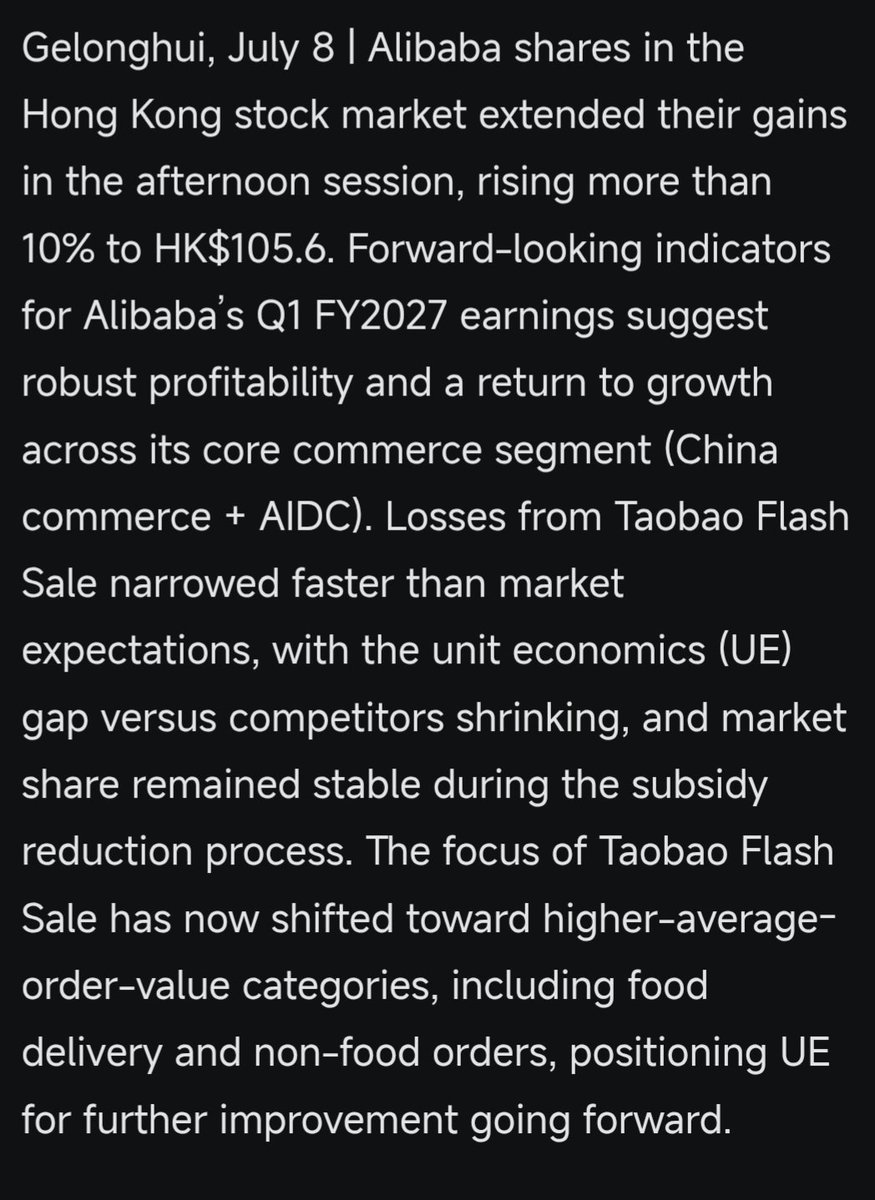
$BABA : Alibaba surged, rising more than 10%, as reports indicate that Taobao Quick Commerce's path to reduced losses is progressing faster than expected.
To be honest, for a while there I really thought their FlashEx business (what we call Shansong) had dragged Alibaba into yet another capital black hole. But looking at it now, it seems like the situation is actually starting to turn around.$BABA
$BABA : Alibaba surged, rising more than 10%, as reports indicate that Taobao Quick Commerce's path to reduced losses is progressing faster than expected.
Even though housing prices are dropping, overall income levels are also falling.
This makes it feel even harder to afford a home now than it was during more prosperous economic times.
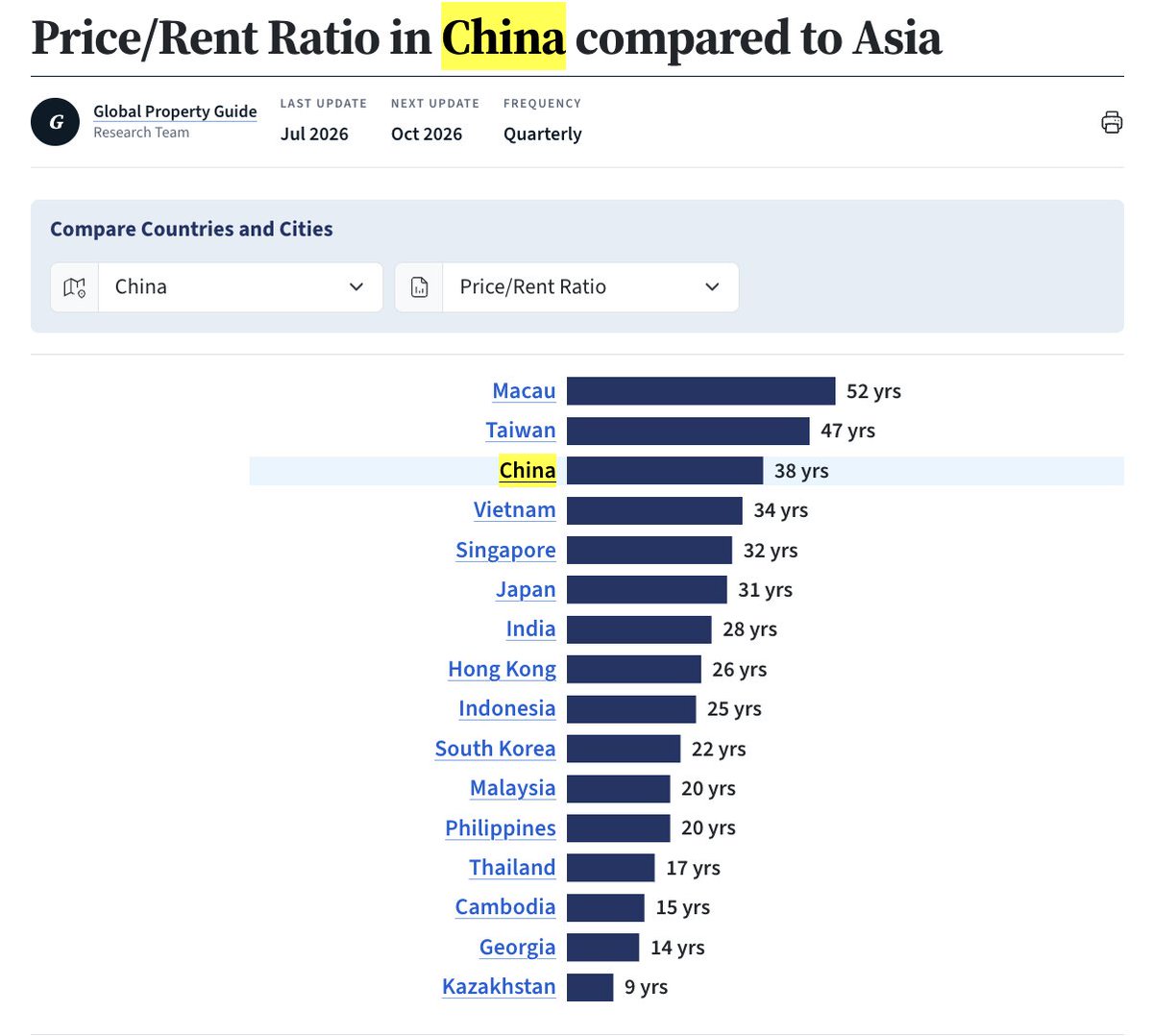
China still has one of the least affordable real estate markets in the world, even after a 20% decline in prices. It takes 38 years of rent to buy a property. By comparison:
- Australia: 26 years
- Germany: 25 years
- US: 23 years
- UK: 19 years
- Canada: 18 years
- Poland: 13 years
- Romania: 12 years
- Kazakhstan: 9 years
The lower the number of years - the more affordable local real estate is to buy vs rent.
Data source: @GlobalPropGuide (July 2026)
Link: https://t.co/ZLdjDx7QZJ
Anyone who has driven or experienced an electric vehicle tends to become obsessed with the feeling it provides, often losing interest in internal combustion cars entirely.
We refer to this specific EV experience as the "electric feel," while the sensation of driving a traditional car is the "gas feel." Once you have experienced it, the "electric feel" is far more compelling than the "gas feel."
$NIO #electricvehicle
Nobody wants EVs” is now a decade-old genre of journalism.
Over that decade, EV share of new UK car sales went from 0.3% to 25%.
The genre hasn’t aged well.
$JD Retail's elimination of departments below the C3 management level is a critical operational truth often missed by NY analysts. In China, rapid growth led to bloated middle management in large enterprises.
This restructuring mechanically flattens $JD's hierarchy, directly reducing administrative overhead and accelerating decision-making, crucial for a high-volume, low-margin retail business.
It's a strategic move to optimize cost structure and improve efficiency, signaling $JD's commitment to enhancing operating leverage and cash flow in a maturing market, rather than merely cutting costs reactively.
Read the full handbook in the comment below. 👇
$NIO's premium ES9 deliveries exceeding expectations with an ASP of 443,000 RMB signals robust brand positioning, which will directly enhance vehicle gross margins. Concurrently, the Onvo L60's pure vision smart driving internal testing progressing faster than anticipated indicates accelerated readiness for high-margin software monetization on its mass-market models.
This dual catalyst—stronger premium hardware margins and earlier, recurring software revenue—will collectively improve $NIO's overall profitability trajectory. The market should re-evaluate $NIO's ability to drive sustained cash flow beyond volume growth.
Read the full handbook in the comment below. 👇
Wall Street often views $PDD's low-price strategy as an unassailable advantage, driving relentless market share gains. This overlooks the inherent quality and compliance costs that scale with growth. Chinese media reports on Temu's rising compliance expenses and Duoduo Maicai's freshness controversies reveal that the pursuit of extreme affordability creates structural vulnerabilities. As $PDD expands globally and domestically, the overhead for quality assurance and regulatory adherence will accelerate, compressing margins and eroding user trust if unaddressed. The low-price model's sustainability is fundamentally constrained by escalating operational integrity costs.
Read the full handbook in the comment below. 👇