Finally out!
LUX-MS now enables light-controlled detection of cell surface receptor organization and signalling architectures involved in drug action, host-pathogen interactions, and intercellular communication for biological and theranostic discovery 1/6
https://t.co/qqZv1rLJff
We looked at the proteomic diversity of 18 different synapse-types! Check out what we found in the preprint below 👇Big thanks to my co-authors from @erin_schuman lab at @MpiBrain and @snsf_ch for support. #TeamMassSpec
https://t.co/zAnrjyRNDw
"It was always my hope that, as a scientist, I could make some contributions that would benefit human health."
Listen to our conversation with 2022 chemistry laureate @CarolynBertozzi, where she shares why she wanted to become a scientist and the importance of chemistry:
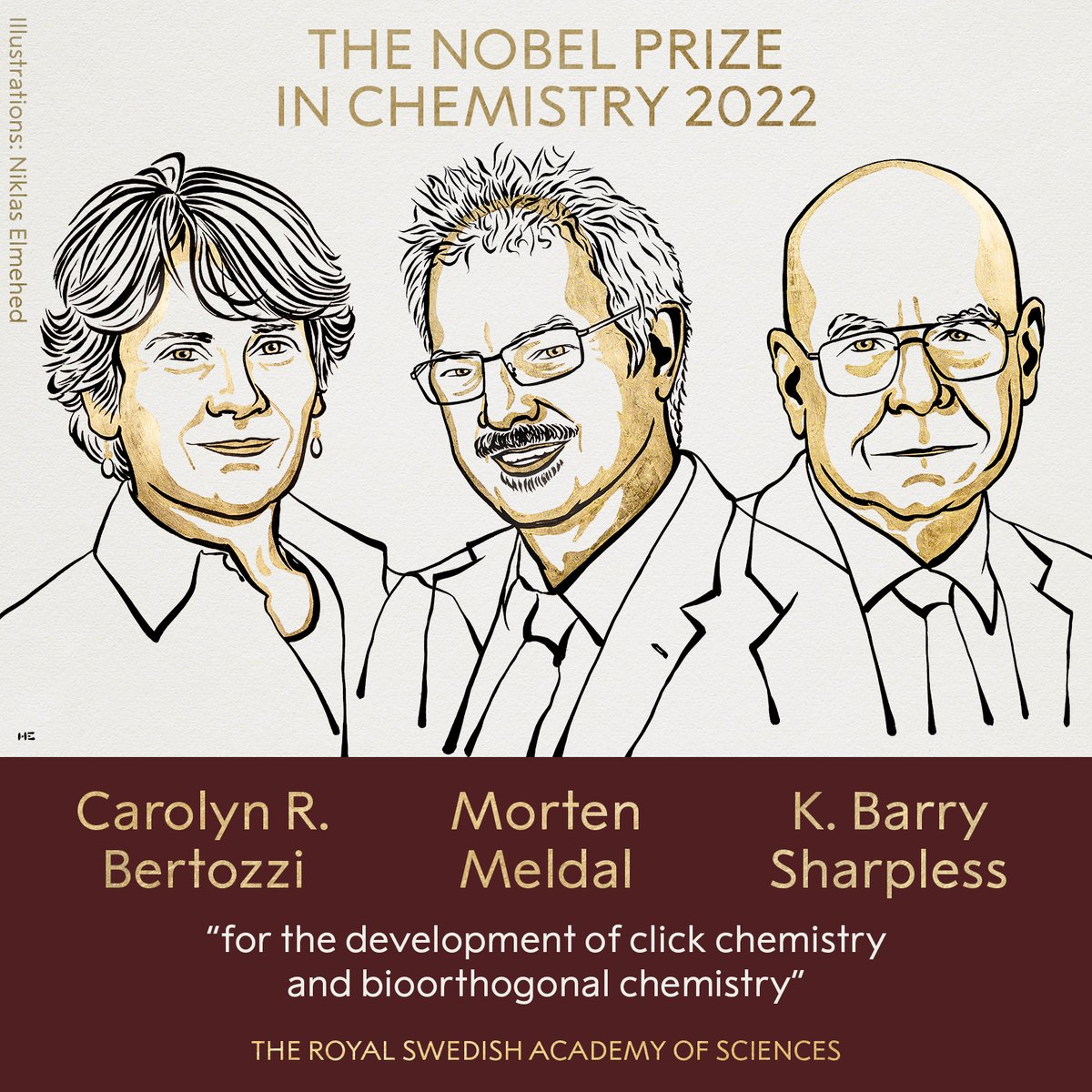
BREAKING NEWS:
The Royal Swedish Academy of Sciences has decided to award the 2022 #NobelPrize in Chemistry to Carolyn R. Bertozzi, Morten Meldal and K. Barry Sharpless “for the development of click chemistry and bioorthogonal chemistry.”
Excited to announce extension of our alliance between @UCBerkeley & @NovartisScience w/the Novartis-Berkeley Translational Chemical Biology Institute to include @dannomura, @Toste_Group, Tom Maimone, @olzmannlab, & @bignerdzzy to tackle the "undruggable"!
https://t.co/EOTRYI8KWU
Happy to share our latest paper about the constitutive biogenesis of the MHC class I immunopeptidome across primary tissues! @HippHupo@hupo_org@CellPressNews https://t.co/wusGVGEnlp
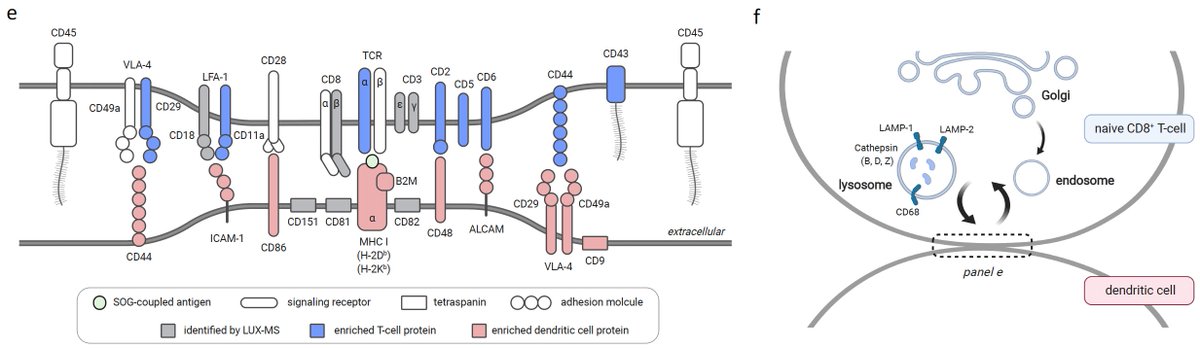
An optoproteomic method from @Maik__M, @bwollsch and coworkers enables mapping of protein interactions on the cell surface, revealing cellular responses to antibodies, drugs and viral particles as well as immunosynapse signaling events @ETH_en
https://t.co/ztKSdxB16H
Meet the neighbors! Context-dependent interactions within protein communities enable cells to adapt to diverse environments. Dysfunctional protein communities drive disease. LUX-MS platform permits spatially-resolved #surfaceome analysis. Distance matters https://t.co/yAqEljqjkP
Finally out!
LUX-MS now enables light-controlled detection of cell surface receptor organization and signalling architectures involved in drug action, host-pathogen interactions, and intercellular communication for biological and theranostic discovery 1/6
https://t.co/qqZv1rLJff
Lastly, using a two-cell system with SOG-coupled antigens and SILAC-DIA proteomics we were able to molecularly dissect functional immunosynapses between interacting immune cells revealing intercellular receptor interaction networks implicated in cell-to-cell communication. 5/6
Happy to contribute to this work led by @bwollsch lab on optoproteomic LUX-MS technology to decode ligand receptor interactions. #MSFragger open modification search helped to reveal light-induced protein labeling sites and then to optimize the subsequent MS data analysis.
Scientists at ETH Zurich have developed a new method to determine how #proteins are organised on the surface of #cells. Insights gained with the technology could lead to the development of novel #drugs to fight #cancer. @bwollsch https://t.co/qVoAA0lZWY
Forschende der ETH Zürich entwickelten eine neue Methode, mit der sie messen können, wie #Proteine auf der Oberfläche von #Zellen organisiert sind. Die Erkenntnisse könnten unter anderem zur Entwicklung neuartiger #Krebsmedikamente führen. @bwollsch https://t.co/AbJPupBAMa
3 gute Nachrichten zu omikron (ja, es gibt sie!):
1) es ist leicht festzustellen
2) Antigentests schlagen darauf an
3) wir dürfen auf weiter guten Schutz durch Impfung vor schwerer Erkrankung(!) hoffen.
Alle drei haben eine Sache gemeinsam … 🧵
Proteomics should be sensitive, accurate, fast, robust & affordable.
👉 Welcome plexDIA!
Proteins / sample: ~ 8,000
Sample size: 500 ng
Samples / day: 48 (should be 72 with Evosep)
MS system: 1st generation QE classic
https://t.co/vqDoZ0dXqj