Hice 30 skills para los alumnos de la facu que cubren todas las fuentes de datos de finanzas que hay, la comparto aca
npx skills add gauss314/skills
Si no saben lo que es, pero usan IA para finanzas, le pueden decir a claude que use el repo https://t.co/jsT1a547s9
This 30-min workshop by the creator of Claude Code will teach you more about vibe-coding than 100 YouTube video guides.
Bookmark it & give it 30 minutes today. This video will change the way you use Claude forever.
Charlando con amigos que no son devs y se pusieron a hacer cositas con AI me di cuenta de porque gastan tantos tokens y queman límite a 2 manos:
- Usan todo en un mismo chat por lo que el chat va creciendo y creciendo y creciendo y cada vez le mandas mas contexto.
Cuando pensamos un proyecto hay que irlo separando en pequeñas funciones, cada función va a ser un desarrollo en si, ejemplo en OpenCode hacen /new y arrancan una sesión nueva, el mismo OpenCode es lo suficientemente inteligente para saber a dónde buscar en la carpeta que esta parado.
Estaba viendo que algunos usaban Cursor y gastaban 900k a 3M de tokens por request, es una locura, mis ventanas de contexto no superaban los 150k de tokens en la totalidad del chat, siempre piensen cada chat cómo una funcionalidad, no cómo un proyecto y no solo van a tener más tokens para desarrollo sino que el modelo se va volviendo más tonto a mayor cantidad de tokens pasado cierto umbral.
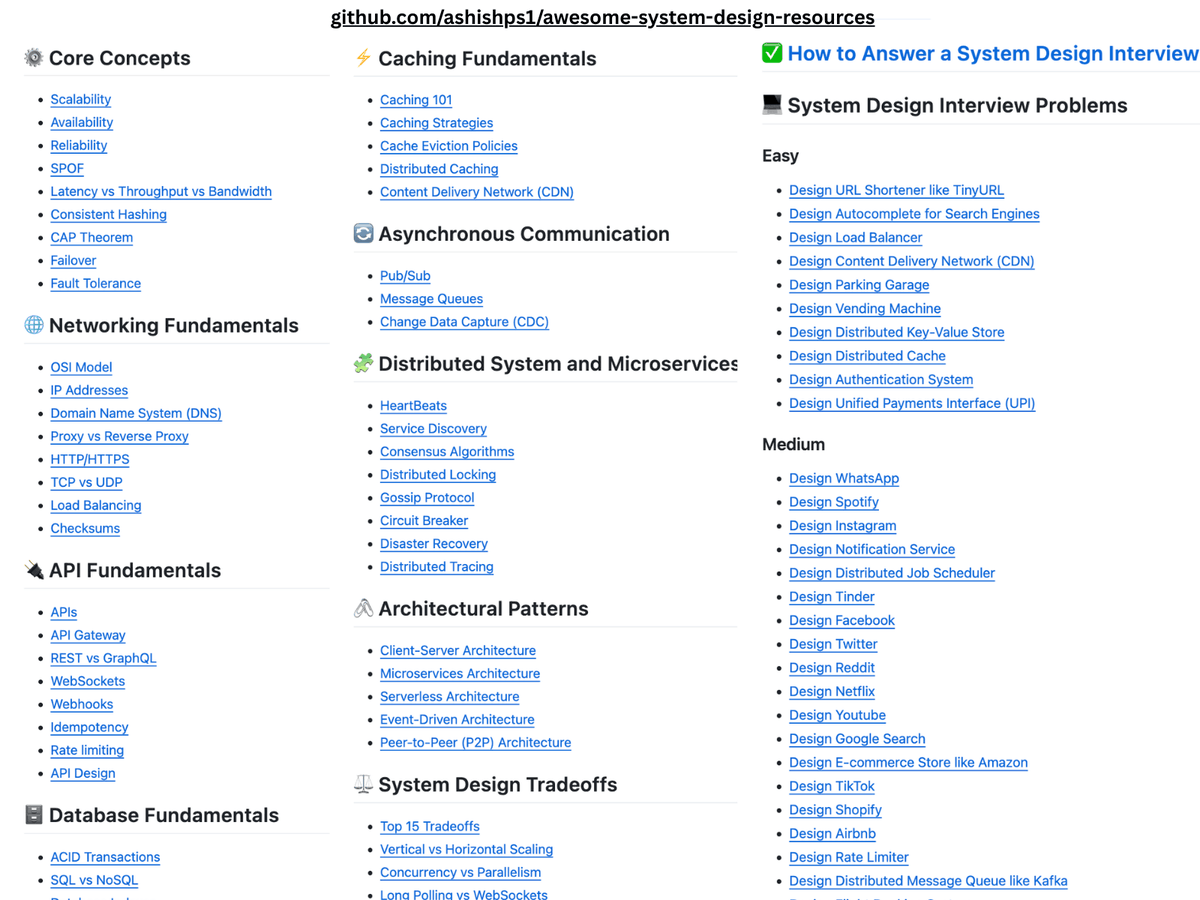
I created a Github repository to learn System Design, and I'm excited to share that it crossed 30k stars recently.
The repository contains a collection of resources to study:
- System Design Core Concepts
- Networking and API Fundamentals
- Database and Caching Fundamentals
- Distributed Systems, Microservies and Architectural Patterns
- System Design Tradeoffs
- 40+ System Design problems categorized by difficulty level
Check it out here: https://t.co/pkVpi6LxSV
If you find the repo valuable, consider giving it a ⭐️ and share with others.
Thanks to everyone who has starred or forked the repository!
Alguien tiene algún challenge técnico de entrevista reciente para pasarme ? Fullstack o backend, junior a senior, lo que sea! Lo aprecio mucho, y si me dan un like para visibilidad me ayudan tmb !
I've been programming Ruby for damn-near a quarter of a century now, and it's been the honor of a lifetime to help it succeed with Rails. I'm eternally grateful to @yukihiro_matz and the core team for creating and perfecting this divine language.
Incremental caching is now enabled by default for 𝚗𝚎𝚡𝚝 𝚍𝚎𝚟.
When agents create new projects or open existing ones, Next will feel instantaneous.
For tools like @anything, @budapp and @v0, this means scaling from prototypes to projects of any size.
I migrated cursor.com from a CMS to raw code and Markdown.
I had estimated it would take a few weeks, but was able to finish the migration in three days with $260 in tokens and hundreds of agents.
Here's how I did it + all my my usage stats.
https://t.co/QIAOmLsffx
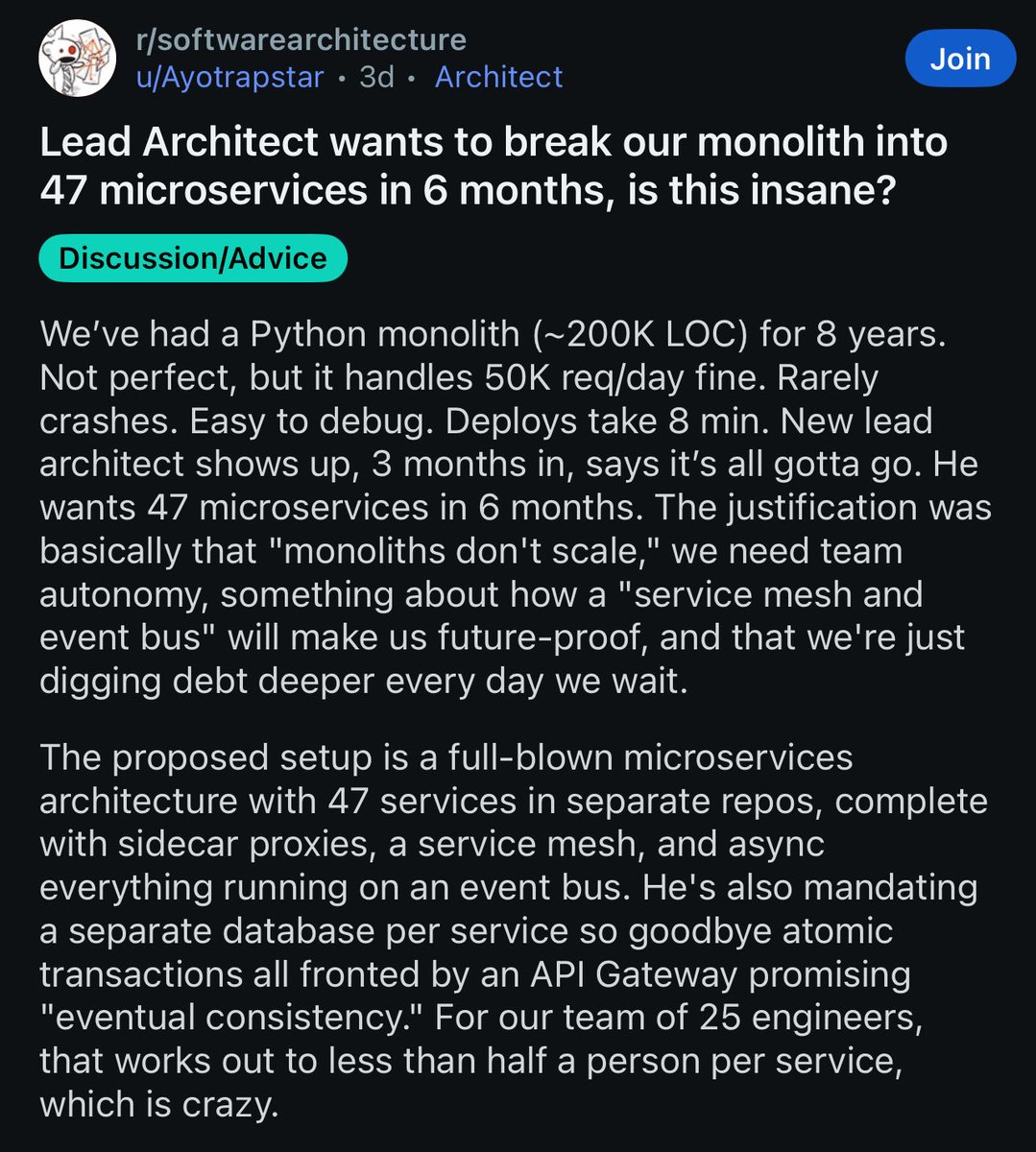
Microservices is the software industry’s most successful confidence scam. It convinces small teams that they are “thinking big” while systematically destroying their ability to move at all. It flatters ambition by weaponizing insecurity: if you’re not running a constellation of services, are you even a real company? Never mind that this architecture was invented to cope with organizational dysfunction at planetary scale. Now it’s being prescribed to teams that still share a Slack channel and a lunch table.
Small teams run on shared context. That is their superpower. Everyone can reason end-to-end. Everyone can change anything. Microservices vaporize that advantage on contact. They replace shared understanding with distributed ignorance. No one owns the whole anymore. Everyone owns a shard. The system becomes something that merely happens to the team, rather than something the team actively understands. This isn’t sophistication. It’s abdication.
Then comes the operational farce. Each service demands its own pipeline, secrets, alerts, metrics, dashboards, permissions, backups, and rituals of appeasement. You don’t “deploy” anymore—you synchronize a fleet. One bug now requires a multi-service autopsy. A feature release becomes a coordination exercise across artificial borders you invented for no reason. You didn’t simplify your system. You shattered it and called the debris “architecture.”
Microservices also lock incompetence in amber. You are forced to define APIs before you understand your own business. Guesses become contracts. Bad ideas become permanent dependencies. Every early mistake metastasizes through the network. In a monolith, wrong thinking is corrected with a refactor. In microservices, wrong thinking becomes infrastructure. You don’t just regret it—you host it, version it, and monitor it.
The claim that monoliths don’t scale is one of the dumbest lies in modern engineering folklore. What doesn’t scale is chaos. What doesn’t scale is process cosplay. What doesn’t scale is pretending you’re Netflix while shipping a glorified CRUD app. Monoliths scale just fine when teams have discipline, tests, and restraint. But restraint isn’t fashionable, and boring doesn’t make conference talks.
Microservices for small teams is not a technical mistake—it is a philosophical failure. It announces, loudly, that the team does not trust itself to understand its own system. It replaces accountability with protocol and momentum with middleware. You don’t get “future proofing.” You get permanent drag. And by the time you finally earn the scale that might justify this circus, your speed, your clarity, and your product instincts will already be gone.
Frontend libraries I refuse to code without in 2025:
🔶 zod – validation
🔶 react-hook-form – forms
🔶 tRPC + react-query – data sync
🔶 shadcn – UI
🔶 motion – animations
🔶 date-fns – date utils
🔶 zustand – state management
🔶 nuqs – search params
🔶 recharts – charts
🔶 ai – AI toolkit
🔶 react-table – tables (still underrated)
Your turn…
Which libraries are MUST-HAVE in your stack?
Drop your top 3 below.
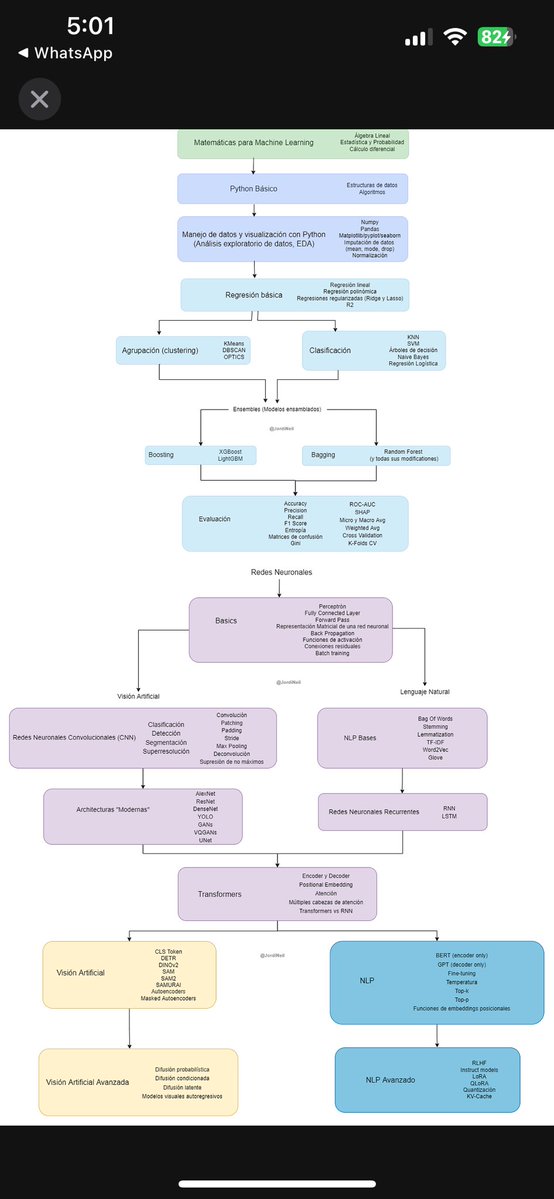
Ya está, lo subí así. Un roadmap que hice para IA y Machine Learning.
Traté de agregar todos los temas y términos que considero importantes respecto al tema.
Creo que si alguien va paso a paso y entiende a detalle cada una de las palabras de este roadmap, va a aprender muchísimo.
Cada bloque puede tener la profundidad de un curso completo, seguro que si ponen "curso de <título de cualquier bloque>" les va a salir un montón de material.
Se los dejo en el link de abajo también por si en la imagen no se ve bien.
Igual es la versión 1.0, seguro se me quedan temas por fuera y lo voy a seguir actualizando con más y más información.
Actualicé mi curso gratuito de Next.js para incluir cache components y PPR, también tiene traducciones a inglés y portugués. Un solo Readme gigante con todo el contenido, de manera incremental, donde aprendes leyendo pero más haciendo, gratis.
Se agradece feedback 🤝