A GITHUB TRAINER COLLECTED THE WORST WAYS PEOPLE HAVE DESTROYED A GIT REPO AND PROVED ALMOST EVERY ONE OF THEM CAN BE UNDONE
34 minutes of git disasters from Hector Alfaro, who trains developers on git for a living: the deleted branch, the force-push over everyone's work, the commit that vanished, the merge that ate three days.
-> The moment it lands, the panic goes away. Almost nothing in git is truly gone. The history you thought you destroyed is usually still sitting there, waiting for someone who knows where to look.
Most people, the second git breaks, just delete the folder and reclone. That's not recovery. That's amputation and it throws away work you could've gotten back in one command.
Panicking when git breaks was never the only option -> knowing it keeps almost everything is what separates calm from chaos. And when an AI agent force-pushes, rebases, and tangles your history faster than you can read, the person who knows how to walk it back is the one who saves the repo.
Everyone has a git horror story. The difference is whether you knew how to undo it or just nuked the repo and started over.
Bookmark & Watch it today ↓
A DEVELOPER PROVED THE REGEX YOU'VE WRITTEN A THOUSAND TIMES IS SECRETLY A COMPILER AND THAT ALMOST NO ONE WHO USES THEM HAS ANY IDEA WHAT ACTUALLY RUNS
36 minutes from Paul Wankadia, the engineer behind a regex engine that compiles your pattern straight down to raw machine code -- walking through what really happens between the slashes.
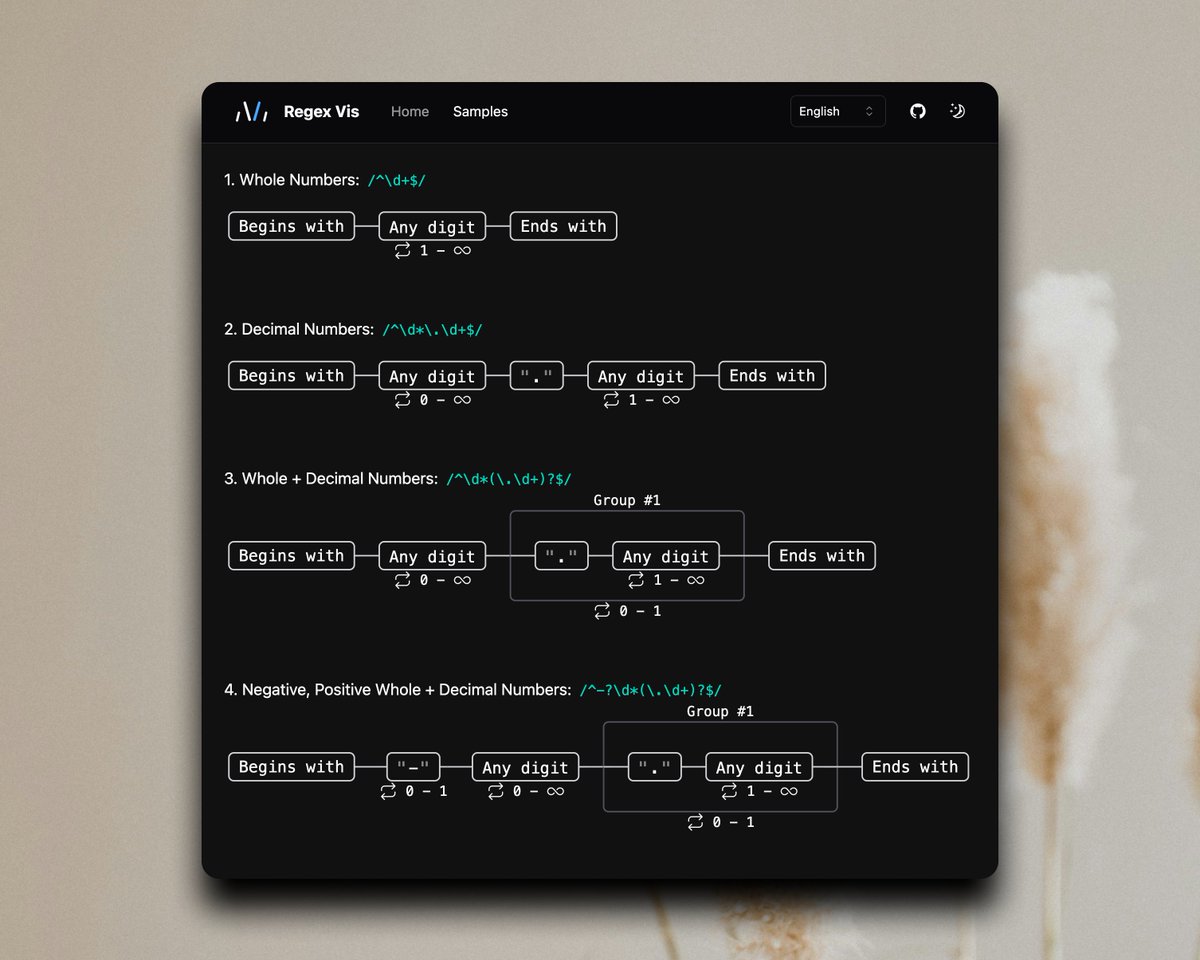
-> The moment it clicks, regex stops being magic punctuation you paste from Stack Overflow and becomes what it actually is: a tiny machine. Your pattern gets turned into a state machine, and that machine is what runs against every character of your text.
That one idea explains everything you never understood. Why one regex returns instantly and a nearly identical one hangs your whole server. Why some patterns are safe and others are a denial-of-service waiting to happen. It was never random -- it's whether the machine underneath is built well or badly.
Writing a regex was never the skill -> reading one is. And now that an AI agent hands you dense, clever patterns you'd never write yourself, the person who can see the machine underneath is the one who catches the one that takes down production at 3am.
Everyone copies regex and prays. This is the talk that ends the praying.
Save it. The next time a pattern "Just works," you'll actually know why ↓
📢 Kotlin 2.4.0 is out! Here are some of the highlights:
✅ Language: Stable context parameters, explicit backing fields, and multiple features for annotation use-site targets.
✅ Standard library: Stabilized support for the UUID API and support for checking sorted order.
✅ Kotlin/JVM: Support for Java 26 and annotations in metadata enabled by default.
✅ Kotlin/Native: Support for Swift packages as dependencies, updates on Swift export, and the CMS GC enabled by default.
✅ Kotlin/Wasm: Incremental compilation enabled by default and support for WebAssembly Component Model.
✅ Kotlin/JS: Support for value class export and ES2015 features in JS code inlining.
✅ Gradle: Compatibility with Gradle 9.5.0.
✅ Maven: Automatic alignment between Java and JVM target versions.
✅ Kotlin compiler: More consistent inline function behavior during .klib compilation.
Learn more: https://t.co/8cT1Jicklk
Supply chain attacks and OSS sustainability go hand in hand. I've semi-seriously joked for years that OSS upstreams should periodically purposely inject full vulns into their code and let downstreams fuck around and find out. Downstreams can pay to get the non-FAFO version.
The not joke part is simply that OSS maintainers aren't a supply chain. OSS maintainers are not responsible for monitoring CVEs (because, they are not a supply chain). OSS maintainers are not at fault when bad shit happens to downstreams, because basically every OSS license (MIT, Apache, GPL, etc.) literally says: the software is provided "as-is, without warranty." You get what you pay for (that is to say: absolutely nothing!)
Now, the joke part is that I do believe there is an ethical obligation to try to prevent harm downstream. But "try" is the key word. So, this isn't a serious proposal.
But, if you're using OSS code and you're not paying for a license with a contract that promises some kind of warranty, you have no supply chain. You (the downstream user of an OSS lib) ARE the supply chain.
To use a metaphor: physical goods have a real supply chain. Car manufacturers, chips, clothes, toys, etc. You have a signed commercial agreement with all your suppliers that promises quantity AND quality and blowback if either are missed. Thats a supply chain.
If someone puts some chips on the side of the road with a "FREE" sign, then you integrate those into a product, then find out those chips are hacking customers, its your fault, not the person who dropped them on the side of the road.
diffshub[dot]com
Take any public diff from GitHub and virtualize it nearly instantly, no matter how large, with DiffsHub. Built to show off our brand new CodeView component.
To try it out, replace `github` with `diffshub` in your address bar.
🤖 Kotlin agent skills are now available on GitHub!
Explore AI-assisted skills for converting Java to Kotlin, migrating to AGP 9.0, mapping JPA entities, and moving from CocoaPods to Swift Package Manager.
Check out the repository 👇 https://t.co/F6DMbfXsb6
Weather widget that I created some time ago for a platform that allows you to control your house (temp, air cond.)
No specific requirements, just testing how we can go with the visuals.
compose-ai-tools - Render @Preview composables to PNG outside Android Studio, so AI coding agents can see what they're changing.
https://t.co/lUiPyuqKy4
They are paying this much for standout software engineers - who can generate better software, faster, using Claude Code vs “just” avg sw engineers (who do OK with it.)
AI amplifies existing ability, and the best in any indusrty (who learn to use these tools) are in more demand
Technology Radar Vol. 34 is here.
From AI-assisted engineering to the tools and techniques shaping today’s landscape, this edition cuts through the hype to show what really matters — built by practitioners, grounded in real-world experience.
👉 https://t.co/QJVN8q1YoK
🎨 UI design tip: Name colours after what they do, not what they look like.
If your tokens are named after the colour itself (blue-500, grey-100) nobody knows when to use them. Name them after their role instead.
A simple structure that works:
[element.tone.emphasis.state]
Each word describes how and where the colour appears in the interface. Four words maximum. Most tokens need fewer.
You can go deeper and create component-specific colour names, but in most cases it adds complexity without adding clarity.
What's your token naming structure?
📘 PS This is just 1 of 100+ guidelines from my @PracticalUi design book. I also use this naming structure in my Figma design system.
This might be the wildest AI engineering breakdown on the internet right now 🤯
After the Anthropic leak…
Someone turned the ENTIRE Claude Code system into a readable playbook.
👉 https://t.co/d6OptOkWbC
We’re talking:
* 500K+ lines of real production AI agent logic
* Broken down into 18 chapters you can actually learn from
* Multi-agent systems, tool pipelines, memory, orchestration… all exposed
This isn’t theory
This is how a top-tier AI coding agent actually works under the hood
Key ideas you’ll steal instantly:
→ Agent loops with async execution
→ Multi-agent “teams” coordinating tasks
→ File-based memory (no DB 🤯)
→ Context compression tricks
→ Tool execution pipelines at scale
Basically…
Instead of guessing how to build AI agents
you now have a blueprint from a real system used by thousands of devs
https://t.co/8R2lBSfn3C
Crazy part?
The whole thing was analyzed + rewritten in HOURS using AI agents
https://t.co/8R2lBSfn3C
If you're building:
• AI agents
* Dev tools
* LLM products
* or learning MLOps
This is not optional
This is a cheat code
I built my dream Markdown editor for Mac.
→ Introducing Cogito (pronounced koh-gee-toh).
It started out of frustration: Obsidian is powerful but overwhelming. iA Writer is beautiful but feels built for a different era.
Nothing felt right for how I actually write and work now: plain files, lots of folders, agents and scripts editing alongside me.
I wanted both: native and beautiful, powerful and calm.
So I finally built it.
It's fast, keyboard-first, polished, truly native. A Mac app built with power users and developers in mind.
This is my love letter to writing and Mac apps.
I use it for all my writing now.
Free while in beta ✌️
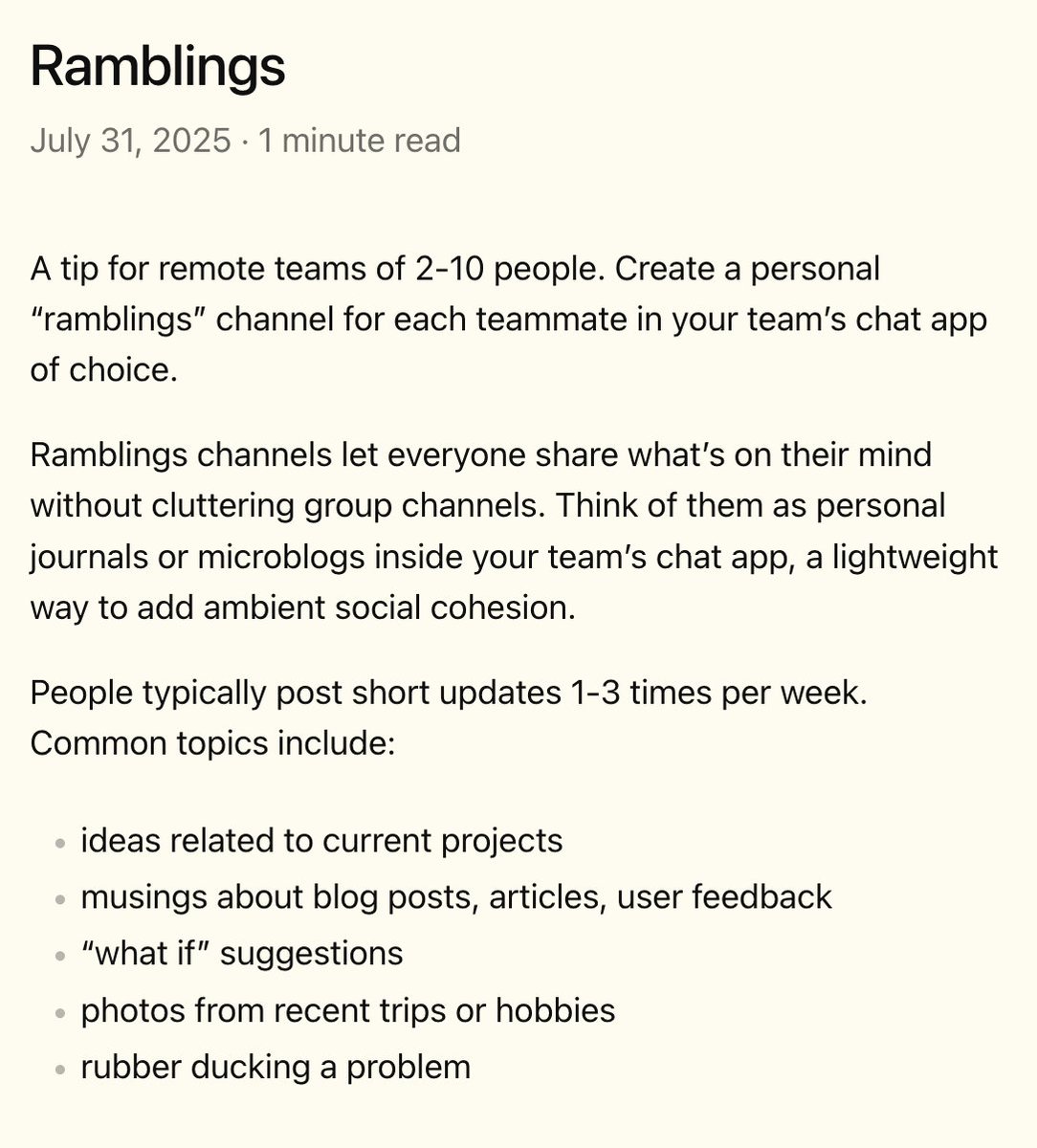
A tip for remote teams of 2-10 people. Create a personal "ramblings" channel for each teammate in your team's chat app of choice.
Ramblings channels let everyone share what’s on their mind without cluttering group channels. Think of them as personal journals or microblogs inside your team’s chat app, a lightweight way to add ambient social cohesion.
People typically post short updates 1-3 times per week. Common topics include:
- ideas related to current projects
- musings about blog posts, articles, user feedback
- "what if" suggestions
- photos from recent trips or hobbies
- rubber ducking a problem
Each ramblings channel should be named after the team member, and only that person can post top-level messages. Others can reply in threads, but not start new ones.
All the ramblings channels should be in a Ramblings section at the bottom of the channel list. They should be muted by default, with no expectation that anyone else will read them.
We started experimenting with ramblings at Obsidian two years ago, and they've been surprisingly sticky. We have no scheduled meetings, so ramblings are our equivalent of water cooler talk. We want as much deep focus time as possible, so ramblings help us stay connected while minimizing interruptions.
Because they are so free and loose, some of our best ideas emerge from ramblings. They're often the source of feature ideas, small prototypes, and creative solutions to long-standing problems.
About once a year, we do a week-long in-person meetup. Ramblings have been one successful way we keep the human connection going throughout the rest of the year.




![AdhamDannaway's tweet photo. 🎨 UI design tip: Name colours after what they do, not what they look like.
If your tokens are named after the colour itself (blue-500, grey-100) nobody knows when to use them. Name them after their role instead.
A simple structure that works:
[element.tone.emphasis.state]
Each word describes how and where the colour appears in the interface. Four words maximum. Most tokens need fewer.
You can go deeper and create component-specific colour names, but in most cases it adds complexity without adding clarity.
What's your token naming structure?
📘 PS This is just 1 of 100+ guidelines from my @PracticalUi design book. I also use this naming structure in my Figma design system.](https://pbs.twimg.com/media/HEY3NIibcAAG6WS.jpg)


