How can an LLM switch between low-, medium-, and high-effort reasoning? And how does an LLM learn to reason more or less?
I put together a “little” article explaining how these effort levels are implemented at inference time and during training.
"LLMs are Unaware of the Person Beyond the Prompt"
We can’t stop thinking about this paper.
It exposes a very strange failure mode in personal AI.
-> The more your AI assistant remembers about you, the more confidently it may start making things up.
The paper calls this the Severance Problem: an assistant only sees the small part of your life that made it into the chat.
It may know your age, job, or past preferences, but it has no real sense of everything outside that window – your health, financial pressure, emotional state, or what happened 5 minutes before you opened the app.
But ufortunately, memory can make this worse.
In the experiments, personal memory made models less likely to notice what they still did not know. Hallucinations rose from almost zero to as high as 11.7% because the models began filling in the missing pieces themselves.
Researchers then forced the models to track 2 things:
• What they knew
• What remained unknown about the person
That really changed the behavior.
Models asked better questions and produced less harmful advice, sycophancy, and hallucination across 5 model families.
▪️ But there's a much bigger question here.
We are building personal AI on the idea that more memory means better personalization. Yet at some point, fragments start to look like understanding without actually being it.
So what should a personal assistant optimize for? Knowing as much as possible about you?
Or staying aware that, however much it remembers, most of your life is still outside the chat?
What do you think?
Congratulations to the entire Skyroot Aerospace Team on the successful launch of Vikram-1 (Mission Aagaman) from the Satish Dhawan Space Centre, Sriharikota.
The mission marks a significant milestone for India’s private space sector and reflects the growing capability of the country’s space ecosystem.
Congratulations to IN-SPACe and ISRO teams, who enabled and facilitated the launch and ground testing operations along with technical consultancy and 24x7 safety surveillance.
This achievement is also a testament to the Space Sector Reforms envisioned by our Hon’ble Prime Minister Shri Narendra Modi ji.
#Vikram1
#IndiawithVikram1
#SkyrootAerospace
#OpeningSpaceForAll
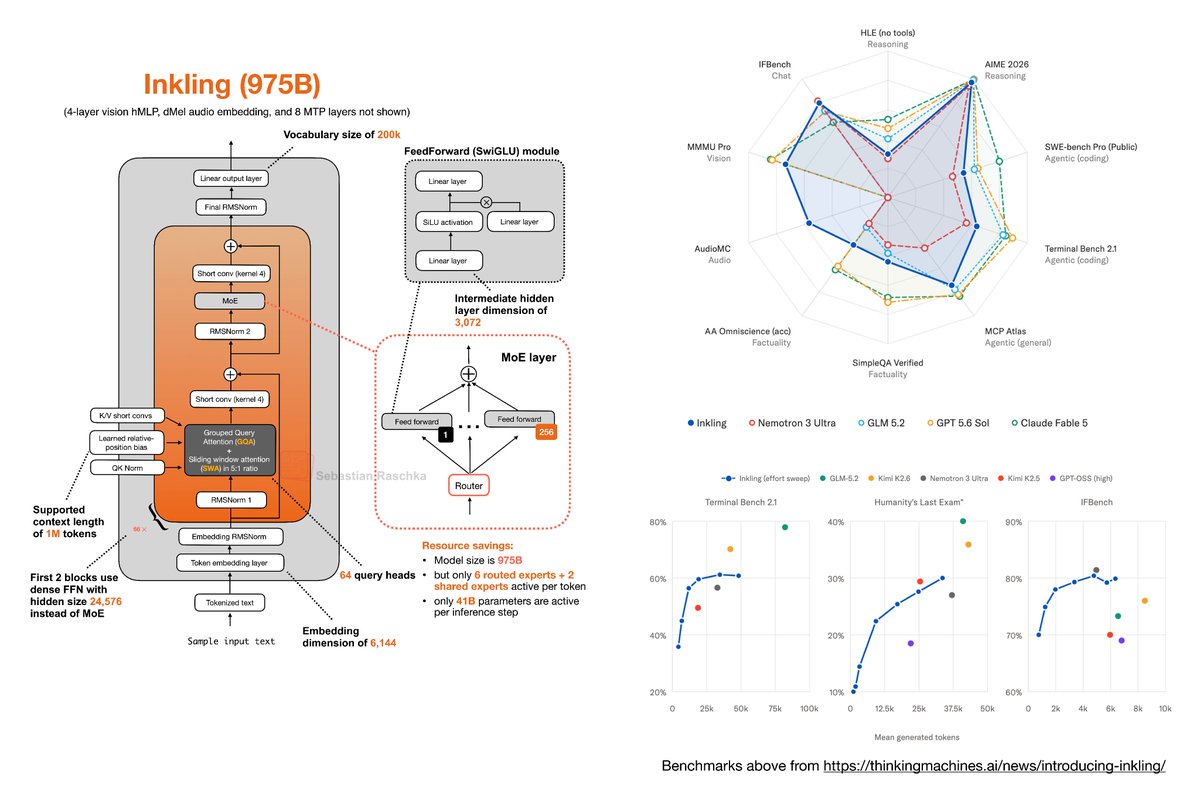
Thinking Machines just dropped the best open weight AI model outside of China!
Inkling beats Nemotron 3 Ultra and benchmarks put it between Kimi 2.5 & 2.6. Many were contending to this throne, but Thinky has come out on top.
Really solid release, and will pair well with Tinker.
Interesting surprise drop from Thinky! The Inkling model looks pretty solid on benchmarks, and it has some little surprises in its architecture:
- Small conv layers in several places
- An RMSNorm for the embeddings (before the block RMSNorm)
- Rel. position bias instead of RoPE
GPT 5.6 Sol can one-shot convert an arXiv paper into an interactive Marimo notebook!
Great for papers best understood hands on (lots of fun examples in interpretability, inference engineering, agent harnesses, benchmarking, and more)
Play around with the notebook, inspect the code, or try the same workflow with your own agents below
The first experimental evidence of recursive self-improvement (RSI).
Autoresearching the autoresearch agent for eight days.
The result beats the harness we hand-tuned for two years, on held-out benchmarks: 🧵(1/7)
Why does RL improve reasoning after SFT?
This paper says SFT gives the model full worked solutions, but the useful pieces inside them are tangled together.
RL basically adds reward guided variation, which helps the model separate those pieces into reusable skills and routing rules.
Then the model can recombine them on problems it never saw during SFT.
Sleep deprivation makes people less willing to help others.
In this study, a single night without sleep reduced people’s desire to help, even friends.
At the societal level, donation amounts dropped ~10% after the spring daylight saving time sleep loss.
"KAT-Coder-V2.5 Technical Report"
This new model from KwaiKAT called KAT-Coder-V2.5 rivals GLM-5.2 on coding, and in their report, they argue that better coding agents need better training worlds, not just bigger models.
To train their model, they built this AutoBuilder which turns real repos into reproducible sandboxes with real tests, then converts messy issues into clear executable tasks.
It recovers useful failed attempts, filters bad passing solutions, and randomizes tool harnesses so the model learns software engineering, not one interface.
The results in top PinchBench performance and second place behind Opus 4.8 on repo-level SWE.
"LLM-as-a-Verifier: A General-Purpose Verification Framework"
The key idea of this paper is that it does not ask for one rough score, it reads the model’s full uncertainty over scores, which helps to make the judgment much more fine-grained.
This approach lets agents pick better solutions, track progress, and learn from denser feedback.
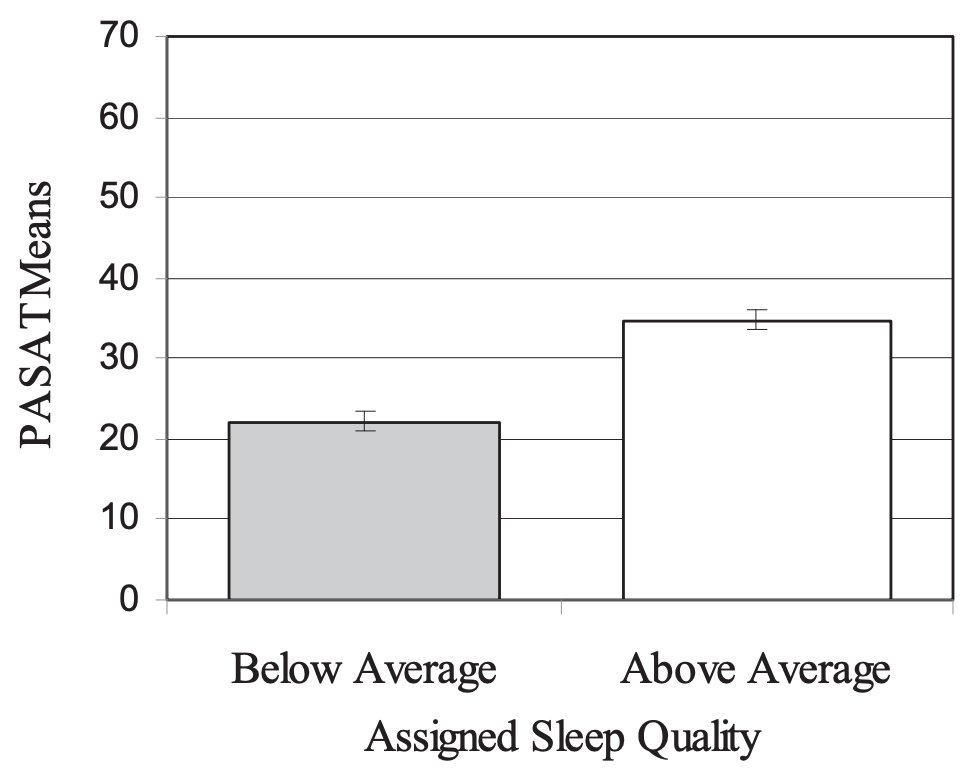
There is actually evidence for this.
Researchers gave people fake feedback about their REM sleep.
Those told they had “above average” sleep had improved cognitive performance.
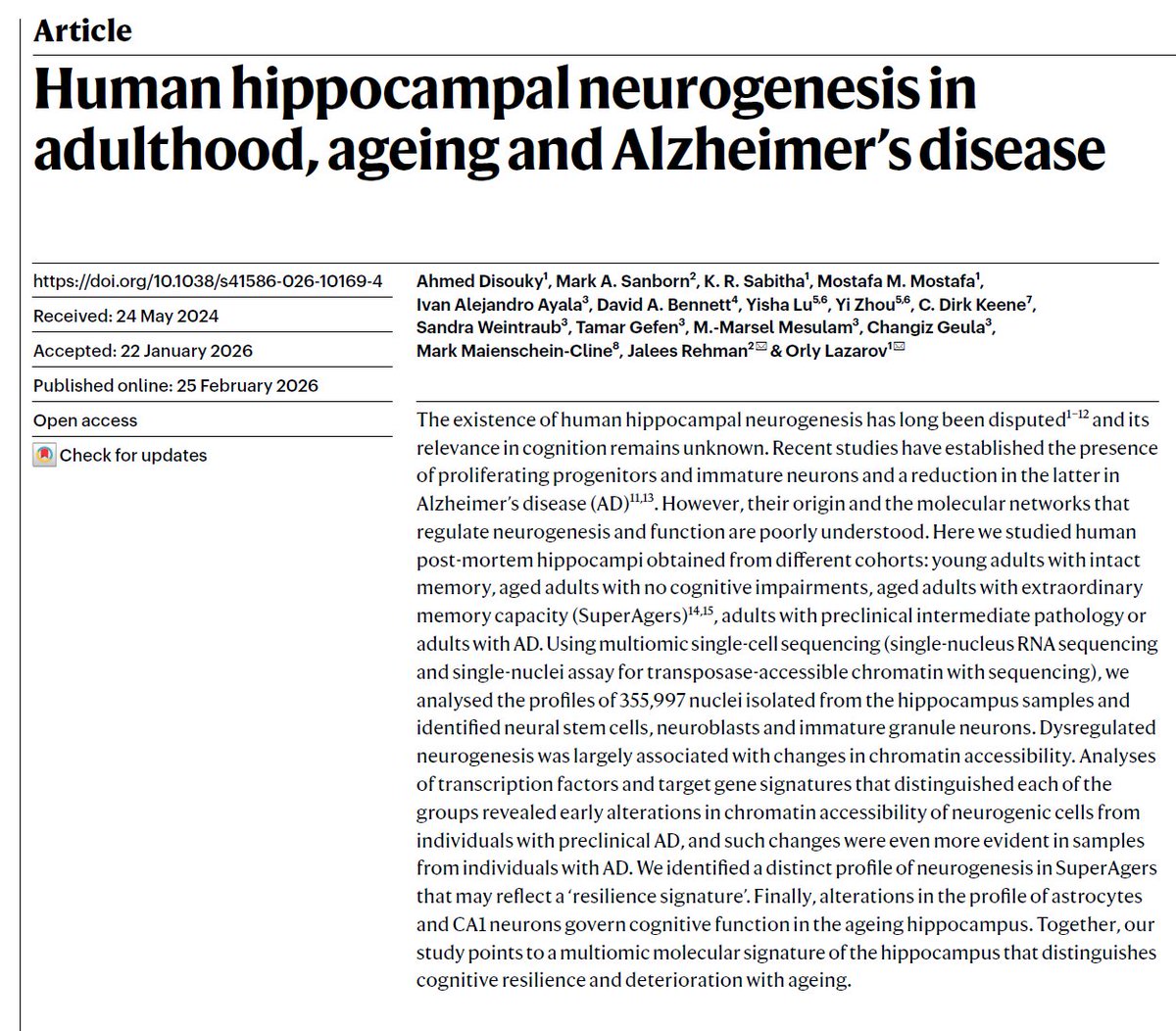
A massive leap forward in understanding cognitive resilience. This study highlights how human hippocampal neurogenesis persists in adulthood, offering incredible insights into how we fight off cognitive decline and Alzheimer's.
Andrej Karpathy highlighting the biggest trap in AI right now: rushing to force agentic workflows instead of mastering the foundational models first. If you skip the core mechanics, everything breaks at scale.
Anthropic Engineer Andrej Karpathy:
"The biggest mistake in AI right now - people are forcing agents to work instead of mastering the model first
We made that mistake in 2016 at OpenAI - It cost us 5 years "
what Karpathy actually means:
step 1 → stop forcing your agent to do everything, understand the model underneath first
step 2 → demos are easy - products take a decade. self-driving proved it - if you skip the foundation, everything breaks
step 3 → the agent is not the product. the foundation is. build that - and agents emerge on their own
"you building agents right now - you're at the forefront. not OpenAI. not DeepMind. you "
watch - bookmark, then read article below ↓
@0xCodila Trying to build complex agentic workflows without deeply understanding the base model capability is just building on quicksand. The foundation is everything.